Monuments historiques de l'ancienne Nara
Historic Monuments of Ancient Nara
Nara was the capital of Japan from 710 to 784. During this period the framework of national government was consolidated and Nara enjoyed great prosperity, emerging as the fountainhead of Japanese culture. The city's historic monuments – Buddhist temples, Shinto shrines and the excavated remains of the great Imperial Palace – provide a vivid picture of life in the Japanese capital in the 8th century, a period of profound political and cultural change.
La description est disponible sous licence CC-BY-SA IGO 3.0
Monuments historiques de l'ancienne Nara
Nara a été la capitale du Japon de 710 à 784. Durant cette période, la structure du gouvernement national s'est consolidée et la capitale, très prospère, est devenue la source d'inspiration de la culture japonaise. Les monuments historiques de Nara – temples bouddhiques et sanctuaires shintoïstes , ainsi que les fouilles du grand palais impérial – offrent une image frappante de ce que fut la capitale du Japon au VIIIe siècle, période de profond changement politique et culturel.
La description est disponible sous licence CC-BY-SA IGO 3.0
النصب التاريخيّة في نارا القديمة
كانت مدينة نارا عاصمة اليابان من العام 710 حتى العام 784. وفي خلال هذه الفترة، ثبُتَت بنية الحكومة الوطنيّة وأصبحت العاصمة التي كانت مزدهرةً جدًا في ذلك الوقت مصدر الوحي للثقافة اليابانيّة. وتدلّ الآثار التاريخيّة في نيارا من معابد بوذيّة ومزارات شنتويّة، بالاضافة إلى حفريّات القصر الامبراطوري الكبير، على الصورة المذهلة لما كانت عليه عاصمة اليابان في القرن الثامن، وهي الفترة التي شهدت التغيّر السياسي والثقافي الكبير.
source: UNESCO/CPE
La description est disponible sous licence CC-BY-SA IGO 3.0
古奈良的历史遗迹
奈良在公元710年至784年是日本的首都,在那个时期,日本国家政府的结构确定了下来,并且奈良到达了其鼎盛时期,成为日本文化的发源地。古奈良的历史遗迹——佛教庙宇、神道教神殿以及挖掘出来的帝国宫殿遗迹——向世人展示了一幅公元8世纪日本首都的生动画面,深刻揭示了当时的政治及文化动荡和变迁。
source: UNESCO/CPE
La description est disponible sous licence CC-BY-SA IGO 3.0
Памятники исторической части города Нара
Нара была столицей Японии в 710-784 гг. В этот период произошла консолидация системы государственного управления, а Нара процветала и была источником развития японской культуры. Исторические памятники города – буддийские храмы, синтоистские святилища и раскопанные остатки большого императорского дворца - дают наглядную картину жизни японской столицы в VIII в., т.е. во времена коренных политических и культурных изменений.
source: UNESCO/CPE
La description est disponible sous licence CC-BY-SA IGO 3.0
Monumentos históricos de la antigua Nara
Nara fue la capital de Japón entre los años 710 y 784, época en la que la consolidación de la estructura del gobierno nacional dio una gran prosperidad a la ciudad, haciendo de ella el foco de la cultura japonesa. Sus templos budistas y santuarios sintoístas, así como los vestigios del palacio imperial, son monumentos históricos que ofrecen una vívida imagen de lo que fue la capital del Japón en el siglo VIII, un periodo de hondos cambios políticos y culturales.
source: UNESCO/CPE
La description est disponible sous licence CC-BY-SA IGO 3.0
古都奈良の文化財
世界遺産としての「古都奈良の文化財」には、東大寺、興福寺、春日大社、春日山原始林、元興寺、薬師寺、唐招提寺、平城京跡の8ヵ所が記載された。平城京跡は、初の考古学的遺跡として登録されている。710年のこの地への遷都により、壮大な都市計画のもとにかつてない規模で道路・市街地・宮殿・寺院などが造営され、794年の平安京遷都後も寺社の多くは旧都に残された。春日山原始林は文化的景観としての価値が高く評価された。source: NFUAJ
Historische monumenten van oud Nara
Nara was de hoofdstad van Japan van 710 tot 784. Tijdens deze periode werd het kader van de nationale overheid geconsolideerd en kende Nara grote welvaart. De stad ontpopte zich als de bron van de Japanse cultuur. De historische monumenten die Nara bezit – Boeddhistische tempels, shinto heiligdommen en de opgegraven overblijfselen van het grote Keizerlijke paleis – geven een levendig beeld van het leven in de Japanse hoofdstad tijdens de 8e eeuw, een periode van diepgaande politieke en culturele veranderingen. De monumenten weerspiegelen ook de ontwikkeling van Japanse architectuur en kunst, als gevolg van de culturele banden met China en Korea.
Source : unesco.nl


Valeur universelle exceptionnelle
Brève synthèse
Les monuments historiques de Nara constituent un témoignage exceptionnel de l’évolution de l’architecture et de l’art japonais et illustrent de la manière la plus éclatante une période cruciale du développement culturel et politique du Japon, lorsque, entre 710 et 784, Nara était la capitale. Pendant cette période, la structure du gouvernement de la nation japonaise s’est consolidée et Nara, très prospère, fut la source d’inspiration de la culture japonaise.
Situé dans la ville moderne de Nara, le bien comprend huit composantes, sur une superficie totale de 617 ha, il abrite 78 édifices, et est entouré d’une zone tampon (1.962,5 ha) et de la « zone d’harmonisation d’environnement historique » (539 ha).
L’emplacement du site de Heijô-kyô a été soigneusement choisi selon les principes de la géomancie chinoise. Sur le modèle de villes chinoises comme Chang’an, un grand plan urbain orthogonal a été conçu avec des palais, des temples bouddhistes, des sanctuaires shintoïstes, des édifices publics, des maisons et des routes. Le palais, situé à l’extrémité nord de l’avenue centrale, s’étendait sur 120 ha. Il comprenait les bâtiments officiels dans lesquels se déroulaient les cérémonies politiques et religieuses, notamment le Daigokuden (salle d’audience impériale), le Chôdô-in (salles d’État) et le Dairi (résidence impériale), ainsi que différentes annexes destinées à des fonctions administratives et autres.
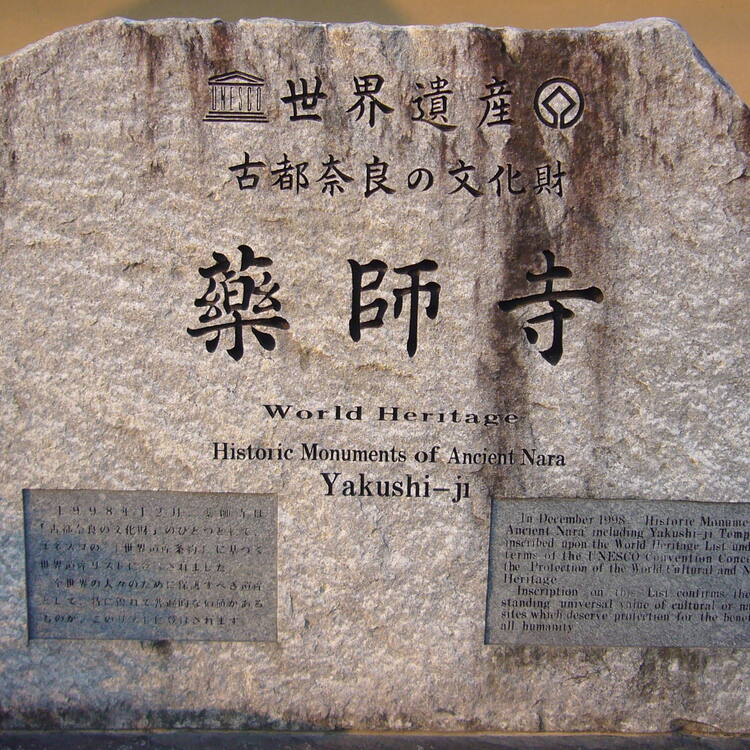
Le bien est composé d’un site archéologique (le site du palais de Nara), de cinq temples bouddhistes (le Tôdai-ji, le Kôfuku-ji, le Yakushi-ji, le Gangô-ji et le Tôshôdai-ji), d’un sanctuaire shintoïste (le Kasuga-Taisha) et d’un paysage culturel associé (la forêt primitive de Kasugayama), l’environnement naturel faisant partie intégrante de tous les temples shintoïstes. Tous ces lieux offrent une image vivante et complète de la religion et de la vie dans la capitale du Japon au 8e siècle, une époque de profonds changements politiques et culturels.
Critère (ii) : Les monuments historiques de l’ancienne Nara constituent des témoins exceptionnels de l’évolution de l’architecture et de l’art japonais, influencés par les liens culturels entretenus avec la Chine et la Corée, dont l’influence sur les développements ultérieurs s’est révélée déterminante.
Critère (iii) : L'épanouissement de la culture japonaise à l'époque où Nara était la capitale est particulièrement démontré par son patrimoine architectural.
Critère (iv) : L'agencement du Palais impérial et la conception des monuments qui subsistent à Nara sont des exemples remarquables de l'architecture et de l'urbanisme des anciennes capitales asiatiques.
Critère (vi) : Les temples bouddhistes et les sanctuaires shintoïstes de Nara témoignent de manière exceptionnelle de la permanence de la force spirituelle et de l'influence de ces religions.
Intégrité
Les monuments historiques de l’ancienne Nara sont constitués du groupe d’édifices des temples bouddhistes qui représentent la ville historique, l’harmonieux paysage culturel de la forêt sacrée et le sanctuaire shintoïste qui illustrent un culte traditionnel au Japon un site archéologique. Ces composantes essentielles du bien illustrent la structure politique et la tradition culturelle japonaises du 8e siècle. Chaque composante du bien dispose d’une zone tampon adéquate, ce qui garantit le caractère entier et intact de l’intégrité du bien.
Depuis qu’en 2003, le Comité du patrimoine mondial a exprimé ses inquiétudes quant à l’impact négatif des variations de niveau de la nappe phréatique, induites par la construction de l’autoroute Yamato-Kita, sur les biens culturels enfouis sur le site du palais de Nara, le gouvernement est intervenu et les contrôles sont en cours. L’État partie examine actuellement l’impact visuel des nouvelles installations destinées à l’accueil des visiteurs sur le site du palais de Nara.
Authenticité
Les travaux de restauration des bâtiments de l’ancienne Nara ont débuté à la fin du 19e siècle lorsque la Loi de préservation des sanctuaires et temples anciens a été promulguée (1897). Le sanctuaire shintoïste de Kasuga-Taisha a gardé sa tradition de reconstruction permanente.
Du point de vue de la forme et de la conception, des matériaux et de la substance, des traditions et des techniques, de la situation et du cadre, le degré d’authenticité des différents bâtiments situés sur le territoire du bien est élevé. Les principes de conservation mis en œuvre au Japon ont permis de garantir que le remplacement des éléments architecturaux abimés ou détériorés s’est fait dans le respect des matériaux et techniques d’origine. Le site archéologique du palais de Nara, qui fut pendant longtemps protégé par des rizières, a également un degré élevé d’authenticité en matière de forme, de matériaux et de substance, de situation et de cadre. Des vestiges archéologiques découverts, ont été ré-enfouis à des fins de protection.
Sur le site du palais de Nara, les travaux de reconstruction de la porte, de la salle d’études et du jardin ont été entrepris. La permanence de l’architecture traditionnelle au Japon et la très grande quantité de données récupérées lors des fouilles archéologiques confèrent aux bâtiments reconstruits un degré élevé d’authenticité en matière de forme et de conception. L’Etat partie se penche actuellement sur comment conserver au mieux cette continuité dans les travaux de reconstruction en cours en mettant l’accent sur la nécessité d’une justification claire et réelle pour toutes les interventions.
La forêt primitive de Kasugayama a été préservée, c’est en effet une forêt sacrée dans laquelle la chasse et l’abattage d’arbres sont interdits depuis 841. Elle conserve ainsi un degré élevé d’authenticité tant en matière de situation et de cadre, que d’esprit et d’expression.
Éléments requis en matière de protection et de gestion
Toutes les composantes sont classées Trésor national ou Monument naturel spécial ou encore Site spécial, en vertu de la Loi de 1950 sur la protection des biens culturels.
Les lieux de cultes (les temples bouddhistes et le sanctuaire shintoïste) sont la propriété des communautés religieuses concernées, et leur état de conservation est excellent. La Préfecture de Nara est en charge de la gestion et de la protection de la forêt primitive de Kasugayama, tandis que le site du palais de Nara est entretenu également par la préfecture mais en collaboration avec le Gouvernement japonais. Depuis 2008, le site du palais de Nara et sa zone tampon font partie d’un Parc national géré par le gouvernement dans lequel les projets de conservation sont envisagés dans le cadre d’une protection et d’un usage adaptés du site archéologique.
Toutes les composantes du bien disposent d’une zone tampon appropriée dont les limites sont clairement définies. La Loi sur la protection des biens culturels, la Loi sur les mesures spéciales en matière de préservation des cités anciennes et différentes réglementations, tant préfectorales que municipales, prévoient des dispositions en la matière.
Le bien, en tant qu’ensemble de monuments, n’a pas de plan général de conservation et de gestion. Chaque composante fait cependant l’objet d’un programme de suivi de la conservation et de l’entretien qui prévoit des mesures de restauration. Afin de garantir une conservation et une protection à long terme du bien, des politiques de gestion et de conservation devront être élaborées et mises en œuvre. Découvrez les photos de OUR PLACE the World Heritage Collection


Protections
par d'autres instruments de conservation
1 protection / 1 élément
2003 Convention pour la sauvegarde du patrimoine culturel immatériel (1 element)