Presqu'île de Valdés
Península Valdés
Península Valdés in Patagonia is a site of global significance for the conservation of marine mammals. It is home to an important breeding population of the endangered southern right whale as well as important breeding populations of southern elephant seals and southern sea lions. The orcas in this area have developed a unique hunting strategy to adapt to local coastal conditions.
La description est disponible sous licence CC-BY-SA IGO 3.0
Presqu'île de Valdés
Située en Patagonie, la presqu’île de Valdés est un site d’importance mondiale pour la préservation des mammifères marins. Elle héberge d’importantes populations reproductrices de baleines franches menacées, ainsi que d’éléphants et de lions de mer du Sud. Les orques de cette région ont développé une stratégie de chasse unique en son genre, afin de s’adapter aux conditions côtières locales.
La description est disponible sous licence CC-BY-SA IGO 3.0
شبه جزيرة فالديه
تقع شبه الجزيرة في الباتاغونيا وهي موقع مهم جداً على المستوى العالمي لجهة الحفاظ على الثدييات البحرية. تجمع عدداً كبيراً من المجموعات المهمة المتوالدة من الحيتان المهدّدة والفيلة وأسود البحر القادمة من الجنوب. وقد نجحت الأركة الموجودة في هذه المنطقة في تطوير استراتيجية صيد فريدة من نوعها من أجل التكيّف مع الشروط الساحلية المحليّة.
source: UNESCO/CPE
La description est disponible sous licence CC-BY-SA IGO 3.0
瓦尔德斯半岛
瓦尔德斯半岛是全球海洋哺乳动物资源的重点保护区,也是濒危的南美露脊鲸以及南美海豹和南美海狮的重要繁衍生息地。这个地区的逆戟鲸还具有独特的捕猎技巧,可以适应当地的海洋条件。
source: UNESCO/CPE
La description est disponible sous licence CC-BY-SA IGO 3.0
Полуостров Вальдес
Полуостров Вальдес в Патагонии – район, имеющий глобальное значение для сохранения морских млекопитающих. Это место размножения исчезающего южного кита, южных морских слонов и южных морских львов. Хищные касатки в этом районе выработали уникальную, адаптированную к местным условиям, методику охоты.
source: UNESCO/CPE
La description est disponible sous licence CC-BY-SA IGO 3.0
Península Valdés
Situada en Patagonia, la Península Valdés es un lugar de preservación de mamíferos marinos de importancia mundial. El sitio alberga importantes poblaciones reproductoras de ballenas francas en peligro de extinción, así como de elefantes y leones marinos. Las orcas de la región practican una estrategia de caza única en su género, que es el resultado de su adaptación a las condiciones específicas del litoral.
source: UNESCO/CPE
La description est disponible sous licence CC-BY-SA IGO 3.0
バルデス半島
source: NFUAJ
Península Valdés
Source : unesco.nl


Valeur universelle exceptionnelle
Brève synthèse
La presqu’île de Valdés est située dans la province argentine de Chubut. D’une superficie d’environ 360 000 ha, elle s’avance sur plus de 100 km vers l’est dans l’océan Atlantique sud. Ses 400 km de côtes se caractérisent par une série de golfes, notamment les très grands Golfo San Matias au nord et Golfo Nuevo au sud qui s’étendent sur plusieurs milliers de km2. Le littoral est dynamique, on y trouve des falaises rocheuses d’une altitude supérieure à 100 mètres, des baies peu profondes, des lagunes côtières mouvantes avec de vastes vasières, des plages de sable et de galets, des dunes de sable actives et de petites îles. Les zones humides, dont certaines sont aujourd’hui reconnues « Zone humide d’importance internationale » en vertu de la Convention de Ramsar, sont associées avec les zones intertidales de la presqu’île et constituent d’importants sites de nidification et d’étape pour de nombreux oiseaux de rivage migrateurs. Les différents écosystèmes terrestres, côtiers et marins de la presqu’île de Valdés abritent des habitats naturels d’une valeur exceptionnelle tant du point de vue de la conservation que de l’intérêt scientifique.
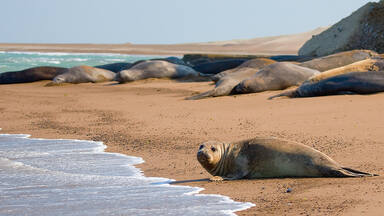
Reliée au continent par une étroite bande de terre, la presqu’île, en forme de champignon, et son littoral sont par nature presque insulaires. Ses golfes calmes, protégés de la violence de l’Atlantique sud, sont des zones essentielles pour la reproduction, la naissance et l’allaitement de la Baleine franche australe et de nombreux autres mammifères marins tels que l’Éléphant de mer austral, l’Otarie à crinière (lion de mer du sud) et l’Orque. D’importantes colonies d’oiseaux de rivage et des dizaines de milliers de Manchots de Magellan viennent s’y reproduire. L’écosystème est en majorité celui de la steppe désertique patagonienne, il abrite, malgré sa taille relativement modeste, plus de la moitié des plantes inventoriées en Patagonie argentine. Le Guanaco, un camélidé originaire d’Amérique du sud et le Mara de Patagonie, un rongeur endémique en Argentine, sont des représentants de la faune sauvage terrestre de la presqu’île. 181 espèces d’oiseaux sont identifiées, notamment le Nandou de Darwin, le Brassemer à tête blanche, une espèce endémique en Argentine, et le Chionis blanc, une espèce migratrice.
Critère (x) : Avec plus de 1 500 spécimens présents chaque année sur le territoire du bien, la presqu’île de Valdés est le plus important lieu au monde pour la reproduction des Baleines franches australes, une espèce qui a beaucoup souffert de la pêche commerciale à la baleine. Les efforts qui y ont été entrepris en matière de conservation ont joué et jouent encore un rôle important dans la reconstitution de cette espèce de baleine, ce qui constitue un succès encourageant pour la conservation de toutes les espèces. Le bien est également remarquable pour plusieurs autres espèces de mammifères marins, en particulier d’importantes populations d’Otaries à crinière et d’Éléphants de mer austraux qui viennent s’y reproduire. En ce qui concerne cette dernière espèce, la presqu’île de Valdés abrite ses colonies les plus septentrionales et la seule population reproductrice de l’espèce en Argentine continentale. La petite population locale d’Orques a développé une méthode de chasse spectaculaire en s’échouant volontairement sur la côte afin d’attraper les petits des Otaries à crinière et des Éléphants de mer. Les zones côtières, un paysage très divers alternant zones humides, vasières, dunes et falaises, et les terres, une partie distincte et relativement intacte de la steppe désertique patagonienne, abritent une faune et une flore très variées de grande valeur en termes de conservation.
Intégrité
La presqu'île est un élément naturellement défini du paysage de la Patagonie. Elle abrite des habitats terrestres, avec une faune et une flore en tout point remarquables, y compris des habitats côtiers de grande valeur. À l’origine, avant la colonisation, les habitants de la région étaient les Tehuelche qui vivaient de la terre et de la mer. Puis, l’élevage ovin a occupé, jusqu’à l’époque actuelle, la plus grande partie des terres. L’exploitation des mammifères marins a constitué une source complémentaire de revenus et d’emplois. Malgré le pâturage ovin et, en conséquence, la concurrence entre moutons exogènes et herbivores indigènes, et malgré la chasse aux prédateurs autochtones, le bien abrite toujours différentes communautés de faune et de flore sauvages indigènes. Il y a très peu d’habitants sur le territoire du bien et le réseau d’infrastructures est très limité. À l’exception d’une fonderie d’aluminium dans la ville de Puerto Madryn, située sur le continent mais sur les rives du Golfo Nuevo, il n’y a aucun équipement industriel.
Par le passé, la Baleine franche australe avait presque entièrement disparu en raison d’une pêche excessive mais elle finit par être protégée dans le monde entier en 1935. L’Otarie à crinière fit également l’objet d’une chasse intensive sur la presqu'île, pour sa peau et son huile, officiellement jusqu’en 1953 et de façon illégale jusque dans les années 70. Les mesures de conservation se sont traduites par une très impressionnante reconstitution des populations de ces deux espèces.
Les zones marines sont également intactes. Malgré le bon état général de la conservation, le bien est une illustration des limites inhérentes aux zones protégées. Toutes les espèces emblématiques pour lesquelles la presqu'île de Valdés est mondialement connue ne font qu’un séjour temporaire sur son territoire. Il semble donc évident que malgré la bonne conservation sur le territoire du bien d’habitats critiques et sensibles, l’avenir des populations dépend également de la présence en d’autres lieux du globe d’habitats intacts et appropriés.
Éléments requis en matière de protection et de gestion
La conservation officielle de la presqu'île de Valdés a débuté dans les années 1960 lorsque la législation provinciale a créé les premières Réserves naturelles touristiques de Punta Norte et de Isla de los Pájaros. Plusieurs autres aires provinciales protégées ont depuis été créées, en particulier dans des zones de grande valeur, notamment en 1974, le Parc marin provincial de Golfo San José. En 1983, une très grande « Réserve naturelle pour un développement intégré du tourisme » fut créée pour orienter le développement d’un tourisme responsable, en regroupant toutes les aires protégées précédemment établies. Une Réserve marine intégrale a été créée dans le Golfo Nuevo en 1995 afin de renforcer la protection de la Baleine franche australe, elle s’étend sur une distance de 5 miles nautiques presque tout autour de la presqu'île. L’ « Organisation en charge du tourisme dans la province de Chubut » est l’entité responsable des réserves. Depuis les années 70, des gardiens de la faune et la flore viennent en renfort de la police et des Gardes côtes nationaux. La plus grande partie des terres appartient à des propriétaires privés et est divisée en grandes « estancias ». Dans le mécanisme de prise de décisions, un dialogue est nécessaire avec des représentants de toutes les parties prenantes, parmi lesquels les propriétaires fonciers sont majoritaires. La recherche scientifique est une composante de poids dans la gestion du bien qui implique le Centre national patagonien et de nombreux partenaires nationaux et internationaux issus tant du monde universitaire que d’organisations non gouvernementales. Les mesures de conservation in situ de la Baleine franche australe sont complétées par les instruments nationaux et internationaux en la matière. L’espèce n’est pas seulement protégée au niveau international contre la pêche commerciale, elle a également été déclarée « Monument naturel » par le Congrès national argentin en 1985.
Sur la terre, la présence de niveaux adéquats de populations de bétail permettra d’empêcher toute dégradation supplémentaire et de restaurer les habitats. Le tourisme, un secteur vital pour l’économie locale, est un sujet essentiel de gestion car il a la capacité de générer des revenus destinés à garantir le financement de la conservation. Mais, en parallèle, le tourisme a des impacts environnementaux complexes sur le bien. L’observation incontrôlée des baleines et d’autres formes d’observation des espèces de faune sauvage peuvent déranger les populations sensibles lors des périodes de reproduction tant sur la terre qu’en mer. Un contrôle attentif et d’éventuelles limitations sont indispensables. La présence de touristes augmente la consommation d’eau douce, une denrée rare dans un environnement aride, et la production de déchets solides et d’eaux usées. Une gestion environnementale adaptée de la pollution liée aux installations de traitements des eaux usées, des usines de transformation de poissons et des industries présentes autour de la ville de Puerto Madryn, est nécessaire. Un traitement des déchets solides est également requis afin de prévenir les impacts de la présence croissante et artificielle de mouettes et de rats qui sont des prédateurs pour les principales espèces du bien.
Un plan de gestion de la presqu'île, élaboré au moyen d’une méthodologie de planification stratégique participative, a été mis en œuvre depuis 1998. L’achèvement, la mise en œuvre effective et le suivi régulier des plans de gestion pour le bien sont essentiels.
Les principales causes anthropiques de mortalité de la Baleine franche australe sont la collision avec des navires et l’enchevêtrement des spécimens dans les engins de pêche. En conséquence, le trafic accru des navires pour observer les baleines, la fonderie d’aluminium de Puerto Madryn et la pêche commerciale sont des sujets d’inquiétude qui requièrent des mesures de protection et de gestion. Le trafic maritime de navires traversant la presqu'île représente un risque supplémentaire de déversement accidentel qui ne peut être atténué qu’au moyen d’une stratégie adaptée de préparation aux risques.
Le fait que tous les mammifères marins qui se reproduisent dans la presqu'île de Valdes soient vulnérables à la pollution, aux accidents et aux effets directs et indirects de la pêche excessive représente un défi plus complexe qui ne peut être relevé qu’au moyen de la coopération internationale.
Liens


Les dossiers de proposition d’inscription produits par les États parties sont publiés par le Centre du patrimoine mondial sur son site Internet et/ou dans des documents de travail afin de garantir la transparence, l’accès à l’information et de faciliter la préparation d’analyses comparatives par d’autres États parties soumissionnaires.
Le contenu de chaque dossier de proposition d’inscription relève de la responsabilité exclusive de l'État partie concerné. La publication d’un dossier de proposition d’inscription, y compris les cartes et les noms, ne saurait être interprétée comme exprimant une prise de position de la part du Comité du patrimoine mondial ou du Secrétariat de l'UNESCO à propos de l’histoire ou du statut juridique d'un pays, d'un territoire, d'une ville ou d'une zone, ou de ses frontières.
Protections
par d'autres instruments de conservation
2 protections / 2 éléments
Les réserves de biosphère (1 element)RAMSAR (1 element)