Parc national de la rivière souterraine de Puerto Princesa
Puerto-Princesa Subterranean River National Park
This park features a spectacular limestone karst landscape with an underground river. One of the river's distinguishing features is that it emerges directly into the sea, and its lower portion is subject to tidal influences. The area also represents a significant habitat for biodiversity conservation. The site contains a full 'mountain-to-sea' ecosystem and has some of the most important forests in Asia.
La description est disponible sous licence CC-BY-SA IGO 3.0
Parc national de la rivière souterraine de Puerto Princesa
Ce parc offre un paysage karstique spectaculaire avec sa rivière souterraine qui se jette dans la mer et subit l'influence des marées. Le site est un habitat important pour la conservation de la diversité biologique. Il comprend un écosystème « montagne-mer » complet et abrite des forêts parmi les plus significatives de l'Asie.
La description est disponible sous licence CC-BY-SA IGO 3.0
منتزه النهر الارضي في بويرتو برينسيسا الوطني
يُعتبَر المنظر في هذا المنتزه الذي يتألَّف من التضاريس الصلصالية جذّابًا بنهره الذي يصبّ في البحر ويتأثَّر بالمدّ والجزر. كما يُعتبر هذا الموقع مأوًى هامًا للحفاظ على التنوع البيولوجي. فهو عبارة عن نظام طبيعي يضمّ الجبل والبحر ويأوي غابات هي من بين الأبرز في آسيا.
source: UNESCO/CPE
La description est disponible sous licence CC-BY-SA IGO 3.0
普林塞萨港地下河国家公园
普林塞萨港地下河国家公园以雄伟的石灰石喀斯特地貌和那里的地下河流而举世闻名。这些河流的特点之一是它们直接流入大海,所以河流下游受潮汐影响。这个地方还是生物多样性保护区。该公园包括整个“山–海”生态系统以及亚洲一些非常重要的森林。
source: UNESCO/CPE
La description est disponible sous licence CC-BY-SA IGO 3.0
Подземная река Пуэрто-Принсеса
Этот парк включает удивительный известняковый ландшафт с подземной карстовой рекой. Одна из особенностей реки состоит в том, что она впадает прямо в море, и в этом – расположенном наиболее низко – месте река подвержена приливно-отливным циклам. Район подземной реки также примечателен высоким биоразнообразием. В границы парка входят экосистемы, представляющие весь спектр – от горных до прибрежных. Здесь также сохранились лесные массивы, имеющие ценность в масштабах всей Азии.
source: UNESCO/CPE
La description est disponible sous licence CC-BY-SA IGO 3.0
Parque nacional del río subterráneo de Puerto Princesa
Al paisaje cárstico extraordinario de este parque viene a sumarse un río subterráneo espectacular. Este río emerge directamente en el mar y, a lo largo de su corto curso, está sujeto a la influencia de las mareas. El sitio es un hábitat importante para la conservación de la diversidad biológica y comprende un ecosistema “mar-montaña” completo, así como uno de los bosques más importantes de Asia.
source: UNESCO/CPE
La description est disponible sous licence CC-BY-SA IGO 3.0
プエルト-プリンセサ地下河川国立公園
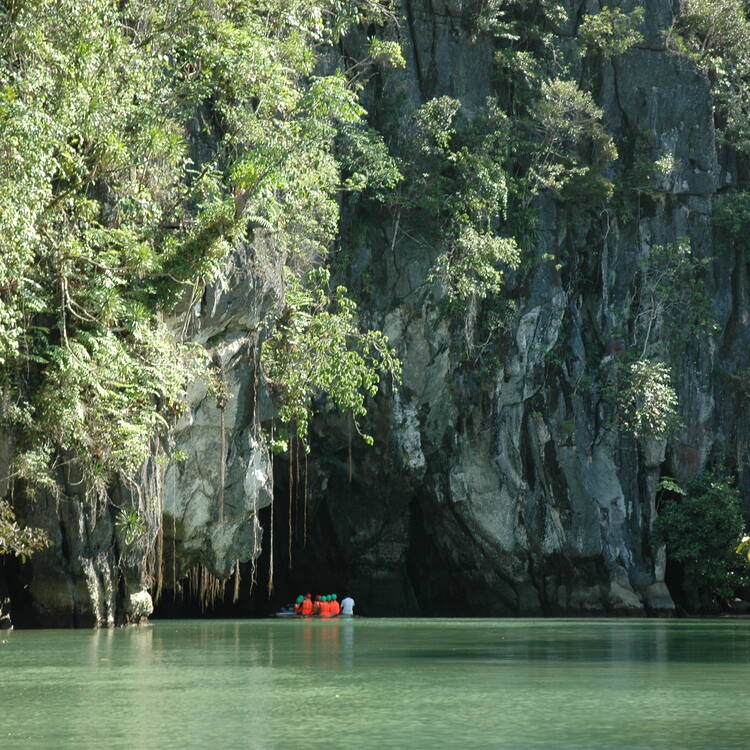
プエルト-プリンセサはフィリピン南西部のパラワン州の州都。主島パラワン島はフィリピン最後の楽園といわれ、豊かな自然が残る。この地下河川国立公園はプエルト・プリンセサから西へ約80km、セントポール山の麓にある石灰岩洞穴の下を、全長約8.2kmの世界遺産最長の川が海に流れ出ている。川の入り口に広がるラグーンの美も賞賛される。多様な生物が今なお棲息する場でもある。写真は地下河川入口と双胴船。source: NFUAJ
Nationaal park ondergrondse rivier Puerto-Princesa
Dit nationaal park ligt in het zuidwestelijke deel van de Filippijnse archipel, ongeveer 76 kilometer ten noordwesten van Puerto-Princesa en 360 kilometer ten zuidwesten van Manilla. Het bestaat uit een spectaculair kalkstenen karstlandschap met (vermoedelijk 's werelds langste) ondergrondse rivier. De 8,2 kilometer lange en gedeeltelijk bevaarbare ondergrondse rivier mondt direct uit in zee en het brakke lager gelegen deel ervan kent getijden. De riviergrot vertoont dramatische rotsformaties en een aantal grote ruimtes van maar liefst 120 meter breed en 60 meter hoog.
Source : unesco.nl


Valeur universelle exceptionnelle
Brève synthèse
Le Parc national de la rivière souterraine de Puerto Princesa réunit l’un des ensembles de grottes les plus impressionnants du monde, offrant un paysage karstique spectaculaire, une beauté naturelle intacte, des forêts primaires inaltérées et une faune sauvage incomparable. Il se situe dans le sud-ouest de l’archipel des Philippines, dans la partie centrale de la côte ouest de Palawan, à 76 kilomètres de Puerto Princesa et à 360 kilomètres au sud-ouest de Manille.
D’une superficie de 22,202 hectares, le site abrite une rivière souterraine d’une longueur de 8,2 kilomètres. La caractéristique la plus marquante de cette rivière souterraine est qu’elle débouche directement dans la mer et que sa portion inférieure, saumâtre, est soumise à l’influence des marées, phénomène naturel rare sur la planète. À l’intérieur de la grotte où circule la rivière, on peut observer des formations rocheuses aussi remarquables qu’esthétiques. Le site contient un écosystème complet – de la montagne jusqu’à la mer – qui constitue un habitat adapté à la conservation de la biodiversité et protège des forêts qui comptent parmi les mieux préservées et les plus fascinantes de la province biogéographique de Palawan. Le fait qu’il s’agisse du premier parc national confié à la responsabilité d’autorités locales, qui en assurent une gestion efficace, est un symbole de l’engagement du peuple philippin envers la protection et la conservation de son patrimoine naturel.
Critère (vii) : Le Parc national de la rivière souterraine de Puerto Princesa présente un paysage de karst (pierre calcaire) saisissant. Il renferme une rivière souterraine qui débouche directement dans la mer. La partie inférieure de cette rivière est constituée d’eau saumâtre et soumise aux marées. L’influence que celles-ci exercent sur la rivière est un phénomène naturel rare.
On trouve dans la grotte qui abrite la rivière de spectaculaires spéléothèmes et plusieurs vastes cavités qui atteignent jusqu’à 120 mètres de largeur et 60 mètres de hauteur. Du fait qu’elle est accessible et navigable et qu’elle peut être remontée sur 4,5 kilomètres depuis la mer, la rivière permet au grand public de s’embarquer pour une croisière à nulle autre pareille et unique au monde, au cœur de magnifiques formations rocheuses.
Critère (x) : Le bien recèle un habitat qui revêt une importance mondiale pour la conservation de la biodiversité. Il abrite un écosystème complet – de la montagne jusqu’à la mer – qui protège les forêts les plus précieuses de la province biogéographique de Palawan. On y dénombre huit formations forestières intactes : sur sol ultrabasique, sur sol calcaire, sur sol subalpin, en marais d’eau douce, à feuillage persistant très humide en zone basse, ripicole, littorale et littorale de palétuviers. Le bien contient une biodiversité exceptionnelle, comme l’a attesté le Rapport mondial dans lequel le Fonds mondial pour la nature (WWF) a déterminé que la forêt humide de Palawan contenait la diversité d’essences la plus riche, avec un taux élevé de variétés régionales et locales, et qu’il s’agissait de la plus vaste et de la plus précieuse forêt sur sol calcaire d’Asie.
Intégrité
Le bien, qu’il s’agisse des paysages montagneux de karst ou de la rivière souterraine, est en excellent état. Son intégrité s’exprime aussi au travers de l’écosystème complet, de la montagne jusqu’à la mer, qui protège l’une des forêts les plus dignes d’intérêt d’Asie. Le caractère unique des mangroves de la Baie, comme celui de la flore et de la faune qu’elles abritent, et la connexion bioécologique avec les grottes et la forêt environnante sont préservés au cœur du bien, ce qui garantit la protection, au niveau local, des relations qu’entretiennent ses principales composantes, corrélées et interdépendantes.
Le Parc national de la rivière souterraine de Puerto Princesa, qui s’étend sur 22,202 hectares répartis sur trois barangays (petites municipalités), contient tout l’éventail des richesses naturelles locales et il est d’une taille adéquate pour protéger l’ensemble des types géomorphologiques représentés ainsi que l’écosystème de l’estuaire, qui lui confèrent sa valeur universelle exceptionnelle. Le bien couvre la totalité du bassin versant de la rivière souterraine, ce qui a pour effet de préserver la qualité et l’abondance de l’eau et d’assurer la viabilité à long terme des richesses naturelles exceptionnelles qu’il renferme. C’est à Barangay Marufinas qu’on trouve les exemples de biodiversité les plus remarquables – même si les barangays adjacents en contiennent eux aussi – de même que des habitats importants pour la préservation de leur intégrité. Des directives de gestion sont nécessaires pour écarter les menaces qui pèsent sur le site, à commencer par les polluants qui altèrent la qualité de l’eau de la rivière souterraine. Les autres menaces sont constituées principalement par les activités dommageables menées dans les impluviums voisins, en premier lieu l’abattage d’arbres et l’agriculture. Il faut également planifier et gérer avec soin les activités touristiques afin qu’elles n’aient pas d’impact négatif sur les richesses naturelles.
Eléments requis en matière de protection et de gestion
La protection effective du bien est assurée au niveau local davantage qu’à l’échelle nationale grâce à des accords qui confèrent la propriété juridique du bien aux autorités municipales de Puerto Princesa. Cet arrangement garantit que les richesses naturelles du bien seront préservées même si les orientations locales en matière de gestion devaient évoluer. Le bien est également couvert par la loi relative au Système national intégré des zones protégées (1992), qui réglemente la préservation des zones protégées des Philippines. Elle dispose que toutes les décisions concernant la gestion du bien sont prises en consultation avec le Conseil de gestion des zones protégées. Il a été tenu compte des accords multilatéraux conclus entre organismes nationaux et parties prenantes locales à tous les niveaux de la planification et de la gestion du bien, afin de garantir la protection et la conservation de ses richesses naturelles.
La gestion du Parc est organisée en deux zones : la première comprend le Parc à proprement parler, la seconde la zone tampon environnante. Le Plan de gestion énonce des objectifs et programmes pertinents et définit plusieurs zones auxquelles s’appliquent des modalités de gestion distinctes. La gestion du bien est très efficace, car il bénéficie d’un solide appui des responsables politiques locaux, aussi ses dotations budgétaire et en effectifs sont-elles satisfaisantes. La consigne essentielle est la suivante : assurer la conservation de la rivière souterraine et de l’écosystème forestier en préservant autant que possible leur état naturel.
Le tourisme, qui constitue une menace potentielle avérée, a une incidence dommageable aux richesses naturelles que renferme le bien. Des objectifs de gestion du tourisme ont donc été fixés dans le Plan de gestion. Mais à mesure que le nombre de visiteurs augmente, il devient nécessaire de former davantage de personnel à la planification et à la gestion. Le programme touristique du bien a pour objet d’améliorer l’expérience vécue par les visiteurs au contact de la nature tout en protégeant celle-ci. La menace que constituait l’accès incontrôlé de visiteurs venus de l’extérieur a donc été jugulée par l’imposition d’une limite de 600 entrées par jour dans le Parc. Chaque année, des enquêtes sont menées afin de déterminer l’incidence du tourisme sur la faune sauvage.
Il faut également que le Plan de gestion apporte des réponses aux menaces que présentent des activités telles que l’abattage d’arbres et l’agriculture. Les directives de gestion doivent apporter des réponses aux préoccupations suscitées par la qualité de l’eau, qui pâtit invariablement des activités menées en amont du bassin versant et des polluants qui s’y déposent. Enfin, des campagnes de sensibilisation à la nécessité de préserver les richesses naturelles présentes sur leurs territoires respectifs doivent être menées régulièrement au niveau des barangays, et un plan intégré d’aménagement des terres sera requis aux fins de la conservation à long terme de ces richesses.


 12
12





 1
1

Protections
par d'autres instruments de conservation
2 protections / 2 éléments
Les réserves de biosphère (1 element)RAMSAR (1 element)