Parc national d'Iguaçu
Iguaçu National Park
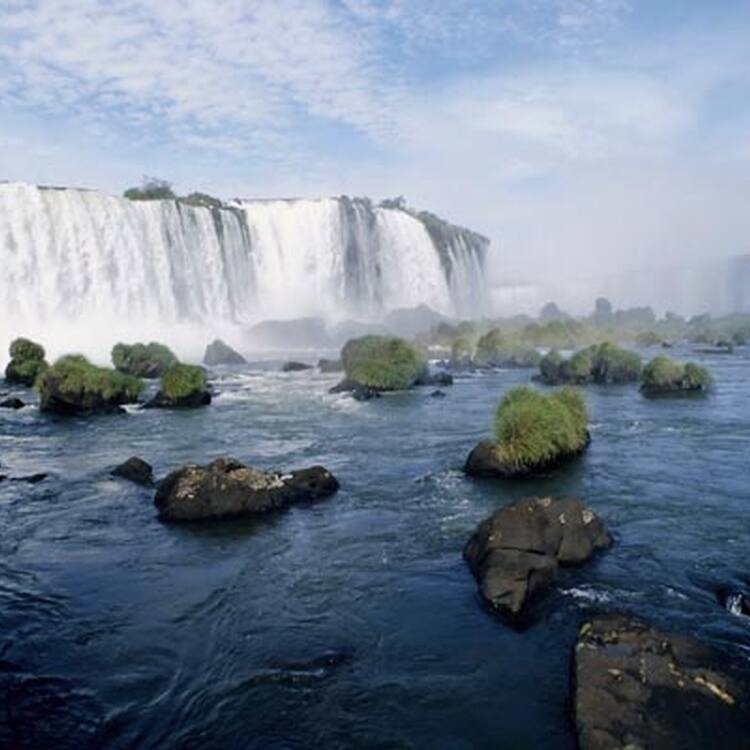
The park shares with Iguazú National Park in Argentina one of the world’s largest and most impressive waterfalls, extending over some 2,700 m. It is home to many rare and endangered species of flora and fauna, among them the giant otter and the giant anteater. The clouds of spray produced by the waterfall are conducive to the growth of lush vegetation.
La description est disponible sous licence CC-BY-SA IGO 3.0
Parc national d'Iguaçu
Comme son voisin d’Argentine, le parc national de l’Iguaçu permet d’admirer, sur une longueur de 2 700 m, l’une des cataractes les plus grandes et les plus impressionnantes du monde. Il abrite de nombreuses espèces rares et menacées de flore et de faune, et notamment la loutre géante et le fourmilier géant. Les nuages d’embruns qui se dégagent des chutes favorisent la croissance d’une végétation luxuriante.
La description est disponible sous licence CC-BY-SA IGO 3.0
منتزه إيغواسو الوطني
على غرار جاره في الأرجنتين، يطلّ منتزه إيغواسو الوطني، على امتداد 2700 متر، على أحد الشلالات الأكثر ضخامة وروعة في العالم. ويأوي المنتزه العديد من الأجناس النباتية والحيوانية النادرة والمهددة بالإنقراض، لا سيما ثعلب الماء العملاق وآكل النمل العملاق. وتعزّز سحابات الرذاذ المنبثقة من الشلالات نمو نباتات وافرة.
source: UNESCO/CPE
La description est disponible sous licence CC-BY-SA IGO 3.0
伊瓜苏国家公园
巴西伊瓜苏国家公园同阿根廷伊瓜苏国家公园共同分享着世界上最大和最壮观的瀑布群之一,整个瀑布群宽约2700米。这里是许多稀有濒危动植物物种的栖息地,其中包括大水獭和巨食蚁兽。瀑布产生的雾气滋润着这里的各种植物,使得它们能够茂密地生长。
source: UNESCO/CPE
La description est disponible sous licence CC-BY-SA IGO 3.0
Национальный парк Игуасу
На территории этого парка находится один из самых грандиозных водопадов мира с фронтом падающей воды 2,7 км. Здесь отмечен целый ряд редких и исчезающих видов растений и животных, в т.ч. гигантская выдра и гигантский муравьед. В зоне, орошаемой брызгами водопада, произрастает пышная растительность.
source: UNESCO/CPE
La description est disponible sous licence CC-BY-SA IGO 3.0
Parque Nacional del Iguazú
Al igual que el parque nacional argentino colindante del mismo nombre, el Parque Nacional del Iguazú brasileño permite admirar una de las cascadas mí¡s grandes e impresionantes del mundo, que tiene una anchura de mí¡s de 2.700 metros. El parque alberga numerosas especies raras de flora y fauna en peligro de extinción como la nutria y el oso hormiguero gigantes. Las nubes de bruma de las cascadas propician el desarrollo de una vegetación exuberante.
source: UNESCO/CPE
La description est disponible sous licence CC-BY-SA IGO 3.0
イグアス国立公園
イグアス国立公園はブラジルとアルゼンチンの国境に位置している。先住民グアラーニの言葉で「大いなる水」と呼ばれるイグアスには幅2.7km、高さ60-80mを越える大小300もの滝があり、ナイアガラ、ヴィクトリアと並ぶ世界3大瀑布のうちでも最大である。1884年にアルゼンチン側、86年にブラジル側のあわせて約22万5千haの亜熱帯地域と滝が世界遺産に登録された。source: NFUAJ
Nationaal park Iguaçu
Dit park deelt samen met het Nationaal park Iguazú in Argentinië een van 's werelds grootste en indrukwekkendste watervallen. De halfronde waterval in het hart is zo'n 80 meter hoog en heeft een diameter van 2.700 meter. Hij vormt de grens tussen Argentinië en Brazilië. Er leven vele zeldzame en bedreigde planten- en dierensoorten, waaronder de reuzenotter en de reuzenmiereneter. Het park bestaat voor ongeveer 90 procent uit subtropisch regenwoud. In het lagere gedeelte groeien voornamelijk boomvarens, epifyten en lianen. In het hogere, vochtigere gedeelte groeien de Braziliaanse den met twee palmen, de Assaï palm, de wilde kokospalm en de imbuya.
Source : unesco.nl


Valeur universelle exceptionnelle
Brève synthèse
Le parc national d’Iguaçu est un bien du patrimoine mondial de 169 695,88 ha situé dans l’État du Paraná, au sud du Brésil, contigu au parc national de l’Iguazú, également site du patrimoine mondial et situé en Argentine. Les deux biens ainsi que certaines aires protégées constituent des vestiges contigus importants de la forêt intérieure atlantique, qui fut une zone forestière bien plus étendue située au confluent de l’Iguaçu et du Paraná, là où se rencontrent le Paraguay, l’Argentine et le Brésil.
Les caractéristiques géomorphologiques exceptionnelles de ce paysage proviennent de son origine volcanique, il y a 500 millions d’années. L’impressionnant ensemble de chutes d’eau de l’Iguaçu (ou Iguazú) constitue le point d’intérêt principal du parc, qui est aussi une destination touristique nationale et internationale importante. Renommé pour sa beauté visuelle et acoustique, il s’étend sur presque 3 km et comporte des chutes de 80 m. La rivière, dont le nom indigène signifie « grande eau », forme un demi-cercle au cœur des deux parcs et constitue la frontière entre l’Argentine et le Brésil avant de se jeter dans le grand fleuve Paraná, à 25 km en aval du parc. Le bien abrite le bassin de la rivière Floriano, seul bassin hydrographique de l’État du Paraná entièrement préservé.
Les deux parcs comprennent également des forêts subtropicales humides semi-décidues dont la diversité et l’endémisme sont très importants car elles abritent plusieurs espèces rares et emblématiques. Les parcs sont actuellement situés au sein d’un paysage qui a été fortement altéré par l’exploitation forestière intense passée et actuelle, l’intensification et l’expansion de l’agriculture industrielle et traditionnelle, les plantations forestières pour l’industrie papetière et les implantations rurales. La superficie des parcs brésilien et argentin atteint 250 000 ha, dont 169 695,88 ha pour ce bien.
Critère (vii) : le parc national d’Iguaçu et son homologue argentin, le parc national de l’Iguazú, également bien du patrimoine mondial, comprennent une des plus imposantes et spectaculaires chutes d’eau au monde, comprise dans un système de cascades et de rapides sur un front d’environ 3 km dans un cadre de forêt de feuillus subtropicale luxuriante et variée. Les gouttelettes formées en permanence par les cataractes forment d’impressionnants nuages qui humidifient les îles couvertes de forêt et les berges de la rivière, créant ainsi une étonnante interface, en constante évolution, entre terre et eau.
Critère (x) : le Parc national d’Iguaçu, conjointement avec le bien mitoyen du patrimoine mondial, le parc national de l’Iguazú en Argentine, forme l’un des plus grands vestiges de la forêt humide subtropicale paranaense qui fait partie de la forêt atlantique de l’intérieur. La riche biodiversité comprend des espèces menacées et vulnérables comme le jaguar (Panthera onca), l’ocelot (Leopardus tigrinus), le puma (Puma concolor), le margay (Leopardus wiedii), le jaguarondi (Puma yagouaroundi), la harpie féroce (Harpia harpyja), la loutre géante (Pteronura brasiliensis), la pénélope à front noir (Aburria jacutinga), le tapir (Tapirus terrestris), le chien des buissons (Speothos venaticus), la mazama nana (Mazama nana), le tamanoir (Myrmecophaga tridactyla), le monjolo ou surubim de l’Iguaçu (Steindachneridion sp), le piracanjuba (Brycon orbignyanus) et l’onoré fascié (Tigrisoma fasciatum).
Intégrité
Le parc national d’Iguaçu fut officiellement établi parc national en 1939 par le gouvernement fédéral et fut agrandi deux fois, en 1944 et 1981, pour atteindre sa taille actuelle. Il est propriété intégrale de l’État. Avec le bien argentin et d’autres zones de conservation, et pour autant que la continuité géographique soit maintenue, la taille du bien présente des perspectives potentielles de conservation pérenne. Les limites et les zones environnantes du bien sont clairement établies et circonscrites.
Éléments requis en matière de protection et de gestion
Le parc national d’Iguaçu est une zone entièrement protégée limitée à l’utilisation non destructive des ressources naturelles. La zone est gérée par l’Institut Chico Mendes pour la conservation de la biodiversité (ICMBio), organisme fédéral en autonomie rattaché au Ministère de l’Environnement brésilien, et partie intégrante du Système environnemental national brésilien (SISNAMA). La gestion et l’administration sont mises en œuvre afin de garantir la préservation de la beauté naturelle exceptionnelle et la conservation de la biodiversité. Des actions de surveillance sont menées au sein et aux environs du parc, en collaboration avec les forces de police forestières du Paraná. Des actions de suivi sont également menées avec les forces des gardes forestiers argentins responsables de la conservation du parc national de l’Iguazú en Argentine.
Les niveaux d’eau sont artificiellement régulés par les centrales hydroélectriques situées en amont, provoquant des impacts paysagers et écologiques. Les niveaux d’eau sont suivis afin d’atténuer et de prévenir les impacts.
La gestion touristique est une activité importante au sein du bien qui vise à contenir les impacts directs et indirects d’une fréquentation importante tout en tirant profit des possibilités de sensibilisation à la conservation de la nature et au financement de la conservation.
Les deux parcs partagent une stratégie de conservation à long terme et bénéficient beaucoup de leur collaboration et coopération étroite.
À l’avenir, la gestion devra intégrer des scénarios à plus long terme et trouver un équilibre entre la conservation et l’utilisation des autres terres et des ressources afin d’entretenir ou restaurer la continuité du paysage. Cela passera par la concertation avec les autres secteurs et les communautés locales. Par la suite, les zones adjacentes situées en Argentine, au Brésil et au Paraguay devraient constituer des zones tampons en vertu d’un plan d’occupation des sols approprié et harmonisé.
Les efforts actuels visant à établir des « couloirs de biodiversité » – le corridor intérieur de la forêt atlantique et le corridor trinational – ainsi qu’une recherche accrue et des activités d’éducation environnementale constituent déjà une base solide. Les activités d’éducation environnementale visent à intégrer les communautés voisines, les étudiants, les universités, les professeurs, les leaders communautaires et associatifs afin de sensibiliser et renforcer les relations avec la société civile.
Les aménagements hydroélectriques existants et envisagés en amont, l’empiètement agricole, ainsi que le braconnage et le prélèvement de végétaux figurent parmi les menaces qui demandent une attention permanente.


Liste du patrimoine mondial en péril
Année d'inscription du bien sur la Liste du patrimoine mondial en péril
1999 -2001