Parc international de la paix Waterton-Glacier
Waterton Glacier International Peace Park
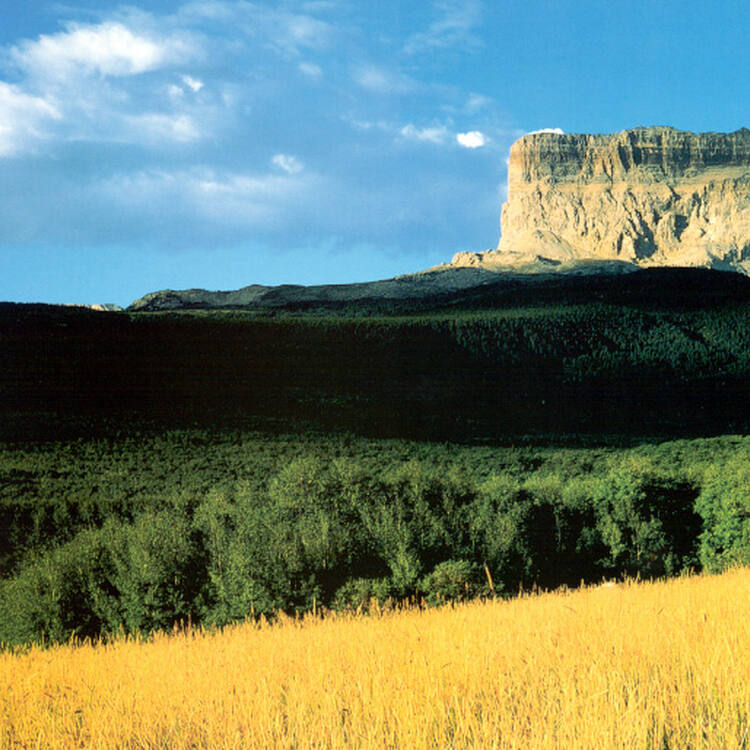
In 1932 Waterton Lakes National Park (Alberta, Canada) was combined with the Glacier National Park (Montana, United States) to form the world's first International Peace Park. Situated on the border between the two countries and offering outstanding scenery, the park is exceptionally rich in plant and mammal species as well as prairie, forest, and alpine and glacial features.
La description est disponible sous licence CC-BY-SA IGO 3.0
Parc international de la paix Waterton-Glacier
En 1932, le parc national des Lacs-Waterton (Alberta, Canada) et le Glacier National Park (Montana, États-Unis d'Amérique) ont été réunis pour former le premier « parc international de la paix » du monde. Situé de part et d'autre de la frontière entre les deux pays, il offre des paysages d'une beauté exceptionnelle. Il est particulièrement riche en espèces végétales et en mammifères ainsi qu'en prairies, forêts, éléments alpins et glaciers.
La description est disponible sous licence CC-BY-SA IGO 3.0
الحديقة الدولية للسلام، حديقة واترتون-الكتل الجليدية
في العام 1932، جرى ضمّ الحديقة الوطنية للبحيرات-حديقة واترتون (في ولاية ألبرتا، في كندا) إلى الحديقة الوطنية للكتل الجليدية (في ولاية مونتانا، في الولايات المتحدة الأميركية) لتصبحا "الحديقة الدولية الأولى للسلام" في العالم التي تقع من جانبي الحدود الكندية-الأميركية، وتوّفر مناظر طبيعية رائعة الجمال. تزخر هذه الحديقة بالأجناس النباتية وبأصناف الثديات وكذلك بالمروج والغابات وعناصر البيئة الجبلية والكتل الجليدية.
source: UNESCO/CPE
La description est disponible sous licence CC-BY-SA IGO 3.0
沃特顿冰川国际和平公园
1932年,沃特顿湖区国家公园(加拿大艾伯塔省)与冰河国家公园(美国蒙大拿州)进行合并,组成世界上第一个国际和平公园。该公园位于加拿大和美国边界,风光迷人,特别是植物以及哺乳动物种类丰富,同时还拥有草原、森林、山地和冰川等地貌。
source: UNESCO/CPE
La description est disponible sous licence CC-BY-SA IGO 3.0
Международный Парк Мира Уотертон-Лейкс–Глейшер
В 1932 г. национальный парк Уотертон-Лейкс (провинция Альберта, Канада) был объединен с национальным парком Глейшер (штат Монтана, США), в результате чего был образован первый в мировой практике Международный Парк Мира. Располагающийся на стыке государственных границ двух стран, этот очень живописный парк, включающий участки прерий, лесов, альпийских и ледниковых высокогорий, обладает исключительно богатой флорой и фауной.
source: UNESCO/CPE
La description est disponible sous licence CC-BY-SA IGO 3.0
Parque Internacional de la Paz Waterton-Glacier
En 1932, el Parque Nacional de Waterton Lakes (Provincia de Alberta, Canadá) y el Parque Nacional de Glacier (Estado de Montana, EE.UU.) se fusionaron para formar “el primer parque internacional de la paz del mundo”. Situado a ambos lados de la frontera entre el Canadá y los Estados Unidos, este parque posee paisajes de excepcional belleza y una gran variedad de especies vegetales y mamíferos, así como praderas, bosques y formaciones geológicas alpinas y glaciares.
source: UNESCO/CPE
La description est disponible sous licence CC-BY-SA IGO 3.0
ウォータートン・グレーシャー国際平和自然公園
カナダ・アルバータ州のウォータートン湖国立公園とアメリカ・モンタナ州のグレイシャー国立公園からなり、1932年に世界初の国際平和自然公園として指定された。高い山々や氷河の壮大な景観か広がり、動物、植物ともに非常に豊富である。source: NFUAJ
Internationaal vredespark Waterton Glacier
In 1932 werden het Nationaal park Waterton Lakes (Alberta, Canada) en het Nationaal park Glacier (Montana, Verenigde Staten) samengevoegd tot Internationaal vredespark Waterton Glacier, het eerste Internationale vredespark van de wereld. Het park is gelegen op de grens tussen Canada en de Verenigde Staten. Het bestaat uit een prachtig landschap en is uitzonderlijk rijk aan planten- en zoogdiersoorten. Het meest in het oog springende kenmerk van Waterton Glacier is de plotselinge overgang van prairie naar berglandschap, een contrast dat wordt benadrukt door het vrijwel geheel ontbreken van tussenliggende uitlopers. Het park staat verder bekend om zijn overvloed aan wilde dieren.
Source : unesco.nl


Valeur universelle exceptionnelle
Brève synthèse
Le parc international de la paix Waterton-Glacier présente un climat distinctif, un cadre physiographique, une mise en contact des écosystèmes de montagne et de prairie et une ligne de partage des eaux tri-océanique. C’est une aire dotée de valeurs panoramiques remarquables, avec une flore et une faune abondantes et variées.
Critère (vii) : Les deux parcs nationaux ont été désignés à l’origine par leurs nations respectives en raison du décor montagneux superbe, du relief topographique élevé, du paysage glaciaire et de la faune et de la flore abondamment diversifiées.
Critère (ix): Le bien occupe une place centrale dans la cordillère occidentale de l’Amérique du Nord, ce qui a donné lieu à l’évolution de communautés végétales et à des complexes écologiques qui ne sont observés nulle part ailleurs dans le monde. Les régimes climatiques maritimes non entravés par les chaînes de montagnes au nord et au sud permettent aux plantes et aux animaux caractéristiques du Pacifique nord-ouest de s’étendre dans le parc jusqu’à la ligne continentale de partage des eaux. A l’est, les communautés de prairie se blottissent contre les montagnes sans le moindre contrefort, ce qui permet le développement d’une interface entre communautés de prairie, montagnardes et alpines. Le parc international de la paix comprend les sources de trois grands bassins fluviaux drainant des biomes remarquablement différents vers différents océans. L’importance biogéographique de cette ligne de partage tri-océanique est accrue par les nombreuses liaisons végétalisées entre les eaux d’amont. Le résultat net est la création d’un ensemble unique et d’une grande diversité de flore et de faune concentrée dans un espace restreint.
Intégrité
D’une superficie de 457 600 hectares, le parc international de la paix forme la pièce maîtresse d’un écosystème transfrontalier beaucoup plus vaste, la « Couronne du continent ». Le bien inscrit seul est d’une superficie suffisante pour préserver bon nombre des valeurs panoramiques et des processus géomorphologiques à l’origine de son inscription. Plus de 95 % de la propriété est gérée pour ses valeurs sauvages, mais sa gestion doit tenir compte du contexte de l’écosystème de la Couronne du continent pour assurer la viabilité génétique et la survie à long terme de bon nombre d’espèces, dont des grands carnivores comme le grizzli, le couguar, le loup gris et le carcajou, qui peuvent s’aventurer sur de grandes distances à l’extérieur des limites du parc. De plus, le réseau hydrographique de la rivière Flathead, qui forme les limites ouest et sud du Glacier National Park et abrite d’importantes populations de poissons, prend sa source à l’extérieur du parc international de la paix. La majeure partie de la propriété est bordée par d’autres aires protégées, ce qui ajoute des éléments de connectivité importants pour les déplacements de la faune. S’il demeure certains obstacles à la connectivité dans le grand écosystème, des efforts ont été investis par les deux pays dans la gestion de la Couronne du continent afin d’éliminer ces barrières. Ces efforts devront se poursuivre afin d’assurer la protection à long terme de la valeur universelle exceptionnelle du bien.
Eléments requis en matière de protection et de gestion
Les deux parcs nationaux sont gérés et protégés en vertu de leurs cadres législatifs nationaux respectifs. Le Glacier National Park est administré par l’Organic Act du 25 août 1916, qui établit le National Park Service des États-Unis. Ce parc est également régi par une loi habilitante qui prescrit les orientations du Congrès à l’égard des principaux objectifs du parc. Le parc national des Lacs-Waterton est administré en vertu de la Loi sur les parcs nationaux du Canada et ses règlements d’application qui régissent la protection et la gestion des ressources naturelles et culturelles du parc. La gestion quotidienne est assurée par le directeur de chacun des parcs conformément au mandat prévu par les lois et règlements pertinents du National Park Service des États-Unis et de Parcs Canada. Les deux organismes entretiennent respectivement des relations intergouvernementales avec la tribu des Pieds-Noirs et les tribus confédérées de Salish et de Kootenai (tribus de Kootenai, de Pend d’Oreille et de Salish), aux États-Unis, et avec la Confédération des Pieds-Noirs (Premières Nations des Kainai, des Siksika et des Piikani du Nord) et la Nation des Ktunaxa au Canada.
Les buts et objectifs de gestion du bien ont été établis dans le plan directeur respectif de chacun des deux parcs : le plan directeur général du Glacier National Park (1999) et le plan directeur du parc national du Canada des Lacs-Waterton (2010). Bien que chaque composante de la propriété soit gérée selon son propre plan directeur, un certain nombre de principes directeurs communs à tous les plans guident la gestion des ressources naturelles et culturelles, l’utilisation par les visiteurs et l’interprétation, la science et la recherche ainsi que les relations avec les peuples autochtones, et témoignent d’une solide collaboration entre les gestionnaires du bien. Les plans directeurs et leurs buts et objectifs connexes sont périodiquement revus et mis à jour en consultation avec les Autochtones, le public, les intervenants et les partenaires.
Les plans directeurs des parcs de la propriété établissent un grand nombre de mesures de protection : processus d’évaluation environnementale, zonage, surveillance de l’intégrité écologique et de l’expérience du visiteur, et programmes éducatifs visant à atténuer les pressions exercées de l’extérieur du parc, comme le développement résidentiel, industriel et de l’infrastructure ainsi que les pratiques forestières dans les deux pays.
En 2011, après la signature du protocole d’entente sur la protection de l’environnement, le changement climatique et l’énergie (Memorandum of Understanding on Environmental Protection, Climate Action and Energy) par le gouvernement de la Colombie-Britannique et le gouvernement de l’État du Montana en 2010, la Colombie-Britannique a adopté une loi visant à éliminer l’exploration et l’exploitation minières, pétrolières et gazières de la liste des utilisations admissibles des terres dans le bassin hydrographique de la rivière Flathead au Canada, ajoutant ainsi à la protection environnementale du parc international de la paix. Le Crown Managers Partnership (un groupe de gestionnaires fonciers du gouvernement fédéral, d’État, provincial, de tribus et de Premières Nations) fait la promotion de stratégies de collaboration transfrontalière axées sur la santé écologique à long terme du grand écosystème transfrontalier de la Couronne du continent. En outre, la « Great Northern Landscape Conservation Cooperative » offre d’autres possibilités de coopération entre gouvernements et nations de part et d’autre de la frontière.
Une attention particulière sera accordée, à long terme, à la surveillance de nombreux facteurs et à l’adoption de mesures appropriées à l’intérieur et à proximité de la propriété. Cette attention sera surtout centrée sur les effets du développement de l’infrastructure, le risque de pollution aquatique et aérienne, le pâturage des animaux d’élevage, l’incidence de l’utilisation des ressources biologiques, les effets du changement climatique et les espèces envahissantes ou surabondantes. Les activités d’exploitation forestière et d’extraction de ressources physiques actuelles ou potentielles à proximité du bien seront également surveillées.
Liens
-
Youtube - Parc national des Glaciers
-
Tumblr - Parc national des Glaciers
-
Flickr - Parc national des Glaciers
-
Instagram - Parc national des Glaciers
-
Twitter - Parc national des Glaciers
-
Facebook - Parc national des Glaciers
-
Parc national du Montana - Service des parcs nationaux (en anglais)
-
Youtube - Parcs Canada
-
Twitter - Parc national des Lacs-Waterton, Parcs Canada
-
Page Facebook - Parc national des Lacs-Waterton, Parcs Canada
-
Parc national des Lacs-Waterton
-
Protectedplanet.net


Les dossiers de proposition d’inscription produits par les États parties sont publiés par le Centre du patrimoine mondial sur son site Internet et/ou dans des documents de travail afin de garantir la transparence, l’accès à l’information et de faciliter la préparation d’analyses comparatives par d’autres États parties soumissionnaires.
Le contenu de chaque dossier de proposition d’inscription relève de la responsabilité exclusive de l'État partie concerné. La publication d’un dossier de proposition d’inscription ne saurait être interprétée comme exprimant une prise de position de la part du Comité du patrimoine mondial ou du Secrétariat de l'UNESCO à propos de l’histoire ou du statut juridique d'un pays, d'un territoire, d'une ville, d'une zone ou de ses frontières.
Protections
par d'autres instruments de conservation
1 protection / 1 élément
Les réserves de biosphère (1 element)