Site archéologique de Troie
Archaeological Site of Troy
Troy, with its 4,000 years of history, is one of the most famous archaeological sites in the world. The first excavations at the site were undertaken by the famous archaeologist Heinrich Schliemann in 1870. In scientific terms, its extensive remains are the most significant demonstration of the first contact between the civilizations of Anatolia and the Mediterranean world. Moreover, the siege of Troy by Spartan and Achaean warriors from Greece in the 13th or 12th century B.C., immortalized by Homer in the Iliad, has inspired great creative artists throughout the world ever since.
La description est disponible sous licence CC-BY-SA IGO 3.0
Site archéologique de Troie
Troie, chargée d'une histoire de 4 000 ans, figure parmi les sites archéologiques les plus connus du monde. Les premières fouilles dans ce site datent de 1871 et furent effectuées par le grand archéologue Heinrich Schliemann. En termes scientifiques, ses nombreux vestiges offrent la preuve la plus significative du premier contact entre les civilisations de l'Anatolie et du monde méditerranéen. En outre, le siège de Troie par les guerriers grecs de Sparte et d'Achaïe au XIIIe ou au XIIe siècle av. J.-C., immortalisé par Homère dans l'Iliade , a inspiré depuis lors les grands artistes du monde entier.
La description est disponible sous licence CC-BY-SA IGO 3.0
موقع طروادة الأثري
تبرز طروادة المثقلة بتاريخ دام 4000 سنة بين المواقع الأثرية الأشهر في العالم. وتعود أعمال التنقيب الاولى التي تناولت هذا المكان الى عام1781 وقد تولاها عالم الآثار الكبير هنريخ شليمان. وتشكل آثارها المتعددة دليلاً بالغ الأهمية على الاتصال الأول بين حضارة الأناضول وحضارة العالم المتوسطي. الى ذلك، شكل حصار طروادة الذي شنه محاربو اسبارطة وأكاي اليونانيون في القرن الثالث عشر أو الثاني عشر قبل الميلاد والذي خلّده هوميروس في إلياذته مصدر ايحاء لكبار الفنانين في العالم أجمع.
source: UNESCO/CPE
La description est disponible sous licence CC-BY-SA IGO 3.0
特洛伊考古遗址
特洛伊以其4000多年的历史成为世界上最著名的考古遗址之一。1870年,著名的考古学家海因里希·谢里曼(Heinrich Schliemann) 对这个遗址进行了第一次挖掘。从科学的角度来说,它大量的遗存物是安纳托利亚和地中海文明之间联系的最重要最实质的证明。特洛伊于公元前13世纪或12世纪遭到来自希腊的斯巴达人和亚加亚人的围攻,这一史实由荷马写进史诗而流传千古,而且从那时起它便启发了世界上众多艺术家的创作灵感。
source: UNESCO/CPE
La description est disponible sous licence CC-BY-SA IGO 3.0
Археологические памятники Трои
Троя с ее 4000-летней историей – это один из наиболее известных археологических объектов в мире. Его открыл знаменитый археолог Генрих Шлиман в 1870 г. Научная ценность этих богатейших находок состоит в том, что они ярко демонстрируют первые контакты между цивилизациями Анатолии и миром Средиземноморья. Кроме того, осада Трои спартанцами и ахейцами из Древней Греции в XIII-XII вв. до н.э., которую обессмертил Гомер в Илиаде, вдохновляла людей искусства во всем мире.
source: UNESCO/CPE
La description est disponible sous licence CC-BY-SA IGO 3.0
Sitio arqueológico de Troya
El sitio arqueológico de Troya, con sus 4.000 años de historia, es uno de los más célebres del mundo. Las primeras excavaciones del sitio datan del año 1870 y fueron realizadas por el famoso arqueólogo Heinrich Schliemann. Desde un punto de vista científico, sus numerosos vestigios constituyen la prueba más importante del primer contacto entre las civilizaciones de Anatolia y el mundo mediterráneo. El asedio de Troya por los guerreros espartanos y aqueos, llegados de Grecia hacia el siglo XIII o XII a.C., fue inmortalizado por Homero en La Ilíada y desde entonces ha sido una fuente continua de inspiración para grandes artistas del mundo entero.
source: UNESCO/CPE
La description est disponible sous licence CC-BY-SA IGO 3.0
トロイの古代遺跡
source: NFUAJ
Archeologisch gebied van Troje
Source : unesco.nl


Valeur universelle exceptionnelle
Brève synthèse
Le site archéologique de Troie est chargé de 4000 ans d’histoire. Ses nombreux vestiges témoignent de manière significative du premier contact entre les civilisations de l'Anatolie et du monde méditerranéen émergeant. Les premières fouilles ont commencé il y a plus d’un siècle et ont établi une chronologie qui est fondamentale pour la compréhension de cette période très importante du monde antique et son développement culturel. En outre, le siège de Troie par les guerriers Grecs de Mycènes au XIIIe siècle av. J.C., immortalisé par Homère dans l’Iliade, n’a cessé d’inspirer depuis lors de grands artistes à travers le monde.
Le site de Troie se situe sur le promontoire d'Hisarlik qui surplombe la plaine le long de la côte turque de l'Égée, à 4,8 kilomètres de l'entrée sud des Dardanelles. Le célèbre archéologue Heinrich Schliemann entreprit les premières fouilles de ce site en 1870 et ces fouilles pourraient être considérées comme le point de départ de l’archéologie moderne et sa reconnaissance publique. Les recherches et les fouilles menées à Troie et dans la Troade révèlent que cette région est habitée depuis 8000 ans. Au fil des siècles, Troie a joué un rôle de pont culturel entre la Troade et les Balkans, l’Anatolie, la mer Égée et la mer Noire par la migration, l’occupation, le commerce et la transmission des savoirs.
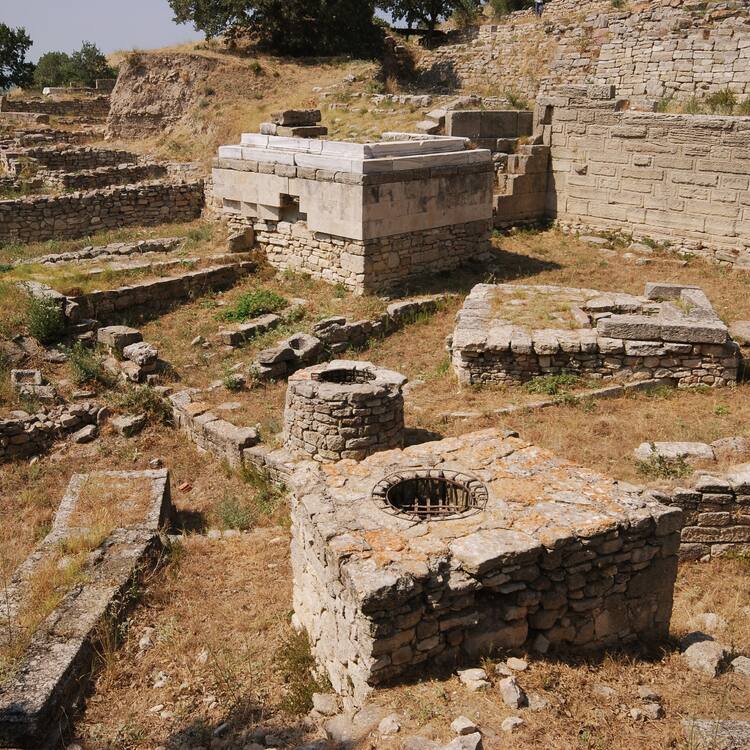
Les 24 campagnes de fouilles qui se sont déroulées au cours des 140 dernières années ont mis au jour de nombreux éléments datant de toutes les périodes d’occupation de la citadelle et de la ville basse, notamment 23 sections de l’appareil défensif autour de la citadelle, révélant 11portes, une rampe en pierre et les parties inférieures de cinq bastions défensifs. Ces éléments archéologiques datent presque tous de Troie II et VI. Toutefois, on a retrouvé une section du premier mur (Troie I) près de la porte sud du premier ouvrage défensif. Depuis une quinzaine d’années, il apparaît clairement qu’une ville basse existait au sud de la citadelle à toutes les périodes préhistoriques et s’étendait sur une trentaine d’hectares à la fin de l’âge du Bronze. Plusieurs monuments, notamment le temple d’Athéna et le sanctuaire récemment fouillé, font partie de la ville grecque et romaine d’Ilion, sur le site de Troie. L’organisation urbaine romaine se reflète dans deux bâtiments publics principaux situés à la limite de l’agora (place du marché centrale), l’ôdeion (dédié à la musique) et le bouleuterion (salle des conseils) tout proche.
Le paysage environnant recèle de nombreux sites historiques et archéologiques importants, notamment des établissements et des cimetières préhistoriques, des sites funéraires hellénistiques, des tumuli monumentaux, des établissements grecs et romains, des ponts romains et ottomans et de nombreux monuments commémoratifs de la bataille des Dardanelles.
Critère (ii) : Le site archéologique de Troie revêt une signification considérable pour comprendre le développement de la civilisation européenne à l’étape cruciale de ses premiers balbutiements. Il témoigne d’une histoire ininterrompue de plus de 3000 ans qui aura vu se succéder diverses civilisations. Le rôle de Troie est d'une importance capitale pour illustrer les relations existant entre l'Anatolie, la mer Égée et les Balkans, cette ville se trouvant au point de rencontre entre les trois cultures.
Critère (iii) : Le site archéologique de Troie témoigne des différentes civilisations qui occupèrent ce site sur plus de 4000 ans. Troie II et Troie VI constituent un exemple unique de ville orientale intégrée à un contexte égéen, dotées d'une magnifique citadelle fortifiée comprenant des palais et des bâtiments administratifs et entourée d'une ville basse étendue, également fortifiée. Plusieurs autres monuments et vestiges reflètent les caractéristiques d’établissements romains et grecs et d’autres attributs distincts témoignant des établissements ottomans.
Critère (vi) : Le site archéologique de Troie apporte un témoignage culturel exceptionnel en raison de l'influence profonde qu’il eut sur des œuvres littéraires importantes comme l’Iliade d’Homère et l’Énéide de Virgile et sur les arts créatifs sur plus de deux millénaires.
Intégrité
Le bien inscrit comprend tous les éléments nécessaires pour exprimer sa valeur universelle exceptionnelle. Les vestiges archéologiques offrent un impressionnant aperçu de la ville de l’âge du Bronze avec ses fortifications, ses palais et ses bâtiments administratifs. Des périodes grecque et romaine, deux grands édifices publics situés à la limite de l’agora nous sont parvenus de manière quasi-intégrale.
Authenticité
Le degré d’authenticité du site archéologique est élevé car les reconstructions sont peu nombreuses. Celles qui ont été réalisées sur l’appareil défensif l’ont été dans le plus strict respect des principes d’anastylose. Le degré d’authenticité du paysage environnant est aussi élevé et représente un développement organique depuis la préhistoire jusqu’à nos jours qui n’a été soumis à aucun développement touristique gênant.
Éléments requis en matière de protection et de gestion
Le site archéologique est classé site historique par le décret 3925 du 13 mai 1968 établi par le Conseil supérieur des biens immobiliers culturels et naturels sous l’autorité du Ministère de la culture et du tourisme. La cité antique de Troie a également été classée en tant que site archéologique de premier ordre et une zone de conservation a été créée en 1981 par la Décision N°12848 du Conseil supérieur des biens immobiliers culturels et naturels. Les limites de la cité antique de Troie ont été définies par la décision N°2414 du Conseil régional d'Edirne pour la conservation du patrimoine culturel et naturel prise en en 1995 afin de coïncider avec celles du bien du patrimoine mondial. Ce site est donc protégé selon les dispositions de la loi N°2863 de la République de Turquie sur la conservation des biens culturels et naturels. Selon cette législation, les sites et les biens mobiliers que l’on y découvre appartiennent à l'État et aucune intervention n’est possible sans l'autorisation du conseil régional compétent. Le site antique de Troie et son paysage environnant ont été classés en tant que parc national historique par le décret du Conseil des ministres n°8676 de 1996. A ce jour, la majorité des zones archéologiques de Troie sont détenues par l’État et donc protégées par la loi. Suite à la préemption de plusieurs biens en 1994, 75% de la ville basse et les cimetières sont aujourd’hui la propriété de l’État, et d’autres mesures de ce type sont en cours. Le reste des terrains privés sont actuellement cultivés.
La responsabilité globale de la protection et de la gestion des sites classés incombe au Directorat général du patrimoine culturel et des musées. Les institutions associées au niveau régional sont le Conseil de Çanakkale pour la préservation du patrimoine culturel, le gouvernorat de Çanakkale et le Musée de Çanakkale.
Le Département des parcs nationaux du ministère des Eaux et Forêts collabore avec le ministère de la culture sur les questions concernant le paysage environnant. Un plan de conservation préparé par le ministère en 1971 a été révisé en 2010 et constitue le principal document de planification destiné à la gestion du bien.
Liens
-
Page Instagram
-
Page Twitter (X)
-
Le site archéologique de Troie (en anglais seulement)
-
 Our Place (en anglais)
-
Découvrez les photos de OUR PLACE the World Heritage Collection
-
Explore Turkey: Troy - Truva (seulement en anglais)
-
Troia und die Troas - Archäologie einer Landschaft (seulement en anglais et allemand)
-
Turquie sur la liste du Patrimoine Mondial

Les dossiers de proposition d’inscription produits par les États parties sont publiés par le Centre du patrimoine mondial sur son site Internet et/ou dans des documents de travail afin de garantir la transparence, l’accès à l’information et de faciliter la préparation d’analyses comparatives par d’autres États parties soumissionnaires.
Le contenu de chaque dossier de proposition d’inscription relève de la responsabilité exclusive de l'État partie concerné. La publication d’un dossier de proposition d’inscription, y compris les cartes et les noms, ne saurait être interprétée comme exprimant une prise de position de la part du Comité du patrimoine mondial ou du Secrétariat de l'UNESCO à propos de l’histoire ou du statut juridique d'un pays, d'un territoire, d'une ville ou d'une zone, ou de ses frontières.