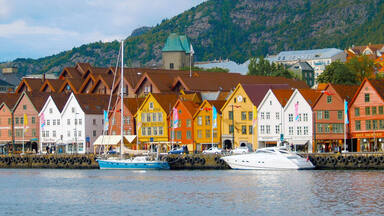
Quartier de « Bryggen » dans la ville de Bergen
Bryggen
Bryggen, the old wharf of Bergen, is a reminder of the town’s importance as part of the Hanseatic League’s trading empire from the 14th to the mid-16th century. Many fires, the last in 1955, have ravaged the characteristic wooden houses of Bryggen. Its rebuilding has traditionally followed old patterns and methods, thus leaving its main structure preserved, which is a relic of an ancient wooden urban structure once common in Northern Europe. Today, some 62 buildings remain of this former townscape.
La description est disponible sous licence CC-BY-SA IGO 3.0
Quartier de « Bryggen » dans la ville de Bergen
Bryggen, le vieux quai de Bergen rappelle l’importance de la ville comme élément de l’empire commercial de la Ligue hanséatique, du XIVe siècle au milieu du XVIe siècle. De nombreux incendies, dont le dernier en 1955, ont ravagé les maisons typiques en bois de Bryggen. Sa reconstruction a traditionnellement repris les anciennes méthodes et modèles, (ainsi en laissant)sa structure principale a été préservée, qui est une relique d’une ancienne structure urbaine en bois autrefois commune dans le nord de l’Europe. Aujourd’hui, environ 62 immeubles persistent dans cet ancien townscape.
La description est disponible sous licence CC-BY-SA IGO 3.0
حيّ بريغين في مدينة بيرغن
يذكرنا حيّ بريغين وهو رصيف بيرغن القديم، بأهمية هذه المدينة كعنصر من امبراطورية الجامعة التحالفية التجارية التي امتدت من القرن الرابع عشر وحتى منتصف القرن السادس عشر. وقد دمرت حرائق عدة آخرها في العام 1955، المنازل النموذجية المصنوعة من خشب بريغين. وتطلّبت اعادة بنائها اعتماد الوسائل والنماذج القديمة وفقًا للتقليد والمحافظة على بنيتها الاساسية التي تشكل ذخيرة البنية المدنية الخشبية القديمة التي كانت في وقت من الاوقات شائعةً في شمال أوروبا. وما زال حوالي 62 مبنى صامدًا حتى اليوم في هذه المدينة الجميلة القديمة.
source: UNESCO/CPE
La description est disponible sous licence CC-BY-SA IGO 3.0
卑尔根市布吕根区
布吕根地区是卑尔根的一个旧码头,该遗迹告诉人们这是14世纪到16世纪中叶汉萨同盟贸易帝国的一个重镇。多起火灾(最后一起是在1955年) 烧毁了布吕根地区美丽的木头房子,但是其主要建筑仍然保存下来。如今残存的58幢建筑大部分被用作艺术家的工作室。
source: UNESCO/CPE
La description est disponible sous licence CC-BY-SA IGO 3.0
Старый портовый квартал Брюгген (город Берген)
Брюгген, старая верфь Бергена, напоминает о важности этого города в торговой империи Ганзейского союза в период с XIV в. до середины XVI в. Многочисленные пожары (последний в 1955 г.) разрушили красивые деревянные постройки Брюггена, но его основная структура сохранилась. Многие из уцелевших 58 зданий теперь используются как студии художников.
source: UNESCO/CPE
La description est disponible sous licence CC-BY-SA IGO 3.0
Barrio de Bryggen en Bergen
El barrio antiguo del muelle de Bryggen recuerda la importancia que tuvo la ciudad de Bergen en el imperio comercial de la Liga Hanseática, desde el siglo XIV hasta mediados del siglo XVI. Las típicas casas de madera de este barrio fueron pasto de las llamas en numerosas ocasiones; el último incendio se remonta al año 1955. Las reconstrucciones sucesivas se efectuaron sobre la base de los modelos primigenios y con arreglo a métodos tradicionales, habiéndose preservado así la configuración esencial del sitio, que es una reliquia de las antiguas estructuras urbanas en madera muy generalizadas antaño en el norte de Europa. Hoy en día, subsisten 62 inmuebles de este conjunto urbano.
source: UNESCO/CPE
La description est disponible sous licence CC-BY-SA IGO 3.0
ブリッゲン
source: NFUAJ
Bryggen
Bryggen is de oude werf van Bergen. De oude werf herinnert aan het belang van de stad als deel van het handelsimperium van het Hanze Verbond, van de 14e eeuw tot het midden van de 16e eeuw. Veel branden hebben de karakteristieke houten huizen van Bryggen verwoest. De laatste brand was in 1955. De herbouw heeft traditiegetrouw oude patronen en methoden gevolgd, waardoor de hoofdstructuur bewaard is gebleven. Dit is een overblijfsel van een oude houten stedelijke bebouwing die ooit gebruikelijk was in Noord-Europa. Er zijn nu nog 62 gebouwen van dit voormalige stadsgezicht over.
Source : unesco.nl


Valeur universelle exceptionnelle
Brève synthèse
Bryggen est un quartier portuaire historique de Bergen, une des plus anciennes cités portuaires d’Europe du nord, sur la côte occidentale de la Norvège, un centre de commerce établi au XIIe siècle. En 1350, la Ligue hanséatique a créé un « bureau hanséatique » à Bergen. Celui-ci est progressivement devenu le propriétaire de Bryggen et a contrôlé le commerce du stockfisch en provenance du Nord de la Norvège grâce à un privilège accordé par la Couronne. Au total, la Ligue hanséatique a établi quatre bureaux hanséatiques, Bryggen est à ce jour le seul qui ait été conservé.
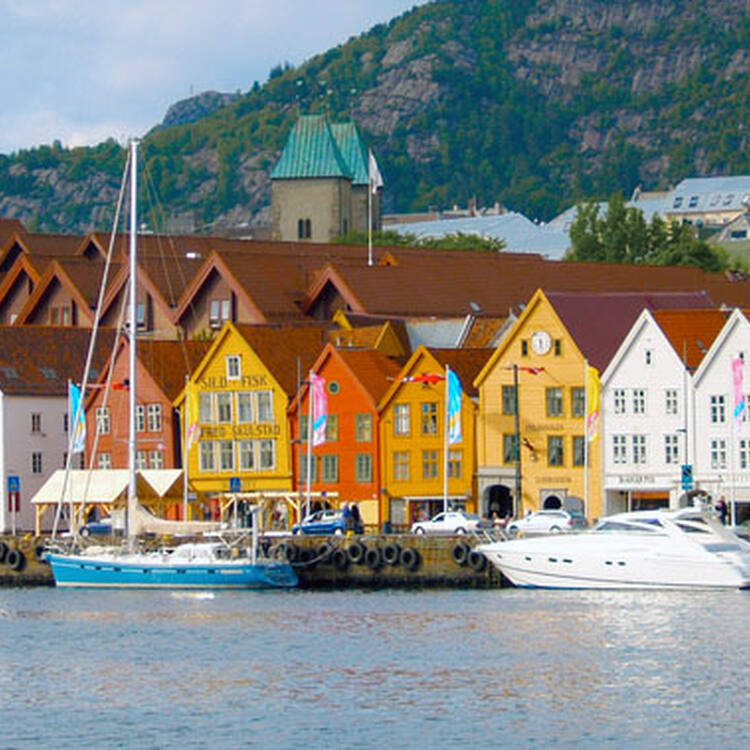
Au cours des siècles, Bryggen a été ravagé par un certain nombre d’incendies et a été, à chaque fois, reconstruit, en se conformant avec précision à la structure, aux techniques de construction et aux plans antérieurs. L’aspect actuel de Bryggen est semblable à celui du quartier après l’incendie de 1702. Les bâtiments sont en bois et sont construits selon des traditions vernaculaires. La structure urbaine compacte d’origine médiévale est conservée avec ses longues rangées étroites de bâtiments qui font face au port, séparées par d’étroits passages en bois. À ce jour, 62 édifices de ce paysage urbain ancien demeurent et ils conservent suffisamment d’éléments pour témoigner de la façon dont cette colonie de marchands allemands, tous célibataires, vivait et travaillait et de l’utilisation de l’espace dans ce district. Cet espace se caractérise par une construction de bâtiments le long de passages étroits parallèles aux docks. Les unités urbaines sont des rangées de bâtiments de deux à trois étages désignées par le nom médiéval de « gård ». Ces bâtiments ont des façades à pignon qui font face au port et ils sont répartis soit d’un seul côté soit des deux côtés de passages étroits qui font office de cour privée. Les maisons sont bâties selon diverses constructions traditionnelles en rondins de bois et les galeries sont constituées de colonnes et de poutres avec un habillage de panneaux horizontaux en bois. Les toits sont recouverts de leurs tuiles d’origine ou de tôle, suite à des réparations rapidement exécutées après une explosion au cours de la Seconde Guerre mondiale. Au fond du « gård », se trouvent de petits entrepôts ou de petites réserves (kjellere) résistant au feu, construits en pierre, afin de protéger les marchandises particulières ou de valeur contre les risques d’incendie. La structure répétitive des constructions était bien adaptée aux conditions de vie du comptoir de commerce hanséatique. Les marchands allemands prenaient leur quartier d’hiver dans les petites résidences individuelles en bois et les réserves étaient alors utilisées comme entrepôt individuel ou collectif. Bryggen était une véritable colonie, elle jouissait d’une quasi extraterritorialité qui s’est perpétuée au delà du départ des marchands hanséatiques jusqu’à la création du comptoir commercial norvégien en 1754, sous l’impulsion des pêcheurs et armateurs d’origine allemande. Aujourd’hui, Bryggen constitue une partie significative de la ville historique de Bergen, construite en bois.
Critère (iii) : Bryggen porte les traces d’une organisation sociale et illustre une utilisation de l’espace dans un quartier de marchands hanséatiques qui remonte au XIVe siècle. Il s’agit là d’un type de « fondaco » du nord, sans autre équivalent dans le monde, ses structures ont perduré dans le paysage urbain et perpétuent la mémoire de l’un des plus anciens grands ports commerciaux de l’Europe du nord.
Intégrité
Seul un quart des bâtiments d’origine de Bryggen demeure après les démolitions du début du XIXe siècle et plusieurs incendies dans les années 1950 ; le bien est composé de ces bâtiments qui ont survécu. Quoiqu’il en soit, la structure urbaine médiévale est conservée et les bâtiments présentent tous les éléments nécessaires pour témoigner de la façon dont Bryggen fonctionnait : bureaux et lieux d’habitation en façade, entrepôts au milieu et salles de réunion (Schøtstuer), cuisines et celliers en pierre, résistant au feu, à l’arrière.
Bryggen peut être envisagé comme une entité au sein d’un vaste et harmonieux paysage urbain. Ce quartier est plus étroitement relié aux zones de petites habitations en bois situées au delà de ses limites et dans la ville médiévale qu’aux bâtiments plus grands, construits au XXe siècle, qui sont très proches.
Le risque d’incendie, un nombre excessif de visiteurs ainsi que le changement climatique entrainant des conditions météorologiques extrêmes et l’élévation du niveau de la mer sont quelques-uns des risques potentiels auxquels Bryggen doit faire face aujourd’hui.
Authenticité
La période hanséatique de Bryggen s’est achevée il y a fort longtemps, mais le patrimoine hanséatique est documenté à travers les bâtiments, les archives et les objets qui sont bien conservés pour la postérité. Par ailleurs, depuis 1900, des séries d’enquêtes et d’études architecturales ont été menées.
La sauvegarde à grande échelle des bâtiments a débuté dans les années 1960 et a fait des progrès conséquents en 1979, année de l’inscription sur la Liste du patrimoine mondial. Certains bâtiments sur l’arrière ont été déplacés en 1965 afin de créer une zone dégagée pour les urgences en cas d’incendies, cependant aucune autre modification n’a été apportée à la structure urbaine depuis lors. Les solutions et méthodes choisies ont toutes été bien documentées et le remplacement minimal des matériaux d’origine constitua le but recherché. Bryggen est construit en bois, un matériau sujet au pourrissement, aux attaques d’insectes et au vieillissement. Depuis 2000, on a tout particulièrement veillé à recourir à des méthodes et à des matériaux d’origine dans le cadre de la restauration en choisissant attentivement les matériaux, peintures, chevilles, clous, etc. et en utilisant, autant que possible, les outils d’origine.
L’activité à Bryggen ayant décru après 1900, les bâtiments ont été laissés à l’abandon. Cependant, depuis les années 1960, le commerce du stockfisch et des matières premières a été progressivement remplacé par de petites entreprises d’artisanat d’art. Le nombre croissant de visiteurs a conduit à l’installation de restaurants et de boutiques et services destinés aux touristes. En conséquence, l’esprit du lieu a inévitablement changé, en particulier le long des façades donnant sur le port, tandis que l’atmosphère propre à la période hanséatique peut encore être ressentie dans la partie plus retirée du quartier, à l’arrière.
Éléments requis en matière de protection et de gestion
Bryggen, et notamment ses artéfacts, est classé au titre la Loi sur le patrimoine culturel norvégien et est également protégé par la Loi norvégienne sur la planification et la construction. Le plan de protection adopté prévoit une zone très étendue qui fait office de zone tampon.
Bryggen est un bien privé et la majorité des bâtiments est la propriété de la Bryggen Foundation qui a été créée en 1962 dans le but de sauvegarder Bryggen. Les autres propriétaires privés ont créé une association distincte pour protéger leurs intérêts. À Bryggen, les parties prenantes collaborent avec de nombreux propriétaires et diverses autorités.
Le « Projet Bryggen » a été officiellement créé en 2000. Il s’agit d’un projet de grande envergure et à long terme de suivi, de sauvegarde et de restauration de Bryggen, tant de ses artéfacts archéologiques que de ses édifices bâtis.
Bryggen est géré par un plan de gestion qui fait l’objet d’une révision régulière. Un système de protection contre les incendies, avec détection et extinction, a été installé et est constamment amélioré. Les conditions climatiques sont un problème majeur, des mesures ont été prises afin de se préparer aux changements à venir. Les impacts potentiels liés au tourisme sont suivis. Le développement et l’aménagement urbains exercent une pression sur les secteurs aux alentours de Bryggen. Tout projet d’aménagement susceptible d’avoir un impact visuel sur le bien du patrimoine mondial fait l’objet d’un suivi attentif par les autorités en charge du patrimoine culturel.