Birka et Hovgården
Birka and Hovgården
The Birka archaeological site is located on Björkö Island in Lake Mälar and was occupied in the 9th and 10th centuries. Hovgården is situated on the neighbouring island of Adelsö. Together, they make up an archaeological complex which illustrates the elaborate trading networks of Viking-Age Europe and their influence on the subsequent history of Scandinavia. Birka was also important as the site of the first Christian congregation in Sweden, founded in 831 by St Ansgar.
La description est disponible sous licence CC-BY-SA IGO 3.0
Birka et Hovgården
Le site archéologique de Birka, sur l'île Björkö dans le lac Mälar, occupé aux IXe et Xe siècles de notre ère, ainsi que le site de Hovgården, sur l'île voisine d'Adelsö, constituent un ensemble archéologique qui illustre clairement les réseaux commerciaux complexes de l'époque des Vikings et leur influence sur l'histoire de la Scandinavie. Birka abrita en outre la plus ancienne congrégation chrétienne de Suède, fondée en 831 par saint Ansgar.
La description est disponible sous licence CC-BY-SA IGO 3.0
بيركا وهوفغاردن
يشكّل موقع بيركا الأثري على جزيرة بيوركو في بحيرة مالار والذي خضع للاحتلال في القرنين التاسع والعاشر بعد الميلاد وموقع هوفغاردن القابع على جزيرة أديلسو المجاورة مجموعة أثرية تجسّد الشبكات التجارية المعقدة في عهد الفايكينغ وتأثيرها في تاريخ سكاندينافيا. واحتضنت بيركا أيضاً أقدم رهبانية مسيحية في السويد وقد اسّسها القديس أنسكار عام 831.
source: UNESCO/CPE
La description est disponible sous licence CC-BY-SA IGO 3.0
比尔卡和霍夫加登
比尔卡考古遗址位于梅拉伦湖的比约克岛上,公元9世纪至10世纪开始有人居住。霍夫加登在毗邻的阿德尔斯岛上。这两个岛构成了反映欧洲海盗时期贸易网络情况的考古遗址,并且影响到斯堪的纳维亚以后的历史。比尔卡还是瑞典第一个基督圣会(831年由圣安斯加创立)的地点所在。
source: UNESCO/CPE
La description est disponible sous licence CC-BY-SA IGO 3.0
Археологические объекты Бирка и Ховгорден
Археологический объект Бирка расположен на острове Бьеркë, озеро Меларен, который был заселен в IХ-Х вв. Ховгорден находится на соседнем острове Одельсë. Данный археологический комплекс свидетельствует о развитии торговых отношений в Европе во времена викингов, а также о влиянии Бирки и Ховгордена на всю последующую историю Скандинавии. Бирка также известна как место образования первой христианской общины в Швеции, основанной в 831 г. Св. Ансгаром.
source: UNESCO/CPE
La description est disponible sous licence CC-BY-SA IGO 3.0
Birka y Hovgården
Situado en la isla de Björkö, en el lago Mälar, el sitio arqueológico de Birka estuvo poblado en los siglos IX y X. Junto con el sitio de Hovgården, emplazado en la vecina isla de Adelsö, forma un conjunto arqueológico ilustrativo de las redes comerciales complejas de tiempos de los vikingos y de su influencia en la historia de Escandinavia. Birka fue también la sede de la congregación cristiana más antigua de Suecia, fundada el año 831 por San Ansgar.
source: UNESCO/CPE
La description est disponible sous licence CC-BY-SA IGO 3.0
ビルカとホーヴゴーデン
source: NFUAJ
Birka en Hovgården
Source : unesco.nl
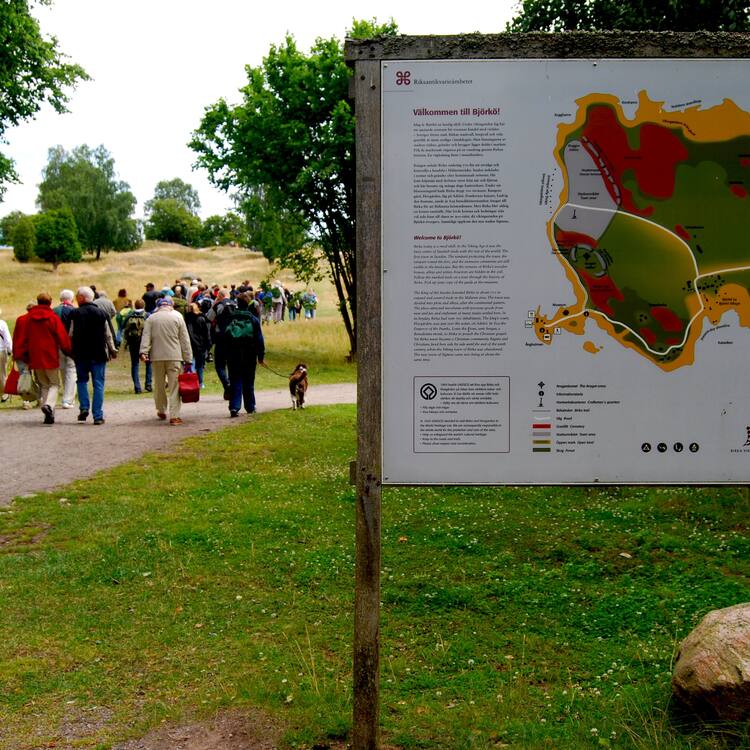


Valeur universelle exceptionnelle
Brève synthèse
Birka et Hovgården, qui se situent à environ 30 km à l’ouest de Stockholm, sur les petites îles de Björkö et Adelsö dans le lac Mälar, représentent des sites archéologiques complets et remarquablement bien conservés de l’âge des Vikings. Ce bien en série offre un témoignage toujours visible de la société préhistorique à travers les structures de la ville marchande, le domaine royal et le port, les systèmes de défense et les cimetières préhistoriques.
La ville de Birka était idéalement située sur l’île de Björkö, au point de convergence de plusieurs importantes voies d’eau. Ses activités étaient organisées et régies depuis la résidence royale d’Hovgården, de l’autre côté du détroit, sur l’île voisine d’Adelsö. Birka était l’une des villes marchandes les plus importantes d’Europe du Nord entre 750 et 980 après J.-C. Elle était au cœur d’un vaste réseau commercial établi par les Scandinaves du temps des Vikings et fut un puissant catalyseur du développement social de la région balte. Cette puissante synergie entre le lieu et l’initiative a jeté les bases de l’expansion politique et économique phénoménale qui a caractérisé cette période dynamique et a contribué à forger durablement la renommée de l’âge viking scandinave. Birka est aussi reconnue comme étant le premier lieu d’évangélisation des Suédois par le missionnaire Frankish Anskar en 829-831.
Birka cessa ses activités commerciales à la fin du Xe siècle. Une certaine forme de transformation sociale –peut-être liée à des difficultés logistiques – a pu amener la fonction centrale de Birka dans la région du Svealand à se trouver dépassée par la nouvelle ville de Sigtuna. Toutefois, le fait que le domaine royal d’Hovgården ait continué d’exister pendant de nombreuses années après l’abandon de Birka témoigne de l’importance durable de ce lieu. Cela met également en lumière la légitimité et la position unique de Birka et Hovgården du temps des Vikings. Une pierre runique taillée vers 1070, à Hovgården, atteste de la présence du roi. Plusieurs rois résidèrent à Hovgården au cours des années 1200 ; l’un d’eux, Magnus Ladulås, construisit un édifice en brique et en pierre connu sous le nom de Alsnö hus. Dans ce bâtiment siégea le Conseil royal de 1280 qui posa les fondements du système féodal suédois au Moyen Âge.
Critère (iii): L’ensemble de Birka et Hovgården livre un témoignage remarquablement bien préservé du réseau commercial très développé par les Vikings au cours des deux siècles de leur phénoménale expansion politique et économique.
Critère (iv): Birka offre l’un des exemples les plus complets et intacts d’une ville marchande viking du VIIIe au Xe siècle.
Intégrité
Dans les limites du bien en série de 226 hectares figurent tous les éléments nécessaires pour exprimer la valeur universelle exceptionnelle de Birka et Hovgården. Les éléments qui restent visibles à Birka sont : le fort en haut de la colline, les remparts de la ville, les tumuli funéraires des cimetières qui entourent les « Terres noires » et le site de l’établissement de l’âge des Vikings. Des jetées et des ports le long du rivage représentent d’autres vestiges de cette période. Parmi les éléments visibles au domaine royal d’Hovgården, près de l’église d’Adelsö, figurent plusieurs tumuli monumentaux, un cimetière, un port, une pierre runique et les fondations d’Alsnö hus, palais en brique et en pierre du XIIIe siècle érigé sur un terre-plein. On trouve les restes de matériaux culturels exceptionnels de Birka et Hovgården, tant sur les terres que dans les eaux avoisinantes, depuis les objets du quotidien et de la préparation des aliments jusqu’à l’artisanat et aux articles commerciaux issus de contrées lointaines. Des fouilles archéologiques ont été réalisées sur moins de 1 % du bien et environ un tiers des sépultures a été examiné sur les quelque 3 000 tombes de Birka. Les délimitations du site permettent d’assurer la représentation complète des caractéristiques et des processus qui montrent l’importance du bien en série, et il y a une zone tampon de 2 272 hectares. Le bien ne subit pas d’effets négatifs liés au développement et/ou à un manque d’entretien. Des mesures s’imposent toutefois afin de mieux protéger les espaces de la zone tampon, surtout en ce qui concerne la construction de nouveaux bâtiments.
Authenticité
Le site archéologique de Birka et Hovgården est parfaitement authentique au niveau de la situation et du cadre, de la forme et de la conception, des matériaux et de la substance. Il n’y a eu aucune construction dans le périmètre du site archéologique. Afin de répondre aux besoins des visiteurs à Birka, quelques bâtiments ont été érigés dans la zone tampon : un musée de site, quatre maisons de l’époque viking reconstruites, une aire d’activités pour les enfants et des installations complémentaires destinées aux visiteurs et au personnel. Aucun bâtiment de ce genre accessible au public n’a été réalisé dans la zone d’Hovgården.
Les menaces et les risques potentiels identifiés pour l’authenticité de Birka et Hovgården comprennent les dangers pour l’environnement tels les incendies au sol ou les feux de forêt, l’usage excessif d’engrais dans les exploitations agricoles, les dommages causés au rivage par les loisirs à proximité et le trafic maritime de passagers, et le transport de produits dangereux près des îles ; l’endommagement de la surface au sol par les visiteurs ; le dépeuplement de l’île de Björkö ; et l’absence de plan de recherche archéologique.
Eléments requis en matière de protection et de gestion
Birka et Hovgården et leur zone tampon sont officiellement protégés en vertu de la loi sur l’environnement historique (1988:950), de la réglementation et des instruments de planification municipale. Le bien est la propriété du Conseil national suédois du patrimoine, agence gouvernementale qui, avec le conseil d’administration du comté de Stockholm et la municipalité d’Ekerö, forment un conseil de gestion chargé de la protection et de la gestion du bien. Ce Conseil qui a établi un plan de gestion du bien, est responsable de la mise en œuvre et du suivi du plan. La situation de Birka et Hovgården sur de petites îles et leur propriété publique de longue date ont largement contribué à protéger ce bien contre tout projet de planification et de développement inapproprié.
Le maintien de la valeur universelle exceptionnelle du bien dans la durée exige de traiter les menaces et les risques potentiels identifiés à Birka et Hovgården, y compris la pression du développement dans la zone tampon, les dangers pour l’environnement, la pression due à l’afflux de visiteurs, le dépeuplement et l’absence de plan de recherche.
Les dossiers de proposition d’inscription produits par les États parties sont publiés par le Centre du patrimoine mondial sur son site Internet et/ou dans des documents de travail afin de garantir la transparence, l’accès à l’information et de faciliter la préparation d’analyses comparatives par d’autres États parties soumissionnaires.
Le contenu de chaque dossier de proposition d’inscription relève de la responsabilité exclusive de l'État partie concerné. La publication d’un dossier de proposition d’inscription, y compris les cartes et les noms, ne saurait être interprétée comme exprimant une prise de position de la part du Comité du patrimoine mondial ou du Secrétariat de l'UNESCO à propos de l’histoire ou du statut juridique d'un pays, d'un territoire, d'une ville ou d'une zone, ou de ses frontières.