Parc national du Gros-Morne
Gros Morne National Park
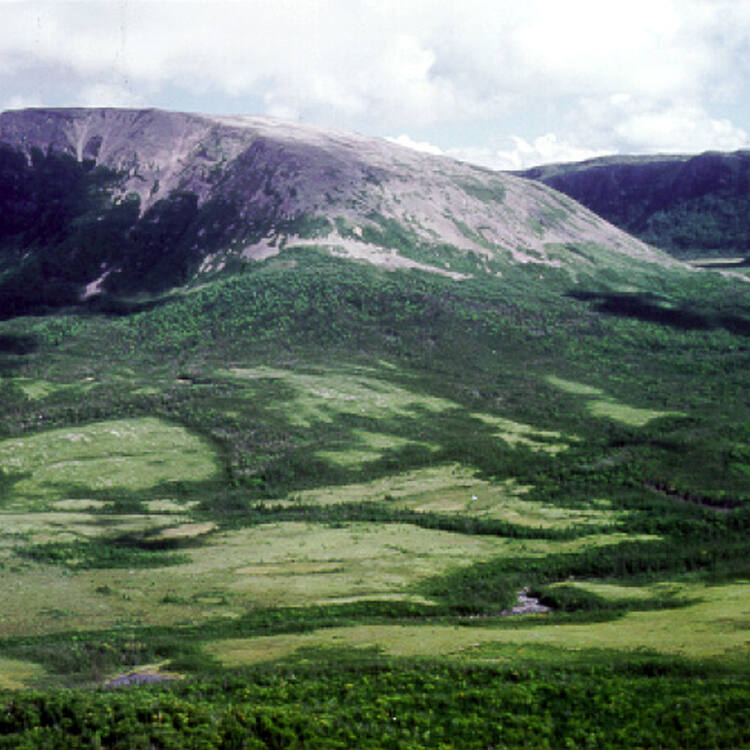
Situated on the west coast of the island of Newfoundland, the park provides a rare example of the process of continental drift, where deep ocean crust and the rocks of the earth's mantle lie exposed. More recent glacial action has resulted in some spectacular scenery, with coastal lowland, alpine plateau, fjords, glacial valleys, sheer cliffs, waterfalls and many pristine lakes.
La description est disponible sous licence CC-BY-SA IGO 3.0
Parc national du Gros-Morne
Situé sur la côte ouest de l'île de Terre-Neuve, le parc offre un exemple rare de l'évolution de la dérive des continents où la croûte océanique profonde et les rochers du manteau terrestre sont exposés. L'action glaciaire plus récente a sculpté un paysage spectaculaire composé de basses terres côtières, de plateaux alpins, de fjords, de vallées glaciaires, de falaises abruptes, de chutes et de plusieurs lacs inviolés.
La description est disponible sous licence CC-BY-SA IGO 3.0
منتزه غرو مورن الوطني
يقع هذا المنتزه على ضفاف الساحل الغربي لجزيرة نيوفاوندلاند الكندية، وهو يعطي مثالاً نادراً عن تطوّر طفو القارّات حيث تبرز القشرة المحيطية العميقة وصخور أديم الأرض. ثم رسمت الحركة الجليدية معالم منظر طبيعي رائع يتألف من أراضٍ ساحلية منخفضة وهضاب ألبية وأزقة بحرية وأودية جليدية وجروف وعرة وشلالات والعديد من البحيرات التي لا تزال في حالتها البدائية.
source: UNESCO/CPE
La description est disponible sous licence CC-BY-SA IGO 3.0
格罗斯莫讷国家公园
格罗斯莫讷公园位于纽芬兰岛西海岸,为我们提供了一个大陆漂移的珍稀标本,这里的深海地壳和大陆地幔的岩石都暴露在外面。最近的冰川运动产生了许多令人惊叹的景观,包括海岸低地、高山高原、海湾、冰川峡谷、悬崖峭壁、瀑布以及许多纯净的湖泊。
source: UNESCO/CPE
La description est disponible sous licence CC-BY-SA IGO 3.0
Национальный парк Грос-Морн
Парк, располагающийся на западном побережье острова Ньюфаундленд, предоставляет редкую возможность изучения дрейфа континентов, поскольку именно здесь выходят на поверхность породы, вынесенные некогда из мантии Земли и из океанической земной коры. Последнее оледенение сформировало здесь оригинальный рельеф – это прибрежные низины, альпийские плато, фьорды, выработанные ледником горные долины, крутые утесы, водопады и множество чистейших озер.
source: UNESCO/CPE
La description est disponible sous licence CC-BY-SA IGO 3.0
Parque Nacional de Gros-Morne
Situado en la costa occidental de la provincia de Terranova, este parque presenta afloramientos de la corteza oceí¡nica profunda y de rocas del manto terrí¡queo, que ofrecen un ejemplo excepcional de la deriva continental. Las glaciaciones mí¡s recientes han modelado un paisaje espectacular formado por tierras bajas costeras, mesetas alpinas, fiordos, valles glaciares, farallones abruptos, cascadas y numerosos lagos impolutos.
source: UNESCO/CPE
La description est disponible sous licence CC-BY-SA IGO 3.0
グロス・モーン国立公園
ニューファンドランド島の西海岸沿いに位置する自然景観。カナダでも特異な景観が見られる公園で知られる。アパラチア山脈の最北端にあたり、氷河によって削られた地形に自然の美しさが映え、この地域は元は海底で、今もわずかに隆起を続けており、地学、考古学上からも興味深い地域とされてる。source: NFUAJ
Nationaal park Gros Morne
Het nationaal park Gros Morne ligt aan de westkust van het eiland Newfoundland. Het park is een zeldzaam voorbeeld van het proces van continentale drift, waarbij diepe oceaankorst en rotsen van de aardmantel blootliggen. Meer recente glaciale activiteit heeft een spectaculair landschap gevormd, met laaggelegen kustgebieden, hoogvlaktes, fjorden, gletsjervalleien, steile kliffen, watervallen en veel ongerepte meren. In het gebied zijn ook fjorden en watervallen te vinden. Het park bestaat uit een deel van de Long Range Mountains in de Golf van Saint Lawrence. Langs de kustlijn zijn stranden, steile kliffen en duinformaties tot 30 meter hoog te vinden.
Source : unesco.nl


Valeur universelle exceptionnelle
Brève synthèse
Le Parc national du Gros-Morne, situé sur la péninsule Great Northern dans la province canadienne de Terre-Neuve-et-Labrador, est l’une des plus parfaites illustrations du phénomène de tectonique des plaques. Dans un espace relativement restreint, on trouve des exemples typiques et concrets de forces monumentales de construction et de modification de la Terre dont la clarté, l’expression et la facilité d’accès sont uniques. Le bien permet de brosser le tableau complet des événements géologiques qui ont eu lieu lorsque l’ancienne marge continentale de l’Amérique du Nord s’est trouvée modifiée à la suite du mouvement tectonique d’une vaste portion de la croûte océanique et de dépôts sédimentaires au niveau du plancher océanique. Le parc offre aussi une démonstration exceptionnelle des glaciations dans un cadre insulaire. Les fjords, les chutes d’eau et les structures géologiques qui le caractérisent se conjuguent pour produire un paysage d’une beauté saisissante.
Critère (vii) : Le Parc national du Gros-Morne, environnement exceptionnel de nature sauvage composé de fjords d’eau douce spectaculaires à l’intérieur des terres et de promontoires érodés par les glaciers dans un cadre océanique, est un espace d’une très grande beauté naturelle.
Critère (viii) : Les roches du Parc national du Gros-Morne illustrent de manière collective et significative au niveau international le processus de dérive continentale le long de la côte est de l’Amérique du Nord et contribuent largement à enrichir la somme de connaissances et la compréhension de la tectonique des plaques et de l’évolution géologique des anciennes ceintures montagneuses. Dans les plateaux érodés par les glaciers et les fjords spectaculaires, les glaciations ont rendu visibles les nombreuses caractéristiques géologiques du parc.
Intégrité
Les limites clairement définies du Parc national du Gros-Morne englobent une région de 180 500 hectares. Cette superficie est suffisamment grande pour dépeindre intégralement la progression des événements géologiques qui se sont produits lorsqu’un ancien océan et l’ancienne marge continentale de l’Est de l’Amérique du Nord ont été détruits et soulevés pour former une chaîne de montagnes sous l’action de la tectonique des plaques. Collectivement, la séquence rocheuse illustrant l’évolution géologique est représentée par les éléments suivants : une ancienne croûte continentale constituée de granit et de gneiss profondément métamorphosés; un plateau continental formé de sédiments carbonatés tropicaux regorgeant d’une abondante quantité de fossiles; une pente continentale caractérisée par d’épaisses séquences de schistes renfermant des strates de conglomérat à fragments de calcaire, où abondent aussi les fossiles; une section transversale complète de lithosphère océanique exposant de larges pans de matériau mantellique; et d’importantes séquences de roches volcaniques d’origine océanique.
Les caractéristiques géologiques et la topographie issue des glaciations du parc national du Gros-Morne sont à peu près intactes. Cet état est susceptible d’être préservé, car les lois en vigueur protègent le bien du développement, ce bien étant administré de manière à supporter le nombre actuel ou projeté de visiteurs sans effets néfastes. En outre, la collecte de roches et de fossiles est contrôlée et limitée aux seules fins de la recherche. Le processus d’érosion naturelle se poursuit et continue de façonner et d’exposer les séquences géologiques à l’origine de la désignation du patrimoine mondial.
L’intégrité des caractéristiques géologiques sur lesquelles repose l’inscription sur la liste du patrimoine mondial n’est nullement affectée par l’un quelconque des facteurs de stress ciblés dans le plan directeur du parc national. Toutefois, une population d’orignaux introduite il y a plus de cent ans à Terre-Neuve a pris de l’expansion et a contribué à la dégradation de forêts naturelles, ce qui a eu une incidence visuelle et écologique sur le parc. Des mesures ont été adoptées pour atténuer ce problème.
Eléments requis en matière de protection et de gestion
La Loi sur les parcs nationaux du Canada fournit une protection efficace au bien. Dans le cadre du processus officiel de planification de gestion, prescrit par la Loi, les ressources patrimoniales du bien sont surveillées de manière structurée afin que les menaces et les facteurs de stress soient rapidement repérés. Selon les pratiques adoptées, des stratégies visant à atténuer la vulnérabilité de certains éléments sont élaborées en collaboration avec les résidants de la région ainsi que les groupes autochtones et d’autres intervenants et groupes d’utilisateurs, au besoin. Le plan directeur du parc est mis à jour tous les dix ans.
Le Parc national du Gros-Morne compte deux emprises – un corridor de transport routier et un corridor de transport d’hydroélectricité. Toutes les décisions de Parcs Canada à l’égard de ces corridors sont prises dans le contexte de la protection de l’intégrité écologique du parc et de sa valeur universelle exceptionnelle.
Les pressions exercées par le développement à l’extérieur des limites du parc comprennent l’exploration pétrolière et gazière en mer et le développement potentiel sur les terres appartenant à la Province. La direction du parc national surveille la progression de ces facteurs ainsi que tout autre développement possible à l’extérieur du parc, et participe à tous les processus de consultation réglementaires officiels concernant ces facteurs de développement dans le but de protéger la valeur universelle exceptionnelle du site et son intégrité écologique.