Paysage culturel d’Aranjuez
Aranjuez Cultural Landscape
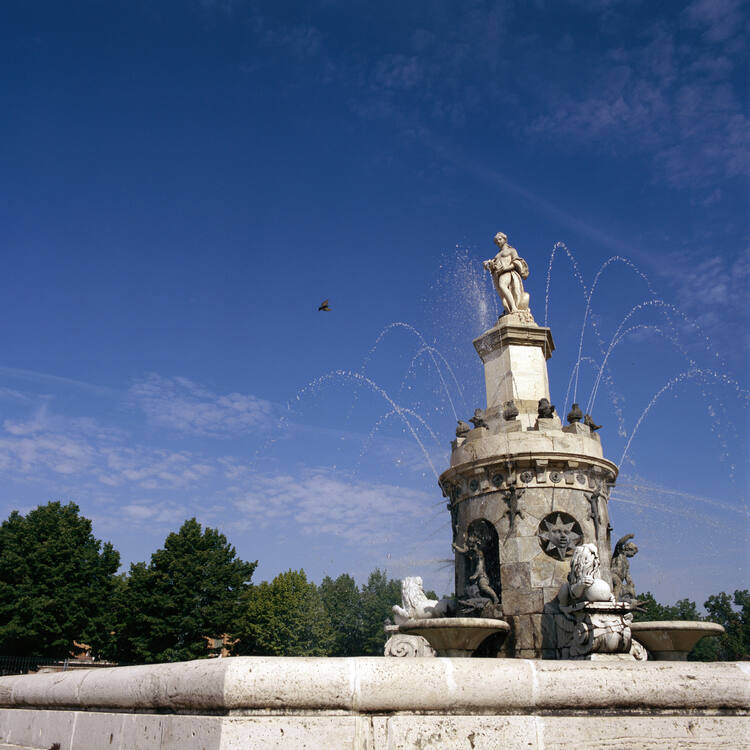
The Aranjuez cultural landscape is an entity of complex relationships: between nature and human activity, between sinuous watercourses and geometric landscape design, between the rural and the urban, between forest landscape and the delicately modulated architecture of its palatial buildings. Three hundred years of royal attention to the development and care of this landscape have seen it express an evolution of concepts from humanism and political centralization, to characteristics such as those found in its 18th century French-style Baroque garden, to the urban lifestyle which developed alongside the sciences of plant acclimatization and stock-breeding during the Age of Enlightenment.
La description est disponible sous licence CC-BY-SA IGO 3.0
Paysage culturel d’Aranjuez
Avec ses voies d'eau sinueuses qui s'opposent aux lignes droites d'un paysage géométrique, rural et urbain, ses paysages arboricoles et l'architecture délicatement modulée de ses édifices palatiaux, le paysage culturel d'Aranjuez témoigne des relations complexes qui se tissent entre l'homme et la nature. Pendant trois cent ans, la famille royale s'est attachée à développer et à entretenir ce paysage qui a réussi à intégrer les caractéristiques du jardin baroque de style français du XVIIIe siècle mais aussi celles d'un mode de vie urbain allant de pair avec la pratique scientifique de l'acclimatation botanique et de l'élevage au siècle des Lumières. L'apparition de concepts tels que l'humanisme et la centralisation politique ont également influencé à leur façon ce paysage.
La description est disponible sous licence CC-BY-SA IGO 3.0
منظر أرانخويث الثقافي
يشكّل منظر أرنخويث الثقافي كتلةً من العلاقات المعقّدة: بين الإنسان والطبيعة، بين مسالك المياه المتعرّجة وتصاميم المناظر الطبيعيّة الهندسيّة، بين المناظر الريفية والحضرية، وبين غابات الأشجار والهندسة منحوتة المعالم لمبانيه الفخمة. وعلى مرّ ثلاثمائة عام من الاهتمام الملكي في تطوّر هذا المنظر الطبيعي ورعايته، تجلّى تطوّر المفاهيم من النواحي الإنسانيّة والمركزيّة السياسيّة إلى الصفات مثل تلك الموجودة في حديقة فرنسيّة الطراز الباروكي التي ترقى إلى القرن الثامن عشر وإلى نمط حياةٍ حضريّ نما إلى جانب خبرات زراعة وعناية النبات وتربية الماشية في خلال عصر الأنوار.
source: UNESCO/CPE
La description est disponible sous licence CC-BY-SA IGO 3.0
阿兰胡埃斯文化景观
阿兰胡埃斯文化景观体现了许多复杂的关系,例如人类活动与自然的关系、蜿蜒水道与呈现几何形态的景观设计之间的关系、乡村和城市之间的关系,以及森林环境和当地富丽堂皇的精美建筑之间的关系。300年来,西班牙王室对于阿兰胡埃斯文化景观倾注了许多精力,使得它向世人展示着奇妙的变化。我们不仅能看到人道主义和政治集权的观念,而且可以领略到公元18世纪建造的法国式巴洛克花园所体现出来的特色,以及启蒙运动时期伴随着植物种植和牲畜饲养所发展起来的城市生活方式。
source: UNESCO/CPE
La description est disponible sous licence CC-BY-SA IGO 3.0
Культурный ландшафт дворцово-паркового ансамбля Аранхуэс
Этот культурный ландшафт, где в течение 300 лет размещалась королевская резиденция, демонстрирует целый комплекс взаимосвязей: между природой и деятельностью человека, между извилистыми естественными водотоками и геометрически спланированным парковым ландшафтом, между сельской и городской средой, между лесным ландшафтом и тщательно разработанной архитектурой дворцовых зданий.
source: UNESCO/CPE
La description est disponible sous licence CC-BY-SA IGO 3.0
Paisaje cultural de Aranjuez
Con sus sinuosos canales y acequias, que contrastan con las líneas rectas del paisaje rural y urbano, sus jardines arbolados y la arquitectura delicadamente modulada de sus edificios palaciales, el paisaje cultural de Aranjuez es un ejemplo de la compleja relación entre el hombre y la naturaleza. A lo largo de trescientos años, los monarcas españoles se dedicaron a diseñar y cuidar este sitio, haciendo de él una muestra de la evolución de los conceptos de humanismo y centralización política, así como un paisaje en el que confluyen las características del jardín barroco francés del siglo XVIII con las del modo de vida urbano propio del Siglo de Luces, en el que también están presentes las prácticas científicas en materia de aclimatación botánica y cría del ganado.
source: UNESCO/CPE
La description est disponible sous licence CC-BY-SA IGO 3.0
アランフェスの文化的景観
マドリードの南約30km、タホ川南岸にあるフェリペ2世時代からの王領地で、王家の夏の離宮。入り組んだ水路が幾何学的にデザインされた文化的景観は、自然と暮らし、村落と都市、整然とした樹林帯と豪華な建築物群など、多様な要素が織り交ぜられている。王家は啓蒙主義時代のフランス式バロック庭園や王宮を建設し、新たな都市生活様式を生みだした。ロドリーゴ作曲の『アランフェス協奏曲』によって世界中に知られた。source: NFUAJ
Cultuurlandschap Aranjuez
Het cultuurlandschap Aranjuez is een geheel van complexe verhoudingen: tussen de natuur en menselijke activiteit, tussen kronkelige rivieren en het geometrisch landschapsontwerp, tussen de landelijke en stedelijke omgeving en tussen het boslandschap en de fijn gemoduleerde architectuur van paleisachtige gebouwen. Er is driehonderd jaar lang koninklijke aandacht gegeven aan de ontwikkeling en het behoud van dit gebied. Hierdoor drukt het cultuurlandschap de evolutie van concepten uit. Van humanisme en politieke centralisatie tot de karakteristieken van een 18e-eeuwse baroktuin in Franse stijl, en tot een stedelijke levensstijl die zich ontwikkelde naast de plant- en dierwetenschappen in de Verlichtingstijd.
Source : unesco.nl


Valeur universelle exceptionnelle
Brève synthèse
Le Paysage culturel d’Aranjuez représente un ensemble singulier de relations complexes et historiques entre la nature et l’activité humaine – contraste des cours d’eau sinueux et des lignes droites du paysage géométrique, de la vie urbaine et rurale –, et entre la faune et la flore des forêts et l’architecture raffinée. Un fleuve et une rivière, le Tage et le Jarama, constituent les artères principales du Paysage culturel d’Aranjuez qui couvre une vaste surface de 2 047,56 ha dans le sud de la communauté autonome de Madrid. La zone tampon qui l’entoure est incluse dans les limites de la municipalité d’Aranjuez et couvre 16 604,56 ha.
Aranjuez témoigne de divers échanges culturels au fil du temps qui ont largement influencé le développement de ses monuments emblématiques et la création de son paysage, et qui en ont fait un modèle d’utilisation culturelle de son territoire. Le processus de transformation remonte au règne de Philippe II, lorsqu’Aranjuez devint Real Sitio (site royal) au XVIe siècle, grâce à l’action déterminante de la Couronne et à la richesse de la nature environnante. Les ordonnances royales de Ferdinand VI, Charles II et Isabelle II marquèrent son évolution aux XVIIIe et XIXe siècles. Ce paysage a traversé intact le XXe siècle, époque à laquelle il a été ouvert à la visite d’agrément du public.
Le bien comprend divers éléments qui en constituent les différentes zones : potagers historiques, avenues bordées d’arbres et bois (Legamarejo, Picotajo, El Rebollo), château et jardins d’ornement (jardins du Prince, de l’Île, du Parterre, du Roi et d’Isabelle II) et centre urbain historique du XVIIIe siècle. L’association conceptuelle de ces zones a créé une série de paysages dont l’ensemble forme le Paysage culturel d’Aranjuez. Cela comprend le paysage aquatique (cours d’eau, bassins, barrages et rigoles), le paysage culturel agricole (vergers et pépinières, fermes d’élevage et prairies), le magnifique paysage d’agrément (jardins d’ornement), le paysage ordonné (la géométrie des rues et des places qui façonnent le relief naturel), et le paysage construit (le palais, la ville planifiée, les routes et les bâtiments agricoles).
Critère (ii) : Aranjuez représente l’association d’influences culturelles diverses qui ont permis la création d’un paysage culturel qui a eu une influence formatrice sur les évolutions ultérieures en ce domaine.
Critère (iv) : Le paysage culturel complexe d’Aranjuez conçu par l’homme, fruit de diverses influences, marque une étape déterminante dans le développement du paysagisme.
Intégrité
Le Paysage culturel d’Aranjuez conserve tous ses éléments et attributs : son système d’irrigation et son réseau hydraulique, ses potagers et ses jardins d’ornement, ses rues et ses places bordées d’arbres, son palais royal et son centre historique.
Les éléments naturels et géométriques de l’ensemble du bien ont remarquablement traversé le temps, avec relativement peu de perte et à l’évidence aucune autre intrusion inappropriée que des routes de communication modernes. Les principaux bâtiments ainsi que le plan de la ville, ses jardins et ses avenues bordées d’arbres ont été préservés comme caractéristiques d’une communauté urbaine établie au milieu des vergers et des bois, selon un plan au sol répondant à ceux des jardins d’ornement de l’autre côté du fleuve. La ligne de chemin de fer historique du XIXe siècle, la seconde construite en Espagne, existe toujours.
Les mesures en place pour la conservation de ses éléments et attributs garantissent l’intégrité du bien. Cela est favorisé par le fait que la plupart des éléments ont conservé leur usage initial. Le réseau hydraulique et le système d’irrigation sont toujours utilisés. Les potagers historiques sont toujours cultivés et les rues et places bordées d’arbres sont conservées et restaurées. Les jardins d’ornement sont toujours visités pour l’agrément du public et pour des événements culturels. Le palais royal est utilisé pour des manifestations culturelles et des événements institutionnels. La ville du XVIIIe siècle associe à son rôle de centre résidentiel l’esthétique et les aspects culturels de son tracé urbain, ses caractéristiques architecturales et ses bâtiments exceptionnels.
La conservation du site n’est pas un phénomène contemporain mais remonte à l’époque de son mécénat par la Couronne d’Espagne. Les confiscations de biens menées au XIXe siècle et les nouvelles constructions agressives édifiées pendant quelques années du XXe siècle n’ont pas eu d’impact négatif significatif.
Le bien n’est pas véritablement menacé. Il n’y a pas de risques naturels et les mesures prises pour répondre aux menaces du développement industriel ou de la croissance démographique – y compris avec impact éventuel sur le cadre plus large du bien –, garantissent un bon état de conservation de tous ses attributs.
Authenticité
Le Paysage culturel d’Aranjuez est remarquable d’un point de vue historique, chronologique et d’aménagement de l’espace. Depuis ses origines au XVIe siècle, Aranjuez reflète le mécénat et la splendeur de la Couronne d’Espagne, incarnés par deux des plus importants monarques de l’histoire universelle, Charles V et Philippe II. Aranjuez représente une convergence d’idées, d’esthétique et de science à différentes époques de l’histoire. Cela reste aussi un creuset d’idées, un point de référence et un lieu d’influence depuis sa création.
Malgré le fait qu’il ne soit plus une résidence royale, le bien a conservé à un degré exceptionnel son authenticité en termes de lieu et de conception, d’architecture et d’hydrologie, et à un point remarquable en termes de fonction. Certains des espaces de jardins exigent une restauration mais l’état général de conservation est tel que le site peut encore clairement montrer les étapes de son évolution, de la moitié du XVIe à la moitié du XIXe siècle.
Eléments requis en matière de protection et de gestion
Le Paysage culturel d’Aranjuez est doté d’un système approprié de protection et de gestion fondé sur une solide base juridique qui en garantit et préserve les différents éléments. Aranjuez a été déclaré Site de valeur historique en 1983, mesure juridique qui garantit la conservation de son centre historique. La loi de 1996 sur l’aménagement urbain donne des directives pour les futures constructions qui devront être harmonieuses et réalisées dans le respect de la préservation des valeurs d’Aranjuez.
L’État et les administrations publiques régionales et locales supervisent sa conservation. Malgré la perte d’influence de la Couronne sur le développement actuel d’Aranjuez, certains des éléments du bien sont administrés par le Patrimonio Nacional (Conseil du patrimoine national espagnol).
Le plan de gestion prescrit différents niveaux de gestion pour la mise en œuvre de la partie technique du plan : dispositions, droit de propriété et responsabilités de chacune des institutions chargées de la conservation du site (conseil municipal d’Aranjuez, communauté autonome de Madrid et Gouvernement central).
Le bien possède d’autres outils de planification complets et réactifs adaptés à des questions spécifiques comme l’urbanisme, la circulation, le développement d’infrastructures, les installations touristiques et la rénovation et la restauration de bâtiments et de paysages naturels. Ces plans sont étayés par des sources correspondantes de financement et une dotation de ressources. Le suivi du bien est statistiquement fondé sur des problèmes comme l’impact de la circulation ou du tourisme.
De plus, le plan de gestion énumère les attributs constitutifs du Paysage culturel et définit les dispositions régissant les usages et activités compatibles permettant de maintenir l’intégrité et l’authenticité du bien. Il définit en outre les outils jugés nécessaires à une bonne gestion cohérente du site. Il est essentiel qu’une structure de gestion incluant toutes les entités engagées dans la supervision et la conservation du Paysage culturel d’Aranjuez soit totalement opérationnelle, et que les systèmes de gestion favorisent la mise en œuvre du plan avec la participation et l’accord des différents partenaires concernés.
Liens
-
Google Arts & Culture : histoire
-
World Heritage Journeys visitworldheritage.com
-
Ministerio de Educación, Cultura y Deporte (en espagnol)
-
 Découvrez les photos de OUR PLACE the World Heritage Collection
-
Ayuntamiento de Aranjuez (Municipalité de Aranjuez; Espagnol seulement
-
Fundacion Paisaje Cultural Aranjuez, Patrimonio de la Humanidad (Espagnol seulement)

 5
5

 2
2