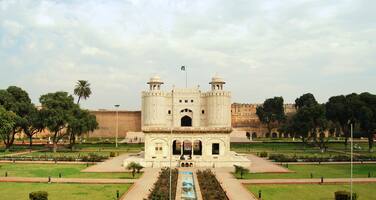
Fort and Shalamar Gardens in Lahore
Factors affecting the property in 2008*
- Deliberate destruction of heritage
- Financial resources
- Housing
- Land conversion
- Legal framework
- Management systems/ management plan
Factors* affecting the property identified in previous reports
a) Demolition of two of the tanks and partial demolition of a third tank of the hydraulic works of the Shalamar Gardens;
b) Encroachments and urban pressure;
c) Insufficient management mechanisms (including incomplete legislation, lack of financial resources);
d) Lack of definition of boundaries of the Lahore Fort and Shalamar Gardens;
e) Problems relating to the management of the property.
Threats for which the property was inscribed on the List of World Heritage in Danger
- Damage to the external walls and demolition of hydraulic works of Shalamar Gardens;
- Serious state of degradation of the historic monuments and garden complex within the property.
Desired state of conservation for the removal of the property from the List of World Heritage in Danger
a) Master plans for Lahore Fort and Shalamar Gardens approved and implemented;
b) Foundations of the water tanks of the hydraulic works at Shalamar Gardens protected and consolidated as archaeological relics;
c) External walls of Shalamar Gardens and Lahore Fort preserved and protected;
d) Boundaries of the core and buffer zones of Lahore Fort and Shalamar Gardens redefined and extended;
e) Encroachments and urban pressure adequately controlled;
f) Safeguarding programme with corresponding timeframe and financial resources elaborated.
Corrective Measures for the property
a) Implementation of master plans for Lahore Fort and Shalamar Gardens;
b) Consolidation and adequate protection of the foundations of the demolished water tanks and preservation of the remaining third tank of the hydraulic works at Shalamar Gardens, as well as overall preservation of the hydraulic works as archaeological relics;
c) Protection and preservation measures for the external walls of Lahore Fort and Shalamar Gardens;
d) Redefinition of boundaries of the core and buffer zones of Lahore Fort and Shalamar Gardens and submission of proposal for extension to the World Heritage Committee, taking into account the recommendations to include the Badshahi Masjid (Royal Mosque) and Tomb of Rangjit Singh, proposed following the 2003 and 2005 missions;
e) Removal of encroachments and control of urban pressures, including removal of parking for busses in the immediate vicinity of Lahore Fort;
f) Prioritisation for allocation and use of available resources according to the management objectives determined in the master plans.
UNESCO Extra-Budgetary Funds until 2008
Total amount provided to the property: USD 975,000
International Assistance: requests for the property until 2008
Total amount approved : 121,000 USD
| 2000 | Rescue programme for Fort and Shalamar Gardens, Lahore ... (Approved) | 50,000 USD |
| 1999 | Archaeological, soil and design research and the ... (Approved) | 10,000 USD |
| 1999 | Signage on-site at the Fort and Shalimar Gardens of ... (Approved) | 5,000 USD |
| 1981 | Emergency restoration work at Lahore Fort (Approved) | 44,000 USD |
| 1981 | Emergency restoration work at Shalimar Gardens (Approved) | 12,000 USD |
Missions to the property until 2008**
October 2000 ; April 2001 ; June 2003 ; November 2005
Conservation issues presented to the World Heritage Committee in 2008
The State Party’s report, received by the World Heritage Centre on 7 February 2008, provides information on the completed and ongoing restoration and preservation activities undertaken in the framework of the “Five Year Programme for the Preservation of Lahore Fort” (2006-2011):
a) The preservation and conservation works at the Old Water reservoir which have been completed during 2006-2007 include the restoration of the arches, consolidations of walls, clearing and sealing of roof. A boundary wall with iron fencing is proposed in the five year programme and will be erected after the Great Trunk road has been realigned;
b) At Lahore Fort parts of the western and northern walls of the fortification have been consolidated and decaying parts have been underpinned. To ensure the protection of the site the iron grill fencing has been completed at the eastern side. Further conservation works of the perimeter wall are necessary and foreseen in the preservation programme;
c) The Action Plan for 2007-2008 foresees the improvements of drainage along the boundary wall of Shalimar Gardens and funds have been committed to the construction of a water collection and drainage system. Other projects include the restoration of the perimeter wall, preservation and restoration of water channels and tanks, provision of public toilets, restoration of Moor Craft building and documentation;
d) In order to ensure a buffer zone around Shalamar Gardens, the Supreme Court of Pakistan has issued orders for the removal of encroachments and illegal buildings. Notices have been issued to inhabitants and, after completion of formalities; these illegal constructions will be removed.
The report however does not provide any information concerning the steps taken to redefine the core and buffer zones of Lahore Fort and Shalamar Gardens nor the possible extension including the Badshahi Masjid (Royal Mosque) and Tomb of Rangjit Singh which form an integral part of the physical and historical context of the Lahore Fort. The report submitted by the State Party indicates that progress has been made, but clarifies that the full implementation of the corrective measures listed in Decision 31 COM 7A.24 will require considerable work in the context of the approved 5-year plans.
Due to the difficult political situation of Pakistan and security concerns the foreseen joint World Heritage Centre / ICOMOS reactive monitoring mission could to date not take place. The aim of the mission was to define, in close collaboration with the authorities, the desired state of conservation and to assess progress in implementing the corrective measures.
Summary of the interventions
Decisions adopted by the Committee in 2008
32 COM 7A.23
Fort and Shalamar Gardens in Lahore (Pakistan) (C 171–172)
The World Heritage Committee,
1. Having examined Document WHC-08/32.COM/7A,
2. Recalling Decision 31 COM 7A.24, adopted at its 31st session (Christchurch, 2007),
3. Notes the progress made by the State Party in the overall preservation and conservation of Lahore Fort and Shalamar Gardens;
4. Reiterates its requests to the State Party to develop, in consultation with the World Heritage Centre and the Advisory Bodies, a draft Statement of Outstanding Universal Value including the conditions of integrity and authenticity, for examination by the World Heritage Committee at its 33rd session in 2009;
5. Requests the State Party to invite a joint World Heritage Centre / ICOMOS Reactive Monitoring mission so as to assess the progress made towards the Desired state of conservation for the removal of the property from the List of World Heritage in Danger, for its examination by the World Heritage Committee at its 33rd session in 2009;
6. Recommends that the State Party submit to the World Heritage Committee a formal request for the modification of the boundaries of the property;
7. Also requests the State Party to submit to the World Heritage Centre by 1 February 2009, a progress report, for examination by the World Heritage Committee at its 33rd session in 2009;
8. Decides to retain the Fort and Shalamar Gardens in Lahore (Pakistan) on the List of World Heritage in Danger.
Draft Decision: 32 COM 7A.23
The World Heritage Committee,
1. Having examined Document WHC-08/32.COM/7A,
2. Recalling Decision 31 COM 7A.27, adopted at its 31st session (Christchurch, 2007),
3. Notes the progress made by the State Party in the overall preservation and conservation of Lahore Fort and Shalamar Gardens;
4. Reiterates its requests to the State Party to develop, in consultation with the World Heritage Centre and the Advisory Bodies, a draft Statement of outstanding universal value including the conditions of integrity and authenticity, for examination by the World Heritage Committee at its 33rd session in 2009;
5. Requests the State Party to invite a joint World Heritage Centre / ICOMOS reactive monitoring mission so as to assess the progress made towards the desired state of conservation for the removal of the property from the List of World Heritage in Danger, for its examination by the World Heritage Committee at its 33rd session in 2009;
6. Recommends that the State Party submit to the World Heritage Committee a formal request for the modification of the boundaries of the property;
7. Also requests the State Party to submit to the World Heritage Centre by 1 February 2009 a progress report, for examination by the World Heritage Committee at its 33rd session in 2009;
8. Decides to retain the Fort and Shalamar Gardens in Lahore (Pakistan) on the List of World Heritage in Danger.
 Pakistan
Exports
* :
The threats indicated are listed in alphabetical order; their order does not constitute a classification according to the importance of their impact on the property.
Furthermore, they are presented irrespective of the type of threat faced by the property, i.e. with specific and proven imminent danger (“ascertained danger”) or with threats which could have deleterious effects on the property’s Outstanding Universal Value (“potential danger”).
** : All mission reports are not always available electronically.