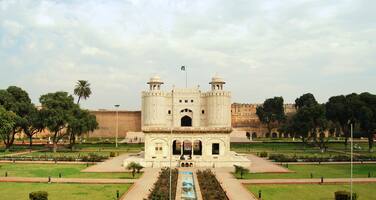
Fort and Shalamar Gardens in Lahore
Factors affecting the property in 2009*
- Deliberate destruction of heritage
- Housing
- Land conversion
- Management systems/ management plan
Factors* affecting the property identified in previous reports
a) Demolition of two of the tanks and partial demolition of a third tank of the hydraulic works of the Shalamar Gardens;
b) Encroachments and urban pressure;
c) Inadequate management mechanisms (including incomplete legislation, lack of financial resources);
d) Lack of definition of boundaries of the Lahore Fort and Shalamar Gardens.
Threats for which the property was inscribed on the List of World Heritage in Danger
- Damage to the external walls and demolition of hydraulic works of Shalamar Gardens;
- Serious state of degradation of the historic monuments and garden complex within the property.
Desired state of conservation for the removal of the property from the List of World Heritage in Danger
a) Master Plans for Lahore Fort and Shalamar Gardens approved and implemented;
b) Foundations of the water tanks of the hydraulic works at Shalamar Gardens protected and consolidated as archaeological relics;
c) External walls of Shalamar Gardens and Lahore Fort preserved and protected;
d) Boundaries of the core and buffer zones of Lahore Fort and Shalamar Gardens redefined and extended;
e) Encroachments and urban pressure adequately controlled;
f) Safeguarding programme with corresponding timeframe and financial resources elaborated.
Corrective Measures for the property
a) Implementation of master plans for Lahore Fort and Shalamar Gardens;
b) Consolidation and adequate protection of the foundations of the demolished water tanks and preservation of the remaining third tank of the hydraulic works at Shalamar Gardens, as well as overall preservation of the hydraulic works as archaeological relics;
c) Protection and preservation measures for the external walls of Lahore Fort and Shalamar Gardens;
d) Redefinition of boundaries of the core and buffer zones of Lahore Fort and Shalamar Gardens and submission of proposal for extension to the World Heritage Committee, taking into account the recommendations to include the Badshahi Masjid (Royal Mosque) and Tomb of Rangjit Singh, proposed following the 2003 and 2005 missions;
e) Removal of encroachments and control of urban pressures, including removal of parking for busses in the immediate vicinity of Lahore Fort;
f) Prioritisation for allocation and use of available resources according to the management objectives determined in the master plans.
UNESCO Extra-Budgetary Funds until 2009
Total amount provided to the property: USD 975,000, Norwegian Funds in Trust, Japanese Funds-in-Trust, United States Embassy in Pakistan
International Assistance: requests for the property until 2009
Total amount approved : 121,000 USD
| 2000 | Rescue programme for Fort and Shalamar Gardens, Lahore ... (Approved) | 50,000 USD |
| 1999 | Archaeological, soil and design research and the ... (Approved) | 10,000 USD |
| 1999 | Signage on-site at the Fort and Shalimar Gardens of ... (Approved) | 5,000 USD |
| 1981 | Emergency restoration work at Lahore Fort (Approved) | 44,000 USD |
| 1981 | Emergency restoration work at Shalimar Gardens (Approved) | 12,000 USD |
Missions to the property until 2009**
October 2000: World Heritage Centre/ICOMOS reactive monitoring mission; April 2001 and June 2003: UNESCO experts advisory missions; November 2005: World Heritage Centre/ICOMOS reactive monitroing mission; February 2009: UNESCO Tehran Office/ICOMOS reactive monitroing mission
Conservation issues presented to the World Heritage Committee in 2009
During its 32nd session, the World Heritage Committee requested that the State Party develop a draft Statement of Outstanding Universal Value including the conditions of integrity and authenticity, for examination by the World Heritage Committee at its 33rd session in 2009; and present a formal request for the modification of the boundaries of the property. The World Heritage Committee also asked the State Party to invite a joint World Heritage Centre / ICOMOS reactive monitoring mission so as to assess the progress made towards the Desired state of conservation for the removal of the property from the List of World Heritage in Danger.
On 1 February 2009, the State Party submitted a state of conservation report, outlining progress as follows:
a) Draft statement of OUV
The State Party report does not include a draft Statement of Outstanding Universal Value and does not mention whether this is being prepared.
b) Progress made in addressing the corrective measures
With regard to the above-mentioned corrective measures, the report presented by the State Party contains the following information:
i) Implementation of master plans for Lahore Fort and Shalamar Gardens
The master plans of Lahore Fort and Shalamar Gardens have been prepared and published, and the Directorate General of Archaeology, Government of Punjab (DGoA,P) is fully determined to their implementation. Mechanisms for implementation including through the establishment of a Steering Committee, a Technical Committee, a Punjab Heritage Fund (independent of annual government allocations), a Documentation Centre, a Special Projects management team, and new procedures to ensure selection of qualified contractors and craftsmen, are described in detail in the State Party report.
ii) Consolidation and adequate protection of the foundations of the demolished water tanks
Following the consolidation and restoration of the remaining hydraulic structures, the State Party report notes that a permanent boundary wall (i.e. fence) is being built around the area, and that once this is complete, archaeologiocal excavations will be undertaken within this perimeter.
iii) Protection and preservation measures for the external walls of Lahore Fort and Shalamar Gardens
The State Party report describes ongoing extensive actions for repair and strengthening of the badly deteriorated external walls of Lahore Fort. Other activities include the creation of walways in the Moat area, partial conservation of the Ath Dara Pavillion and of a water tank in Jahangir’s quadrangle, and the waterproofing of the Moti Mosque. At the Shalamar Gardens, the work carried out involved the re-establishment of ancient fountains, and the conservation of the external wall. All of these activities, some of which started already in 2006, are still on going. The report describes progress as incremental and implies that many years will be necessary to complete this work.
iv) Redefinition of the boundaries
The State Party reports that a formal request for the modification of the boundaries of Lahore Fort and Shalamar Gardens will be submitted to the World Heritage Centre.
v) Removal of encroachments and control of urban pressure
The State Party has reiterated its intention to establish a 50 feet wide buffer zone where no buildings would be allowed around the Shalamar Gardens. Negotiations are apparently underway with City authorities for the setting up of this buffer zone as well as for the removal of the Rim Market and Bus Stand in the vicinity of the Lahore Fort. A parking lot on the road between the western wall of the Fort and the tomb of Ranjit Singh has been removed.
vi) Prioritisation for allocation and use of available resources
The State Party report notes that the main source of expenditures on the World Heritage property is the annual development programme of the Government of Punjab, through its 5 year spending programmes for preservation and restoration of Lahore Fort, and separately Shalamar Gardens. These funds are being supplemented with resources derived from the newly established Punjab Heritage Fund, and a grant from the United States Embassy for the restoration of the Alamgiri Gate at Lahore Fort. While the State Party report does not discuss how available funds are being prioritised according to the management objectives of the approved master plans, it details activities undertaken in 2007-2008 under the Five Year Programmes for the Preservation and Restoration of Lahore Fort and the Shalamar Gardens (see above under point iii).
A joint UNESCO-ICOMOS reactive monitoring mission took place from 4 to 6 February 2009. With regard to the progress accomplished by the State Party in the implementation of the above corrective measures, the mission report noted the following:
i) Implementation of master plans for Lahore Fort and Shalamar Gardens
The two master plans for the Lahore Fort and Shalamar Gardens have been formally adopted by the State Party on 14 February 2009 and their implementation has begun. The State Party is aware of the need to develop a Statement of OUV to guide its activities and assured the mission that this would be prepared “soon”. This is crucial to ensure that the master plans are used in the most effective way. Equally important is the need for capacity-building among the staff of the Directorate General of Archaeology of Punjab (DOAP), to which the responsibility for managing the property has been transferred in recent years.
ii) Consolidation and adequate protection of the foundations of the demolished water tanks
The work carried out since 2005 includes the erection of a a fence around the area and the removal of garbage containers. The third tank remains to be restored and conserved.
iii) Protection and preservation measures for the external walls of Lahore Fort and Shalamar Gardens
The mission noted some conservation work under way, notably at the Royal Hammam and at the eastern and western gateways of the Lahore Fort, with support from the Getty Conservation Institute. Other repair works are been carried out by the State Party. However, large sections of the wall are still in a very dilapidated condition, especially along the southern and eastern side of the Fort. The area between the eastern wall and the fence has been filled with rubbish. The mission noted as well that it would be desirable to divert the traffic from the road passing right next to the north-eastern corner of the Fort, as well as to remove parking of vehicles and buses and street vendors from the area near the main entrance to the Fort.
iv) Redefinition of the boundaries
The mission was provided with an “official notification”, dated 14 February 2009, concerning the boundaries of the property and its buffer zone, as well as with two maps where these boundaries are indicated. There appears to be a discrepancy between the description of the buffer zone around the Lahore Fort in the “notification” and that which is shown in the correspondent map. Moreover, the Badshahi Mosque is included within the proposed buffer zone of the Fort – i.e. not within the property – while the Tomb of Ranjit Singh lies outside of the buffer zone. These proposed modifications have not been formally submitted by the State Party for consideration by the World Heritage Committee according to the provisions of paragraphs 163-165 of the Operational Guidelines.
iv) Removal of encroachments and control of urban pressure
Following the establishment of a buffer zone of 200 feet around the property, a court order has been apparwently issued for the removal of all encroachments within this area. This, however, has not been implemented yet. The mission was informed by DOAP that the bus parking would be also removed, but not provided with a specific timeframe.
vi) Prioritisation for allocation and use of available resources
The DOAP has now been provided with funding (i.e. Rs 300 million, equal to approximately 3,7mio USD, for each of the two sites) for conservation works and is implementing many of the activities foreseen in the master plans. However, there does not seem to be a prioritised plan for the use of these and other resources.
The mission noted, in conclusion, that some of the corrective measures had been carried out, at least in part, while others remained to be implemented. It set out a number of specific recommendations to assist the State Party in accomplishing all the agreed corrective measures, including the elaboration of a Statement of Outstanding Universal Value; urgent measures to secure and conserve the external walls of the Lahore Fort and Shalamar Gardens; the documentation and protection of the remaining hydraulic features in the Fort and Shalamar Gardens; the elaboration of detailed conservation plans and guidelines to complement the master plans; and capacity-building activities for the staff of DOAP and officials at the provincial level. No clear timeframe for the implementation of the corrective measures was discussed with the State Party.
The World Heritage Centre and ICOMOS note the significant efforts made by the State Party to achieve the Desired state of conservation for the property, notably by formally adopting the master plans and starting their implementation. However, they also note that some important issues remain to be addressed for the possible removal of the property from the List of World Heritage in Danger, including strengthening human resources and the organisation of capacity-building programmes, possibly through a request of International Assistance under the World Heritage Fund. This would require further activities and an extended timeframe for their implementation, which needs to be determined.
Summary of the interventions
Decisions adopted by the Committee in 2009
33 COM 7A.23
Fort and Shalamar Gardens in Lahore (Pakistan) (C 171–172)
The World Heritage Committee,
1. Having examined Document WHC-09/33.COM/7A.Add,
2. Recalling Decision 32 COM 7A.23, adopted at its 32nd session (Quebec City, 2008),
3. Notes with satisfaction the progress made by the State Party in the overall preservation and conservation of elements of the World Heritage property, notably by adopting the master plans and carrying out conservation works at the two sites of the Lahore Fort and Shalamar Gardens;
4. Notes however that some of the corrective measures agreed by the World Heritage Committee remain to be implemented, in order to achieve the desired state of conservation for the property;
5. Reiterates its request to the State Party to develop, in consultation with the World Heritage Centre and the Advisory Bodies, a draft Statement of Outstanding Universal Value, and to submit it to the World Heritage Centre by 1 February 2010, for examination by the World Heritage Committee at its 34th session in 2010;
6. Also reiterates its request to the State Party to submit to the World Heritage Committee a formal request for the modification of the boundaries of the property, according to the provision of paragraphs 163-165 of the Operational Guidelines;
7. Urges the State Party to continue its efforts to achieve the desired state of conservation defined by the World Heritage Committee for the removal of the property from the List of World Heritage in Danger, and define a clear timeframe for the implementation of the relevant corrective measures;
8. Encourages the State Party to give consideration to the recommendations of the joint UNESCO/ICOMOS mission of February 2009, and particularly to strengthen the human resources for the conservation and management of the World Heritage property, notably through appropriate capacity building programmes, possibly with International Assistance under the World Heritage Fund;
9. Requests the State Party to submit to the World Heritage Centre, by 1 February 2010, a report on the progress made in the implementation of the corrective measures, including a clear timeframe, for examination by the World Heritage Committee at its 34th session in 2010;
10. Decides to retain the Fort and Shalamar Gardens in Lahore (Pakistan) on the List of World Heritage in Danger.
33 COM 8C.2
Update of the List of World Heritage in Danger
The World Heritage Committee,
1. Following the examination of the state of conservation reports of properties inscribed on the List of World Heritage in Danger (WHC-09/33.COM/7A, WHC-09/33.COM/7A.Add and WHC-09/33.COM/7A.Add.2, WHC-09/33.COM/7A.Corr),
2. Decides to maintain the following properties on the List of World Heritage in Danger:
- Afghanistan, Minaret and Archaeological Remains of Jam (Decision 33 COM 7A.20)
- Afghanistan, Cultural Landscape and Archaeological Remains of the Bamiyan Valley, (Decision 33 COM 7A.21)
- Central African Republic, Manovo-Gounda St Floris National Park (Decision 33 COM 7A.1)
- Chile, Humberstone and Santa Laura Saltpeter Works (Decision 33 COM 7A.28)
- Côte d'Ivoire, Comoé National Park (Decision 33 COM 7A.2)
- Côte d'Ivoire / Guinea, Mount Nimba Strict Nature Reserve (Decision 33 COM 7A.3)
- Democratic Rep. of the Congo, Virunga National Park (Decision 33 COM 7A.4)
- Democratic Rep. of the Congo, Kahuzi-Biega National Park (Decision 33 COM 7A.5)
- Democratic Rep. of the Congo, Garamba National Park (Decision 33 COM 7A.6)
- Democratic Rep. of the Congo, Salonga National Park (Decision 33 COM 7A.7)
- Democratic Rep. of the Congo, Okapi Wildlife Reserve (Decision 33 COM 7A.8)
- Ecuador, Galápagos Islands (Decision 33 COM 7A.13)
- Egypt, Abu Mena (Decision 33 COM 7A.15)
- Ethiopia, Simien National Park (Decision 33 COM 7A.9)
- India, Manas Wildlife Sanctuary (Decision 33 COM 7A.12)
- Iraq, Ashur (Qal'at Sherqat) (Decision 33 COM 7A.16)
- Iraq, Samarra Archaeological City (Decision 33 COM 7A.17)
- Islamic Republic of Iran, Bam and its Cultural Landscape (Decision 33 COM 7A.22)
- Jerusalem, Old City of Jerusalem and its Walls (Decision 33 COM 7A.18)
- Niger, Air and Ténéré Natural Reserves (Decision 33 COM 7A.10)
- Pakistan, Fort and Shalamar Gardens in Lahore (Decision 33 COM 7A.23)
- Peru, Chan Chan Archaelogical Zone (Decision 33 COM 7A.29)
- Philippines, Rice Terraces of the Philippine Cordilleras (Decision 33 COM 7A.24)
- Senegal, Niokolo Koba National Park (Decision 33 COM 7A.11)
- Serbia, Medieval Monuments in Kosovo (Decision 33 COM 7A.27)
- United Republic of Tanzania, Ruins of Kilwa Kisiwani and Ruins of Songo Mnara (Decision 33 COM 7A.14)
- Venezuela, Coro and its Port (Decision 33 COM 7A.30)
- Yemen, Historic Town of Zabid (Decision 33 COM 7A.19 )
Draft Decision: 33 COM 7A.23
The World Heritage Committee,
1. Having examined Document WHC-09/33.COM/7A.Add,
2. Recalling Decision 32 COM 7A.23, adopted at its 32nd session (Quebec City, 2008),
3. Notes with satisfaction the progress made by the State Party in the overall preservation and conservation of elements of the World Heritage property, notably by adopting the master plans and carrying out conservation works at the two sites of the Lahore Fort and Shalamar Gardens;
4. Notes, however, that some of the corrective measures agreed by the World Heritage Committee remain to be implemented, in order to achieve the Desired state of conservation for the property;
5. Reiterates its request to the State Party to develop, in consultation with the World Heritage Centre and the Advisory Bodies, a draft Statement of Outstanding Universal Value including the conditions of integrity and authenticity, and submit this to the World Heritage Centre by 1 February 2010, for examination by the World Heritage Committee at its 35th session in 2011;
6. Also reiterates its request to the State Party to submit to the World Heritage Committee a formal request for the modification of the boundaries of the property, according to the provision of paragraphs 163-165 of the Operational Guidelines;
7. Urges the State Party to continue its efforts to achieve the Desired state of conservation defined by the World Heritage Committee for the removal of the property from the List of World Heritage in Danger, and define a clear timeframe for the implementation of the relative corrective measures;
8. Encourages the State Party to give consideration to the recommendations of the joint UNESCO/ICOMOS mission of February 2009, and particularly to strengthen the human resources for the conservation and management of the World Heritage property, including through appropriate capacity building programmes, possibly with international assistance under the World Heritage Fund;
9. Requests the State Party to submit to the World Heritage Centre, by 1 February 2010, a report on the progress made in the implementation of the corrective measures, including a clear timeframe, for examination by the World Heritage Committee at its 34th session in 2010;
10. Decides to retain the Fort and Shalamar Gardens in Lahore (Pakistan) on the List of World Heritage in Danger.
 Pakistan
Exports
* :
The threats indicated are listed in alphabetical order; their order does not constitute a classification according to the importance of their impact on the property.
Furthermore, they are presented irrespective of the type of threat faced by the property, i.e. with specific and proven imminent danger (“ascertained danger”) or with threats which could have deleterious effects on the property’s Outstanding Universal Value (“potential danger”).
** : All mission reports are not always available electronically.