Chan Chan Archaeological Zone
Factors affecting the property in 2009*
- Crop production
- Identity, social cohesion, changes in local population and community
- Illegal activities
- Livestock farming / grazing of domesticated animals
- Management activities
- Management systems/ management plan
- Water (rain/water table)
- Other Threats:
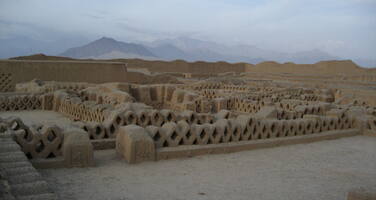
Continuous deterioration of earthen architecture structures and decorated surfaces from lack of conservation and maintenance practices
Factors* affecting the property identified in previous reports
a) Continuous deterioration of earthen architecture structures and decorated surfaces from lack of conservation and maintenance practices;
b) Illegal occupation of the property;
c) Unregulated farming activities;
d) Rising water table levels;
e) Delay in implementing protective measures (legislation and regulations already passed by the National Authorities).
Threats for which the property was inscribed on the List of World Heritage in Danger
- Fragile state of conservation of earthen structures and decorated surfaces due to extreme climatic conditions (El Niño phenomena) and other environmental factors;
- Inadequate management system in place;
- Insufficient capacity and resources for the implementation of conservation measures;
- Increase in the levels of the phreatic water table.
Desired state of conservation for the removal of the property from the List of World Heritage in Danger
The State Party reports on the preparation of the proposed Desired state of conservation to the World Heritage Centre.
Corrective Measures for the property
a) Full and systematic implementation of the management plan: secure sustainable funding, abide by prescribed courses of action and policies, adhere to prescribed institutional arrangements, for the conservation, presentation and revalorization of the property;
b) Enforce legislative and regulatory frameworks already passed by the State Party to address the issues of illegal occupations and activities at the property. Collaborate with pertinent authorities for the relocation of settlers;
c) Broad dissemination of the management plan amongst interest groups to strengthen public and private support in its implementation;
d) Collaboration with entities in defining regulatory measures for the management of the buffer zone and of the World Heritage property. Precise plans of the property and its zoning need to be circulated amongst stakeholders;
e) Physical delineation of the property: vegetation barriers, perimeter walls, etc.;
f) Priority conservation measures: control and mitigation of water table levels, conservation of perimeter walls, backfilling of fragile areas with decorated surfaces;
g) Development of an emergency and disaster preparedness plan.
Timeframe for the implementation of the corrective measures
a) Secured funding for the implementation of the management plan in 2008;
b) Functioning institutional arrangements in 2008 (as per management plan);
c) Illegal occupations addressed and activities at the site regulated in 2009 and beyond;
d) Emergency and risk preparedness plan in 2008;
e) Drainage works completed by the end of 2007;
f) Priority conservation works in 2009;
g) Other conservation and maintenance works 2008 and beyond;
h) Management and coordination of works carried out by other sectors in the buffer zone in 2008 and beyond.
International Assistance: requests for the property until 2009
Total amount approved : 118,700 USD
| 1998 | Master Plan for Chan Chan Archaeological Zone (Approved) | 8,700 USD |
| 1997 | Emergency assistance for the Archaeological Zone of ... (Approved) | 50,000 USD |
| 1997 | Technical advice for the preparation of an Integral ... (Approved) | 20,000 USD |
| 1994 | Regional and International Course on the Conservation ... (Approved) | 20,000 USD |
| 1987 | Consultancy and equipment for the safeguarding of Chan ... (Approved) | 20,000 USD |
Missions to the property until 2009**
1997: ICOMOS mission; February 2007: World Heritage Centre / ICOMOS and ICCROM mission.
Conservation issues presented to the World Heritage Committee in 2009
The archaeological zone of Chan Chan has been on the List of World Heritage in Danger since the time of inscription in 1986. The State Party has implemented several actions to mitigate decay at the site, including the development of a management plan, but insufficient resources and discontinuity in implementation have hindered the success of these actions. A joint World Heritage Centre/ICOMOS/ICCROM mission was carried out on 19-23 February 2007 and set out a course of action to remove the property from the List of World Heritage in Danger.
At its 32nd session (Quebec City, 2008), the World Heritage Committee requested the State Party, in light of the new tourism pressures, to incorporate into the management plan, an approach to public use and visitor management. It also requested it to develop a Desired state of conservation for the removal of the property from the List of World Heritage in Danger.
The State Party’s report was received on 3 February 2009. The report details progress made in implementing the identified corrective measures and in meeting the timeframe for removing the property from the List of World Heritage in Danger.
a) Full and systematic implementation of the management plan
The management unit (Unidad Ejecutora 110) continues to operate and implement the Management Plan for the property, prioritizing conservation, dissemination and outreach activities.
b) Enforce legislative and regulatory frameworks
Regulatory measures for Law no. 28261 are pending since 2005; today they are under review for approval by the Ministry of Education. Actions were implemented to stop soil removal (for agricultural purposes) at the “extensive use” zone and to address the illegal occupations in the buffer zone in order to protect a prehispanic road associated to the property. With increased surveillance at the property, unauthorized activities, such as farming and vehicular traffic, and illegal occupations have been better controlled.
c) Broad dissemination of the management plan
The State Party has continued to hold a variety of dissemination activities among public and private entities. The management unit also put in place an outreach programme with primary, secondary students and university students to raise awareness of the significance of the property and to engage them in endeavours required for the conservation of the property. The State Party reports that over 15,000 students have participated in the programme to date.
d) Collaboration with entities in defining regulatory measures for the management of the buffer zone and of the property
The site plan and limits have been updated using modern technology. The revised plan was approved in November 2008 with a National Directorial Resolution (No. 1605 INC). Project was implemented with the collaborative agreement between the Istituto per le Tecnologie Applicate ai Beni Culturali del Consiglio Nazionale delle Ricerche (ITABC-CNR) Rome, Italy and the INC. In addition to mapping, it is foreseen that a Territorial Information System will be created upon completion. These plans were included with the report from the State Party.
The National Institute of Culture has collaborated with the Municipality of Trujillo in establishing a buffer zone based on the results from the revised mapping. The buffer zone will include archaeological remains related to the site that are outside the limits of the protected zone and new regulatory measures will be established for their protection. The updated site plan and its buffer zone will be included in the territorial development plan and urban development plans for the Municipality of Trujillo, with precise zoning and land use regulations which are currently under review. Upon approval, wide dissemination is foreseen.
e) Physical delineation of the property: vegetation barriers, perimeter walls, etc;
Vegetation barriers have been set to physically delineate the property at the north, east and west limits. Debris from demolition and accumulated garbage was cleared along the south sector of the property, contributing to the recovery of the landscape and promoting environmental conservation.
f) Priority conservation measures
For the control of water table levels, technical files have been developed jointly with the local water authority for additional drains (DM12A and DM14A) to lower current levels at the south part of the complex. Existing drains (10, 11, 12, 13 and 14) were given maintenance, widened and cleaned to improve their efficiency.
Conservation interventions focused on the perimeter walls at Tschudi and Bandelier Palaces, and on priority areas to stabilize architecture in risk of collapse. Regular maintenance was carried out in Palaces including vegetation removal and temporary protection of walls. To prevent effects from rain on the historic fabric, temporary shelters and drainage systems are being evaluated to substitute the existing systems at Tschudi Palace and Huacas Arco Iris and Esmeralda. Funding has been secured for 2009 and 2010 to continue with conservation interventions according to the prioritized course of action set forth in the management plan.
g) Development of an emergency and disaster preparedness plan
The first phase of risk assessment has been completed and is being used as the base document to prepare a revised contingency plan by the National Institute of Culture and the Management Unit. Given that additional studies are still needed, the State Party foresees its completion by the end of 2009.
As for the timeframe for the implementation of the corrective measures, the State Party reports:
a) Secured funding for the implementation of the management plan in 2008
Funding was secured for the implementation of the prioritised course of action in 2008, nevertheless funding for 2009 depends on the national budget planning by the Government for the fiscal year 2009.
b) Functioning institutional arrangements in 2008 (as per management plan)
The State Party has strengthened institutional collaboration and promoted sustainable and permanent synergies for the implementation of the plan, reflected in interventions for the control of water table levels, emergency works and projects for the conservation and protection of the property.
c) Illegal occupations addressed and activities at the site regulated in 2009 and beyond
Regulatory measures are currently under review for approval.
d) Emergency and risk preparedness plan in 2008
Under preparation, completion is foreseen by the end of 2009.
e) Drainage works completed by the end of 2007
Timeframe was met; additional drainages are being evaluated to mitigate potential risks associated with water table levels.
f) Priority conservation works in 2009
The proposed plan of action will make progress in continuing to address priority conservation concerns in line with the Master Plan, the execution of the activities will depend on the budget for the fiscal year 2009.
g) Other conservation and maintenance works 2008 and beyond
Sustained collaboration between entities on the national and international levels is being explored to guarantee the implementation of the management plan.
h) Management and coordination of works carried out by other sectors in the buffer zone in 2008 and beyond
Collaboration between the INC and the Municipality of Trujillo has achieved significant progress in establishing a buffer zone and regulatory measures.
Although significant progress has been made to date in improving the state of conservation of the property, the World Heritage Centre and the Advisory Bodies remain concerned that protective and regulatory measures are still not fully enforced to guarantee the protection of the property and its setting. Similarly, progress in implementing the management plan exists but mechanisms and resources to secure long-term sustainability of the management system have yet to be explored. These include not only financial resources but also technical expertise to address the vast challenges faced by preserving such a fragile property and to adequately and efficiently respond to conditions as they arise.
The World Heritage Centre and the Advisory Bodies note that the requested draft Statement of outstanding universal value, including the conditions of integrity and authenticity, and the Desired state of conservation have not yet been submitted, but it is understood that the State Party is currently working on these.
Summary of the interventions
Decisions adopted by the Committee in 2009
33 COM 7A.29
Chan Chan Archaeological Zone (Peru) (C 366)
The World Heritage Committee,
1. Having examined Document WHC-09/33.COM/7A,
2. Recalling Decision 32 COM 7A.29, adopted at its 32nd session (Quebec City, 2008),
3. Notes with satisfaction and appreciates the significant progress made in the implementation of corrective measures within the timeframe for implementation, particularly in regard to the implementation of the management plan;
4. Takes note that the State Party has developed a proposal for the desired state of conservation for the removal of the property from the List of World Heritage in Danger and urges the State Party to complete its review in cooperation with the World Heritage Centre and the Advisory Bodies, for examination by the World Heritage Committee at its 34th session in 2010;
5. Also notes the updating of the plan of the property and the establishment of a buffer zone which will be articulated with other planning tools at the territorial and municipal levels and requests the State Party to submit the new boundaries for the buffer zone, including appropriate cartography as well as the legal framework for its regulation and protection, for approval by the World Heritage Committee;
6. Reiterates its concern about the lack of enforcement of protective legislation and regulatory measures in full to guarantee the protection of the site and urges the State Party to conclude the revision process to ensure the sustainability of the management system;
7. Also reiterates its request to the State Party to develop, in consultation with the World Heritage Centre and the Advisory Bodies, a draft Statement of Outstanding Universal Value within the framework of the Retrospective Inventory for Latin America and the Caribbean;
8. Further reiterates its request to the State Party, in light of the new tourism pressures, to revise provisions for public use and visitor management at the property and to integrate measures into the existing management plan;
9. Notes the advances made by the State Party in the preparation of the emergency and disaster preparedness plan and also requests a copy to be sent to World Heritage Centre and the Advisory Bodies upon finalization at the end of 2009;
10. Further requests the State Party to provide secure funding to the management unit (Unidad Ejecutora 110) in order to guarantee the implementation of activities foreseen in the management plan;
11. Requests furthermore the State Party to submit to the World Heritage Centre, by 1 February 2010, a detailed report on the state of conservation of the property and on the progress made in the implementation of the above recommendations, for examination by the World Heritage Committee at its 34th session in 2010;
12. Decides to retain Chan Chan Archaeological Zone (Peru) on the List of World Heritage in Danger.
33 COM 8C.2
Update of the List of World Heritage in Danger
The World Heritage Committee,
1. Following the examination of the state of conservation reports of properties inscribed on the List of World Heritage in Danger (WHC-09/33.COM/7A, WHC-09/33.COM/7A.Add and WHC-09/33.COM/7A.Add.2, WHC-09/33.COM/7A.Corr),
2. Decides to maintain the following properties on the List of World Heritage in Danger:
- Afghanistan, Minaret and Archaeological Remains of Jam (Decision 33 COM 7A.20)
- Afghanistan, Cultural Landscape and Archaeological Remains of the Bamiyan Valley, (Decision 33 COM 7A.21)
- Central African Republic, Manovo-Gounda St Floris National Park (Decision 33 COM 7A.1)
- Chile, Humberstone and Santa Laura Saltpeter Works (Decision 33 COM 7A.28)
- Côte d'Ivoire, Comoé National Park (Decision 33 COM 7A.2)
- Côte d'Ivoire / Guinea, Mount Nimba Strict Nature Reserve (Decision 33 COM 7A.3)
- Democratic Rep. of the Congo, Virunga National Park (Decision 33 COM 7A.4)
- Democratic Rep. of the Congo, Kahuzi-Biega National Park (Decision 33 COM 7A.5)
- Democratic Rep. of the Congo, Garamba National Park (Decision 33 COM 7A.6)
- Democratic Rep. of the Congo, Salonga National Park (Decision 33 COM 7A.7)
- Democratic Rep. of the Congo, Okapi Wildlife Reserve (Decision 33 COM 7A.8)
- Ecuador, Galápagos Islands (Decision 33 COM 7A.13)
- Egypt, Abu Mena (Decision 33 COM 7A.15)
- Ethiopia, Simien National Park (Decision 33 COM 7A.9)
- India, Manas Wildlife Sanctuary (Decision 33 COM 7A.12)
- Iraq, Ashur (Qal'at Sherqat) (Decision 33 COM 7A.16)
- Iraq, Samarra Archaeological City (Decision 33 COM 7A.17)
- Islamic Republic of Iran, Bam and its Cultural Landscape (Decision 33 COM 7A.22)
- Jerusalem, Old City of Jerusalem and its Walls (Decision 33 COM 7A.18)
- Niger, Air and Ténéré Natural Reserves (Decision 33 COM 7A.10)
- Pakistan, Fort and Shalamar Gardens in Lahore (Decision 33 COM 7A.23)
- Peru, Chan Chan Archaelogical Zone (Decision 33 COM 7A.29)
- Philippines, Rice Terraces of the Philippine Cordilleras (Decision 33 COM 7A.24)
- Senegal, Niokolo Koba National Park (Decision 33 COM 7A.11)
- Serbia, Medieval Monuments in Kosovo (Decision 33 COM 7A.27)
- United Republic of Tanzania, Ruins of Kilwa Kisiwani and Ruins of Songo Mnara (Decision 33 COM 7A.14)
- Venezuela, Coro and its Port (Decision 33 COM 7A.30)
- Yemen, Historic Town of Zabid (Decision 33 COM 7A.19 )
Draft Decision: 33 COM 7A.29
The World Heritage Committee,
1. Having examined Document WHC-09/33.COM/7A,
2. Recalling Decision 32 COM 7A.29, adopted at its 32nd session (Quebec City, 2008),
3. Notes with satisfaction significant progress made in the implementation of corrective measures within the timeframe for implementation, particularly in regard to the implementation of the management plan;
4. Reiterates its request to the State Party to develop, in consultation with the World Heritage Centre and the Advisory Bodies, a proposal for the Desired state of conservation for the removal of the property from the List of World Heritage in Danger, for examination by the World Heritage Committee at its 34th session in 2010;
5. Notes the updating of the plan of the property and the establishment of a buffer zone which will be articulated with other planning tools at the territorial and municipal levels and requests the State Party to submit the new boundaries for the buffer zone, including appropriate cartography as well as the legal framework for its regulation and protection,for approval by the World Heritage Committee;
6. Reiterates its concern about the full enforcement of protective legislation and regulatory measures to guarantee the protection of the site and urges the State Party to conclude the revision process to ensure the sustainability of the management system;
7. Also reiterates its request to the State Party to develop, in consultation with the World Heritage Centre and the Advisory Bodies, a draft Statement of outstanding universal value including the conditions of integrity and authenticity within the framework of the Retrospective Inventory for the Latin America and the Caribbean region to be started at of the end of 2009;
8. Further reiterates its request to the State Party that in light of the new tourism pressures, to revise provisions for public use and visitor management at the property and to integrate measures into the existing management plan;
9. Notes the advances made by the State Party in the preparation of the emergency and disaster preparedness plan and also requests a copy to be sent to World Heritage Centre and Advisory Bodies upon finalization at the end of 2009;
10. Further requests the State Party to provide secure funding to the management unit (Unidad Ejecutora 110) in order to guarantee the implementation of foreseen activities in the management plan;
11. Requests furthermore the State Party to submit to the World Heritage Centre, by 1 February 2010, a detailed report on the state of conservation of the property and on the progress made in the implementation of the above recommendations, for the examination by the World Heritage Committee at its 34th session in 2010;
12. Decides to retain Chan Chan Archaeological Zone (Peru) on the List of World Heritage in Danger.
 Peru
Peru
Exports
* :
The threats indicated are listed in alphabetical order; their order does not constitute a classification according to the importance of their impact on the property.
Furthermore, they are presented irrespective of the type of threat faced by the property, i.e. with specific and proven imminent danger (“ascertained danger”) or with threats which could have deleterious effects on the property’s Outstanding Universal Value (“potential danger”).
** : All mission reports are not always available electronically.