Crac des Chevaliers and Qal’at Salah El-Din
Crac des Chevaliers and Qal’at Salah El-Din
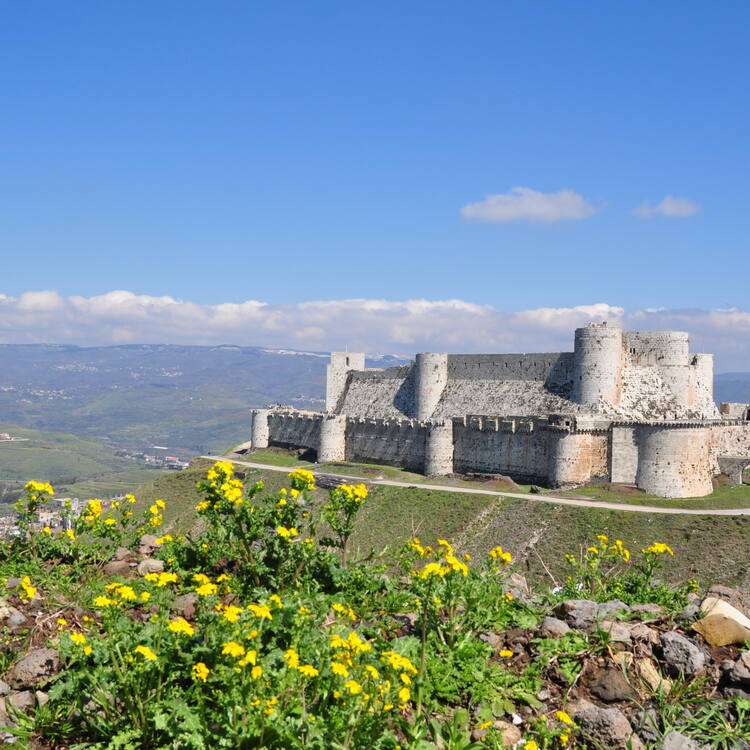
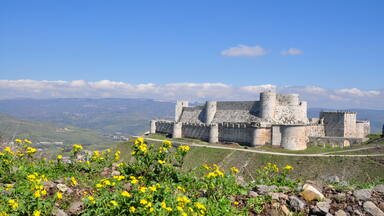
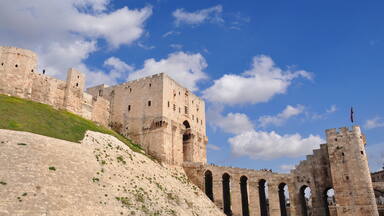
These two castles represent the most significant examples illustrating the exchange of influences and documenting the evolution of fortified architecture in the Near East during the time of the Crusades (11th - 13th centuries). The Crac des Chevaliers was built by the Hospitaller Order of Saint John of Jerusalem from 1142 to 1271. With further construction by the Mamluks in the late 13th century, it ranks among the best-preserved examples of the Crusader castles. The Qal’at Salah El-Din (Fortress of Saladin), even though partly in ruins, represents an outstanding example of this type of fortification, both in terms of the quality of construction and the survival of historical stratigraphy. It retains features from its Byzantine beginnings in the 10th century, the Frankish transformations in the late 12th century and fortifications added by the Ayyubid dynasty (late 12th to mid-13th century).
Description is available under license CC-BY-SA IGO 3.0
Crac des Chevaliers et Qal’at Salah El-Din
Ces deux châteaux illustrent l’échange d’influences culturelles et le développement de l’architecture militaire au Proche-Orient à l’époque des Croisades, du XIe au XIIIe siècles. Le Crac des Chevaliers a été construit par l’ordre des Hospitaliers de Saint-Jean de Jérusalem de 1142 à 1271. Une deuxième vague de travaux a été le fait des Mamelouks à la fin du XIIIe siècle. Il figure parmi les châteaux des Croisades les mieux préservés. Bien que partiellement en ruines, le Qal’at Salah El-Din (Forteresse de Saladin) constitue un autre exemple remarquable de ce type de forteresse, tant en terme de qualité de la construction que de survie de la stratigraphie historique, avec des éléments de l’époque byzantine au Xe siècle, les transformations réalisées par les Francs à la fin du XIIe siècle et les défenses ajoutées par les Ayyoubides (fin du XIIe et XIIIe siècles).
Description is available under license CC-BY-SA IGO 3.0
قلعة الفرسان وقلعة صلاح الدين
يجسّد هذان القصران التأثير الثقافي المتبادل وتطور الهندسة العسكرية في الشرق الأوسط طوال مرحلة الحروب الصليبية من القرن الحادي عشر ولغاية القرن الثالث عشر. وقد تم بناء قلعة الفرسان على يد أخوية فرسان القديس يوحنا المعروفة بفرسان المشفى من عام 1142 الى عام 1271، فيما أنجزت المرحلة الثانية من الأعمال على يد المماليك في نهاية القرن الثالث عشر. وتعدّ قلعة الفرسان من قصور الحروب الصليبية التي حظيت بأعلى درجة من الحماية. أما قلعة صلاح الدين، فتشكل رغم الدمار الجزئي الذي حلّ بها مثالاً هاماً آخر لهذا النمط من القلاع، سواء على مستوى نوعية البناء أو على مستوى البصمات التاريخية المتتالية التي تحملها، وهي تتضمن عناصر من العصر البيزنطي من القرن العاشر وتغييرات أدخلها الإفرنج في نهاية القرن الثاني عشر وتحصينات أضافها الأيوبيون (في نهاية القرنين الثاني عشر والثالث عشر).
source: UNESCO/CPE
Description is available under license CC-BY-SA IGO 3.0
武士堡和萨拉丁堡
这两座堡垒最能体现不同势力的相互影响,它们记载了十字军东征时期(11世纪至13世纪)近东防御工事的演变。1142年至1271年期间,耶路撒冷的圣•约翰骑士修道会修建了武士堡,13世纪末时,马穆鲁克又进一步进行了修建。武士堡是迄今保存最完好的十字军东征时的堡垒之一。它是中世纪堡垒,尤其是军界堡垒的典型,包括修道会建造的八个圆形城堡和之后马穆鲁克建造的一个方形堡垒。同样,不论从建筑质量还是从对不同地层的保存来看,萨拉丁堡都是此类堡垒中的杰出代表,尽管它的一部分已经成为废墟。萨拉丁堡保留了10世纪拜占庭早期的建筑特征、12世纪晚期法兰克人的改建以及12世纪晚期到13世纪中期艾优卜王朝新建的防御工事。
source: UNESCO/CPE
Description is available under license CC-BY-SA IGO 3.0
Замки Крак-де-Шевалье и Калъат-Салах-ад-Дин
Два замка являются наиболее значительными примерами, демонстрирующими взаимообмен влияний и эволюцию крепостной архитектуры на Ближнем Востоке во времена крестовых походов (ХI-ХIII вв.). Замок Крак-де-Шевалье был построен Орденом Госпитальеров Св. Иоанна Иерусалимского в 1142-1271 гг. С добавлениями, сделанными мамелюками в конце ХIII в., он относится к наиболее хорошо сохранившимся замкам крестоносцев. Это образец средневекового орденского замка, включающий восемь круглых башен, построенных госпитальерами, и массивную квадратную башню, добавленную мамелюками. Замок Калъат-Салах-ад-Дин (крепость Саладина), хотя и находится частично в руинах, все еще представляет собой выдающийся пример укреплений данного типа, как с точки зрения качества конструкций, так и сохранности исторической стратиграфии. Он хранит характерные свидетельства своего основания византийцами в Х в., перестроек франками-крестоносцами в конце ХII в., и укреплений, добавленных правителями династии Эйюбидов (конец ХII – середина ХIII вв.).
source: UNESCO/CPE
Description is available under license CC-BY-SA IGO 3.0
Crac de los Caballeros y Qal’at Salah Al Din
Estas dos fortalezas son ejemplos sumamente significativos del intercambio de influencias culturales y de la evolución de la arquitectura militar en el Cercano Oriente en tiempos de las Cruzadas (siglos XI al XIII). El Crac de los Caballeros fue construido por la Orden Militar y Hospitalaria de San Juan de Jerusalén entre 1142 y 1271. A finales del siglo XIII los mamelucos hicieron más obras en esta fortaleza, que es uno de los castillos de la época de las Cruzadas en mejor estado de conservación. Por su parte, el Castillo de Saladino (Qal’at Salah Al Din), aunque está parcialmente en ruinas, es otro ejemplo excepcional de este tipo de edificaciones militares, tanto en lo que se refiere a la calidad de su construcción como a la estratigrafía histórica subsistente. Esta última muestra los elementos bizantinos primigenios del siglo X, las transformaciones efectuadas por los francos a finales del siglo XII y las fortificaciones añadidas por la dinastía de los ayubidas (finales del siglo XII a mediados del XIII).
source: UNESCO/CPE
Description is available under license CC-BY-SA IGO 3.0
クラック・デ・シュヴァリエとサラディン城
シリア北西部に残るこの二つの城は、11~13世紀の十字軍時代に築かれた要塞の代表例であり、要塞建築の発展と、東西文化の交流を示している。クラック・デ。シュヴァリエは1142~1271年に聖ヨハネ騎士団が建設し、彼らの本拠地として難攻不落を誇った城。13世紀後半にマムルーク朝が行った増築も加わり、もっともよく保存された十字軍の城とされる。一方、カル-エッサラ・エル-ディン(サラディンの要塞)は10世紀の建造。現在は一部が廃墟となっているが、ビザンチン帝国、フランク王国、アイユーブ朝時代の諸様式が混在し、歴史的な厚みと質の高さの点において、中世要塞建築の顕著な例とされる。source: NFUAJ
Crac des Chevaliers en Qal’at Salah El-Din
Deze twee kastelen vormen de belangrijkste voorbeelden van de uitwisseling van invloeden gedurende de Kruistochten (11e -13e eeuw). Ze tonen de ontwikkeling van de versterkte architectuur in het Nabije Oosten. De Crac des Chevaliers werd gebouwd door de Hospitaal Orde van Sint Jan van Jeruzalem van 1142 tot 1271. De Mamelukken bouwden het kasteel af in de laat 13e eeuw, waarmee het behoort tot de best bewaarde voorbeelden van kruisvaarderskastelen. Qal’at Salah El-Din (fort van Saladin) is – ondanks dat het deels in puin ligt – een uitstekend voorbeeld van dit type van versterking qua constructiekwaliteit en het overblijven van historische stratigrafie. Het toont kenmerken van zijn Byzantijnse oorsprong in de 10e eeuw, de Frankische veranderingen uit het laatste deel van de 12e eeuw en versterkingen die zijn toegevoegd door de Auuybid dynastie (eind 12e - midden 13e eeuw).
Source: unesco.nl


Outstanding Universal Value
Brief synthesis
These two castles represent the most significant examples illustrating the exchange of influences and documenting the evolution of fortified architecture in the Near East during the Byzantine, Crusader and Islamic periods. The Crac des Chevaliers was built by the Hospitaller Order of Saint John of Jerusalem from 1142 to 1271. With further construction by the Mamluks in the late 13th century, it ranks among the best-preserved examples of the Crusader castles. The Qal'at Salah El-Din, even though partly in ruins, retains features from its Byzantine beginnings in the 10th century, the Frankish transformations in the late 12th century and fortifications added by the Ayyubid dynasty (late 12th to mid-13th century). Both castles are located on high ridges that were key defensive positions.
Dominating their surrounding landscapes, the two castles of Crac des Chevaliers and Qal'at Salah El-Din are outstanding examples of fortified architecture relating to the Crusader period. Their quality of construction and the survival of historical stratigraphy demonstrate the interchange of defensive technology through features of each phase of military occupation.
Criterion (ii): The castles represent a significant development in the fortification systems, which substantially differed from the European rather more passive defence systems, and which also contributed to the development of the castles in the Levant. Within the castles that have survived in the Near East, the property represents one of the most significant examples illustrating the exchange of influences and documenting the evolution in this field, which had an impact both in the East and in the West.
Criterion (iv): In the history of architecture, the Crac des Chevaliers is taken as the best preserved example of the castles of the Crusader period, and it is also seen as an archetype of a medieval castle particularly in the context of the military orders. Similarly, the Qal'at Salah El-Din, even though partly in ruins, still represents an outstanding example of this type of fortification, both in terms of its quality of construction and the survival of its historical stratigraphy.
Integrity (2009)
Both castles are located on hill tops dominating visually the surrounding landscape. Apart from some undesirable interventions in the buffer zones, the integrity of the surroundings is well preserved. The illegal constructions (some houses, restaurants and hotels) that have been built near the castles will be demolished. There are also plans for cable cars and an open-air theatre, which would not be in harmony with the integrity of the landscape.
Authenticity (2009)
The Crac des Chevaliers was subject to some limited restoration during the French mandate, while the relatively recent additions by local villagers were removed. The medieval structures were liberated of accumulated soil. As a whole it has well retained its authenticity.
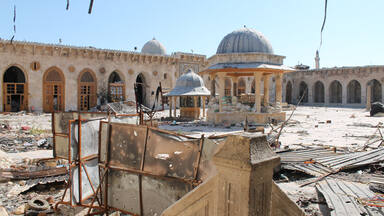
The Qal'at Salah El-Din is located in an isolated region and was not subject to any changes in recent centuries. It has partly fallen in ruins, and is now an archaeological site. It has been subject some restoration. For example, the main gate of the Ayyubid palace was restored in 1936, imitating the original structure. This type of restoration has now been abandoned, and the main emphasis is on consolidation and conservation. As a whole, the fortress has retained its historic condition and authenticity.
Protection and management requirements (2009)
The property is protected by the Syrian Antiquities Law (no. 222, revised in 1999) and by the Law of the Ministry of Local Administration (15/1971). The Ministry of Local Administration contributes to its protection in coordination with the Directorate of Antiquities and Museums (DGAM) and the local authorities.
The DGAM is the agency responsible for the protection of heritage sites and the funds for the maintenance and care of the castles are guaranteed from its annual budget. Each castle has a separate management system, organized jointly by the DGAM in collaboration with the local authorities. In the case of Crac des Chevaliers, the management system involves the village of al-Hosn, and in the case of the Qal'at Salah El-Din, the DGAM collaborates with the department located in the regional capital of Latakieh.
At the time of inscription, the DGAM was in the process of adopting a new administrative structure with new regulations that would be integrated so as to allow for a unified management system for the Castles of Syria. There is an on-going need to protect the eastern slopes of the Crac de Chevaliers from the development of the nearby modern city. The necessary administrative procedures have started to ensure the removal of irregular buildings near the castles.
 13
13

List of World Heritage in Danger
Inscription Year on the List of World Heritage in Danger
2013 - Present