Gare Chhatrapati Shivaji (anciennement gare Victoria)
Chhatrapati Shivaji Terminus (formerly Victoria Terminus)
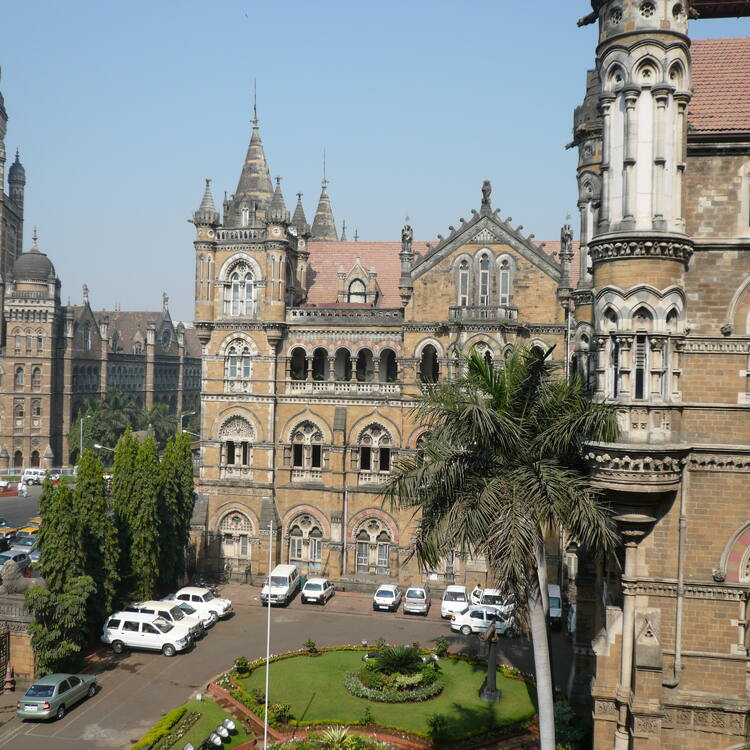
The Chhatrapati Shivaji Terminus, formerly known as Victoria Terminus Station, in Mumbai, is an outstanding example of Victorian Gothic Revival architecture in India, blended with themes deriving from Indian traditional architecture. The building, designed by the British architect F. W. Stevens, became the symbol of Bombay as the ‘Gothic City’ and the major international mercantile port of India. The terminal was built over 10 years, starting in 1878, according to a High Victorian Gothic design based on late medieval Italian models. Its remarkable stone dome, turrets, pointed arches and eccentric ground plan are close to traditional Indian palace architecture. It is an outstanding example of the meeting of two cultures, as British architects worked with Indian craftsmen to include Indian architectural tradition and idioms thus forging a new style unique to Bombay.
La description est disponible sous licence CC-BY-SA IGO 3.0
Gare Chhatrapati Shivaji (anciennement gare Victoria)
La gare Chhatrapati Shivaji, autrefois appelée gare Victoria, à Mumbai, est un remarquable exemple d’architecture néogothique victorienne en Inde, mêlée à des éléments issus de l’architecture traditionnelle indienne. Le bâtiment, conçu par l’architecte britannique F.W. Stevens, allait devenir le symbole de Bombay, la « ville gothique » et le plus important port marchand d’Inde. Le terminal, dont la construction, commencée en 1878, dura dix ans, obéit à une conception du gothique victorien s’inspirant des modèles de la fin du Moyen Âge en Italie. Certains éléments remarquables comme le dôme de pierre, les tourelles, les arcs brisés et le plan excentré rappellent l’architecture des palais indiens traditionnels. C’est un exemple exceptionnel de la rencontre de deux cultures, les architectes britanniques ayant fait appel à des artisans indiens pour intégrer la tradition architecturale indienne afin de créer un style nouveau, propre à Bombay.
La description est disponible sous licence CC-BY-SA IGO 3.0
محطة تشاتراباتي شيفاجي المعروفة آنفاً بمحطة فكتوريا
إنّ محطة تشاتراباتي شيفاجي المعروفة آنفاً بمحطة فكتوريا في مومباي هي مثال مُلفت للهندسة القوطية الجديدة الفكتورية في الهند، ممزوجة بعناصر صادرة عن الهندسة الهندية التقليدية. أصبح فيما بعد البناء الذي صمّمه المهندس البريطاني ف. و. ستيفنز رمزَ بومباي المدينة القوطية وأهمّ مرفأ تجاري في الهند. وتخضع المحطة التي بدأ تشييها عام 1878 واستمرّ عشرة أعوام لتصوّر قوطي فكتوري يُستوحى من نماذج أواخر القرون الوسطى في إيطاليا. وتُعيد بعض العناصر المُلفتة كالقبّة الحجرية، والأبراج الصغيرة، والأقواس الحادة، والتصميم الغريب، إلى الذاكرة هندسة القصور الهندية التقليدية. وتشكّل المحطة مثالاً استثنائياً لتلاقي ثقافي إذ أنّ المهندسين استدعوا فنانين هنودا في سبيل دمج الهندسة الهندية بهدف خلق أسلوب جديد خاص ببمباي.
source: UNESCO/CPE
La description est disponible sous licence CC-BY-SA IGO 3.0
贾特拉帕蒂•希瓦吉终点站(前维多利亚终点站)
贾特拉帕蒂·希瓦吉终点站旧名孟买的维多利亚终点站,是印度维多利亚时代哥特式复兴风格的建筑典范,融合了印度传统建筑的主题。由英国建筑师F.W.Stevens设计的这座建筑成为孟买这个“哥特式城市”和印度重要的国际商业港口城市的象征。终点站根据中世纪晚期意大利模式的哥特式设计建造,从1878年开始,历时十年以上。其引人注目的石头圆屋顶、塔楼、尖拱和不规则的地面设计, 都接近传统的印度宫殿建筑。英国建筑师和印度工匠相互协作,融合了印度的建筑传统和风格,形成了孟买独一无二的新风格,这是两种文化交汇的杰出典范。
source: UNESCO/CPE
La description est disponible sous licence CC-BY-SA IGO 3.0
Вокзал Чхатрапати-Шиваджи, бывший Виктория-Терминус (город Мумбаи)
Вокзал Чхатрапати-Шиваджи в Мумбаи (Бомбее), ранее известный как Виктория-Терминус, – это выдающийся пример викторианской неоготической архитектуры в Индии, сочетающийся с мотивами, заимствованными из традиционной индийской архитектуры. Здание, спроектированное британским архитектором Ф.У. Стивенсом, и строившееся в течение 10 лет, начиная с 1878 г., стало символом Бомбея как «города готики» и главного международного торгового порта Индии. Его замечательный каменный купол, башенки, стрельчатые арки и замысловатый план близки к традиционной архитектуре индийских дворцов.
source: UNESCO/CPE
La description est disponible sous licence CC-BY-SA IGO 3.0
Chhatrapati Shivaji (ex Estación Victoria)
Situada en la ciudad de Mumbai (antes, Bombay), la estación ferroviaria de Chhatrapati Shivaji –antaño denominada Estación Victoria– es un destacado ejemplo de la mezcla del estilo arquitectónico neogótico de la época victoriana con la temática de la arquitectura india tradicional. Este edificio, diseñado por el arquitecto británico F.W. Stevens, se convirtió en el símbolo del principal puerto comercial de la India, Mumbai, llamada por algunos la “ciudad gótica”. Su construcción, iniciada en 1878 y finalizada diez años después, se llevó a cabo con arreglo a un proyecto arquitectónico de estilo gótico victoriano, inspirado en los monumentos italianos de finales de la Edad Media. El plano excéntrico de su planta, su cúpula de piedra, sus torrecillas y sus arcos puntiagudos presentan semejanzas con la arquitectura palacial clásica de la India. Chhatrapati Shivaji es un ejemplo excepcional del encuentro entre dos culturas, ya que los arquitectos británicos trabajaron con los artesanos indios para incorporar las tradiciones y los estilos arquitectónicos autóctonos, creando así un nuevo estilo, exclusivamente característico de Mumbai.
source: UNESCO/CPE
La description est disponible sous licence CC-BY-SA IGO 3.0
チャトラパティ・シヴァージー・ターミナス駅(旧名ヴィクトリア・ターミナス)
インド最大の貿易港ムンバイにある駅舎、チャトラパティ・シヴァージ・ターミナス(旧ビクトリア・ターミナス)は19世紀末の竣工。インドの伝統的な建築様式を融合した、ヴィクトリア・ゴシック建築の傑作である。イギリスのF.W.スティーヴンスが設計し、「ゴシック建築の都市」としてだけでなくムンバイを象徴する建築物となった。ヴィクトリア・ゴシック様式は、イタリアの中世末期をモデルにした格調高い様式。卓越した石のドームやタレット、尖塔アーチや奇抜な平面図などは、伝統的なインドの宮殿に見られる建築様式と類似している。source: NFUAJ
Chhatrapati Shivaji Terminus (voorheen Victoria Terminus)
Dit treinstation in Mumbai is een prachig voorbeeld van Victoriaans-neogotische Indiase architectuur, vermengd met traditionele architectuur van India. Het gebouw, ontworpen door de Britse architect F.W. Stevens, werd het symbool van Bombay als gotische stad en grote Indiase internationale handelshaven. De bouw duurde tien jaar (vanaf 1878). Het station is naar hoog Victoriaans-gotisch ontwerp gebouwd, gebaseerd op laatmiddeleeuwse Italiaanse modellen. De stenen koepel, torentjes, spitsbogen en excentrieke plattegrond tonen gelijkenis met de traditionele Indiase paleisarchitectuur. Chhatrapati Shivaji Terminus is een mooi voorbeeld van samensmeltende culturen, aangezien de Britse architecten werkten met Indiase ambachtslieden om Indiase architectonische tradities in de bouw op te nemen.
Source : unesco.nl
छत्रपति शिवाजी टर्मिनस (पूर्व में विक्टोरिया टर्मिनस)
मुंबई में छत्रपति शिवाजी टर्मिनस, जिसे पहले विक्टोरिया टर्मिनस स्टेशन के रूप में जाना जाता था, भारत में विक्टोरियन गोथिक जीर्णोद्धार वास्तुकला का एक उत्कृष्ट उदाहरण है, जिसमें भारतीय पारंपरिक वास्तुकला को मिश्रित किया गया है। ब्रिटिश वास्तुकार एफ॰डब्ल्यू॰ स्टीवंस द्वारा डिजाइन की गई इमारत, जो बंबई का प्रतीक 'गोथिक सिटी' और भारत के प्रमुख अंतरराष्ट्रीय व्यापारिक बंदरगाह के रूप में विकसित हुई है। बाद के मध्यकालीन इतालवी मॉडल के आधार पर उच्च विक्टोरियन गोथिक डिजाइन के अनुसार इस टर्मिनल को 1878 में शुरू किया गया था। इसकी उल्लेखनीय पत्थर की गुंबद, बुर्ज, नुकीले मेहराब और जटिल आधार योजना पारंपरिक भारतीय महल वास्तुकला से मिलती हैं। यह दो संस्कृतियों के मिलन का एक उत्कृष्ट उदाहरण है, क्योंकि ब्रिटिश वास्तुकारों ने भारतीय शिल्पकारों के साथ भारतीय वास्तु परंपरा और लोकोक्तियों को शामिल किया है और इस तरह से बंबई के लिए एक नई शैली तैयार की है।
Source : India


Valeur universelle exceptionnelle
Brève synthèse
La gare Chhatrapati Shivaji (anciennement gare Victoria) se trouve à Mumbai, dans la partie occidentale de l'Inde qui borde les rives de la mer d’Arabie. Ce bâtiment, conçu par F. W. Stevens, s’étend sur une superficie de 2,85 hectares. La construction du terminal, commencée en 1878, dura dix ans. C'est l’une des plus belles gares fonctionnelles du monde et elle est utilisée par plus de trois millions de voyageurs quotidiennement. Ce bien est un exemple exceptionnel de l’architecture néo- gothique victorienne en Inde, mêlée à des thèmes issus de l'architecture traditionnelle indienne. Ses éléments remarquables comme le dôme de pierre, les tourelles, les arcs brisés et le plan excentré, rappellent l’architecture des palais indiens traditionnels. C’est un exemple exceptionnel de la rencontre de deux cultures, les architectes britanniques ayant fait appel à des artisans indiens pour intégrer la tradition architecturale indienne afin de créer un style nouveau, propre à Mumbai. Il s'agissait de la première gare terminus du sous-continent. Elle devint un palais commercial représentant la richesse économique de la nation.
Critère (ii): la gare Chhatrapati Shivaji (anciennement gare Victoria) de Mumbai (anciennement Bombay) témoigne d'un échange d'influences considérable de l’architecture de style néo-gothique victorien italianisant et de l’architecture traditionnelle indienne. Elle est devenue le symbole de Mumbai en tant que principale ville portuaire de commerce du sous-continent indien dans le Commonwealth britannique.
Critère (iv): la gare Chhatrapati Shivaji est un exemple exceptionnel de l’architecture ferroviaire de la fin du XIXe siècle dans le Commonwealth britannique, se distinguant par l’association de caractéristiques du style néo-gothique victorien et du style traditionnel de l’Inde ainsi que par des solutions structurelles et techniques avancées
Intégrité
Le bâtiment de la gare Chhatrapati Shivaji (anciennement gare Victoria) est l'expression de la planification architecturale britannique italianisante et indienne et de son utilisation pour les Chemins de fer Indiens. L'ensemble du bâtiment a conservé l’intégralité de sa structure. Sa façade, son aspect extérieur et son utilisation sont d’origine. Le site de l'édifice est une zone strictement protégée gérée par les Chemins de fer Indiens. Le bien est protégé par une zone tampon de 90,21 hectares. La gare est l'une des grandes gares de la métropole de Mumbai et plus de trois millions de banlieusards l’utilisent quotidiennement. En plus des quatre premières voies ferrées initiales, la gare compte maintenant sept voies suburbaines et onze en dehors du bâtiment d’origine. Cela a conduit à la restructuration de plusieurs zones dans les environs, et à l'ajout de bâtiments annexes. Les Chemins de fer Indiens s’efforcent de décongestionner cette gare et de dévier une partie du trafic vers d'autres gares.Le bien est situé dans la partie sud de la ville, et soumis à d'énormes pressions de développement et à des réaménagements potentiels. Toutefois, compte tenu des intérêts commerciaux dans une telle zone centrale, le contrôle du développement est un défi permanent. Un autre risque provient du trafic intense et de l’air très pollué autour de la gare. La pollution industrielle dans la zone a diminué grâce à la réduction des activités industrielles et portuaires. Un autre problème est causé par l’air salin de la mer.
Le système de protection contre l'incendie doit être vérifié et amélioré.
Authenticité
Le bâtiment patrimonial a conservé un pourcentage important de son intégrité structurelle d'origine. L'authenticité de la structure exprime la richesse du style gothique italien à travers les spectaculaires sculptures en 3D en pierre représentant des espèces locales d’animaux, de flore et de faune, des symboles, les tympans arqués, les médaillons à visages humains et les rinceaux de pierre ornant les roses des fenêtres. Le décor élaboré de l’édifice patrimoniale est d’origine. Il comporte des sculptures en pierre jaune locale agrémentées de marbre italien et de granit poli à quelques endroits. Le décor architectural est en calcaire. Les portes et les fenêtres sont en bois de teck birman avec certaines fenêtres en acier montées dans la maçonnerie du tambour de la coupole et des armoiries et des tableaux correspondants dans les vitraux. Il y a de nombreux autres embellissements dans la statuaire, que l'architecte a introduit dans la décoration de la façade principale. Ils comprennent des gargouilles, des allégories grotesques transportant des étendards et des haches, et des bustes représentant les différentes castes et communautés de l'Inde. Bien en vue sur la façade des bas-reliefs représentent les dix administrateurs de l’ancienne Société des chemins de fer indiens (GIPR). Les colonnes des portes d'entrée de la gare de Chhatrapati Shivaji (anciennement gare Victoria) sont surmontées l’un par un lion (représentant du Royaume-Uni) et l’autre par un tigre (représentant l’Inde) et il y a des tympans figurant des paons.
Toutefois, des modifications à l’intérieur et des ajouts à l’extérieur ont modérément affecté l’authenticité. Ces modifications étaient en général réversibles et ont depuis l'inscription été supprimées pour rendre au bâtiment et à ses environs leur gloire d’antan.
Eléments requis en matière de protection et de gestion
Le bien a été déclaré un structure de « patrimoine Grade – I » en vertu de la Loi du gouvernement de l'Etat du Maharashtra du 21 Avril 1997. Des efforts soutenus sont déployés pour améliorer l'état général du bien et pour veiller à ce qu’il ne se dégrade pas en raison de son utilisation par les voyageurs et les visiteurs. La zone tampon est établie pour prévenir et réduire toute évolution négative dans les environs. Tous les droits sur le bien sont dévolus au ministère des Chemins de fer du gouvernement de l’Inde. Mumbai a été la première ville de l'Inde à se doter d’une législation sur le patrimoine, mise en application par un règlement du gouvernement en 1995 (N ° 67). La gare Chhatrapati Shivaji (anciennement gare Victoria) et la zone du Fort, dont elle fait partie, sont protégés par cette législation. Un comité multidisciplinaire, appelé Comité de conservation du patrimoine de Mumbai (CSMC), a été créé pour assurer la protection des bâtiments patrimoniaux. Il y a 624 bâtiments classés dans toute la ville, dont 63 sont des structure de « Grade –I », ce qui inclut la gare. La surveillance administrative et la gestion du bien relèvent du directeur de la division de Mumbai des chemins de fer centrals. L'entretien quotidien et la protection des bâtiments est aussi de la responsabilité du directeur des chemins de fer divisionnaire. Les Chemins de fer Indiens ont également considéré la possibilité de développer la gare Chhatrapati Shivaji (anciennement gare Victoria) comme une gare de niveau mondial ce qui conduirait à décongestionner et alléger la pression sur cette gare actuellement engorgée par le trafic.
L'autorité de Développement régional métropolitain de Mumbai (MMRDA) travaille sur le plan de transport urbain de Mumbai, qui vise à améliorer le réseau de transports urbains. Au niveau local, il y aura des changements dans le système de gestion, ce qui aura des conséquences dans l’est de la zone du front de mer de la ville. La gare, qui se trouve en un point stratégique de cette zone, sera affectée par ces modifications.
Le plan de gestion à long terme pour la gare Chhatrapati Shivaji (anciennement gare Victoria) a été lancé en 1997 par les Chemins de fer Indiens qui ont nommé la cellule de Conservation de l'Architecture (CCA) en tant que consultant. Actuellement la deuxième phase des travaux est en cours impliquant la restauration de la gare terminus; elle concerne des travaux de conservation pour le bien, la gestion de la circulation autour du site, la gestion du tourisme et la formation du personnel.
Les fonds pour la gestion de la gare proviennent du gouvernement indien. Les Chemins de fer Indiens peuvent disposer de fonds pour des travaux de conservation nécessaires à l'entretien de leurs bâtiments. Le système de gestion technique des chemins de fer fonctionne de façon adéquate, et, de ce point de vue fondamental, permet toutes les garanties pour la conservation de la valeur universelle exceptionnelle du bien. Une agence expérimentée dans le domaine de la conservation a été désignée pour assurer la conservation architecturale des bâtiments de la gare et de ses annexes. Le plan de gestion doit être amélioré du point de vue de la de conservation du patrimoine architectural, et en impliquant les collectivités territoriales.
 Découvrez les photos de OUR PLACE the World Heritage Collection