Cathédrale, abbaye Saint-Augustin et église Saint-Martin à Cantorbéry
Canterbury Cathedral, St Augustine's Abbey, and St Martin's Church
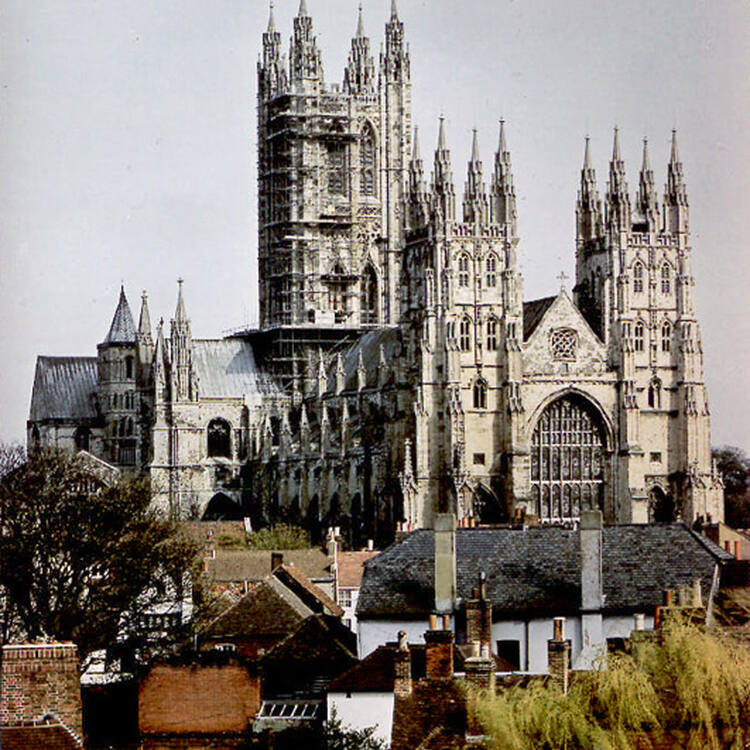
Canterbury, in Kent, has been the seat of the spiritual head of the Church of England for nearly five centuries. Canterbury's other important monuments are the modest Church of St Martin, the oldest church in England; the ruins of the Abbey of St Augustine, a reminder of the saint's evangelizing role in the Heptarchy from 597; and Christ Church Cathedral, a breathtaking mixture of Romanesque and Perpendicular Gothic, where Archbishop Thomas Becket was murdered in 1170.
La description est disponible sous licence CC-BY-SA IGO 3.0
Cathédrale, abbaye Saint-Augustin et église Saint-Martin à Cantorbéry
Siège presque cinq fois centenaire du chef spirituel de l'Église d'Angleterre, Cantorbéry, dans le Kent, abrite la modeste église Saint-Martin, la plus ancienne d'Angleterre, les ruines de l'abbaye Saint-Augustin, qui rappellent la mission évangélisatrice du saint dans l'Heptarchie à partir de 597, et la superbe cathédrale de Christ Church, saisissant mélange des styles roman et gothique perpendiculaire, où l'archevêque Thomas Becket fut assassiné en 1170.
La description est disponible sous licence CC-BY-SA IGO 3.0
الكاتدرائية ودير القديس أغسطين وكنيسة سان مارتان في كانتربيري
بعد أن شكلت مقراً للزعيم الروحي لكنيسة انكلترا طيلة خمسة قرون تقريباً، تحتضن كانتربيري في مقاطعة كنت كنيسة سان مارتان الصغيرة والأولى من حيث القدم في انكلترا، الى جانب آثار دير القديس أغسطين التي تعيد الى الذاكرة بعثة التبشير بالإنجيل التي تولاها القديس المذكور في الممالك السبع منذ عام 597 وكاتدرائية كنيسة السيد المسيح الرائعة بمزيجها الأخاذ بين الطراز الروماني والقوطي العمودي الخطوط والتي شهدت اغتيال المطران طوماس بيكيت عام 1170.
source: UNESCO/CPE
La description est disponible sous licence CC-BY-SA IGO 3.0
坎特伯雷大教堂、圣奥古斯汀教堂和圣马丁教堂
位于肯特郡的坎特伯雷大教堂是近500年来英国大教堂的精神领袖,坎特伯雷的其他重要建筑有圣奥古斯汀教堂,它是英国最古老的教堂之一;还有圣马丁教堂的遗迹,圣马丁教堂从公元597年就在基督教传教中担负着十分重要的角色,它巧妙地融合了罗马式风格和直角哥特式风格。贝克特大主教于1170年在此地被暗杀。
source: UNESCO/CPE
La description est disponible sous licence CC-BY-SA IGO 3.0
Кафедральный собор, монастырь Сент-Огастин и церковь Сент-Мартин в городе Кентербери
Город Кентербери в Кенте является местопребыванием духовного главы Англиканской церкви в течение почти пяти веков. Важными памятниками Кентербери являются: скромная церковь Сент-Мартин – старейшая церковь Англии; руины монастыря Сент-Огастин – напоминание о роли Св. Августина в крещении «Хептархии» (семи королевств англо-саксов), начиная с 597 г.; и кафедральный собор – захватывающее дух соединение романского стиля и перпендикулярной готики, где в 1170 г. был убит архиепископ Томас Бекет.
source: UNESCO/CPE
La description est disponible sous licence CC-BY-SA IGO 3.0
Catedral, abadía de San Agustín e iglesia de San Martín en Canterbury
Situada en el condado de Kent, la pequeña ciudad de Canterbury es la sede del primado de la Iglesia Anglicana. Sus monumentos más importantes son: la humilde iglesia de San Martín, que es la más antigua de Inglaterra; las ruinas de la abadía de San Agustín de Canterbury, que traen a la memoria la misión evangelizadora emprendida el año 597 por este santo en los reinos de la Heptarquía; y la soberbia Iglesia Catedral de Cristo, escenario del asesinato del arzobispo Thomas Becket en el año 1170, en cuya arquitectura se funden con increíble acierto el estilo románico y el gótico perpendicular.
source: UNESCO/CPE
La description est disponible sous licence CC-BY-SA IGO 3.0
カンタベリー大聖堂、聖オーガスティン大修道院及び聖マーティン教会
イギリス国教会の総本山であるカンタベリー大聖堂は6世紀末に建てられたが、12世紀末に焼失したのちに再建され、イギリス最初のゴシック様式の大聖堂となった。高さ72mの棟は15世紀末に完成しており、12~13世紀のステンドグラスや壁画・柱頭彫刻がある。source: NFUAJ
Kathedraal van Canterbury, Sint Augustinus abdij en kerk van Sint Martin
Canterbury ligt in Kent en is sinds bijna vijf eeuwen de zetel van de geestelijk leider van de Kerk van Engeland. Aartsbisschop Thomas Becket werd in 1170 vermoord in de kathedraal van Canterbury, mede hierdoor is Canterbury van belang als pelgrimsoord. Na de moord en de heiligverklaring van Becket transformeerde de kathedraal en trok pelgrims uit heel Europa. Andere belangrijke Canterbury-monumenten zijn de bescheiden kerk van Sint Martin (de oudste kerk in Engeland) en de ruïnes van de Sint Augustinus abdij (een herinnering aan de evangeliserende rol van deze heilige in de Heptarchie vanaf 597).
Source : unesco.nl


Valeur universelle exceptionnelle
Brève synthèse
La cathédrale Christ Church de Cantorbéry, dans le Kent, au sud-est de l’Angleterre, un prodigieux mélange d’architectures romane et gothique, est le siège spirituel de l’Église d’Angleterre depuis près de cinq siècles. Suite à l’assassinat de l’archevêque Thomas Becket en 1170 et à sa canonisation, Cantorbéry est devenu un lieu de pèlerinage. L’église Saint-Martin et les ruines de l’abbaye Saint-Augustin sont les autres éléments majeurs du bien.
L’église Saint-Martin, les ruines de l’abbaye Saint-Augustin et de la cathédrale Christ Church sont le reflet des étapes marquantes de l’histoire de la chrétienté en Grande-Bretagne. Ces monuments matérialisent la réintroduction du christianisme dans le sud de l’Angleterre par Saint Augustin qui a commencé à l’église Saint-Martin, là même où la Reine Bertha priait déjà et où elle conduisit le roi Ethelbert à se convertir. Ces monuments illustrent également les réponses architecturales successives au rôle grandissant de Cantorbéry en tant que siège de l’Église d’Angleterre - adaptation des édifices romains, développement d’un style de construction anglo-saxon en brique et en pierre et épanouissement des styles roman et gothique en parallèle au développement, sous l’impulsion de Saint Augustin et des moines venus de Rome, du monachisme bénédictin qui naquit à Cantorbéry, s’étendit à toute la Grande Bretagne et eut un impact très fort sur la société anglaise. Le scriptorium de l’abbaye fut l’un des plus grands centres de production de livres de toute l’île britannique et son influence s’étendit bien au delà des limites du Kent et de la Northumbrie. Le développement du degré d’alphabétisation, de l’éducation et de l’érudition à l’abbaye eut pour conséquence la transformation de Cantorbéry en l’un des plus grands lieux d’enseignement du pays. Dans le sillage d’Augustin et des premiers saints, Cantorbéry devint un grand centre de pèlerinage suite à l’assassinat et à la canonisation de l’archevêque Thomas Becket dont le tombeau dans la cathédrale attirait des pèlerins venus de l’Europe entière. Cantorbéry devint le siège du chef spirituel de l’Église d’Angleterre. Au XIIème siècle, la puissance de la cathédrale et sa richesse, acquise grâce aux offrandes d’un grand nombre de pèlerins, permit l’agrandissement vers l’est avec ses exceptionnels vitraux et la reconstruction du chœur et du transept après l’incendie de 1174. Ces éléments constituent l’un des plus beaux exemples d’art gothique primitif. Le riche panorama d’architectures et d’arts roman, gothique primitif et gothique tardif de la cathédrale est exceptionnel.
Critère (i) : La cathédrale Christ Church, tout particulièrement dans ses parties orientales, représente une création artistique unique. La beauté de son architecture est rehaussée par une parure exceptionnelle de vitraux primitifs qui constituent la collection la plus riche de tout le Royaume-Uni.
Critère (ii) : L’influence du monastère bénédictin de Saint-Augustin a été décisive pendant tout le Moyen Âge en Angleterre. Le rayonnement de ce centre monastique et de son scriptorium ont dépassé de beaucoup les limites du Kent et de la Northumbrie.
Critère (vi) : Saint-Martin, Saint-Augustin et la cathédrale sont directement et matériellement associées à l’histoire de l’évangélisation des royaumes anglo-saxons.
Intégrité
Les trois éléments qui composent le bien, l’église Saint-Martin, l’abbaye Saint-Augustin et la cathédrale Christ Church sont reliés entre eux par la zone tampon. La composante du bien dite « Église Saint-Martin » est incluse dans les limites de l’église et du cimetière. Presque toute l’abbaye Saint-Augustin, y compris la majeure partie de son enceinte, est incluse dans les limites de cette composante du bien alors que les parties de son enceinte aujourd’hui occupées par la maison de justice (Sessions House), la prison qui reliait l’abbaye à l’église Saint-Martin, les bâtiments de l’aumônerie (Almonry buildings) situés sur la Place Lady Wootton et les édifices de la conduite d’alimentation en eau (Conduit House), datant du XIIIème siècle, n’en font pas partie. Le territoire de la cathédrale, une des trois composantes du bien, correspond aux anciennes limites de son enceinte. Situé sur Military Road, le pavillon de la conduite d’alimentation en eau de la cathédrale qui date du XIIème siècle est exclu du bien.
Bien que les attributs majeurs du bien soient inclus dans les limites de ses structures principales, les liens visuels et cérémoniels qui les relient entre eux sont situés dans la zone tampon, comme quelques rares bâtiments annexes en lien avec leur fonction. Dans une certaine mesure, l’intégrité générale du bien repose sur sa zone tampon. La présence d’une route très fréquentée qui traverse cette même zone a de réelles conséquences sur la relation entre les trois composantes du bien. Des pressions exercées par l’aménagement urbain dans la zone tampon ou à ses alentours sont avérées et nécessitent une gestion rigoureuse.
Les ruines présentes sur le territoire du bien pâtissent des conditions atmosphériques et de l’érosion et nécessitent d’être régulièrement inspectées, entretenues et réparées.
En 2006, on a estimé que la structure de la cathédrale était menacée et une grande campagne de don a été lancée afin de financer son entretien. Cette campagne est toujours en cours et le transept sud-est fait actuellement l’objet d’un vaste programme de réparations. On considère que les vestiges du prieuré de Christ Church nécessitent des travaux de réparations qui restent à venir.
En 1988, lors de l’inscription du bien, il a été précisé que la conservation des trois composantes du bien ne respectait pas des normes identiques. Les différences entre ces trois composantes se reflètent aujourd’hui par des régimes de conservation différents. Des travaux sont actuellement menés pour régulariser cette situation et un plan de conservation a été élaboré pour la cathédrale. Lors de l’inscription, le Bureau du Comité du patrimoine mondial a recommandé que la cathédrale, l’abbaye Saint-Augustin et l’église Saint-Martin soient intégrées au sein d’une seule et unique zone de protection. Cela a été en grande partie accompli par la définition de zones monumentales protégées et des aires de conservation .
Authenticité
Depuis le VIème siècle et sans discontinuer, l’église Saint-Martin a été un lieu de culte, il en va de même pour les bâtiments actuels (en surface) de la cathédrale depuis le XIème siècle. La cathédrale est également un haut lieu d’enseignement et de pèlerinage notamment avec le tombeau de Saint Thomas Becket. La plus grande partie du bien conserve ainsi son usage et sa fonction hérités de l’histoire.
La cathédrale est l’église-mère du diocèse de Cantorbéry, elle est également connue dans le monde entier comme le lieu où siège l’archevêque de Cantorbéry et où, tous les dix ans, la conférence de Lambeth à laquelle participent les évêques de la Communion anglicane, se réunit.
L’église Saint-Martin a été modifiée et agrandie aux VIème, VIIème et XIVème siècles, cependant le mur sud conserve toujours son style romain. L’abbaye a été en grande partie détruite pendant la Réforme et est désormais partiellement en ruine. La cathédrale et son enceinte composent un ensemble divers mais cohérent d’architecture médiévale.
Depuis cinq siècles, la vaste cathédrale, et en particulier sa tour Bell Harry, dominent la ville. La tour est le plus haut monument de la ville et, étant située dans le lit de la vallée, elle peut être vue depuis les hautes terres environnantes et de partout dans la vallée. La conservation des perspectives visuelles depuis et vers la cathédrale est essentielle au maintien de cette prédominance visuelle.
L’intérieur de la cathédrale rassemble de magnifiques exemples d’architecture, de vitraux et de mobilier d’époque médiévale. La cohérence et l’homogénéité presque parfaite de son chœur, de son transept est, de sa tour est non achevée et de ses chapelles latérales romanes sont toujours frappantes. Lors de l’inscription du bien, ceux-ci ont été considérés comme quelques uns des plus beaux espaces architecturaux d’art gothique primitif.
Les ruines de l’abbaye Saint-Augustin transmettent leur valeur de façon moins spectaculaire et les liens entre ces ruines, la cathédrale et l’église Saint-Martin doivent être renforcés afin que ces trois éléments puissent être considérés comme un seul et même bien, transmettant ainsi plus aisément la façon dont ils contribuent chacun à la Valeur universelle exceptionnelle.
Éléments requis en matière de protection et de gestion
Le Gouvernement du Royaume-Uni protège les biens anglais inscrits sur la Liste du patrimoine mondial de deux façons. En premier lieu, les bâtiments individuels, les monuments et les paysages sont classés au titre de la Loi de planification (Bâtiments classés et zones de conservation) de 1990 (Planning (Listed Buildings and Conservation Areas) Act 1990) et de la Loi sur les monuments anciens et les zones archéologiques de 1979 (1979 Ancient Monuments and Archaeological Areas Act), et en second lieu, par le Système d’aménagement de l’espace du Royaume-Uni (UK Spatial Planning system) au titre des dispositions prévues par les Lois de planification urbaine et rurale (Town and Country Planning Acts).
Les orientations gouvernementales en matière de protection de l’environnement historique et du patrimoine mondial sont définies par la Circulaire et le cadre de politique nationale de planification 07/09 (National Planning Policy Framework and Circular 07/09). Les politiques de protection, de promotion, de conservation et d’amélioration des biens du patrimoine mondial, de leur cadre et de leur zone tampon sont également détaillées dans des documents règlementaires de planification.
Le Conseil municipal de Cantorbéry, l’autorité au niveau local, est en charge de la gestion, de la promotion et de l’interprétation des trois composantes du bien. Ses objectifs spécifiques sont d’améliorer le lien entre chaque composante et de sauvegarder et d’améliorer la zone tampon et le cadre des trois composantes. Le Plan local du district de Cantorbéry (The Canterbury District Local Plan) prévoit des politiques destinées à garantir la protection du cadre du bien du patrimoine mondial. Le Conseil municipal a adopté l’Évaluation de la zone de conservation de Cantorbéry (Canterbury Conservation Area Appraisal). Cette évaluation concerne les trois composantes du bien du patrimoine mondial et inclut une analyse des perspectives visuelles stratégiques depuis et vers la ville. L’importance de la sauvegarde des perspectives visuelles de la cathédrale est établie dans le document, il en sera tenu compte lors de l’examen des demandes d’aménagement.
La plus grande partie du périmètre de la cathédrale est protégée au titre de la Mesure de protection des cathédrales de 1990 (Care of Cathedrals Measure 1990) modifiée en 2005 qui a un statut semblable à une Loi votée par le Parlement. Le bâtiment de la cathédrale bénéficie d’une exemption d’autorisation de permis de construire pour un bâtiment classé, comme il est stipulé dans l’Ordonnance d’exemption ecclésiastique (bâtiments classés et zones de conservation) de 2010 (Ecclesiastical Exemption (Listed Buildings and Conservation Areas) Order 2010).
Toute l’enceinte de la cathédrale, les parties principales de l’abbaye Saint-Augustin et l’église Saint-Martin et le cimetière sont inclus dans les zones de conservation. Le Comité de planification et de gestion du site du patrimoine mondial (The World Heritage Site Management Plan Committee) est représenté auprès du Comité consultatif de conservation de Cantorbéry (Canterbury Conservation Advisory Committee -CCAC) au coté de représentants de sociétés d’histoire locale, d’associations d’habitants, de comités locaux de conservation du patrimoine, des intérêts économiques, et également au coté de représentants locaux d’organisations nationales professionnelles ainsi que d’organisations en charge de la conservation du patrimoine au niveau national. Le CCAC examine toutes les demandes d’aménagement qui ont un impact sur les zones de conservation de la ville de Cantorbéry. Le CCAC conseille le Comité de planification du conseil municipal et permet aux projets d’aménagement qui ont un impact sur le bien du patrimoine mondial et sa zone tampon d’être examinés.
Tout le bien du patrimoine mondial est situé dans une Zone de valeur archéologique (Area of Archeological Importance). La plus grande partie de l’enceinte de la cathédrale ainsi que les vestiges de l’abbaye Saint-Augustin et une partie de son enceinte médiévale sont des « Monuments anciens répertoriés » (Scheduled Ancient Monuments) et de nombreux bâtiments sis sur le territoire du bien du patrimoine mondial sont inscrits au titre de la loi.
Il existe un plan de gestion qui est régulièrement révisé. Sa mise en œuvre est contrôlée par le Comité du plan de gestion du site du patrimoine mondial (World Heritage Site Management Plan Committee) au sein duquel siègent des représentants de tous les principales parties prenantes. Des propositions en matière de zone tampon sont à l’étude.
Le Doyen et le Chapitre de la cathédrale entreprennent tous les cinq ans une inspection des bâtiments. Un programme d’importantes réparations est actuellement mené, les administrateurs du Fonds de la cathédrale de Cantorbéry ont lancé un appel pour collecter les fonds nécessaires à ces travaux.
Certaines des ruines des bâtiments monastiques de l’ancien prieuré Christ Church sont inscrites à la catégorie B du registre des « bâtiments à risque » d’English Heritage. Cette catégorie concerne les bâtiments dont la détérioration ou la disparition du tissu risquent de se poursuivre rapidement. Une solution a été trouvée mais celle-ci n’est pas encore pleinement mise en œuvre, bien que les travaux progressent lentement avec l’aide d’une subvention accordée par English Heritage.
En ce qui concerne la gestion des visiteurs, les trois éléments principaux du bien du patrimoine mondial disposent de plans de gestion touristique indépendants et des réunions de coordination sont organisées. Le Conseil municipal de Cantorbéry dispose également d’un schéma directeur de gestion touristique qui est régulièrement révisé, de fréquents échanges ont lieu entre les autorités locales et les représentants des composantes du bien du patrimoine mondial.

Les dossiers de proposition d’inscription produits par les États parties sont publiés par le Centre du patrimoine mondial sur son site Internet et/ou dans des documents de travail afin de garantir la transparence, l’accès à l’information et de faciliter la préparation d’analyses comparatives par d’autres États parties soumissionnaires.
Le contenu de chaque dossier de proposition d’inscription relève de la responsabilité exclusive de l'État partie concerné. La publication d’un dossier de proposition d’inscription, y compris les cartes et les noms, ne saurait être interprétée comme exprimant une prise de position de la part du Comité du patrimoine mondial ou du Secrétariat de l'UNESCO à propos de l’histoire ou du statut juridique d'un pays, d'un territoire, d'une ville ou d'une zone, ou de ses frontières.