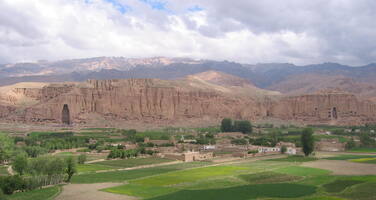
Cultural Landscape and Archaeological Remains of the Bamiyan Valley
Factors affecting the property in 2009*
- Civil unrest
- Deliberate destruction of heritage
- Illegal activities
- Other Threats:
a) Risk of imminent collapse of the Giant Buddha nichesb) Irreversible deterioration of the mural paintingse) Anti-personnel mines and unexploded ordinances (i.e. munitions)
Factors* affecting the property identified in previous reports
a) Risk of imminent collapse of the Giant Buddha niches
b) Irreversible deterioration of the mural paintings
c) Looting, illicit traffic and illegal excavations of cultural heritage assets
d) Continued use of certain heritage areas for military posts
e) Anti-personnel mines and unexploded ordinances (i.e. munitions)
Threats for which the property was inscribed on the List of World Heritage in Danger
- Risk of imminent collapse of the Giant Buddha niches;
- Irreversible deterioration of the mural paintings;
- Looting, illicit traffic and illegal excavations of cultural heritage assets;
- Continued use of certain heritage areas for military posts;
- Anti-personnel mines and unexploded ordinances (i.e. munitions).
Desired state of conservation for the removal of the property from the List of World Heritage in Danger
a) Site security ensured;
b) Long-term stability of the Giant Buddha niches ensured;
c) Adequate state of conservation of archaeological remains and mural paintings achieved;
d) Management plan and cultural master plan (the protective zoning plan) implemented.
Corrective Measures for the property
a) Ensure site security by:
(i) exerting strict control of illicit excavations and looting through hiring of adequate number of trained site guards, and
(ii) clearing unexploded ordnances and anti-personnel mines from the property;
b) Ensure long-term stability of the Giant Buddha niches by installing a permanent monitoring system;
c) Ensure adequate state of conservation of archaeological remains and mural paintings by:
(i) completing the conservation of the fragments of the Giant Buddha statues;
(ii) completing the conservation of the mural paintings in the prioritized Buddhist caves;
d) Implement the management plan and the cultural master plan (the protective zoning plan) by developing institutional capacity, notably for the Ministry of Culture and the intersectoral Bamiyan Cultural Landscape Coordination Committee (BCLCC).
Timeframe for the implementation of the corrective measures
UNESCO Extra-Budgetary Funds until 2009
Total amount provided to the property: USD 4,781,737 (2003-2010) through the Japanese Funds-in-Trust.
International Assistance: requests for the property until 2009
Total amount approved : 30,000 USD
| 2002 | Training for national and local authorities in the ... (Approved) | 30,000 USD |
Missions to the property until 2009**
No reactive monitoring missions have been carried out, but UNESCO expert missions have been sent every year since 2002 in the context of the implementation of specific projects.
Conservation issues presented to the World Heritage Committee in 2009
The Cultural Landscape and Archaeological Remains of the Bamiyan Valley was co-inscribed on the World Heritage List and World Heritage in Danger List in 2003 due to damage it sustained fromabandonment, military action and dynamite explosions. At its 32nd session (Quebec City, 2008), the World Heritage Committee had requested the State Party to develop, in consultation with the World Heritage Centre and the Advisory Bodies, a draft Statement of outstanding universal value.
As of 23 April 2009, the State Party has not yet submitted to the World Heritage Centre a progress report on the state of conservation of the property, nor a draft Statement of outstanding universal value. However, information on the current state of conservation of the property is contained in two documents prepared by UNESCO in the framework of a Japanese funded “Project for the safeguarding of the Bamiyan Site”. These include a ’Progress Report on the Bamiyan 2008 Emergency activities Plan’ (16 October 2008) and the ‘2008 Implementation Status Report on the“Safeguarding of the Bamiyan Site” project - Phase III’ (January 2009).
These reports indicate progress in implementing the corrective measures as follows:
a) Site security
From June 2008, through the Bamiyan phase III project, UNESCO has been providing support to the Ministry of Information and Culture, for the provision of security and surveillance at the property. This included overall protection for the sensitive archaeological areas, prevented illicit excavations and guarded expensive equipment left on site for planned activities in 2009. Six guards permanently monitor the property and carry out daily surveillance patrols, particularly in the area of the two Buddha niches and Shar-e-Gholgholah.
b) Demining
Activities in Bamiyan were initiated in September 2008 in cooperation with the United Nations Mine Action Centre in Afghanistan (UNMACA) and financed by the United Nations Mine Action Service (UNMAS) with separate Japanese funding. The UNESCO Kabul office, together with one UNESCO architect-archaeologist expert, and in close collaboration with the Bamiyan Governor’s Office, the Afghan Ministry of Information and Culture and the Office of the Bamiyan Chief of Police havemonitored the de-mining intervention in sensitive archaeological areas, and have documented damage done to archaeological sites or historical monuments and any archaeological objects discovered, disturbed or removed in the course of de-mining activities. They have also assisted UNMAS in prioritizing areas within the property for de-mining and ensured that UNMAS’s activities make as much allowance as possible for access by the public to archaeological sites such as Shar-e-Gholgholah, Shar-i Zohak and Dragon Valley. It is anticipated that de-mining activities will be completed by the end of 2009.
c) Long term stability of the Giant Buddha niches
UNESCO has contracted ICOMOS Germany to conduct a scientific analysis of the Buddhas niches surface fragments, with a view to their long-term preservation, and to carry out scientific tests for the consolidation of the back wall in the Small Buddha niche. With funding from the German Foreign Office, in 2008 the ICOMOS team rebuilt the partition walls in one of the caves blown up in 2001 and installed a scaffolding. These measures have created the requirements for the stabilization of the entire back wall of the Small Buddha niche. Furthermore, the ICOMOS team developed a differentiated method for the conservation of the wall with its sculptural remains and conserved the most important parts with original surface that are still in situ (right arm and sections of the robe). A scientific report with recommendations for the long-term conservation of the stone Buddha fragments and the stabilization of the Buddha niches has been produced for possible implementation in 2009.
d) Training of Afghan experts
Owing to the deterioration of the security situation in the country, which prevented the dispatching of international experts to the property in 2008, a ‘2008 Emergency Activities Plan for Bamiyan’ was developed jointly by UNESCO and the Afghan authorities. This Plan identifies the training programmes that could not be undertaken in Afghanistan and had to be held abroad. These included a six-month training programme (from late June to late December 2008) at the National Research Institute for Cultural Properties, Tokyo (NRICP) for two Afghan archaeologists. Two Afghan conservators from the Kabul National Museum were also trained in manuscript conservation (October–November 2008), through the practical conservation of about six hundred fragments of manuscripts excavated by the NRICP in Bamiyan in 2003. Moreover, a training workshop on heritage site management is under preparation together with the Aachen University, Germany, and is due to take place in Bamiyan in September 2009 (subject to appropriate security conditions), or alternatively in Aachen.
e) Cultural Master Plan
The cultural master plan was officially adopted in 2006. In 2008, the UNESCO Kabul Office participated in several inter-ministerial conferences in Bamiyan and Kabul, which were focused on sustainable policy development in Bamiyan, through the effective and integrated implementation of the cultural master plan’s guidelines and protective zones.
f) Development of the management plan
The development of a Management Plan for the World Heritage property is still in progress. Looting, illicit traffic and illegal excavations of cultural heritage assets are being addressed and progress is being made. However, due to the security situation within the country, it remains extremely difficult to ensure effective governance of the property.
g) UNESCO/ICOMOS Seventh Expert Working Group on the Preservation of Bamiyan
A meeting of the Expert Group for Bamiyan took place in June 2008 in Munich, with the participation of the Afghan authorities and experts, international experts and representatives of the World Heritage Centre and UNESCO Kabul Office. This enabled the coordination and harmonisation of ongoing activities by the various international teams working at the site, a review of the main conservation issues and the formulation of specific recommendations, available online from: https://whc.unesco.org/uploads/events/documents/event-563-1.pdf
The World Heritage Centre and the Advisory Bodies note that, despite the lack of submission of a state of conservation report by the State Party, progress towards achieving the Desired state of conservation has been made throughout 2008. However, the World Heritage Centre and the Advisory Bodies also note that the draft Statement of outstanding universal value including the conditions of integrity and authenticity, and the management plan, as requested by the World Heritage Committee at its 32nd session (Quebec City, 2008), are yet to be prepared and submitted to the World Heritage Centre. The World Heritage Centre and the Advisory Bodies will provide assistance to the State Party in preparing the Statement of outstanding universal value for the property in the framework of the upcoming periodic reporting exercise for the Asia Pacific region.
The World Heritage Centre and the Advisory Bodies acknowledge the continued technical and financial support and commitment to achieving the Desired state of conservation of Bamiyan of the international community.
Summary of the interventions
Decisions adopted by the Committee in 2009
33 COM 7A.21
Cultural Landscape and Archaeological Remains of the Bamiyan Valley (Afghanistan) (C 208 rev)
The World Heritage Committee,
1. Having examined Document WHC-09/33.COM/7A,
2. Recalling Decision 32 COM 7A.21, adopted at its 32nd session (Quebec City, 2008),
3. Takes note of the report provided by the State Party on the state of conservation of the property, as requested by the World Heritage Committee at its 32nd session;
4. Notes the efforts and commitment of the State Party and the international community for the safeguarding of this property and urges the State Party to continue its work on the corrective measures, particularly the completion of the management plan for the property;
5. Thanks the governments of Germany and Japan for their support and calls upon the international community to continue providing technical and financial support, in particular to achieve the desired state of conservation;
6. Reiterates its request to the State Party to develop, in consultation with the World Heritage Centre and Advisory Bodies, a draft Statement of Outstanding Universal Value, for examination by the World Heritage Committee;
7. Requests the State Party to submit to the World Heritage Centre by 1 February 2010 a progress report on the implementation of the corrective measures, for examination by the World Heritage Committee at its 34th session in 2010;
8. Decides to retain the Cultural Landscape and Archaeological Remains of the Bamiyan Valley (Afghanistan) on the List of World Heritage in Danger.
33 COM 8C.2
Update of the List of World Heritage in Danger
The World Heritage Committee,
1. Following the examination of the state of conservation reports of properties inscribed on the List of World Heritage in Danger (WHC-09/33.COM/7A, WHC-09/33.COM/7A.Add and WHC-09/33.COM/7A.Add.2, WHC-09/33.COM/7A.Corr),
2. Decides to maintain the following properties on the List of World Heritage in Danger:
- Afghanistan, Minaret and Archaeological Remains of Jam (Decision 33 COM 7A.20)
- Afghanistan, Cultural Landscape and Archaeological Remains of the Bamiyan Valley, (Decision 33 COM 7A.21)
- Central African Republic, Manovo-Gounda St Floris National Park (Decision 33 COM 7A.1)
- Chile, Humberstone and Santa Laura Saltpeter Works (Decision 33 COM 7A.28)
- Côte d'Ivoire, Comoé National Park (Decision 33 COM 7A.2)
- Côte d'Ivoire / Guinea, Mount Nimba Strict Nature Reserve (Decision 33 COM 7A.3)
- Democratic Rep. of the Congo, Virunga National Park (Decision 33 COM 7A.4)
- Democratic Rep. of the Congo, Kahuzi-Biega National Park (Decision 33 COM 7A.5)
- Democratic Rep. of the Congo, Garamba National Park (Decision 33 COM 7A.6)
- Democratic Rep. of the Congo, Salonga National Park (Decision 33 COM 7A.7)
- Democratic Rep. of the Congo, Okapi Wildlife Reserve (Decision 33 COM 7A.8)
- Ecuador, Galápagos Islands (Decision 33 COM 7A.13)
- Egypt, Abu Mena (Decision 33 COM 7A.15)
- Ethiopia, Simien National Park (Decision 33 COM 7A.9)
- India, Manas Wildlife Sanctuary (Decision 33 COM 7A.12)
- Iraq, Ashur (Qal'at Sherqat) (Decision 33 COM 7A.16)
- Iraq, Samarra Archaeological City (Decision 33 COM 7A.17)
- Islamic Republic of Iran, Bam and its Cultural Landscape (Decision 33 COM 7A.22)
- Jerusalem, Old City of Jerusalem and its Walls (Decision 33 COM 7A.18)
- Niger, Air and Ténéré Natural Reserves (Decision 33 COM 7A.10)
- Pakistan, Fort and Shalamar Gardens in Lahore (Decision 33 COM 7A.23)
- Peru, Chan Chan Archaelogical Zone (Decision 33 COM 7A.29)
- Philippines, Rice Terraces of the Philippine Cordilleras (Decision 33 COM 7A.24)
- Senegal, Niokolo Koba National Park (Decision 33 COM 7A.11)
- Serbia, Medieval Monuments in Kosovo (Decision 33 COM 7A.27)
- United Republic of Tanzania, Ruins of Kilwa Kisiwani and Ruins of Songo Mnara (Decision 33 COM 7A.14)
- Venezuela, Coro and its Port (Decision 33 COM 7A.30)
- Yemen, Historic Town of Zabid (Decision 33 COM 7A.19 )
Draft Decision: 33 COM 7A.21
The World Heritage Committee,
1. Having examined Document WHC-09/33.COM/7A,
2. Recalling Decision 32 COM 7A.21, adopted at its 32nd session (Quebec City, 2008),
3. Regrets that the State Party did not submit the state of conservation report, as requested by the World Heritage Committee at its 32nd session;
4. Notes the efforts and commitment of the State Party and the international community for the safeguarding of this property and urges the State Party to continue its work on the corrective measures, particularly the completion of the management plan for the property;
5. Calls upon the international community to continue providing technical and financial support, in particular to achieve the Desired state of conservation;
6. Reiterates its request to the State Party to develop, in consultation with the World Heritage Centre and Advisory Bodies, a draft Statement of outstanding universal value including the conditions of integrity and authenticity, for examination by the World Heritage Committee;
7. Requests the State Party to submit to the World Heritage Centre by 1 February 2010 a progress report on the implementation of the corrective measures, for examination by the World Heritage Committee at its 34th session in 2010;
8. Decides to retain the Cultural Landscape and Archaeological Remains of the Bamiyan Valley (Afghanistan) on the List of World Heritage in Danger.
 Afghanistan
Exports
* :
The threats indicated are listed in alphabetical order; their order does not constitute a classification according to the importance of their impact on the property.
Furthermore, they are presented irrespective of the type of threat faced by the property, i.e. with specific and proven imminent danger (“ascertained danger”) or with threats which could have deleterious effects on the property’s Outstanding Universal Value (“potential danger”).
** : All mission reports are not always available electronically.