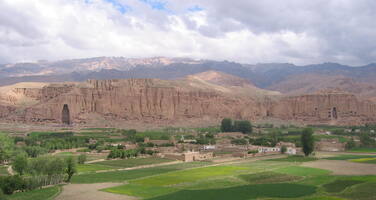
Cultural Landscape and Archaeological Remains of the Bamiyan Valley
Factors affecting the property in 2012*
- Civil unrest
- Illegal activities
- Other Threats:
Risk of imminent collapse of the Giant Buddha niches; Irreversible deterioration of the mural paintings; Anti-personnel mines and unexploded ordinances (i.e. munitions).
Factors* affecting the property identified in previous reports
- Risk of imminent collapse of the Giant Buddha niches
- Irreversible deterioration of the mural paintings
- Looting, illicit traffic and illegal excavations of cultural heritage assets
- Continued use of certain heritage areas for military posts
- Anti-personnel mines and unexploded ordinances (i.e. munitions)
Threats for which the property was inscribed on the List of World Heritage in Danger
- Site security not ensured
- Long-term stability of the Giant Buddha niches not ensured
- State of conservation of archaeological remains and mural paintings not adequate
- Management Plan and Cultural Master Plan (the protective zoning plan) not implemented
Desired state of conservation for the removal of the property from the List of World Heritage in Danger
Adopted, See page https://whc.unesco.org/en/list/208/documents
Corrective Measures for the property
Adopted, See page https://whc.unesco.org/en/list/208/documents
Timeframe for the implementation of the corrective measures
UNESCO Extra-Budgetary Funds until 2012
Total amount provided to the property: USD 4,781,737 (2003-2011) through the Japanese Funds-in-Trust.
International Assistance: requests for the property until 2012
Total amount approved : 30,000 USD
| 2002 | Training for national and local authorities in the ... (Approved) | 30,000 USD |
Missions to the property until 2012**
No reactive monitoring mission was carried out; November 2010: World Heritage Centre/ICCROM advisory mission; April 2011: UNESCO Kabul/ICOMOS advisory mission; UNESCO expert missions in the context of the implementation of specific projects.
Conservation issues presented to the World Heritage Committee in 2012
No state of conservation report has been submitted by the State Party as of 20 April 2012. However, information was obtained from technical reports of the UNESCO/ Japanese Funds-In-Trust for the Preservation of the World Cultural Heritage of Bamiyan, Phase III project, and presentations made at the Tenth Bamiyan Expert Working Group Meeting held in Tokyo, Japan, from 6 to 8 December 2011. With regard to the implementation of the corrective measures, the following progress has been noted:
a) Ensure site security
It has been suggested to the State Party to undertake public awareness-raising and education programs in order to address the illicit traffic of antiquities; and further recommended the incorporation of recent excavations into the site security plan (e.g. MO/Oriental Monastery, MR/ Royal Monastery). This public awareness-raising activity had been organised in Bamiyan in mid June 2012.
b) Ensure long-term stability of the Giant Buddha niches and installation of a permanent monitoring system
The World Heritage Centre and the Advisory Bodies were informed that accessibility to the lower gallery of the Eastern Buddha niche should be improved for safety purposes and that, although emergency stabilisation works on the Western Buddha had commenced since September 2011, urgent consolidations still needed to be undertaken, in particular at the entrance of the western niche, where a crack was subject to constant seismic vibration and in danger of imminent collapse.
c) Ensure adequate state of conservation of archaeological remains and mural paintings
Although the National Research Institute for Cultural Properties (NRICP), Tokyo, in close collaboration with national conservation technicians had undertaken and ensured some successful conservation of mural paintings in the Bamiyan cliff, these activities should be extended. Additional measures required include the identification and execution of emergency conservation actions for mural paintings as well as the archaeological investigation, cleaning, drainage, repairing and protection of archaeological remains, which should also be extended to other sites, notably for Shar-i-Zohak, Shar-i-Gholghola, Quala-i-Kaphari, Kakrak and Foladi. It has been reported the progressing land purchases by Afghan authorities, including lands which contain archaeological remains in Bamiyan Valley, particularly the sites recently excavated by the French archaeological mission.
d) Implement the Management Plan and the Cultural Master Plan
Progress is noted of the production of the first Annual Progress Report (June 2010-June 2011) for the Preparation of a Management Plan for the Cultural Landscape and Archaeological Remains of the Bamiyan Valley, developed by experts of Aachen University (Germany) in close consultation with the local authorities in November 2011. They consider that a prerequisite in this process is the completion of an archaeological sites map which should be cross-read with the Cultural Master Plan in order to avoid damage to potentially embedded archaeological remains.
e) Interventions on two main niches where statues were destroyed
There has been no progress made in regard to the various propositions made by the different experts on potential interventions to the two main niches and their presentation.
f) Proposed development projects, notably the Foladi road construction
According to the information made available by UNOPS, the proposed road construction in Foladi Valley is to improve the critical road system in Bamiyan in order to Increase market access and opportunities for rural households, thereby contributing to the reduction of poverty and vulnerability in Foladi Valley, Bamyan. In addition, the World Heritage Centre had brought to the attention of the State Party that any planned development should be submitted and reviewed prior to taking any decisions that might be difficult to reverse in line with Paragraph 172 of the Operational Guidelines.
g) Approval of the Bamiyan phase IV project
The UNESCO/ Japanese Funds-In-Trust for the Preservation of the World Cultural Heritage of Bamiyan, Phase IV project, totalling USD 1.5 million for the period 2012- 2014, has been approved and is operational since late March 2012. The funds are to be used to implement a programme to safeguard the setting of the ‘Cultural Landscape and Archaeological Remains of the Bamiyan Valley’ World Heritage property.
Outcome of the Tenth Expert Working Group Meeting (Tokyo, 6 – 8 December 2011)
The Tenth Expert Working Group meeting organized in Tokyo, Japan from 6 to 8 December 2011 discussed the current initiatives for the conservation and sustainable management of the property and considered these to be fully in line with the UNDAF (United Nations Assistance Development Framework) and the Afghan National Development Strategy. The conservation of the property was regarded to contribute to the promotion of peace and foster sustainable development for the Afghan people. Finally, it was proposed to redefine the timeframe for the Desired State of Conservation and the removal from the List of World Heritage in Danger over a longer period than initially anticipated (2013).
Analysis and Conclusion by World Heritage Centre and the Advisory Bodies in 2012
The World Heritage Centre and the Advisory Bodies note that the State Party did not submit a state of conservation report, but consider, as per information received from other sources, that the progress made by the State Party to ensure site security is satisfactory; however the size of the security force could be increased.
In this context, the World Heritage Centre and the Advisory Bodies are of the view that during the finalization of the Management Plan, the Cultural Master Plan and the Annual Progress Report (June 2010-June 2011) for the preparation of a Management Plan, should be shared with all the national and international actors, and should function as a reference for the overall development strategy for the valley. They also reiterate the importance of enforcing building codes and controls on development in the property boundary and its buffer zones and other areas protected under the Afghan Law on the Protection of Historical and Cultural Properties 2004.
The World Heritage Centre and the Advisory Bodies note that no progress has been made on developing an approach on the presentation of the two Buddha niches, and stress the need for proposals to be based on factors indicated in Decision 35 COM 7A.25.
The World Heritage Centre and the Advisory Bodies recommend that the Committee recall that it is essential that any decision on the proposed development projects should be based on a Heritage Impact Assessment (HIA), in conformity with the ICOMOS Guidelines on Heritage Impact Assessments for World Heritage cultural properties, and be considered in the framework of the on-going development of the Management Plan.
They further note that as an outcome of the above Tenth Expert Working Group meeting the previously proposed timeline of 2013 for implementing the corrective measures cannot be reached and has to be revised and postponed, so as to gradually attain the Desired State of Conservation for removal of the property from the List of World Heritage in Danger.
Summary of the interventions
Decisions adopted by the Committee in 2012
36 COM 7A.26
Cultural Landscape and Archaeological Remains of the Bamiyan Valley (Afghanistan) (C 208 rev)
The World Heritage Committee,
1. Having examined Document WHC-12/36.COM/7A.Add,
2. Recalling Decision 35 COM 7A.25, adopted at its 35th session (UNESCO, 2011),
3. Regrets that no report was submitted by the State Party, as requested by the World Heritage Committee at its 35th session (UNESCO, 2011);
4. Notes the production of the first Annual Progress Report (June 2010-June 2011) for the Preparation of a Management Plan for Cultural Landscape and Archaeological Remains of the Bamiyan Valley;
5. Urges the State Party to finalise the Management Plan of the Cultural Landscape and Archaeological Remains of the Bamiyan Valley with an overall strategy of managing the property as a Cultural Landscape;
6. Reiterates its request to the State Party, when considering options for the treatment of the Buddha niches, to ensure that proposals are based on feasibility studies which include:
a) An overall approach to conservation and presentation of the property,
b) An appropriate conservation philosophy based on the Outstanding Universal Value of the property,
c) Technical and financial possibilities for the implementation of the project proposals;
7. Also reiterates its request to the State Party to submit information on any planned development, in particular the proposed Foladi Valley Road, to the World Heritage Centre for review by the Advisory Bodies, including a Heritage Impact Assessment (HIA) in conformity with the ICOMOS Guidelines on Heritage Impact Assessments for World Heritage cultural properties;
8. Also urges the State Party to ensure that the Cultural Master Plan is respected by all national and international actors intervening in the valley; and further urges the State Party to enforce building codes and regulations on development in the buffer zones of the property and other areas protected under the Afghan Law on the Protection of Historical and Cultural Properties 2004;
9. Requests the State Party to continue its work on the implementation of the adopted corrective measures and to develop, in consultation with the World Heritage Centre and the Advisory Bodies, a revised timeframe for the implementation of the corrective measures, for examination by the World Heritage Committee at its 37th session in 2013;
10. Calls upon the international community to continue providing technical and financial support for the protection and management of the property, in order to achieve the Desired state of conservation;
11. Also requests the State Party to submit to the World Heritage Centre, by 1 February 2013, an updated report on the state of conservation of the property and the implementation of the above, for examination by the World Heritage Committee at its 37th session in 2013;
12. Decides to retain the Cultural Landscape and Archaeological Remains of the Bamiyan Valley (Afghanistan) on the List of World Heritage in Danger.
36 COM 8C.2
Establishment of the World Heritage List in Danger (Maintained Properties)
The World Heritage Committee,
1. Following the examination of the state of conservation reports of properties inscribed on the List of World Heritage in Danger (WHC-12/36.COM/7A and WHC-12/36.COM/7A.Add),
2. Decides to maintain the following properties on the List of World Heritage in Danger:
- Afghanistan, Minaret and Archaeological Remains of Jam (Decision 36 COM 7A.25)
- Afghanistan, Cultural Landscape and Archaeological Remains of the Bamiyan Valley (Decision 36 COM 7A.26)
- Belize, Belize Barrier Reef Reserve System (Decision 36 COM 7A.15)
- Central African Republic, Manovo-Gounda St Floris National Park (Decision 36 COM 7A.1)
- Chile, Humberstone and Santa Laura Saltpeter Works (Decision 36 COM 7A.33)
- Colombia, Los Katíos National Park (Decision 36 COM 7A.16)
- Côte d'Ivoire, Comoé National Park (Decision 36 COM 7A.2)
- Côte d'Ivoire / Guinea, Mount Nimba Strict Nature Reserve (Decision 36 COM 7A.3)
- Democratic Rep. of the Congo, Virunga National Park (Decision 36 COM 7A.4)
- Democratic Rep. of the Congo, Kahuzi-Biega National Park (Decision 36 COM 7A.5)
- Democratic Rep. of the Congo, Garamba National Park (Decision 36 COM 7A.6)
- Democratic Rep. of the Congo, Salonga National Park (Decision 36 COM 7A.7)
- Democratic Rep. of the Congo, Okapi Wildlife Reserve (Decision 36 COM 7A.8)
- Egypt, Abu Mena (Decision 36 COM 7A.20)
- Ethiopia, Simien National Park (Decision 36 COM 7A.9)
- Georgia, Bagrati Cathedral and Gelati Monastery (Decision 36 COM 7A.30)
- Georgia, Historical Monuments of Mtskheta (Decision 36 COM 7A.31)
- Honduras, Río Plátano Biosphere Reserve (Decision 36 COM 7A.17)
- Indonesia, Tropical Rainforest Heritage of Sumatra (Decision 36 COM 7A.13)
- Iraq, Ashur (Qal'at Sherqat) (Decision 36 COM 7A.21)
- Iraq, Samarra Archaeological City (Decision 36 COM 7A.22)
- Islamic Republic of Iran, Bam and its Cultural Landscape (Decision 36 COM 7A.27)
- Jerusalem, Old City of Jerusalem and its Walls (Decision 36 COM 7A.23.I)
- Madagascar, Rainforests of the Atsinanana (Decision 36 COM 7A.10)
- Niger, Air and Ténéré Natural Reserves (Decision 36 COM 7A.11)
- Peru, Chan Chan Archaelogical Zone (Decision 36 COM 7A.34)
- Senegal, Niokolo-Koba National Park (Decision 36 COM 7A.12)
- Serbia, Medieval Monuments in Kosovo (Decision 36 COM 7A.32)
- United Rep. of Tanzania, Ruins of Kilwa Kisiwani and Ruins of Songo Mnara (Decision 36 COM 7A.19)
- Uganda, Tombs of Buganda Kings at Kasubi (Decision 36 COM 7A.18)
- United States of America, Everglades National Park (Decision 36 COM 7A.14)
- Venezuela, Coro and its Port (Decision 36 COM 7A.35)
- Yemen, Historic Town of Zabid (Decision 36 COM 7A.24)
Draft Decision: 36 COM 7A.26
The World Heritage Committee,
1. Having examined Document WHC-12/36.COM/7A.Add,
2. Recalling Decision 35 COM 7A.25, adopted at its 35th session (UNESCO, 2011),
3. Regrets that no report was submitted by the State Party, as requested by the World Heritage Committee at its 35th session (UNESCO, 2011);
4. Notes the production of the first Annual Progress Report (June 2010-June 2011) for the Preparation of a Management Plan for Cultural Landscape and Archaeological Remains of the Bamiyan Valley;
5. Urges the State Party to finalise the Management Plan of the Cultural Landscape and Archaeological Remains of the Bamiyan Valley with an overall strategy of managing the property as a Cultural Landscape;
6. Reiterates its request to the State Party, when considering options for the treatment of the Buddha niches, to ensure that proposals are based on feasibility studies which include:
a) an overall approach to conservation and presentation of the property,
b) an appropriate conservation philosophy based on the Outstanding Universal Value of the property,
c) technical and financial possibilities for the implementation of the project proposals;
7. Also reiterates its request to the State Party to submit information on any planned development, in particular the proposed Foladi Valley Road, to the World Heritage Centre for review by the Advisory Bodies, including a Heritage Impact Assessment (HIA) in conformity with the ICOMOS Guidelines on Heritage Impact Assessments for World Heritage cultural properties;
8. Also urges the State Party to ensure that the Cultural Master Plan is respected by all national and international actors intervening in the valley; and further urges the State Party to enforce building codes and regulations on development in the buffer zones of the property and other areas protected under the Afghan Law on the Protection of Historical and Cultural Properties 2004;
9. Requests the State Party to continue its work on the implementation of the adopted corrective measures and to develop, in consultation with the World Heritage Centre and the Advisory Bodies, a revised timeframe for the implementation of the corrective measures, for examination by the World Heritage Committee at its 37th session in 2013;
10. Calls upon the international community to continue providing technical and financial support for the protection and management of the property, in order to achieve the Desired state of conservation;
11. Also requests the State Party to submit to the World Heritage Centre, by 1 February 2013, an updated report on the state of conservation of the property and the implementation of the above, for examination by the World Heritage Committee at its 37th session in 2013.
12. Decides to retain the Cultural Landscape and Archaeological Remains of the Bamiyan Valley (Afghanistan) on the List of World Heritage in Danger.
 Afghanistan
Exports
* :
The threats indicated are listed in alphabetical order; their order does not constitute a classification according to the importance of their impact on the property.
Furthermore, they are presented irrespective of the type of threat faced by the property, i.e. with specific and proven imminent danger (“ascertained danger”) or with threats which could have deleterious effects on the property’s Outstanding Universal Value (“potential danger”).
** : All mission reports are not always available electronically.