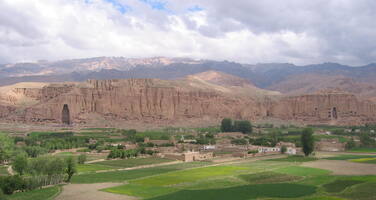
Cultural Landscape and Archaeological Remains of the Bamiyan Valley
Factors affecting the property in 2010*
- Civil unrest
- Illegal activities
- Other Threats:
Risk of imminent collapse of the Giant Buddha niches; Irreversible deterioration of the mural paintings; Anti-personnel mines and unexploded ordinances (i.e. munitions)
Factors* affecting the property identified in previous reports
- Risk of imminent collapse of the Giant Buddha niches
- Irreversible deterioration of the mural paintings
- Looting, illicit traffic and illegal excavations of cultural heritage assets
- Continued use of certain heritage areas for military posts
- Anti-personnel mines and unexploded ordinances (i.e. munitions)
Threats for which the property was inscribed on the List of World Heritage in Danger
- Risk of imminent collapse of the Giant Buddha niches
- Irreversible deterioration of the mural paintings
- Looting, illicit traffic and illegal excavations of cultural heritage assets
- Continued use of certain heritage areas for military posts
- Anti-personnel mines and unexploded ordinances (i.e. munitions)
Desired state of conservation for the removal of the property from the List of World Heritage in Danger
a) Site security ensured;
b) Long-term stability of the Giant Buddha niches ensured;
c) Adequate state of conservation of archaeological remains and mural paintings achieved;
d) Management Plan and Cultural Master Plan (the protective zoning plan) implemented.
Corrective Measures for the property
a) Ensure site security by:
(i) exerting strict control of illicit excavations and looting through hiring of adequate number of trained site guards, and
(ii) clearing unexploded ordnances and anti-personnel mines from the property;
b) Ensure long-term stability of the Giant Buddha niches by installing a permanent monitoring system;
c) Ensure adequate state of conservation of archaeological remains and mural paintings by:
(i) completing the conservation of the fragments of the Giant Buddha statues;
(ii) completing the conservation of the mural paintings in the prioritized Buddhist caves;
d) Implement the Management Plan and the Cultural Master Plan (the protective zoning plan) by developing institutional capacity, notably for the Ministry of Culture and the intersectoral Bamiyan Cultural Landscape Coordination Committee (BCLCC).
Timeframe for the implementation of the corrective measures
UNESCO Extra-Budgetary Funds until 2010
Total amount provided to the property: USD 4,781,737 (2003-2010) through the Japanese Funds-in-Trust.
International Assistance: requests for the property until 2010
Total amount approved : 30,000 USD
| 2002 | Training for national and local authorities in the ... (Approved) | 30,000 USD |
Missions to the property until 2010**
No reactive monitoring missions have been carried out, but UNESCO expert missions have been sent every year since 2002 in the context of the implementation of specific projects.
Conservation issues presented to the World Heritage Committee in 2010
At the time of drafting the present document (10 May 2010), the State Party had not submitted to the World Heritage Centre a progress report on the state of conservation of the property, nor a draft Statement of Outstanding Universal Value, as requested by the World Heritage Committee at its 33rd session (Seville, 2009). However, information on the current state of conservation of the property can be obtained from a UNESCO report prepared in consequence of an ongoing Japanese funded project to safeguard Bamiyan, in addition to presentations made, and discussions held, during the Eighth Bamiyan Expert Group Meeting on 25-26 March 2010 in Munich, Germany.
Within the framework of the project, six expert missions visited Bamiyan between June and October 2009, to carry out a number of activities (see below). The World Heritage Centre and the UNESCO Kabul office, in close cooperation with the Afghan Ministry of Culture and Information, the Ministry of Urban Development, and the Bamiyan provincial authorities, implemented these activities.
The emerging report, and presentations by Afghan and international experts at the Eighth Bamiyan Expert Group Meeting, indicated progress in implementing corrective measures as follows:
a) Ensuring site security
One of the most important developments in 2009 was the complete de-mining of the BamiyanValley. This was achieved through cooperation with UNESCO, the United Nations Mine Action Centre for Afghanistan (UNMACA), the Afghan authorities, and the UN Mine Action Service (UNMAS). Archaeological parts of the property that were heavily mined, included Shar-i-Zohak, Shar-i-Ghulghulah and the top of the Buddha Cliffs, and these areas are now cleared and accessible to specialists and visitors.
In order to ensure overall protection for the sensitive archaeological areas, prevent illicit excavations, and to safeguard the on-site expensive equipment required for conservation activities, UNESCO has continued to provide financial support for the provision of site security and surveillance.
The World Heritage Centre and Advisory Bodies greatly welcome the completion of the de-mining operations as this will make it possible to initiate surveys, and implement priority conservation measures, in previously inaccessible areas. A sustainable solution must be found regarding site security and surveillance where Afghan authorities should provide for the guards’ salaries. UNESCO cannot continue to subsidise this cost over the long term.
b) Ensuring the structural stability of the two standing Giant Buddha niches
In 2009, consolidation of the back wall of the Small Buddha niche was almost completed by means of inserting fibre-glass and stainless steel dowels, and drilled wall anchors. Work also commenced to ensure the safety of access paths and stairs on the Eastern Buddha niche, in addition to the upper crossing behind the Buddha statue. This work, together with the installation of a hoist/crane inside the Eastern Buddha niche to allow for future maintenance and conservation, should be completed in 2010.
The World Heritage Centre and Advisory Bodies note the significant progress made to ensure the structural stability of the Eastern Buddha niche, and requests that the design proposals for the installation of a crane in the niche be shared with them before its construction begins. They also request that, resources permitting, as soon as stabilization of the Eastern Buddha niche is completed, work should start on the Western Buddha niche.
c) Adequate state of conservation of archaeological remains and mural paintings
In close collaboration with the Ministry of Information and Culture of the Islamic Republic of Afghanistan (MoIC) the National Research Institute for Cultural Properties (NRICPT), Tokyo, conducted a mission for the conservation of the Bamiyan mural paintings from 26 June - 9 July 2009, The mission enabled post-conservation monitoring of the condition of mural paintings located inside caves in addition to re-arranging the movable cultural property pieces stored in the Bamiyan Cultural Heritage Training Centre. NRICPT also provided a four-month training programme in Japan for two Afghan archaeologists from the Institute of Archaeology in archaeological, conservation and documentation techniques (from late July to end November 2009).
The World Heritage Centre and Advisory Bodies note the progress made in the conservation of selected caves in the vicinity of the Buddha niches, and welcomes the training of two Afghan archaeologists. With the eight component sites of the World Heritage property having been de-mined, urgent condition assessments should be carried out to plan for, and implement, emergency conservation measures.
d) Implementation of the Management Plan and Cultural Master Plan (the protective zoning plan)
A UNESCO technical advisory mission was carried out in June 2009, to assist the Afghan authorities in the development and implementation of the Management Plan for the property, and of the so-called Cultural Master Plan for Bamiyan (a zoning plan for the entire valley). Discussions included opportunities for developing synergies with a New Zealand funded Bamiyan Eco-tourism Programme being carried out by the Aga Khan Trust for Culture (AKTC). Subsequently, in September 2009, a training workshop on World Heritage management planning was held in Bamiyan. This was co-organised by UNESCO and the AKTC Bamiyan office and involved 50 Afghan cultural heritage professionals, the Governor of Bamiyan and the deputy Minister for Culture, in addition to representatives from the University of Bamiyan, the local community, and the Bamiyan Council leaders (Shura).
The World Heritage and Advisory Bodies welcome the progress being made in building capacity on heritage management planning by Afghan officials. Now that all components of the World Heritage property are accessible, it is hoped that progress on the development of a management plan will be possible. The World Heritage and Advisory Bodies consider that the Cultural Master Plan provisions, including development controls on the cultural landscape, should be urgently and officially adopted and enforced.
Other important developments emerging from the Eighth Meeting of the Expert Group, enabled the coordination and harmonization of ongoing activities by various international teams working at the site; a review of the main conservation issues; and the formulation of specific recommendations, accessible online (see above in “Illustrative material”). Based on the outcomes of this meeting, and with regard to the corrective measures adopted by the World Heritage Committee, the Afghan authorities consider that the desired state of conservation for the property in view of its possible removal from the List of World Heritage in Danger could be achieved by 2013.
Another important outcome of the Munich meeting was the preliminary discussion on possible long–term solutions for the conservation, presentation and interpretation of the Buddha niches that could follow their structural stabilization. In order to gain the support of the local community, there was a general meeting consensus that it was necessary to move from the present phase of studies and consolidation to more visible activities. Different options were discussed, ranging from the anastylosis of the fragments, where possible, to alternative solutions that would restore the ‘image’ of the two statues, without physically reconstructing them. However, any proposal for the conservation and presentation of the two Buddha niches would have to be discussed and based on complete studies and scientific analyses, illustrated by appropriate graphic means, and shared amongst specialists in the Expert Group, in addition to the World Heritage Centre and Afghan authorities. The World Heritage Committee should also be informed of any major restoration plan affecting the property. With a view to discussing further possible options, and if security conditions allow, the Afghan authorities expressed a wish to receive an advisory mission by the World Heritage Centre, ICOMOS and ICCROM during Autumn 2010.
Finally, the Expert Group Meeting recommended the creation of a site interpretation area, where some restored fragments could be exposed, and a larger Museum for the BamiyanValley, to present the property in its broader geo-cultural context. UNESCO will take all of the suggestions emerging from the Meeting into account in planning a possible fourth phase of the project, to start in 2011, with funding from Japan.
The World Heritage Centre and Advisory Bodies note the significant progress made throughout 2009 – 2010 towards achieving the ‘Desired state of conservation’. However, they regret that the State Party did not submit the requested report and draft Statement of Outstanding Universal Value. With regard to the latter, the World Heritage Centre and Advisory Bodies will provide assistance to the State Party in the framework of the upcoming Periodic Reporting exercise for the Asia Pacific region.
The World Heritage Centre and Advisory Bodies welcome the recommendations made by the Expert Group. In particular, they consider that - if security conditions allow - the suggested joint mission to provide technical advice on long-term directions for the conservation and presentation of the property, notably of the two Buddha niches, would be very helpful. In this regard, the World Heritage Centre and Advisory Bodies note the provisions of Paragraph 172 of the Operational Guidelines, requiring that information on any major restoration project or activity affecting the property be provided to the World Heritage Committee, via the World Heritage Centre, “before making any decisions that would be difficult to reverse”.
Summary of the interventions
Decisions adopted by the Committee in 2010
34 COM 7A.23
Cultural Landscape and Archaeological Remains of the Bamiyan Valley (Afghanistan) (C 208 rev)
The World Heritage Committee,
1. Having examined Document WHC-10/34.COM/7A.Add,
2. Recalling Decision 33 COM 7A.21, adopted at its 33rd session (Seville, 2009),
3. Regrets that the State Party did not submit a state of conservation report and a draft Statement of Outstanding Universal Value, as requested by the World Heritage Committee at its 33rd session (Seville, 2009);
4. Notes the efforts and commitment of the State Party, and the international community, for safeguarding the property, notably by completing the de-mining of the eight component sites, consolidating the eastern Buddha niche, and conserving mural paintings;
5. Urges the State Party to continue its work on the corrective measures, particularly with the completion of the management plan for the property, the urgent official adoption and enforcement of the Cultural Master Plan, and the identification of appropriate resources for maintaining guardianship at the site;
6. Also notes that the State Party proposes 2013 as the timeframe for reaching the Desired State of Conservation for removal of the property from the List of World Heritage in Danger;
7. Calls upon the international community to continue providing technical and financial support, in particular to achieve the Desired State of Conservation;
8. Reiterates its request to the State Party to develop, in consultation with the World Heritage Centre and the Advisory Bodies, a draft Statement of Outstanding Universal Value, including the conditions of integrity and authenticity, for examination by the World Heritage Committee;
9. Also reiterates its request to the State Party, in line with the provisions of Paragraph 172 of the Operational Guidelines, to inform the World Heritage Centre of any proposed restoration or new construction within the property, before making any decision that would be difficult to reverse, and requests that the design proposals for the installation of a crane in the eastern Buddha niche be shared with the World Heritage Centre before its construction begins;
10. Welcomes the State Party's invitation of a joint World Heritage Centre /ICOMOS /ICCROM advisory mission to the property in 2010 to assist the State Party to identify long-term solutions for the Buddha niches, if security conditions allow;
11. Also requests the State Party to submit to the World Heritage Centre, by 1 February 2011, a progress report on the implementation of the corrective measures, for examination by the World Heritage Committee at its 35th session in 2011;
12. Decides to retain the Cultural Landscape and Archaeological Remains of the Bamiyan Valley (Afghanistan) on the List of World Heritage in Danger.
34 COM 8C.2
Establishment of the World Heritage List in Danger (Retained Properties)
The World Heritage Committee,
1. Following the examination of the state of conservation reports of properties inscribed on the List of World Heritage in Danger (WHC-10/34.COM/7A, WHC-10/34.COM/7A.Add and WHC-10/34.COM/7A.Add.2),
2. Decides to retain the following properties on the List of World Heritage in Danger:
- Afghanistan, Minaret and Archaeological Remains of Jam (Decision 34 COM 7A.22)
- Afghanistan, Cultural Landscape and Archaeological Remains of the Bamiyan Valley (Decision 34 COM 7A.23)
- Belize, Belize Barrier Reef Reserve System (Decision 34 COM 7A.13)
- Central African Republic, Manovo-Gounda St Floris National Park (Decision 34 COM 7A.1)
- Chile, Humberstone and Santa Laura Saltpeter Works (Decision 34 COM 7A.29)
- Colombia, Los Katios National Park (Decision 34 COM 7A.14)
- Côte d'Ivoire, Comoé National Park (Decision 34 COM 7A.2)
- Côte d'Ivoire / Guinea, Mount Nimba Strict Nature Reserve (Decision 34 COM 7A.3)
- Democratic Rep. of the Congo Virunga National Park (Decision 34 COM 7A.4)
- Democratic Rep. of the Congo Kahuzi-Biega National Park (Decision 34 COM 7A.5)
- Democratic Rep. of the Congo Garamba National Park (Decision 34 COM 7A.6)
- Democratic Rep. of the Congo Salonga National Park (Decision 34 COM 7A.7)
- Democratic Rep. of the Congo, Okapi Wildlife Reserve (Decision 34 COM 7A.8)
- Egypt, Abu Mena (Decision 34 COM 7A.17)
- Ethiopia, Simien National Park (Decision 34 COM 7A.9)
- Georgia, Historical Monuments of Mtskheta (Decision 34 COM 7A.27)
- India, Manas Wildlife Sanctuary (Decision 34 COM 7A.12)
- Iraq, Ashur (Qal'at Sherqat) (Decision 34 COM 7A.18)
- Iraq, Samarra Archaeological City (Decision 34 COM 7A.19)
- Islamic Republic of Iran, Bam and its Cultural Landscape (Decision 34 COM 7A.24)
- Jerusalem, Old City of Jerusalem and its Walls (Decision 34 COM 7A.20)
- Niger, Air and Ténéré Natural Reserves (Decision 34 COM 7A.10)
- Pakistan, Fort and Shalamar Gardens in Lahore (Decision 34 COM 7A.25)
- Peru, Chan Chan Archaelogical Zone (Decision 34 COM 7A.30)
- Philippines, Rice Terraces of the Philippine Cordilleras (Decision 34 COM 7A.26)
- Senegal, Niokolo Koba National Park (Decision 34 COM 7A.11)
- Serbia, Medieval Monuments in Kosovo (Decision 34 COM 7A.28)
- United Republic of Tanzania, Ruins of Kilwa Kisiwani and Ruins of Songo Mnara (Decision 34 COM 7A.16)
- Venezuela, Coro and its Port (Decision 34 COM 7A.31)
- Yemen, Historic Town of Zabid (Decision 34 COM 7A.21)
Draft Decision: 34 COM 7A.23
The World Heritage Committee,
1. Having examined Document WHC-10/34.COM/7A.Add,
2. Recalling Decision 33 COM 7A.23, adopted at its 33rd session (Seville, 2009),
3. Regrets that the State Party did not submit a state of conservation report and a draft Statement of Outstanding Universal Value, as requested by the World Heritage Committee at its 33rd session (Seville, 2009);
4. Notes the efforts and commitment of the State Party, and the international community, for safeguarding the property, notably by completing the de-mining of the eight component sites, consolidating the eastern Buddha niche, and conserving mural paintings;
5. Urges the State party to continue its work on the corrective measures, particularly with the completion of the management plan for the property; the urgent official adoption and enforcement of the Cultural Master Plan, and identifying appropriate resources for maintaining guardianship at the site;
6. Also notes that the State Party proposes 2013 as the timeframe for reaching the Desired state of conservation for removal of the property from the List of World Heritage in Danger;
7. Calls upon the international community to continue providing technical and financial support, in particular to achieve the Desired state of conservation;
8. Reiterates its request to the State Party to develop, in consultation with the World Heritage Centre and Advisory Bodies, a draft Statement of Outstanding Universal Value, including the conditions of integrity and authenticity, for examination by the World Heritage Committee;
9. Also reiterates its request to the State Party, in line with the provisions of Paragraph 172 of the Operational Guidelines, to inform the World Heritage Centre of any proposed restoration or new construction within the property, before making any decision that would be difficult to reverse, and requests that the design proposals for the installation of a crane in the Eastern Buddha niche be shared with the World Heritage Centre before its construction begins;
10. Welcomes the State Party’s invitation of a joint World Heritage Centre/ICOMOS /ICCROM advisory mission to the property in 2010 to assist the State Party to identify long–term solutions for the Buddha niches, if security conditions allow;
11. Also requests the State Party to submit to the World Heritage Centre by 1 February 2011 a progress report on the implementation of the corrective measures, for examination by the World Heritage Committee at its 35th session in 2011;
12. Decides to retain the Cultural Landscape and Archaeological Remains of the Bamiyan Valley (Afghanistan) on the List of World Heritage in Danger.
 Afghanistan
Exports
* :
The threats indicated are listed in alphabetical order; their order does not constitute a classification according to the importance of their impact on the property.
Furthermore, they are presented irrespective of the type of threat faced by the property, i.e. with specific and proven imminent danger (“ascertained danger”) or with threats which could have deleterious effects on the property’s Outstanding Universal Value (“potential danger”).
** : All mission reports are not always available electronically.