Kathmandu Valley
Factors affecting the property in 2004*
- Deliberate destruction of heritage
- Housing
- Illegal activities
- Legal framework
- Management systems/ management plan
- Other Threats:
Fire
Factors* affecting the property identified in previous reports
Urban Pressure; Lack of management mechanism (including legislation); Lack of institution coordination; Earthquake.
Additional Details:
Loss of authenticity and integrity; Lack of enforcement of protective regulations; Rapid growth of population
Threats for which the property was inscribed on the List of World Heritage in Danger
- Partial or significant deterioration of traditional elements of heritage in six of the seven monument zones;
- General loss of authenticity and integrity.
International Assistance: requests for the property until 2004
Total amount approved : 315,679 USD
Missions to the property until 2004**
Conservation issues presented to the World Heritage Committee in 2004
The World Heritage Committee inscribed this property on the List of World Heritage in Danger at its 27th Session in 2003. In doing so, it recommended that the State Party should legally redefine the core and support zones of all Monument Zones, accompanied with management mechanisms to adequately conserve the remaining value of the property in the long term.
From September to November 2003, the Institute of Architecture of the University of Venice was commissioned by the Secretariat to examine the existing heritage value of the property, and prepare an inventory of recent constructions and demolitions for the Bhaktapur and Pashupatinath Monuments Zones, two of the seven Monument Zones that constitute the World Heritage property. The Final Report of this mission has been received by the Secretariat on 22 March 2004.
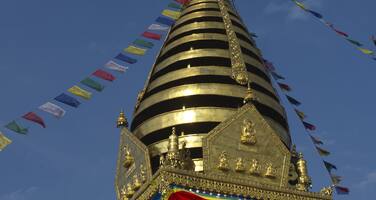
In September 2003, the UNESCO Regional Advisor for Culture undertook a mission to Swayambunath Monument Zone, in order to assess the negative impact of the fire, which broke out and led to serious damage of the structure and interior of the Pratappur Shrine. Following the fire, the Secretariat encouraged the State Party to submit an Emergency Assistance request to the World Heritage Fund, in order to establish a fire-fighting protocol. At the time of preparing this report, the request has not been received.
A Progress Report was submitted to the Secretariat by the State Party on 30 January 2004. It reports on the preparation of a management plan for the property: cadastral maps of all seven zones have been prepared, classification of monuments in all seven Monument Zones has been completed, maps showing the location of classified monuments are being prepared, and the recording of street facades of house, has been initiated. Work on the documentation of illegal constructions in order to decide whether any private houses should be modified or demolished is also in progress.
The State Party also stressed the need for more professional technical support for the capacity building of the national authority, and commented that the different UNESCO experts should not have given conflicting advice, and that better coordination could be exercised by the appointment of a single technical adviser.
Furthermore, a Technical Workshop is foreseen in May 2004 for the conservation of the property, to be organized by the Secretariat and the State Party. The expected outcomes of the Workshop include delineation of the protected core and buffer zones of the seven Monument Zones;identification of corrective measures to address illegal activities in the protected zones and the creation of a mechanism to enhance better coordination of the local management and monitoring, formulation of short and long term plans for the preservation of the urban fabric, active participation by stakeholders, and identification of priority areas and mechanisms for possible international partnerships. The conclusions and recommendations of the Workshop will be reported to the World Heritage Committee at its 28th session.
Summary of the interventions
Decisions adopted by the Committee in 2004
28 COM 15A.25
Kathmandu Valley (Nepal)
The World Heritage Committee,
1. Having examined the state of conservation of this property;
2. Takes note of the conclusions and recommendation of the May 2004 Technical Workshop for the Conservation of the property;
3. Commends the State Party for the initiatives that it has taken regarding the conservation and management of the property since its inscription on the List of World Heritage in Danger in 2003;
4. Expresses its grave concern that although the responsible authorities have made efforts with some positive outcomes, the threat of uncontrolled development persists, resulting in continuous reduction of the urban landscape and architectural fabric of the property, degrading the authenticity and integrity
of the property as a whole;
5. Recommends that the State Party take appropriate measures to ensure that the effective management mechanism will be put in place to preserve the World Heritage value of the property in the long-term;
6. Requests the State Party to submit to the World Heritage Centre by 1 February 2005, a report on the state of conservation of the property including that of the monumental ensembles and the vernacular fabric within the property, together with proposals for redefining the boundaries of the property, for examination by the Committee at its 29th session in 2005;
7. Invites the World Heritage Centre and the Advisory Bodies to assist the State Party in identifying an international technical advisor to provide professional expertise for the national and local authorities;
8. Decides to postpone the discussion on the possibility of deleting the property from the World Heritage List until the 29th session of the World Heritage Committee in 2005 pending a joint mission by the World Heritage Centre and ICOMOS to the property to examine whether the Outstanding Universal Value of the Kathmandu Valley as such has been lost ;
9. Further recommends that the State Party consider the redefinition of the protective core and buffer zones of the seven Monuments as well as new criteria and an appropriate name ;
10. Decides to retain the property on the List of World Heritage in Danger.
28 COM 15C.2
List of World Heritage in Danger
The World Heritage Committee,
1. Following examination of state of conservation reports of properties on the List of World Heritage in Danger (WHC-04/28.COM/15A Rev),
2. Decides to maintain the following properties on the List of World Heritage in Danger:
- Minaret and Archaeological Remains of Jam, Afghanistan (Decision 28 COM 15A.21)
- Cultural Landscape and Archaeological Remains of the Bamiyan Valley, Afghanistan (Decision 28 COM 15A.22)
- Butrint, Albania (Decision 28 COM 15A.28)
- Tipasa, Algeria (Decision 28 COM 15A.16)
- Walled City of Baku with the Shirvanshah's Palace and Maiden Tower, Azerbaijan (Decision 28 COM 15A.29)
- Royal Palaces of Abomey, Benin (Decision 28 COM 15A.14)
- Manovo-Gounda St Floris National Park, Central African Republic (Decision 28 COM 15A.1)
- Comoé National Park, Côte d'Ivoire (Decision 28 COM 15A.2 )
- Mount Nimba Strict Nature Reserve, Côte d'Ivoire/Guinea (Decision 28 COM 15A.5)
- Okapi Wildlife Reserve, Democratic Rep. of the Congo (Decision 28 COM 15A.3)
- Kahuzi-Biega National Park, Democratic Rep. of the Congo (Decision 28 COM 15A.3)
- Virunga National Park, Democratic Rep. of the Congo (Decision 28 COM 15A.3)
- Garamba National Park, Democratic Rep. of the Congo (Decision 28 COM 15A.3)
- Salonga National Park, Democratic Rep. of the Congo (Decision 28 COM 15A.3)
- Sangay National Park, Ecuador (Decision 28 COM 15A.12)
- Abu Mena, Egypt (Decision 28 COM 15A.17)
- Simien National Park, Ethiopia
- (Decision 28 COM 15A.4)
- Río Plátano Biosphere Reserve, Honduras (Decision 28 COM 15A.13)
- Group of Monuments at Hampi, India (Decision 28 COM 15A.24)
- Manas Wildlife Sanctuary, India (Decision 28 COM 15A.10)
- Ashur (Qal'at Sherqat), Iraq (Decision 28 COM 15A.18)
- Old City of Jerusalem and its Walls, Jerusalem (Decision 28 COM 15A.31)
- Timbuktu, Mali (Decision 28 COM 15A. 15)
- Kathmandu Valley, Nepal (Decision 28 COM 15A.25)
- Air and Ténéré Natural Reserves, Niger (Decision 28 COM 15A.6)
- Fort and Shalamar Gardens in Lahore, Pakistan (Decision 28 COM 15A.26)
- Chan Chan Archaelogical Zone, Peru (Decision 28 COM 15A.30)
- Rice Terraces of the Philippine Cordilleras, Philippines (Decision 28 COM 15A.27)
- Djoudj National Bird Sanctuary, Senegal (Decision 28 COM 15A.7 )
- Ichkeul National Park, Tunisia (Decision 28 COM 15A.9)
- Everglades National Park, United States of America (Decision 28 COM 15A.11)
- Historic Town of Zabid, Yemen (Decision 28 COM 15A.20)
Draft Decision:28 COM 15A.25
The World Heritage Committee,
1. Takes note of the conclusions and recommendation of the Technical Workshop for the Conservation of the property;
2. Commends the State Party for the initiatives that it has takenregarding the conservation and management of the property since its inscription on the List of World Heritage in Danger;
3. Expresses its grave concern that although the responsible authorities have made efforts with some positive outcomes, the threat of uncontrolled development persists, resulting in continuous reduction of the urban landscape and architectural fabric of the property, degrading the authenticity and integrity of the property as a whole;
4. Recommends the State Party to continue its work to legally protect the redefined core and buffer zones of the seven Monument Zones, and to implement sustainable management mechanisms to conserve the remaining World Heritage value of the property in the long-term;
5. Invites the Secretariat and the Advisory Bodies to assist the State Party in identifying an international technical advisor to provide professional support to the national and local authorities;
6. Encourages the State Party to submit a request for Emergency Assistance to set up a fire-fighting protocol for the property;
7. Requests the State Party to submit to the Secretariat by 1 February 2005, a progress report on the state of conservation of the monumental ensembles and the vernacular fabric within the property, for examination by the Committee at its 29th session in 2005;
8. Decides to retain the property on the List of World Heritage in Danger.
 Nepal
Nepal
Exports
* :
The threats indicated are listed in alphabetical order; their order does not constitute a classification according to the importance of their impact on the property.
Furthermore, they are presented irrespective of the type of threat faced by the property, i.e. with specific and proven imminent danger (“ascertained danger”) or with threats which could have deleterious effects on the property’s Outstanding Universal Value (“potential danger”).
** : All mission reports are not always available electronically.