Gelati Monastery
Gelati Monastery
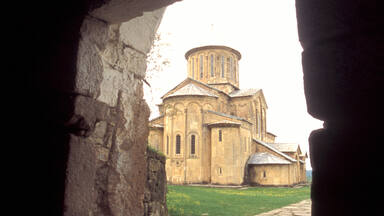
Founded in 1106 in the west of Georgia, the Monastery of Gelati is a masterpiece of the Golden Age of medieval Georgia, a period of political strength and economic growth between the 11th and 13th centuries. It is characterized by the facades of smoothly hewn large blocks, balanced proportions and blind arches for exterior decoration. The Gelati monastery, one of the largest medieval Orthodox monasteries, was also a centre of science and education and the Academy it housed was one of the most important centres of culture in ancient Georgia.
Description is available under license CC-BY-SA IGO 3.0
Monastère de Ghélati
Le Monastère de Ghélati, situé à l’ouest de la Géorgie et fondé en 1106, est un chef-d’œuvre de « l’Âge d’or » de la Géorgie médiévale, période de puissance politique et d’essor économique entre le XIe et le XIIIe siècles. Le monastère se caractérise par des façades de grands blocs de pierre taillés et polis, des proportions équilibrées et la décoration extérieure des arcades aveugles. Le monastère de Ghélati, l’un des plus grands monastères orthodoxes médiévaux, était aussi un centre de science et d’éducation, et l’académie installée dans son enceinte était l’un des plus importants centres de culture de l’ancienne Géorgie.
Description is available under license CC-BY-SA IGO 3.0
Monasterio de Ghelati
Situado al oeste del país, este cenobio se fundó en 1106 y es una obra maestra de la arquitectura medieval de la “edad de oro” del poder político y económico de Georgia (siglos XI a XIII). El edificio monacal se caracteriza por sus fachadas construidas con grandes sillares pulimentados de proporciones equilibradas, así como por su ornamentación exterior con arcos ciegos. Ghelati fue uno de los monasterios ortodoxos más grandes de la Edad Media y además albergó en su recinto un centro docente y científico que lo convirtió en uno de los focos de irradiación cultural más importantes de la antigua Georgia.
source: UNESCO/CPE
Description is available under license CC-BY-SA IGO 3.0
Het Gelati klooster
Het Gelati klooster werd gesticht in 1106 in het westen van Georgië, en is een meesterwerk van middeleeuwse bouwkunst in het land. Het wordt gekarakteriseerd door facades van grote gladde gehouwen blokken steen, uitgebalanceerde proporties en blinde bogen ter decoratie. De belangrijkste gebouwen werden opgetrokken tussen de 12e en de 17e eeuw. Ze bevatten prachtige mozaïeken en muurschilderingen. Gelati was een van de grootste middeleeuwse orthodoxe kloosters en was een centrum van wetenschap en onderwijs. Het klooster huisvestte ook de Academie, een van de belangrijkste cultuurcentra in het oude Georgië.
Source: unesco.nl


Outstanding Universal Value
Brief synthesis
On the lower southern slopes of the mountains of the Northern Caucasus, Gelati Monastery reflects the 'golden age' of medieval Georgia, a period of political strength and economic growth between the reigns of King David IV 'the Builder' (1089-1125) and Queen Tamar (1184-1213). It was David who, in 1106 began building the monastery near his capital Kutaisi on a wooded hill above the river Tskaltsitela. The main church was completed in 1130 in the reign of his son and successor Demetré. Further churches were added to the monastery throughout the 13th and early 14th centuries. The monastery is richly decorated with mural paintings from the 12th to 17th centuries, as well as a 12th century mosaic in the apse of the main church, depicting the Virgin with Child flanked by archangels. Its high architectural quality, outstanding decoration, size, and clear spatial quality combine to offer a vivid expression of the artistic idiom of the architecture of the Georgian “Golden Age” and its almost completely intact surroundings allow an understanding of the intended fusion between architecture and landscape.
Gelati was not simply a monastery: it was also a centre of science and education, and the Academy established there was one of the most important centres of culture in ancient Georgia. King David gathered eminent intellectuals to his Academy such as Johannes Petritzi, a Neo-Platonic philosopher best known for his translations of Proclus, and Arsen Ikaltoeli, a learned monk, whose translations of doctrinal and polemical works were compiled into his Dogmatikon, or book of teachings, influenced by Aristotelianism. Gelati also had a scriptorium were monastic scribes copied manuscripts (although its location is not known). Among several books created there, the best known is an amply illuminated 12th century gospel, housed in the National Centre of Manuscripts.
As a royal monastery, Gelati possessed extensive lands and was richly endowed with icons, including the well-known gold mounted Icon of the Virgin of Khakhuli (now housed in the Georgian National Museum) and at its peak, it reflected the power and high culture of Eastern Christianity.
Criterion (iv): Gelati Monastery is the masterpiece of the architecture of the “Golden Age” of Georgia and the best representative of its architectural style, characterized by the full facing of smoothly hewn large blocks, perfectly balanced proportions, and the exterior decoration of blind arches. The main church of the monastery is one of the most important examples of the cross-in-square architectural type that had a crucial role in the East Christian church architecture from the 7th century onwards. Gelati is one of the largest Medieval Orthodox monasteries, distinguished for its harmony with its natural setting and a well thought-out overall planning concept.
The main church of the Gelati Monastery is the only Medieval monument in the larger historic region of Eastern Asia Minor and the Caucasus that still has well-preserved mosaic decoration, comparable with the best Byzantine mosaics, as well as having the largest ensemble of paintings of the middle Byzantine, late Byzantine, and post-Byzantine periods in Georgia, including more than 40 portraits of kings, queens, and high clerics and the earliest depiction of the seven Ecumenical Councils.
Integrity
The whole monastic precinct is included in the property and contains all the main 12th century buildings as well as those added in the 13th century. All the attributes necessary to express the Outstanding Universal Value are present and included in the area. No important original feature of the monastery from the 12th and 13th centuries have been lost during the centuries, and its landscape setting remains largely intact. Not all buildings are in a good state of conservation.
Some development pressures exist, in the buffer zone and the wider setting of the property but the level of threats is low and the processes are currently under control.
Authenticity
Overall, the architectural forms, spatial arrangement and decoration fully convey their value. For a long period, major parts of the mural paintings were in a bad state of conservation. With the repair of the roofs, the process of degradation has been slowed down and restoration work undertaken although some remain vulnerable.
The Academy building which was roofless in 1994 at the time of inscription was re-roofed with reversible material in 2009. The extensive buffer zone allows a full appreciation of the harmony between the enclosed monastery and its natural setting.
Protection and management requirements
Gelati monastery has been a Listed Monument of National Significance since the Soviet period and was listed in the Georgian National Register of Monuments by presidential decree in 2006. The cultural protection area was enlarged beyond Gelati Monastery to encompass the buffer zone in a Decree of the Minister of Culture and Monument Protection in 2014. The buffer zone is protected for its monuments but also for visual attributes. The natural values of the surrounding landscape are regulated by the Forest Code of Georgia, the Law on Soil Protection, the Law on Environmental Protection and the Water law that constitute the legal framework for the management of the forests and the rivers in the area. Applications for new constructions or reconstructions, including the infrastructure and earthworks within the buffer zone require the approval of the Cultural Heritage Protection Council, Section for Cultural Heritage Protected Zones, and the Agency of Urban Heritage.
Conservation work is guided by the Conservation Master Plan, produced by the Ministry of Culture, Monuments Protection and Sports of Georgia in collaboration with the Orthodox Church of Georgia. This plan covers conservation of the built structures as well as proposals to support the revival of monastic life that started in the 1990s and the needs of visitors. Adequate resources for long-term conservation programmes need to be sustained. A system of documentation for all conservation and restoration work and tri-dimensional measuring and monitoring of the overall stability of the various monastic buildings need to be put in place.
A Memorandum on Collaboration on Cultural Heritage Issues between the Georgian Apostolic Autocephaly Orthodox Church and the Ministry of Culture and Monument Protection of Georgia has been agreed for all properties of the church. Day to day management of the property is entrusted to the monastic community who live in the property. Longer term interventions are implemented by the National Agency for Cultural Heritage Preservation of Georgia. Its local representative agency is the Kutaisi Historical Architectural Museum-Reserve who is also responsible for visitor reception.
The Management Plan 2017-2021 reflects contributions of the Church, and relevant government bodies and community groups who were involved in the consultation process. It aims to set out a shared vision for the property. The Plan was developed in harmony with the Conservation Master Plan, with the Imereti Tourism development strategy, and with the 2014 management plan for the Imereti Protected Areas that includes the valley and canyon of the Tskaltsitela River in the buffer zone. It needs approval to become fully operational and enforceable by relevant authorities. A Management Committee for the property remains to be appointed and it is necessary for key roles and responsibilities to be established.




List of World Heritage in Danger
Inscription Year on the List of World Heritage in Danger
2010 -2017