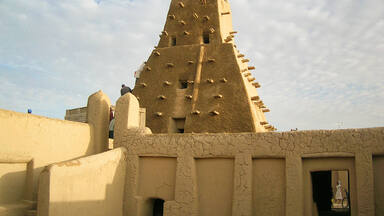
Joya de Cerén Archaeological Site
Joya de Cerén Archaeological Site
Joya de Cerén was a pre-Hispanic farming community that, like Pompeii and Herculaneum in Italy, was buried under an eruption of the Laguna Caldera volcano c. AD 600. Because of the exceptional condition of the remains, they provide an insight into the daily lives of the Central American populations who worked the land at that time.
Description is available under license CC-BY-SA IGO 3.0
Site archéologique de Joya de Cerén
Joya de Ceren était une communauté agricole préhispanique qui, comme Pompéi et Herculanum en Italie, fut brutalement engloutie par une éruption du volcan Laguna Caldera vers 600. Grâce à leur parfait état de conservation, ses vestiges témoignent de la vie quotidienne des cultivateurs mésoaméricains de l’époque.
Description is available under license CC-BY-SA IGO 3.0
موقع خويا دي سيرين الأثري
كانت خويا دي سيرين جماعةً زراعيّةً سالفةً للعصر الإسباني وقد طمرها فوران بركان لاغونا كاليدرا قرابة العام 600 ، تماماً كما حصل مع بومباي وهرقولانيوم في إيطاليا. وتجسّد البقايا الأثريّة المحافظ عليها بشكلٍ ممتاز الحياة اليوميّة لمزارعي الوسط الأمريكي في تلك الحقبة.
source: UNESCO/CPE
Description is available under license CC-BY-SA IGO 3.0
霍亚-德赛伦考古遗址
霍亚-德赛伦考古遗址是古拉丁美洲的一个农庄,像意大利的庞培和赫库兰尼姆一样,于公元600年左右遭到火山喷发掩埋。正是由于这种特殊的保存方式,使得人们现在可以从此了解当时在这块土地上耕作的中美洲人的日常生活。
source: UNESCO/CPE
Description is available under license CC-BY-SA IGO 3.0
Археологические памятники древнего поселения Хойя-де-Серен
Хойя-де-Серен был доиспанским сельским поселением, которое, подобно Помпее и Геркулануму в Италии, около 600 г. было погребено под вулканическими выбросами при извержении. Исключительно хорошее состояние его остатков позволяет получить представление о повседневной жизни населения Центральной Америки, занимавшегося в то время земледелием.
source: UNESCO/CPE
Description is available under license CC-BY-SA IGO 3.0
Sitio arqueológico de Joya de Cerén
Al igual que las ciudades romanas de Pompeya y Herculano, la comunidad agrícola prehispánica de Joya de Cerén fue repentinamente sepultada por una erupción del volcán Laguna Caldera hacia el año 600. Gracias a su perfecto estado de conservación, los vestigios de este sitio aportan un testimonio excepcional sobre la vida cotidiana de los agricultores mesoamericanos de esa época.
source: UNESCO/CPE
Description is available under license CC-BY-SA IGO 3.0
ホヤ・デ・セレンの古代遺跡
source: NFUAJ
Archeologisch gebied Joya de Cerén
Joya de Cerén was een pre-Spaanse agrarische gemeenschap die – net als Pompeii en Herculaneum in Italië – werd bedolven onder een uitbarsting van een vulkaan, de Laguna Caldera omstreeks 590 na Christus. Er is waarschijnlijk een waarschuwende aardbeving geweest die de bewoners de tijd gaf om te vluchten. De as heeft hun persoonlijke bezittingen bewaard, van tuingereedschap en potten gevuld met potten, tot slaapmatten en religieuze artikelen. In wezen is het agrarisch dorp ‘bevroren’ in de tijd. De uitzonderlijke staat van de overblijfselen geven inzicht in het dagelijks leven van de Midden-Amerikaanse volkeren, die op dat moment landbewerkers waren.
Source: unesco.nl


Outstanding Universal Value
Brief Synthesis
Joya de Cerén is an archaeological site located at the Canton Joya de Cerén, in the Department of La Libertad in El Salvador. The property has an extension of 3,200 ha.
The archaeological site contains the remains of a pre-hispanic farming village that was covered by a volcanic eruption in the seventh century AD.
Around AD 500, the central and western parts of the territory of the modern Republic of El Salvador were buried beneath thick layers of volcanic ash from the Ilopango volcano. The area was abandoned until the ash layer had weathered into fertile soil and the Joya de Cerén settlement was founded. Not long afterwards, it was destroyed by the eruption of the Loma Caldera. The site was discovered during the construction of grain-storage silos in 1976, when a clay-built structure was exposed by a bulldozer. Excavations were resumed in 1989 and been continuing since that time.
The circumstances of the volcanic event led to the remarkable preservation of architecture and the artefacts of ancient inhabitants in their original positions of storage and use, forming a time capsule of unprecedented scientific value that can be appreciated in present times.
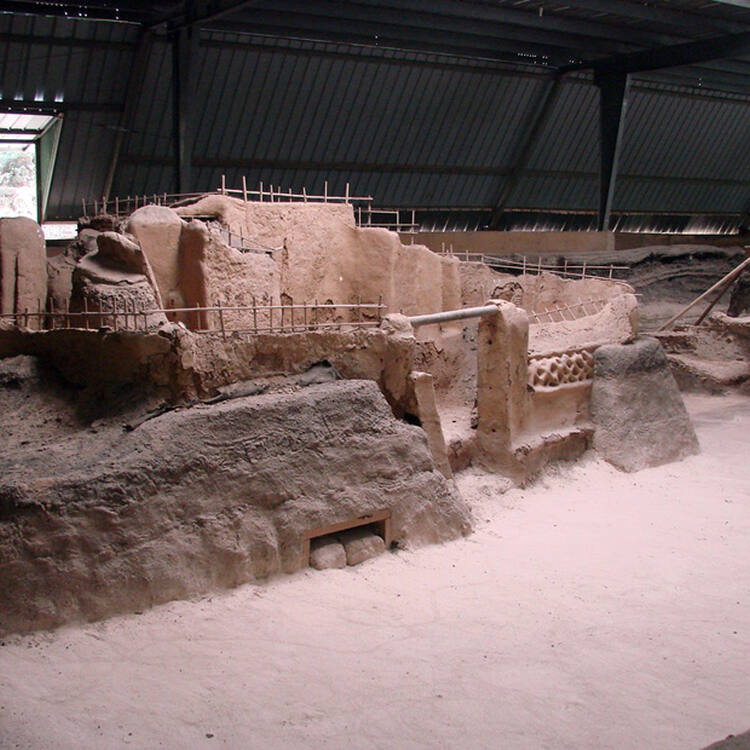
Underneath the layers of volcanic ash, the best preserved example of a pre-hispanic village in Mesoamerica can be found, with architectural remains, grouped into compounds that include civic, religious and household buildings. To date, a total of 18 structures have been identified and 10 have been completely or partially excavated. All structures are made of earth and important features like thatch roofs and artefacts found in-situ have been recovered. The excavated structures include a large community (public) building on the side of a plaza, two houses of habitation that were part of domiciles, three storehouses (one was in the process of being remodeled), one kitchen, and a sweat bath. On the northeast side of the plaza there is a religious building devoted to communal festivities and one where a shaman practiced. Rammed earth construction was used for the public buildings and the sauna, and wattle and daub (which is highly earthquake resistant) for household structures.
The degree of preservation also applies to organic materials, from garden tools and bean-filled pots to sleeping mats, animal remains and religious items that normally deteriorate in tropical conditions and were part of the subsistence and daily life of the inhabitants. These have been preserved as carbonized materials or as casts in the ash deposits. Several cultivated fields and other vegetation has also been uncovered. These include fields containing young and mature maize plants, a garden with a variety of herbs and a henequen (agave) garden. Various fruit trees, including guava and cacao, have also been found.
Although large numbers of archaeological investigations have been carried out in Mesoamerica during the history of archaeology, most researchers have focused in understanding the life of rulers and elite of these settlements. The scientific study of Joya de Cerén has provided detailed information about the activities of ancient Mesoamerican farmers, becoming a unique example that illustrates the daily life of the Maya agriculturalists that inhabited the area. All of these cultural materials found in such a special context have provided information about their function and meanings. As a whole, they have also provided information of the relation between the village itself and other settlements in the region which were part of a complex social interaction.
This exceptional site also provides unique evidence of the characteristics that illustrate the continuity in ways of life and facilitates the understanding of the relationship between present people and past activities and beliefs.
Joya de Cerén archaeological site also constitutes a cultural symbol in El Salvador, where the past is linked to the present and plays an important role in human development of the region. The conservation and presentation of its significance and its values contributes to the cultural identity and sense of belonging generated by this cultural heritage.
Criterion (iii): Joya de Cerén archaeological site is a unique testimony of the daily lives of ordinary people. This site is a remarkable by virtue of the completeness of the evidence that it provides of everyday life in Mesoamerican farming community of the seventh century A.D, which is without parallel in this cultural region.
Criterion (iv): The rapid ash fall from Loma Caldera volcano, and the sudden abandonment of the village, created exceptional circumstances that preserved architecture, organic materials and different artefacts. The archaeological site is a unique window into the past that allows for the interpretation of the interactions between the ancient settlers and their environment. The preserved earthen architecture remains, along with the rest of the material culture, forms a unique context that illustrates daily life of a prehispanic communities during the Late Classic period.
Integrity
Joya de Cerén archaeological site preserves several elements that were part of the ancient settlement and are vivid examples of the daily lives of the inhabitants during this time. All excavated structures and material remains are found within the boundaries of the inscribed property. From the pottery to the extensive cultivation fields, the elements that characterize the farming communities in Central America are found in Joya de Cerén, frozen in time; this is a historical reference for different social groups that live today in the modern state of El Salvador. However, the conservation of the fragile remains is a significant challenge to maintain the material integrity of the built fabric. Measures including roofing and conservation interventions needed to be in place to ensure the physical integrity of the property in the long term.
Authenticity
The circumstances of the burial of the site ensure the absolute authenticity of the remains. Due to the excellent preservation caused by the ash, the earthen structures and construction methods are visible and the layout of the village is easily defined. The sudden abandonment by the villagers left their daily utensils and artefacts in their original place of use. Conservation interventions will need to ensure that the conditions of authenticity continue to be preserved.
Protection and management requirements
Joya de Cerén archaeological site is protected by national laws and international treaties ratified by the government of the Republic of El Salvador which has the “Special Law for the Protection of Cultural Patrimony in El Salvador and Regulations” (Ley Especial de Protección al Patrimonio Cultural en El Salvador y su reglamento). The property has been owned by the State since 1989 and is currently managed by the Government of the Republic of El Salvador, under supervision of the Secretaría de Cultura de la Presidencia, which is committed to a long term protection, conservation and management of the park and site.
Due to the nature of the site, specifically the earthen architecture and organic materials, conservation is an important factor for its protection. Constant monitoring and interventions are carried out and recorded by archaeologists and conservation specialists of the Archaeology Department (Departamento de Arqueología). This department also promotes scientific research at the site with a continuous program. A Regional and Site Management Plan has been produced for the site. The management plan will require sustained implementation and secured resources for that purpose.
Long term conservation the area of the site will require the evaluation of protective shelters and other features to ensure the conservation of the architecture and maintenance of physical integrity. In addition, a protection area is to be established between the nucleus of the site and the contemporary Joya de Cerén settlement in the south of the site.