Maya Site of Copan
Factors affecting the property in 2008*
- Air transport infrastructure
- High impact research / monitoring activities
- Impacts of tourism / visitor / recreation
- Management systems/ management plan
- Other Threats:
Deterioration of construction materials due to natural decay phenomena
Factors* affecting the property identified in previous reports
a) The foreseen construction of an airport in the vicinity of the World Heritage property;
b) Deterioration of construction materials due to natural decay phenomena;
c) Risk of structural failure of archaeological buildings resulting from the excavated tunnels for archaeological purposes;
d) Deterioration derived from uncontrolled visitation and potential to exceed carrying capacity at specific time periods.
International Assistance: requests for the property until 2008
Total amount approved : 226,513 USD
| 1999 | Emergency measures for the protection and ... (Approved) | 43,975 USD |
| 1998 | Replacement of a protective canopy of the Hieroglyphic ... (Approved) | 5,000 USD |
| 1997 | Preparation of a Replica of the Hieroglyphic Stairway ... (Approved) | 29,613 USD |
| 1997 | Scientific seminar on the preservation of the ... (Approved) | 8,800 USD |
| 1990 | Preservation of mural paintings recently discovered in ... (Approved) | 7,000 USD |
| 1983 | Equipment, consultant services and support to training ... (Approved) | 46,000 USD |
| 1982 | Technical mission and equipment for Copan Ruins (Approved) | 24,050 USD |
| 1982 | Training activities foreseen in the management plan for ... (Approved) | 28,950 USD |
| 1982 | Financial contribution to the preparation, publication ... (Approved) | 3,125 USD |
| 1982 | 2 specialists and equipment for Copan Ruins (Approved) | 20,000 USD |
| 1979 | Provision of one expert to prepare a technical ... (Approved) | 10,000 USD |
Missions to the property until 2008**
Monitoring missions in 1999; 2003: ICOMOS-UNESCO Reactive Monitoring Mission; 2005: ICOMOS Reactive Monitoring Mission.
Conservation issues presented to the World Heritage Committee in 2008
The State Party’s report for the property was received by the World Heritage Centre on 11 March 2008, in response to the decision adopted by the World Heritage Committee at its 31st session (Christchurch, 2007)
Plans are currently being explored for an alternate airport location, considering recommendations previously made. The situation should be closely monitored. A pre-feasibility study has been undertaken by the State Party to build the airport in La Concepción, 50 km far from the World Heritage property of Copan. At this site archaeological material has been found. No official assessment has been submitted by the National Institute of Anthropology and History (Instituto Hondureño de Antropologia e Historia) (IHAH), nor has an Environmental Impact Assessment (EIA) so far been carried out.
A letter was sent to the Government of Guatemala by the World Heritage Centre concerning the intention of the State Party to improve the conditions of the airport of Los Tablones, which is situated not far from the border of Guatemala and Honduras and that could be the closest airport to visit Copan. The World Heritage Centre has requested official information on emplacement, system of operations and plans of construction. No information has been received yet.
The PNTS (National Programme for Sustainable Tourism) funded by the Inter American Development Bank could provide funds for the creation of the Rio Amarillo Archaeological Park, to elaborate a public use study. A management plan of the site of Rio Amarillo has been already elaborated by the United States Department of Interior through the National Park Service and the fieldwork at the site could start in 2008.
As for the archaeological site, the State Party plans to expand the protected area, which would be useful in the long term to mitigate impacts from uncontrolled buildings and further protect the integrity of the property. Works have been carried out in response to prior recommendations, but no additional documentation was provided for review of the adequacy of the proposed actions. Stabilization and consolidation works have continued at some areas (Tunnels and Nuñez Chinchilla group), but not indication was provided on further works for other portions of the site or what the final decision will be for the carved sculptures or reliefs. The management plan has yet to be finalised so there are no clear indications on what the future course of actions will be. It is critical that it is completed and implemented as soon as possible, particularly in regard to public use and conservation interventions to mitigate current factors affecting the fabric of the site.
Summary of the interventions
Decisions adopted by the Committee in 2008
32 COM 7B.122
Maya site of Copan (Honduras) (C 129)
The World Heritage Committee,
1. Having examined Document WHC-08/32.COM/7B.Add,
2. Recalling Decision 31 COM 7B.126, adopted at its 31st session (Christchurch 2007),
3. Also recalling the recommendations of the previous monitoring missions of 1999, 2003 and 2005,
4. Notes the interest of the State Party in continuing to build an alternate airport to access the archaeological site and invites the State Party, in accordance with Paragraph 172 of the Operational Guidelines to submit detailed information on the definitive location and plans for construction and operations, accompanied by the official Environmental Impact Assessment and archaeological/cultural impact study from the National Institute of Anthropology and History (IHAH);
5. Encourages the State Party to finalise the management plan and to provide three printed and electronic copies of the resulting document for review by the World Heritage Centre and the Advisory Bodies, prior to its implementation;
6. Invites the State Party to also submit the management plan for the Rio Amarillo site to the World Heritage Centre and the Advisory Bodies to examine its potential articulation with the Copan management plan;
7. Requests the State Party to submit to the World Heritage Centre, by 1 February 2009, a detailed report on the state of conservation of the property and on the progress made in the implementation of the above recommendations, for the examination by the World Heritage Committee at its 33rd session in 2009.
Draft Decision: 32 COM 7B.122
The World Heritage Committee,
1. Having examined Document WHC-08/32.COM/7B.Add,
2. RecallingDecision31 COM 7B.126, adopted at its 31st session (Christchurch 2007),
3. Also recalling the recommendations of the previous monitoring missions of 1999, 2003 and 2005,
4. Notes the interest of the State Party in continuing to build an alternate airport to access the archaeological site and invites the State Party, in accordance with Paragraph 172 of the Operational Guidelines to submit detailed information on the definitive location and plans for construction and operations, accompanied by the official Environmental Impact Assessment and archaeological/cultural impact study from the National Institute of Anthropology and History (IHAH );
5. Encourages the State Party to finalise the management plan and to provide three printed and electronic copies of the resulting document for review by the World Heritage Centre and the Advisory Bodies; prior to its implementation;
6. Invites the State Party to also submit the management plan for the Rio Amarillo site to the World Heritage Centre and the Advisory Bodies to examine its potential articulation to the Copan management plan;
7. Requests the State Party to submit to the World Heritage Centre, by 1 February 2009, a detailed report on the state of conservation of the property and on the progress made in the implementation of the above recommendations, for the examination by the World Heritage Committee at its 33rd session in 2009.
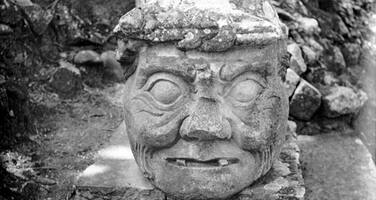
 Honduras
* :
The threats indicated are listed in alphabetical order; their order does not constitute a classification according to the importance of their impact on the property.
Furthermore, they are presented irrespective of the type of threat faced by the property, i.e. with specific and proven imminent danger (“ascertained danger”) or with threats which could have deleterious effects on the property’s Outstanding Universal Value (“potential danger”).
** : All mission reports are not always available electronically.