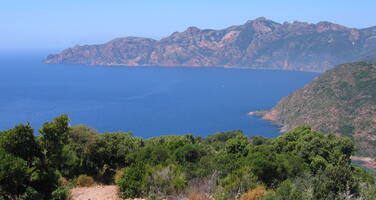
Gulf of Porto: Calanche of Piana, Gulf of Girolata, Scandola Reserve
Factors affecting the property in 2012*
- Impacts of tourism / visitor / recreation
- Non-renewable energy facilities
- Oil and gas
International Assistance: requests for the property until 2012
Total amount approved : 0 USD
Missions to the property until 2012**
Conservation issues presented to the World Heritage Committee in 2012
In February 2012, the World Heritage Centre and IUCN were informed of the granting by the State Party of a prospection permit for liquid or gaseous hydrocarbons adjacent to the property. Following a letter from the World Heritage Centre regarding this issue, the State Party provided the World Heritage Centre with an information note on 30 March 2012 concerning the potential impact of a project for the prospection of liquid or gaseous hydrocarbons on the Outstanding Universal Value of the property. It recalled the background and objectives of the mining exploration license, the environmental, heritage and energy challenges, and described the regulations and specific characteristics of the research.
a) Request for the extension of an exclusive license for liquid or gaseous hydrocarbon research
The World Heritage Centre and IUCN note the request of the Melrose Mediterranean Limited and Noble Energie France SAS companiesfor the renewal of a prospection license for liquid or gaseous hydrocarbons off the coast of the Bouches-du-Rhone and the Var. This exclusiveresearch license called “Rhone-Maritime” was granted by a decree dated 29 October 2002, then extended in 2006 until 19 November 2010.
This third and final request for renewal concerns a sector of 9375 km2 located approximately 102 nautical miles from the western boundary of the property and close to numerous protected areas, including the property. The State Party indicates that it is envisaged to carry out three-dimensional seismic research to confirm the data acquired during the previous 2D campaign undertaken in the winter of 2010/2011. In the event of satisfactory results, it is expected that this stage of prospection would be extended to exploratory drilling in the second half of 2013.
The State Party indicates that the Melrose Mediterranean Limited and Noble Energie France SAS companies hope to demonstrate the existence of exploitable biogenic reserves. However, during a drilling operation there was no element confirming the presence of liquid hydrocarbons. It further informed that the request by these companies concerns the extension of a mining research license and not an authorization for exploratory drilling work. It notes that any project for offshore exploratory work is submitted for decision to the local authorities (Prefect) and consultations are instigated, based on a file containing detailed information concerning the envisaged operations and including an environmental impact study.
The World Heritage Centre also received a copy of a resolution of the Scientific Council for the Scandola Reserve expressing its most serious concerns regarding this prospection project and stating its opposition to all exploratory drilling or eventual exploitation due to the risk of potential oil spills.
The World Heritage Centre and IUCN note that the western Mediterranean is a zone of high seismic activity, and that in 2005 two seismic epicentres were located within the perimeter of the “Rhone Maritime” license. It should also be noted that the risk of a rupture of a wellhead can occur at any stage of drilling. They emphasize the unmanageable consequences of an accident or a hydrocarbon leak in a closed sea such as the Mediterranean, due to the violence and irregularity of dominating winds and the strong marine currents in this zone. Studies on ocean currents have demonstrated that in the event if hydrocarbon leaks, on the seabed or on the surface, there is a very high probability that the Corsican coasts, where the property is located, would be affected within a few days.
The World Heritage Centre and IUCN recall that the property is inscribed for aesthetic and biodiversity criteria. An accident in the boundaries of the prospection zone could have negative impacts on the principal components of the Outstanding Universal Value of the property. Considering the acute sensitivity of the coastal biodiversity, the hydrocarbons would directly affect the intertidal formations, notably species of algae and molluscs. Coral species, fish, birds and marine mammals frequenting the area would most likely be immediately and seriously affected. It should also be noted that the rocky coastline would greatly hamper any cleaning-up operations by land or sea.
The World Heritage Centre and IUCN are aware through the media of the declaration made by the outgoing President of the French Republic, on 6 April 2012, expressing his opposition to all exploratory drilling projects in the Mediterranean, but note that they have not been informed by the State Party of the official decision concerning the non-renewal of this prospection license.
b) Management and draft extension of the property
The World Heritage Centre and IUCN note the important increase in tourism pressure on the property since its inscription. They were only informed in September 2010 that the Committee of Ministers of the European Council had renewed the European Diploma for Protected Areas granted to the Scandola Reserve, but that this decision was accompanied by two conditions and seven recommendations. They consider that some of these conditions are also important for the conservation of the Outstanding Universal Value of the property, in particular the need to limit the impact of anchorage at Posidonie, and limit tourist activities, especially nautical activities that, according to the Resolution, are a cause of major disruption for key species. The World Heritage Centre sent a letter in October 2011 to the State Party in this respect, requesting additional information concerning the increase in tourism activities since inscription of the property, their impact on the Outstanding Universal Value of the property and the measures taken to minimize these impacts. To date no response has been received. The World Heritage Centre and IUCN note that the means allocated to the property to cope with this pressure are very limited and only concern the Scandola Reserve. They recall also the need to define and implement a management plan for the entire property.
The World Heritage Centre and IUCN also note the proposed offshore extension for the Scandola Reserve covering a total area of 4000 hectares, and that the area would be inscribed as a Natura 2000 site and the definition of a document of objectives would be undertaken.
Analysis and Conclusion by World Heritage Centre and the Advisory Bodies in 2012
The World Heritage Centre and IUCN draw the Committee’s attention to the risks of exploratory projects or hydrocarbon exploitation on the marine and coastal ecosystems of the property in the event of an accident, given that the Mediterranean is a partially closed sea.
They recommend that the Committee emphasizes that prospection in this zone could have major negative, irreversible and non-compensatory impacts on the Outstanding Universal Value of the property given the high seismic activity of the zone, the violent and irregular winds and strong marine currents.
They recall that an environmental impact assessment should be provided, in accordance with Paragraph 172 of the Operational Guidelines and consider this impact assessment should be conducted to the highest international standards, and submitted to the World Heritage Centre prior to authorization for exploratory drilling. This study should comprise an in-depth examination of the potential impact of exploration projects on the Outstanding Universal Value of the property. The World Heritage Centre and IUCN note the major increase in tourism pressure on the property since its inscription and recommend that the State Party implement the recommendations of the Committee of Ministers of the European Council to cope with this pressure. They also recall the need to define a management plan for the entire property.
Summary of the interventions
Decisions adopted by the Committee in 2012
36 COM 7B.19
Gulf of Porto: Calanche of Piana, Gulf of Girolata, Scandola Reserve (France) (N 258)
The World Heritage Committee,
1. Having examined Document WHC-12/36.COM/7B.Add,
2. Recalling Decision 07 COM VIII adopted at its 7th session (Florence, 1983),
3. Notes with concern the request for renewal of the prospection license for liquid or gaseous hydrocarbons by the Melrose Mediterranean Limited and Noble Energie France companies, given that this prospection stage could be extended by an exploratory drilling activity during the second half of 2013 in the event of satisfactory results;
4. Considers that the exploratory drillings in this zone could have major negative, irreversible and non-compensatory impacts on the Outstanding Universal Value of the property, and requests the State Party to conduct an environmental impact assessment study in accordance with the highest international standards and prior to authorizing any exploratory drilling, and which should include an in-depth examination of the potential impact of exploration projects on the Outstanding Universal Value of the property, and to submit it to the World Heritage Centre;
5. Urgently requests the State Party not to grant a license to conduct hydrocarbon drilling exploration likely to affect the property and its environment, as well as the adjacent protected areas, until the requested above-mentioned study has been completed and evaluated by the World Heritage Centre and IUCN;
6. Also notes the major increase in tourism pressure on the property since its inscription and urges the State Party to implement the recommendations of the Committee of Ministers of the European Council to cope with this pressure and to define a management plan for the entire property;
7. Also requests the State Party to submit to the World Heritage Centre by 1 February 2013, a detailed report on the state of conservation of the property, including the potential impacts on the property of hydrocarbon exploration and progress in the definition of a management plan and the implementation of the recommendations of the Committee of Ministers of the European Council.
Draft decision: 36 COM 7B.18
The World Heritage Committee,
1. Having examined Document WHC-12/36.COM/7B.Add,
2. Recalling Decision 07 COM VIII adopted at its 7th session (Florence, 1983),
3. Notes with concern the request for renewal of the prospection license for liquid or gaseous hydrocarbons by the Melrose Mediterranean Limited and Noble Energie France companies, given that this prospection stage could be extended by an exploratory drilling activity during the second half of 2013 in the event of satisfactory results;
4. Considers that the exploratory drillings in this zone could have major negative, irreversible and non-compensatory impacts on the Outstanding Universal Value of the property, and requests the State Party to conduct an environmental impact assessment study in accordance with the highest international standards and prior to authorizing any exploratory drilling, and which should include an in-depth examination of the potential impact of exploration projects on the Outstanding Universal Value of the property, and to submit it to the World Heritage Centre;
5. Urgently requests the State Party not to grant a license to conduct hydrocarbon drilling exploration likely to affect the property and its environment, as well as the adjacent protected areas, until the requested above-mentioned study has been completed and evaluated by the World Heritage Centre and IUCN;
6. Also notes the major increase in tourism pressure on the property since its inscription and urges the State Party to implement the recommendations of the Committee of Ministers of the European Council to cope with this pressure and to define a management plan for the entire property;
7. Also requests the State Party to submit to the World Heritage Centre by 1 February 2013, a detailed report on the state of conservation of the property, including the potential impacts on the property of hydrocarbon exploration and progress in the definition of a management plan and the implementation of the recommendations of the Committee of Ministers of the European Council.
 France
Exports
* :
The threats indicated are listed in alphabetical order; their order does not constitute a classification according to the importance of their impact on the property.
Furthermore, they are presented irrespective of the type of threat faced by the property, i.e. with specific and proven imminent danger (“ascertained danger”) or with threats which could have deleterious effects on the property’s Outstanding Universal Value (“potential danger”).
** : All mission reports are not always available electronically.