Kahuzi-Biega National Park
Factors affecting the property in 2012*
- Civil unrest
- Illegal activities
- Land conversion
- Mining
- War
- Other Threats:
Villages in the ecologicalcorridor between the highland and lowland sectors of the park
Factors* affecting the property identified in previous reports
a) Presence of armed groups, lack of security and political instability rendering a large part of the property inacessible to the guards;
b) Attribution of mining permits inside the property;
c) Poaching by armed military groups;
d) Villages in the ecologicalcorridor between the highland and lowland sectors of the park;
e) Illegal mining and deforestation.
Threats for which the property was inscribed on the List of World Heritage in Danger
- Adverse refugee impact ;
- Irregular presence of armed militia and settlers at the property ;
- Increased poaching ;
- Deforestation.
Desired state of conservation for the removal of the property from the List of World Heritage in Danger
A draft has been developed during the 2009 reactive monitoring mission (https://whc.unesco.org/en/list/137/documents), but the indicators still need to be quantified based on the results of a census of large mammals.
Corrective Measures for the property
Adopted, See page https://whc.unesco.org/en/decisions/4081
UNESCO Extra-Budgetary Funds until 2012
Total amount provided to the property: Conservation Programme for the DRC World Heritage properties (DRC Programme) financed by the United Nations Foundation (UNF), Italy and Belgium (2001-2005): approximately USD 300,000; (2005-2009): USD 300,000; (2010-2012): USD 350,000. Financial support (USD 30,000) in 2008 granted by the Rapid Response Facility (RRF) for the rehabilitation of a control post at Itebéro.
International Assistance: requests for the property until 2012
Total amount approved : 119,270 USD
| 2000 | Emergency assistance to World Natural Heritage of the ... (Approved) | 5,400 USD |
| 1999 | Support to Resident Staff of Garamba, Virunga, Kahuzi ... (Approved) | 20,000 USD |
| 1995 | Purchase of a vehicle for Kahuzi Biega National Park (Approved) | 30,000 USD |
| 1994 | Financial contribution for the protection of ... (Approved) | 25,000 USD |
| 1992 | Review of the state of conservation of World Heritage ... (Approved) | 3,750 USD |
| 1988 | Purchase of a 4x4 Jeep for Kahuzi Biega National Park (Approved) | 20,000 USD |
| 1980 | Equipment for Kahuzi-Biega National Park (Approved) | 15,120 USD |
Missions to the property until 2012**
1996 and 2006: several World Heritage Centre missions in the framework of the DRC Programme. December 2009: IUCN/World Heritage Centre reactive monitoring mission.
Conservation issues presented to the World Heritage Committee in 2012
The State Party submitted a detailed report on the state of conservation of the property on 2 February 2012, with information concerning the efforts employed in the implementation of the corrective measures:
a) Evacuate the armed groups from the property and extend the area of surveillance to the whole property
The State Party recalls the military operation of the MONUSCO (United Nations Stabilization Mission in the Democratic Republic of the Congo (RDC)), Amani Leo, Kimya I and Kimya II, to neutralize the armed groups active in the Kivu region, and confirms that these operations have had a positive impact on the occupation of the property by the armed groups.These operations have enabled an increase in the area of surveillance of the property and all the sectors except a few pockets in the inaccessible and obstructed zones. The report provides a detailed description of the surveillance operations and the protection of the Park and informs that in 2011, 27.22% of the extent of the Park had been covered by patrols. The maps presented show a fairly good coverage of the Tshivanga sector (53%) and the Itebero sector (42%). Coverage of the Lulingo sector is rather poor (23%), but it should be noted that it has not been covered since the creation of the Park until the creation of a new station in 2008 in Lulingo and of a sub-station in Kasese in 2011. Surveillance activities have also recommenced in the Nzovu sector (where the station was abandoned after an attack in 2009), but the coverage remains poor. It is almost inexistent in the corridor between the highland and lowland altitudes. The report makes mention of aerial patrols of the Park and scientific expeditions that have enabled the gathering of data to make assessments of the least affected places.
The World Heritage Centre and IUCN note the progress achieved in the coverage of the property but also that the report does not provide information on the frequence of patrols in the sectors covered.
b) Close down all the illegal mining extraction operations within the property and officially cancel all the mining concessions encroaching on the property
In its report, the State Party recalls that in 2010 the Government had suspended mining operations throughout the eastern part of the country which had resulted in the closing down of mining sites in the Park, in both the highland and lowland altitudes. However, the report indicates that a few isolated mining sites are still observed in areas located near camps or military bases. The report notes that the German Cooperation has opened a bureau in the east of the Congo that is attempting to identify the characteristics of minerals originating from the protected areas, which would enable a better monitoring at the level of the trade posts recently installed by the State.
c) Evacuate the ecological corridor and initiate measures to restore plant species and connectivity
The State Party indicates that no decision has been taken at the national level to cancel the occupation rights of the ecological corridor, illegally granted by the services of land rights and the cadastre. However, the report notes that progress has been achieved in the evacuation process of the ecological corridor through concertation with the farmers. The report further notes that through these actions disagreements between the farmers of the Bitale block and the Park have been resolved, and that the parts seized by the farmers have been restituated to the Park and that a participatory demarcation of the Park boundaries has been carried out. The report notes that with this success a similar action shall begin for the Kalubwe-Mulume Munene block. The State Party informs that the natural restoration in the part of the Park that was recuperated in 2010 is underway. The report also notes the progressive and natural reconstitution of the forest in the Mpuse sector (secondary mountain forest). This measure is accompanied by an intensification of patrols in this sector to discourage any attempt of return by the populations. The report further notes the restoration of the bamboo forests.
d) Develop, in a participatory manner, and implement a zoning plan to resolve the issue of the villages in the lowland sector, while maintaining the values and integrity of the property
The State Party informs that consultations with the communities living alongside the Mumbili and Nkolo trail in the Park, are ongoing and that proposals shall be submitted in a few months to the Directorate General for a final decision. These consultations are the result of a study carried out in June 2010 with IUCN assistance, that foresee a zoning of the Park with a relocation of some villages in the perimeter of the property, the establishment of some zones of permanent human occupation and zones of sustainable use inside the property. The report notes that these populations are currently displaced peoples due to insecurity in their zone of origin and presently living in the villages of Nzovu, Lulingu, Shabunda and Kalonge.
The World Heritage Centre and IUCN note that it is very important to ensure that the options identified guarantee the conservation of Outstanding Universal Value of the property.
e) Continue the efforts to reactivate surveillance mechanisms, while ensuring control of the whole Park
As mentioned above, the State Party indicated an increase in the area of surveillance of the Park. The report also notes the establishment of a map with squares to better orient the guards and ensure that the whole of the property is under control. Furthermore, a Management Plan of the infrastructures is being developed in which the strategic places for the location where the guard posts shall be determined. The report indicates nevertheless that the staff, appropriate equipment and access trails in the sectors still remain a problem in ensuring effective control.
f) Complete and approve the Management Plan for the property and ensure the means for its implementation
The State Party indicates that the first phase of the implementation of the Management Plan of the KBNP has just been completed (2009-2011) and that an evaluation is ongoing.
g) Species inventory
The report notes that the inventory of the sectors located in the lowland altitude has not yet been carried out, but that contacts have been made with the specialized NGOs to examine the feasibility of such a study. It indicates that this inventory has also been inscribed in the action plan for the conservation of the great apes in the eastern part of the DCR.
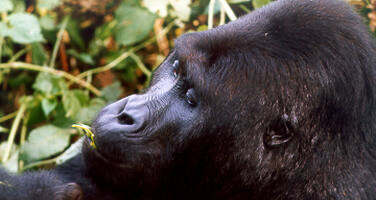
The report informs of a 10% increase in the number of gorillas in the families being monitored, from 126 to 139 individuals. The report confirms previous reports mentioning a small residual population of elephants in the Tshivanga sector.
h) Limit local traffic to only the part of Road RN3 crossing the property, ensure the means for control, and envisage a ring road around the property should the route towards Kisangani reopen
The report notes that work for the rehabilitation of the section crossing the property has been completed respecting environmental standards. Traffic control is carried out by means of barriers at the entrance and exit of the Park but should be reinforced. Teams have been established to assess the environmental impacts of the road on the bush meat commerce and the manufacture of charcoal. The report also mentions that currently the traffic remains minimal given that the rehabilitation of the Hombo – Walikale section (that connects to Kisangani) is not yet envisaged. The report also mentions that an Environmental Impact Study (EIS) for the ring road around the Park has been carried out.
The World Heritage Centre and IUCN reiterate the importance of foreseeing the ring road around the Park in the event of the envisaged Hombo – Walikale section and recommend that the EIS be submitted to the World Heritage Centre, in conformity with Paragraph 172 of the Operational Guidelines, for examination by IUCN.
The report also mentions infrastructure work foreseen, notably the rehabilitation of the Tshivanga station with the construction of offices and a guard camp and the construction of guard posts. The World Heritage Centre and IUCN recall the need to transmit to the World Heritage Centre information on the planned constructions in the Park, in conformity with Paragraph 172 of the Operational Guidelines.
Analysis and Conclusion by World Heritage Centre and the Advisory Bodies in 2012
The World Heritage Centre and IUCN note the important progress reported by the State Party in the implementation of the corrective measures, notably the evacuation of the armed groups from the property and the extension of the area of surveillance, the closing down of a large number of artisanal mining operations in the property and the resolution of illegal occupation in Bitale.
However, the World Heritage Centre and IUCN recommend that the World Heritage Committee expresses its concern with regard to the lack of progress concerning the cancellation by the Government of the land rights granted illegally in the property by the Mining Service of Land Titles and Cadastre, as well as the mining concessions encroaching on the property attributed by the Mining Cadastre. The World Heritage Centre and IUCN are of the opinion that the World Heritage Committee should request the State Party to initiate a dialogue at the political level with the State services that are indispensible for the successful implementation of these corrective measures.
The World Heritage Centre and IUCN note the importance of ensuring that the identified zoning options guarantee the conservation of the Outstanding Universal Value of the property and deem it important to submit these options for consideration to the World Heritage Committee before any decision is taken.
The World Heritage Centre and IUCN conclude that the progress achieved by the managers of the property is very encouraging but share the conclusion of the State Party report that the work still to be achieved remains important. They underline once again the need to carry out without delay an inventory of the lowland sectors. Only with the availability of reliable data on the main populations of wildlife will an assessment of the true state for the Outstanding Universal Value and the establishment of a timetable for the rehabilitation of the property be possible. They consider that the property should be maintained on the List of World Heritage in Danger and the reinforced monitoring mechanism be applied.
Summary of the interventions
Decisions adopted by the Committee in 2012
36 COM 7A.36
World Heritage properties of the Democratic Republic of the Congo (DRC)
The World Heritage Committee,
1. Having examined Document WHC-12/36.COM/7A.Add,
2. Recalling Decision 35 COM 7A.35, adopted at its 35th session (UNESCO, 2011),
3. Expresses its concern that signature of the January 2011 Kinshasa Declaration has not yet resulted in a concerted action between the different Ministries, the army and different technical agencies which is necessary to resolve some urgent conservation issues in the sites and create the conditions for their rehabilitation;
4. Notes with concern the consistent reports from different properties about continued involvement of elements of the Congolese Army in illegal exploitation of the natural resources;
5. Considers that the recent permit which has been granted to the international oil and gas company SOCO to start oil exploration activities in Virunga National Park is not in conformity with commitments made by the State Party in the Kinshasa Declaration;
6. Urges the State Party to ensure a full implementation of the commitments made in the Kinshasa Declaration and ensure the implementation of the Strategic Action Plan and in particular to urgently set up the inter-ministerial committee to ensure that specific activities of the action plan which need political decisions or the cooperation and commitment from other Ministries and state entities are implemented;
7. Welcomes the continued support from donor countries for the conservation of the five properties of the Democratic Republic of the Congo and the on-going efforts to set up a sustainable financing mechanism;
8. Requests the State Party in close cooperation with the World Heritage Centre and IUCN to organize an evaluation of the implementation of the action plan, identify obstacles to its implementation and ways to address these with the concerned Ministries and present a report on this evaluation to the World Heritage Centre, for consideration by the World Heritage Committee at its 37th session in 2013.
36 COM 7A.5
Kahuzi-Biega National Park (Democratic Republic of the Congo) (N 137)
The World Heritage Committee,
1. Having examined Document WHC-12/36.COM/7A,
2. Recalls Decision 35 COM 7A.5, adopted at its 35th session (UNESCO, 2011),
3. Welcomes with satisfaction the important progress reported by the State Party in the implementation of some corrective measures, notably the evacuation of the armed groups from the property and the increase in the area of surveillance, the closure of a large number of artisanal mining operations in the property and the resolution of illegal occupations in Bitale;
4. Notes with concern the absence of progress accomplished concerning the cancellation by the Government of land rights illegally granted in the property by the Land Titles and Cadastre Service as well as the mining concessions encroaching on the property granted by the Mining Cadastre;
5. Strongly urges the State Party to initiate a dialogue at the political level with the services of the State (Ministry responsible for the Cadastre and Land rights, Ministry for Mines, Provincial authorities) to reinforce efforts for the implementation of the updated corrective measures adopted by the World Heritage Committee at its 34th session (Brasilia, 2010), and particularly the immediate cancellation by the Government of land rights illegally granted in the property as well as mining concessions encroaching on the property, in conformity with the commitments undertaken in the Kinshasa Declaration;
6. Takes note of ongoing discussions with concerned populations on the zoning of the property and requests the State Party to ensure that the identified zoning options guarantee the conservation of the Outstanding Universal Value of the property and that they are submitted for consideration to the World Heritage Committee before any final decision is made;
7. Reiterates its request to the State Party to carry out as soon as possible a survey of the main populations of wildlife in the lowland sectors of the property to enable an assessment of the state of the Outstanding Universal Value and establishment of a timetable for the rehabilitation of the property;
8. Also requests the State Party to submit to the World Heritage Centre by 1 February 2013, a report on the state of conservation of the property, including an updated situation of the mining concessions and land rights granted on the territory of the property, progress accomplished in the resolution of the problem of illegal occupation of the ecological corridor and in the implementation of the corrective measures, for examination by the World Heritage Committee at its 37th session in 2013;
9. Decides to maintain the Reinforced monitoring mechanism for the property;
10. Also decides to retain the Kahuzi-Biega National Park (Democratic Republic of the Congo) on the List of World Heritage in Danger.
36 COM 8C.2
Establishment of the World Heritage List in Danger (Maintained Properties)
The World Heritage Committee,
1. Following the examination of the state of conservation reports of properties inscribed on the List of World Heritage in Danger (WHC-12/36.COM/7A and WHC-12/36.COM/7A.Add),
2. Decides to maintain the following properties on the List of World Heritage in Danger:
- Afghanistan, Minaret and Archaeological Remains of Jam (Decision 36 COM 7A.25)
- Afghanistan, Cultural Landscape and Archaeological Remains of the Bamiyan Valley (Decision 36 COM 7A.26)
- Belize, Belize Barrier Reef Reserve System (Decision 36 COM 7A.15)
- Central African Republic, Manovo-Gounda St Floris National Park (Decision 36 COM 7A.1)
- Chile, Humberstone and Santa Laura Saltpeter Works (Decision 36 COM 7A.33)
- Colombia, Los Katíos National Park (Decision 36 COM 7A.16)
- Côte d'Ivoire, Comoé National Park (Decision 36 COM 7A.2)
- Côte d'Ivoire / Guinea, Mount Nimba Strict Nature Reserve (Decision 36 COM 7A.3)
- Democratic Rep. of the Congo, Virunga National Park (Decision 36 COM 7A.4)
- Democratic Rep. of the Congo, Kahuzi-Biega National Park (Decision 36 COM 7A.5)
- Democratic Rep. of the Congo, Garamba National Park (Decision 36 COM 7A.6)
- Democratic Rep. of the Congo, Salonga National Park (Decision 36 COM 7A.7)
- Democratic Rep. of the Congo, Okapi Wildlife Reserve (Decision 36 COM 7A.8)
- Egypt, Abu Mena (Decision 36 COM 7A.20)
- Ethiopia, Simien National Park (Decision 36 COM 7A.9)
- Georgia, Bagrati Cathedral and Gelati Monastery (Decision 36 COM 7A.30)
- Georgia, Historical Monuments of Mtskheta (Decision 36 COM 7A.31)
- Honduras, Río Plátano Biosphere Reserve (Decision 36 COM 7A.17)
- Indonesia, Tropical Rainforest Heritage of Sumatra (Decision 36 COM 7A.13)
- Iraq, Ashur (Qal'at Sherqat) (Decision 36 COM 7A.21)
- Iraq, Samarra Archaeological City (Decision 36 COM 7A.22)
- Islamic Republic of Iran, Bam and its Cultural Landscape (Decision 36 COM 7A.27)
- Jerusalem, Old City of Jerusalem and its Walls (Decision 36 COM 7A.23.I)
- Madagascar, Rainforests of the Atsinanana (Decision 36 COM 7A.10)
- Niger, Air and Ténéré Natural Reserves (Decision 36 COM 7A.11)
- Peru, Chan Chan Archaelogical Zone (Decision 36 COM 7A.34)
- Senegal, Niokolo-Koba National Park (Decision 36 COM 7A.12)
- Serbia, Medieval Monuments in Kosovo (Decision 36 COM 7A.32)
- United Rep. of Tanzania, Ruins of Kilwa Kisiwani and Ruins of Songo Mnara (Decision 36 COM 7A.19)
- Uganda, Tombs of Buganda Kings at Kasubi (Decision 36 COM 7A.18)
- United States of America, Everglades National Park (Decision 36 COM 7A.14)
- Venezuela, Coro and its Port (Decision 36 COM 7A.35)
- Yemen, Historic Town of Zabid (Decision 36 COM 7A.24)
36 COM 8E
Adoption of retrospective Statements of Outstanding Universal Value
The World Heritage Committee,
1. Having examined Document WHC-12/36.COM/8E,
2. Congratulates States Parties for the excellent work accomplished in the elaboration of retrospective Statements of Outstanding Universal Value for World Heritage properties in their territories;
3. Adopts the retrospective Statements of Outstanding Universal Value, as presented in the Annex of Document WHC-12/36.COM/8E, for the following World Heritage properties:
- Australia: Great Barrier Reef; Lord Howe Island Group; Gondwana Rainforests of Australia; Wet Tropics of Queensland; Fraser Island; Australian Fossil Mammal Sites (Riversleigh / Naracoorte); Heard and McDonald Islands; Macquarie Island; Purnululu National Park;
- Bangladesh: Historic Mosque City of Bagerhat;
- Cambodia: Angkor;
- China: Mount Taishan; The Great Wall; Imperial Palaces of the Ming and Qing Dynasties in Beijing and Shenyang; Mogao Caves; Peking Man Site at Zhoukoudian; Jiuzhaigou Valley Scenic and Historic Interest Area; Temple and Cemetery of Confucius, and the Kong Family Mansion in Qufu; Ancient Building Complex in the Wudang Mountains; Historic Ensemble of the Potala Palace, Lhasa; Lushan National Park; Mount Emei Scenic Area, including Leshan Giant Buddha Scenic Area; Old Town of Lijiang; Temple of Heaven: an Imperial Sacrificial Altar in Beijing; Mount Wuyi; Dazu Rock Carvings; Mount Qincheng and the Dujiangyan Irrigation System; Capital Cities and Tombs of the Ancient Koguryo Kingdom; Sichuan Giant Panda Sanctuaries – Wolong, Mt Siguniang and Jiajin Mountains;
- Côte d’Ivoire and Guinea: Mount Nimba Strict Nature Reserve;
- Democratic People’s Republic of Korea: Complex of Koguryo Tombs;
- Democratic Republic of the Congo: Virunga National Park; Garamba National Park; Kahuzi-Biega National Park; Salonga National Park;
- Egypt: Wadi Al-Hitan (Whale Valley);
- Estonia: Historic Centre (Old Town) of Tallinn;
- Ethiopia: Rock-Hewn Churches, Lalibela; Lower Valley of the Awash; Lower Valley of the Omo; Harar Jugol, the Fortified Historic Town;
- Gambia: Kunta Kinteh Island and Related Sites;
- Gambia and Senegal: Stone Circles of Senegambia;
- Ghana: Forts and Castles, Volta, Greater Accra, Central and Western Regions; Asante Traditional Buildings;
- India: Taj Mahal; Keoladeo National Park; Sundarbans National Park; Nanda Devi and Valley of Flowers National Parks;
- Indonesia: Borobudur Temple Compounds; Prambanan Temple Compounds;
- Islamic Republic of Iran: Bam and its Cultural Landscape;
- Kazakhstan: Mausoleum of Khoja Ahmed Yasawi; Petroglyphs within the Archaeological Landscape of Tamgaly;
- Madagascar: Tsingy de Bemaraha Strict Nature Reserve; Royal Hill of Ambohimanga;
- Malaysia: Gunung Mulu National Park;
- Mali: Timbuktu; Cliff of Bandiagara (Land of the Dogons); Tomb of Askia;
- Mongolia: Orkhon Valley Cultural Landscape;
- Nepal: Sagarmatha National Park; Kathmandu Valley; Chitwan National Park; Lumbini, the Birthplace of the Lord Buddha;
- New Zealand: Te Wahipounamu – South West New Zealand; New Zealand Sub-Antarctic Islands;
- Nigeria: Osun-Osogbo Sacred Grove;
- Pakistan: Archaeological Ruins at Moenjodaro;
- Philippines: Baroque Churches of the Philippines; Puerto-Princesa Subterranean River National Park;
- Republic of Korea: Seokguram Grotto and Bulguksa Temple; Haeinsa Temple Janggyeong Pangeon, the Depositories for the Tripitaka Koreana Woodblocks; Jongmyo Shrine; Changdeokgung Palace Complex; Hwaseong Fortress; Gyeongju Historic Areas; Gochang, Hwasun and Ganghwa Dolmen Sites;
- Solomon Islands: East Rennell;
- Thailand: Historic City of Ayutthaya;
- Turkmenistan: State Historical and Cultural Park “Ancient Merv”; Kunya-Urgench;
- United Republic of Tanzania: Serengeti National Park; Kondoa Rock-Art Sites;
- Uzbekistan: Historic Centre of Bukhara; Historic Centre of Shakhrisyabz; Samarkand – Crossroad of Cultures;
- Viet Nam: Ha Long Bay; My Son Sanctuary; Phong Nha-Ke Bang National Park;
- Zambia and Zimbabwe: Mosi-oa-Tunya / Victoria Falls;
- Zimbabwe: Great Zimbabwe National Monument; Khami Ruins National Monument; Matobo Hills;
4. Decides that retrospective Statements of Outstanding Universal Value for World Heritage properties in Danger will be reviewed by the Advisory Bodies in priority;
5. Further decides that, considering the high number of retrospective Statements of Outstanding Universal Value to be examined, the order in which they will be reviewed by the Advisory Bodies will follow the Second Cycle of Periodic Reporting, namely:
- World Heritage properties in the Arab States;
- World Heritage properties in Africa;
- World Heritage properties in Asia and the Pacific;
- World Heritage properties in Latin America and the Caribbean;
- World Heritage properties in Europe and North America.
Draft Decision: 36 COM 7A.5
The World Heritage Committee,
1. Having examined Document WHC-12/36.COM/7A,
2. Recalls Decision 35 COM 7A.5, adopted at its 35th session (UNESCO, 2011),
3. Welcomes with satisfaction the important progress reported by the State Party in the implementation of the corrective measures, notably the evacuation of the armed groups from the property and the increase in the area of surveillance, the closure of a large number of artisanal mining operations in the property and the resolution of illegal occupations in Bitale;
4. Notes with concern the absence of progress accomplished concerning the cancellation by the Government of land rights illegally granted in the property by the Land Titles and Cadastre Service as well as the mining concessions encroaching on the property granted by the Mining Cadastre;
5. Strongly urges the State Party to initiate a dialogue at the political level with the services of the State (Ministry responsible for the Cadastre and Land rights, Ministry for Mines, Provincial authorities) to reinforce efforts for the implementation of the updated corrective measures adopted by the World Heritage Committee at its 34th session (Brasilia, 2010), and particularly the immediate cancellation by the Government of land rights illegally granted in the property as well as mining concessions encroaching on the property, in conformity with the commitments undertaken in the Kinshasa Declaration;
6. Takes note of ongoing discussions with concerned populations on the zoning of the property and requests the State Party to ensure that the identified zoning options guarantee the conservation of the Outstanding Universal Value of the property and that they are submitted for consideration to the World Heritage Committee before any final decision is made;
7. Reiterates its request to the State Party to carry out as soon as possible a survey of the main populations of wildlife in the lowland sectors of the property to enable an assessment of the state of the Outstanding Universal Value and establishment of a timetable for the rehabilitation of the property;
8. Also requests the State Party to submit to the World Heritage Centre by 1 February 2013, a report on the state of conservation of the property, including an updated situation of the mining concessions and land rights granted on the territory of the property, progress accomplished in the resolution of the problem of illegal occupation of the ecological corridor and in the implementation of the corrective measures, for examination by the World Heritage Committee at its 37th session in 2013;
9. Decides to maintain the Reinforced monitoring mechanism for the property;
10. Also decides to retain the Kahuzi-Biega National Park (Democratic Republic of the Congo) on the List of World Heritage in Danger.
 Democratic Republic of the Congo
Exports
* :
The threats indicated are listed in alphabetical order; their order does not constitute a classification according to the importance of their impact on the property.
Furthermore, they are presented irrespective of the type of threat faced by the property, i.e. with specific and proven imminent danger (“ascertained danger”) or with threats which could have deleterious effects on the property’s Outstanding Universal Value (“potential danger”).
** : All mission reports are not always available electronically.