Tombs of Buganda Kings at Kasubi
Factors affecting the property in 2010*
- Other Threats:
Fire
Factors* affecting the property identified in previous reports
Fire is mentioned in the ICOMOS evaluation of 2001 as the main threat to the property:
International Assistance: requests for the property until 2010
Total amount approved : 111,292 USD
| 2010 | Strategic plan for the reconstruction of burnt Kasubi ... (Approved) | 71,342 USD |
| 2005 | Kasubi Tombs, World Heritage Site Uganda, Research ... (Approved) | 19,950 USD |
| 1998 | Training for the conservation and maintenance of Kasubi ... (Approved) | 20,000 USD |
Missions to the property until 2010**
Conservation issues presented to the World Heritage Committee in 2010
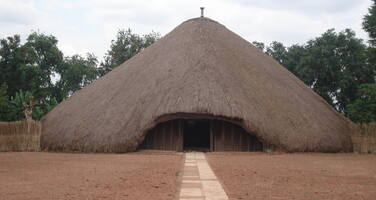
On 16 March 2010, a fire devastated the Muzibu Azaala Mpanga building, a major component of the World Heritage property. This building housed the four royal Buganda tombs. The large, circular thatched building, supported on wooden columns wrapped in bark cloth, was originally built in 1882 as a palace and then became a royal tomb. The building had been significantly repaired since its construction including the insertion of steel and concrete supports in 1938.
As a first response to this tragedy, the Director-General of UNESCO decided to dispatch a mission led by the World Heritage Centre and including experts from the African World Heritage Fund and CRATerre-ENSAG. The mission was undertaken from 7 to 9 April 2010. Its primary objective was to assess the extent of the damage, and discuss with the relevant authorities actions to be taken, including the possible reconstruction of the Muzibu Azaala Mpanga building. The mission observed that almost the entire building was destroyed. The entire vegetal structure (wooden poles, rings), the thatch, the bark clothes and part of the royal artefacts and kingdom symbols had been consumed by the fire. The steel roof structure introduced in 1938 bent completely due to the high temperatures, and the concrete poles which were supporting the steel structure were deformed. Only the peripheral and partition brick walls were still standing. The reed fence and trees all over the property have been also seriously damaged. The mission observed that many traditions and practices could no longer be performed as a result of this destruction. In addition, the royal tombs that are considered sacred were now exposed to outside elements such as rain, causing a traumatism amongst the people of Uganda.
The mission was informed that immediately after the incident, the State Party had established a Cabinet Committee, which has been requested to investigate the cause of the fire. The Buganda Kingdom which is the main site’s custodian also established a Technical and Building Committee to oversee the reconstruction process and organized a mourning ceremony and performed a series of traditional ceremonies in the tombs.
The mission supported the general agreement that the Muzibu Azaala Mpanga should be reconstructed.
The mission stressed the importance of not hastening the reconstruction. The mission considered that the overall reconstruction process should be seen as an educational and training opportunity. The mission particularly stressed the need for time to be taken with the reconstruction, in spite of pressure from the general public to see the place reconstructed as soon as possible, as an over-hastened reconstruction would be detrimental, because of the complexity of the structure, the intangible components associated with it, and the shortage of traditional skilled labour. It advised the State Party that reconstruction without proper studies could bring irreversible changes and might impair the remaining Outstanding Universal Value of the property. Therefore a reconstruction strategy, that clearly states how the building is to be constructed and the evidence base that is to be used would need to be agreed by both the Uganda Government and the Buganda Kingdom authorities.
The following recommendations were made by the mission team:
1) Emergency assistance request
The mission recommended that an Emergency assistance request be submitted by the State Party in order to allow implementation of the following activities:
§ Professional sifting of the wreckage ;
§ Construction of temporary shelters over the royal tombs to allow ritual ceremonies and practices to be maintained;
§ Mounting a temporary exhibition to present Muzibu Azaala Mpanga as it was before the fire incident;
§ National sensitization workshop on the reconstruction process and the implementation of the management plan;
§ Purchase of equipment required to ensure proper documentation of the reconstruction process;
§ Preparation of an overall conservation project document to be submitted to donors, including costs of international expertise to advise on the reconstruction strategy;
§ Reprinting a revised version of the 2006 booklet on Kasubi tombs with 2 pages on the fire incident included;
The State Party submitted the request at the end of May 2010 to the World Heritage Centre. The Advisory Bodies strongly support the principle of this property benefitting from Emergency Assistance along the lines set out by the April 2010 mission. They do however consider that the request needs to be reformulated so that it reflects the urgent work that is needed in the short-term to respond to the emergency. They consider that the workshop needs to be re-formulated to focus on the emergency. They also considers that some of the costs should be revisited and where possible reduced. They consider that the exhibition should be a short-term immediate production rather than a formal exhibition with formal opening.
2) Reconstruction of the Muzibu Azaala Mpanga
The mission, which proposed a short term action plan that foresees the complete reconstruction by December 2011, also recommended:
§ The production of complete documentation before the start of the works which should include:
- Architectural survey of the wreckage;
- Study of the traditional construction techniques and their associated intangible values
- Identification of skilled people and sourcing of materials (where and how they were traditionally sourced);
- Compilation of existing archives (plans, drawings and photographs);
§ Consideration of what constitutes the attributes that convey the Outstanding Universal Value of the property when undertaking reconstruction:
§ The preparation of a detailed reconstruction strategy which will have to be submitted for approval to the UNESCO World Heritage Centre and ICOMOS before any action is undertaken;
§ An estimate of the overall cost of the reconstruction project to be undertaken (cost of the main structure, cost of the roof, cost of the internal finishes, management, etc.);
§ That reconstruction process should be used to train more thatchers who will also be able to maintain other Ganda thatched roofs on associated sites
§ That the reconstruction project integrates both a fire prevention system and a fire fighting strategy;
The World Heritage Centre and the Advisory Bodies consider that the Muzibu Azaala Mpanga building at Kasubi was an outstanding example of an architectural style developed by the Buganda Kingdom since the 13th Century.
With its complete destruction by the 16 March 2010 fire, they consider that the property’s Outstanding Universal Value is seriously threatened.
The World Heritage Centre and the Advisory Bodies consider that the significance of the building lay partly in the way it reflected typical Bugandan traditions but also in its size, elaboration and sacred use which set it apart from other structures. Buildings such as this need constant maintenance and irregular renewal. Their fabric cannot all be maintained over time; the authenticity of their structures lies more in a reflection of traditional materials and practice than in the age of component parts. They consider that a case can thus be made for the reconstruction of the Muzibu Azaala Mpanga building provided that a clear reconstruction strategy is set out and agreed in advance that sets out the rational for the chosen approach, gives due consideration to the various options, such as re-building as in 2010, 1939, 1911 (for which photographic evidence exists) or as in the 1880s, and provides clear documentary evidence.
They also consider that the overall reconstruction process needs to be carefully managed, requires detailed documenting, and also needs close monitoring by the World Heritage Committee in order to ensure full recovery of the property’s Outstanding Universal Value. Finally, they consider that as the property face a serious deterioration of its architectural components, it therefore meets the criteria for inscription on the List of World Heritage in Danger as defined in Paragraph 179 of the Operational Guidelines.
Summary of the interventions
Decisions adopted by the Committee in 2010
34 COM 7B.53
Tombs of Buganda Kings at Kasubi (Uganda) (C 1022)
The World Heritage Committee,
1. Having examined Document WHC-10/34.COM/7B.Add,
2. Recalling that the Muzibu Azaala Mpanga building at Kasubi was an outstanding example of an architectural style developed by the Buganda Kingdom since the 13th century, due to its design and spatial organization, but also its elaboration and size,
3. Thanks the Director-General of UNESCO for having dispatched, immediately after the fire that resulted in the destruction of the property, a mission in April 2010 led by the World Heritage Centre and including experts from the African World Heritage Fund and CRATerre-ENSAG, with the primary objective to assess the extent of the damage, and discuss with the relevant authorities actions to be taken, including its possible reconstruction;
4. Takes note of the results of the 2010 mission, which observed that the entire Muzibu Azaala Mpanga building has been destroyed, and the wish of the State Party to undertake its reconstruction;
5. Considers that, with the unfortunate destruction of the Muzibu Azaala Mpanga, the property faces a serious deterioration of its architectural components and therefore meets the criteria for inscription on the List of World Heritage in Danger as defined in Paragraph 179 of the Operational Guidelines;
6. Also considers that the reconstruction of the Muzibu Azaala Mpanga could be justified, provided, that the new structure is based on authenticity in design, materials, and techniques as well as continuing use; and that:
a) a clear rationale for the overall project is set out and agreed in advance that sets out the basis for the chosen approach,
b) due consideration is given to the various options, such as re-building as in 2010, 1938, 1911 or as in the 1880s, based on sound documentation and traditional materials and techniques,
7. Notes that the State Party has submitted a reconstruction strategy to the World Heritage Centre for review by the Advisory Bodies and requests that no reconstruction work commences before this review is finalized;
8. Further considers that the reconstruction of Muzibu Azaala Mpanga without proper studies and the development of an agreed reconstruction strategy could impair the remaining Outstanding Universal Value of the property;
9. Considers moreover that the overall reconstruction of the Muzibu Azaala Mpanga building will need close monitoring through the Advisory Bodies and detailed documentation;
10. Encourages the State Party to appoint a site manager for the property and to establish a coordination mechanism which will enable the Buganda kingdom and other stakeholders to work together and share responsibilities during the reconstruction process;
11. Decides to inscribe the Tombs of Buganda Kings at Kasubi (Uganda) on the List of World Heritage in Danger;
12. Also notes that the State Party has submitted to the World Heritage Centre the recently revised 2009-2015 management plan, and also requests the State Party to ensure its implementation in close collaboration with the main stakeholders of the property;
13. Further requests the State Party to invite, as soon as possible, a joint World Heritage Centre/ICCROM/ICOMOS reactive monitoring mission and the African World Heritage Fund to the property, to assess the state of conservation of the property, and develop, in cooperation with the State Party, the corrective measures to address the threats to the Outstanding Universal Value as well as a time frame for their implementation, a Desired State of Conservation for the removal of the property from the List of World Heritage in Danger, and to advise the stakeholders on the overall reconstruction of the Muzibu Azaala Mpanga;
14. Finally requests the State Party to submit to the World Heritage Centre, by 1 February 2011, a report on the state of conservation of the property, describing progress made in the reconstruction of the Muzibu Azaala Mpanga and in the implementation of the 2009-2015 management plan, for examination by the World Heritage Committee at its 35th session in 2011.
34 COM 8C.1
Establishment of the World Heritage List in Danger (Inscribed Properties)
The World Heritage Committee,
1. Following the examination of the state of conservation reports of properties inscribed on the World Heritage List (WHC-10/34.COM/7B, WHC-10/34.COM/7B.Add, WHC-10/34.COM/7B.Add.2 and WHC-10/34.COM/7B.Add.3) and of proposals for inscription of properties on the World Heritage List (WHC-10/34.COM/8B, WHC-10/34.COM/8B.Add),
2. Decides to inscribe the following properties on the List of World Heritage in Danger:
- Georgia, Bagrati Cathedral and Gelati Monastery (Decision 34 COM 7B.88)
- Madagascar, Rainforests of the Atsinanana (Decision 34 COM 7B.2)
- Uganda, Tombs of Buganda Kings at Kasubi (Decision 34 COM 7B.53)
- United States of America, Everglades National Park (Decision 34 COM 7B.29)
34 COM 8E
Adoption of retrospective Statements of Outstanding Universal Value
The World Heritage Committee,
1. Having examined Document WHC-10/34.COM/8E,
2. Adopts the retrospective Statements of Outstanding Universal Value, as presented in the Annex I of Documents WHC-10/34.COM/8E, WHC-10/34.COM/8E.Add and WHC-10/34.COM/8E.Add.2 for the following World Heritage properties:
- Algeria: Al Qal'a of Beni Hammad; M'Zab Valley; Djémila; Tipasa; Tassili n'Ajjer; Timgad; Kasbah of Algiers;
- Austria: Historic Centre of the City of Salzburg; Palace and Gardens of Schönbrunn; Hallstatt-Dachstein / Salzkammergut Cultural Landscape;
- Bulgaria: Boyana Church; Madara Rider; Thracian Tomb of Kazanlak; Rock-Hewn Churches of Ivanovo; Rila Monastery; Ancient City of Nessebar; Thracian Tomb of Sveshtari;
- Côte d'Ivoire: Comoé National Park;
- Democratic Republic of the Congo: Okapi Wildlife Reserve;
- Denmark: Jelling Mounds, Runic Stones and Church; Roskilde Cathedral;
- Ethiopia: SimienNational Park;
- Israel: Masada; Old City of Acre; White City of Tel-Aviv - the Modern Movement; Incense Route - Desert Cities in the Negev; Biblical Tels - Megiddo, Hazor, Beer Sheba;
- Jordan: Petra; Quseir Amra; Um er-Rasas (Kastrom Mefa'a);
- Lebanon: Anjar; Byblos; Baalbek; Tyre; Ouadi Qadisha (the Holy Valley) and the Forest of the Cedars of God (Horsh Arz-el-Rab);
- Malawi: Lake Malawi National Park;
- Mauritania: Banc d'Arguin National Park; Ancient Ksour of Ouadane, Chinguetti, Tichitt and Oualata;
- Morocco: Ksar of Ait-Ben-Haddou; Historic City of Meknes; Archaeological Site of Volubilis; Medina of Essaouira (formerly Mogador); Medina of Fez; Medina of Marrakesh; Medina of Tétouan (formerly known as Titawin); Portuguese City of Mazagan (El Jadida);
- Niger: Air and Ténéré Natural Reserves; W National Park of Niger;
- Oman: Bahla Fort;
- Portugal: Laurisilva of Madeira;
- Senegal: Island of Gorée; Niokolo-Koba National Park;
- Seychelles: Aldabra Atoll; Vallée de Mai Nature Reserve;
- South Africa: Fossil Hominid Sites of Sterkfontein, Swartkrans, Kromdraai, and Environs.
- Spain: Cathedral, Alcázar and Archivo de Indias in Seville ;
- Sudan: Gebel Barkal and the Sites of the Napatan Region;
- Syrian Arab Republic: Ancient City of Bosra; Ancient City of Aleppo; Crac des Chevaliers and Qal'at Salah El-Din; City of Damascus; Site of Palmyra;
- Tunisia: Archaeological Site of Carthage; Amphitheatre of El Jem; Ichkeul National Park; Medina of Sousse; Kairouan; Medina of Tunis; Punic Town of Kerkuane and its Necropolis; Dougga / Thugga;
- Uganda: Tombs of Buganda Kings at Kasubi;
- United Kingdom of Great Britain and Northern Ireland: Saltaire; Dorset and East Devon Coast; Derwent Valley Mills; Royal Botanic Gardens, Kew; Liverpool - Maritime Mercantile City; Cornwall and West Devon Mining Landscape.
- United Republic of Tanzania: Selous Game Reserve; Kilimanjaro National Park;
- Yemen: Historic Town of Zabid;
3. Decides that retrospective Statements of Outstanding Universal Value for World Heritage properties in Danger will be reviewed in priority;
4. Further decides that, considering the high number of retrospective Statements of Outstanding Universal Value to be examined, the order in which they will be reviewed will follow the Second Cycle of Periodic Reporting, namely:
- World Heritage properties in the Arab States;
- World Heritage properties in Africa;
- World Heritage properties in Asia and the Pacific;
- World Heritage properties in Latin America and the Caribbean;
- World Heritage properties in Europe and North America.
Draft Decision: 34 COM 7B.53
The World Heritage Committee,
1. Having examined Document WHC-10/34.COM/7B.Add,
2. Recallingthat the Muzibu Azaala Mpanga building at Kasubi was an outstanding example of an architectural style developed by the Buganda Kingdom since the 13th Century, due to its design and spatial organization, but also to its elaboration and size,
3. Thanks the Director-General of UNESCO for having dispatched a mission in April 2010 immediately after the fire that resulted in its destruction, led by the World Heritage Centre and including experts from the African World Heritage Fund and CRATerre-ENSAG, with the primary objective to assess the extent of the damage, and discuss with the relevant authorities actions to be taken, including its possible reconstruction;
4. Takes note of the results of the 2010 mission, which observed that the entire Muzibu Azaala Mpanga building has been destroyed, and the wish of the State Party to undertake its reconstruction;
5. Considers that, with the unfortunate destruction of the Muzibu Azaala Mpanga, the property faces a serious deterioration of its architectural components and therefore meets the criteria for inscription on the List of World Heritage in Danger as defined in Paragraph 179 of the Operational Guidelines;
6. Further considers that the reconstruction of the Muzibu Azaala Mpanga could be justified provided that a clear justification for the overall project is set out and agreed in advance that sets out the rational for the chosen approach, gives due consideration to the various options, such as re-building as in 2010, 1939, 1911 (for which photographic evidence exists) or as in the 1880s, and is based on sound documentation and traditional materials and techniques, in order that the new structure might be seen as having authenticity in relation to design, materials, and techniques as well as continuing use;
7. Invites the State Party to submit, as soon as possible and before any reconstruction work commences, a reconstruction strategy to the World Heritage Centre for review by the Advisory Bodies;
8. Considers furthermore that reconstruction of Muzibu Azaala Mpanga without proper studies and the development of an agreed reconstruction strategy could impair the remaining Outstanding Universal Value of the property;
9. Considers moreover that the overall reconstruction of Muzibu Azaala Mpanga building, will need close monitoring through the Advisory Bodies and detailed documentation;
10. Encourages the State Party to appoint a site manager for the property and to establish a coordination mechanism which will enable the Buganda kingdom and other stakeholders to work together and share responsibilities during the reconstruction process;
11. Decides to inscribe the Tombs of Buganda Kings at Kasubi (Uganda) on the List of World Heritage in Danger;
12. Requests the State Party to submit to the World Heritage Centre the recently revised 2009-2015 management plan, and to ensure its implementation in close collaboration with the main custodians of the property;
13. Also requests the State Party to invite as soon as possible a joint World Heritage Centre/ICCROM/ICOMOS reactive monitoring mission to the property to assess the state of conservation of the property, and develop in cooperation with the State Party the corrective measures to address the threats to the Outstanding Universal Value as well as a time frame for their implementation, and to advise on the overall reconstruction of the Muzibu Azaala Mpanga;
14. Further requests the State Party to submit to the World Heritage Centre, by 1 February 2011, a report on the state of conservation of the property, describing progress made in the reconstruction of the Muzibu Azaala Mpanga and in the implementation of the 2009-2015 management plan, for examination by the World Heritage Committee at its 35th session in 2011.
 Uganda
Exports
* :
The threats indicated are listed in alphabetical order; their order does not constitute a classification according to the importance of their impact on the property.
Furthermore, they are presented irrespective of the type of threat faced by the property, i.e. with specific and proven imminent danger (“ascertained danger”) or with threats which could have deleterious effects on the property’s Outstanding Universal Value (“potential danger”).
** : All mission reports are not always available electronically.