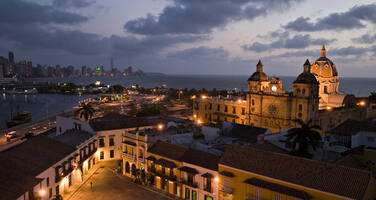
Port, Fortresses and Group of Monuments, Cartagena
Factors affecting the property in 2004*
- Management systems/ management plan
Factors* affecting the property identified in previous reports
Tourism Pressure
International Assistance: requests for the property until 2004
Total amount approved : 108,800 USD
| 1999 | Technical Co-operation request for the Integral ... (Approved) | 60,000 USD |
| 1993 | Provision of experts for the preparation of a master ... (Approved) | 19,000 USD |
| 1991 | Contribution to a monitoring exercise of the following ... (Approved) | 3,300 USD |
| 1990 | Preparation of legislation for the preservation of the ... (Approved) | 5,000 USD |
| 1989 | Additional contribution to a seminar on the ... (Approved) | 7,500 USD |
| 1988 | Specialists to advise on the protection and restoration ... (Approved) | 14,000 USD |
Missions to the property until 2004**
Conservation issues presented to the World Heritage Committee in 2004
Upon request of the Colombian national authorities an ICOMOS Reactive Monitoring mission took place from 29 November to 5 December 2003 to assess the state of conservation of the Church of Santo Domingo in Cartagena de Indias. The ICOMOS mission report was received at the Secretariat on 10 March 2004. A progress report from the Dirección de Patrimonio (Heritage Department) of the Ministry of Culture of Colombia was received on 9 March 2004.
In accordance with the recommendations of the May-June 2003 UNESCO-ICOMOS Reactive Monitoring mission to Cartagena de Indias, the Ministry of Culture has initiated a series of activities involving: a) a proper delimitation of the site; b) elaboration of a Management Plan; c) strengthening of community participation in this process; d) the restoration and conservation of the Church of Santo Domingo; and e) the execution of detailed investigations and inventories of the walled cordon around the inscribed property.
A study was executed that described typologies of structures and spaces of historic and architectonic interest to provide for a detailed delimitation of the historic urban landscape of the property. The elaboration of a Management Plan is taking place in the framework of a Special Protection Plan (Plan Especial de Protección - PEP), which aims to formulate a planning instrument for the integrated protection and development of cultural properties under Law 397 of 1997. In the elaboration and implementation of these activities community participation constituted a central element of the methodology employed.
Concerning the Church of Santo Domingo, the objectives were to assess the overall state of the building's fabric and to advise the Colombian representatives of the Ministry of Culture, and the architects and engineers working on the building site, on the current repair of the masonry construction. The conclusions of the mission were that the repair works on the Church are being executed in a very professional manner, and both the choice of materials and the execution of the work by the craftsmen proved to be of excellent quality. The building's fabric, which has been improved and consolidated over the last 400 years, was considered to be stable with no need for extra reinforcement, and the walls and vaults showed after intense investigation and in spite of their age no serious damage that could be related to earthquakes.
ICOMOS received the report of the State Party and congratulates the authorities for having taken note of the recommendations of the joint UNESCO-ICOMOS mission of 2003, in particular for the preparation of the Management Plan for the property. The first part of the report included a very detailed study of the delimitation of the historic urban landscape of Cartagena. It identified zones for protection and conservation of historic, cultural, architectural and archaeological heritage of the historic centre of Cartagena, its perimeter of influence into the historic urban landscape, including visual axes and the historic sections of urban and rural expansion. This inventory has been completed by a typology of architectural/historic structures and spaces for each of the zones. The second part of the report contained a civil engineering study concerning the different elements of the fortification system of the property (walls, bastions and ditches), an analysis of their capacity aiming at the installation of cultural infrastructures and an evaluation of their state of conservation.
Summary of the interventions
Decisions adopted by the Committee in 2004
28 COM 15B.112
The World Heritage Committee,
1. Taking note of the reports provided by the State Party and ICOMOS on the state of conservation of the property (Decision 27 COM 7B.89),
2. Congratulates the authorities for thoroughly implementing the recommendations of the UNESCO-ICOMOS Reactive Monitoring mission of 2003.
Draft Decision: 28 COM 15B.112
The World Heritage Committee,
1. Taking note of the reports provided by ICOMOS and the State Party on the state of conservation of the property,
2. Congratulates the authorities for thoroughly implementing the recommendations of the UNESCO-ICOMOS Reactive Monitoring mission of 2003.
 Colombia
* :
The threats indicated are listed in alphabetical order; their order does not constitute a classification according to the importance of their impact on the property.
Furthermore, they are presented irrespective of the type of threat faced by the property, i.e. with specific and proven imminent danger (“ascertained danger”) or with threats which could have deleterious effects on the property’s Outstanding Universal Value (“potential danger”).
** : All mission reports are not always available electronically.