National History Park – Citadel, Sans Souci, Ramiers
Factors affecting the property in 2012*
- Deliberate destruction of heritage
- Earthquake
- Ground transport infrastructure
- Impacts of tourism / visitor / recreation
- Major visitor accommodation and associated infrastructure
- Management systems/ management plan
- Water (rain/water table)
Factors* affecting the property identified in previous reports
a) Lack of a Management Plan;
b) Lack of a Conservation Plan;
c) Water damage;
d) Vandalism;
e) Seismic activities;
f) Infrastructure projects;
g) Lack of a Risk Preparedness Plan;
h) Potential uncontrolled touristic development.
UNESCO Extra-Budgetary Funds until 2012
USD 74,780: technical mission July 2010, World Heritage Centre technical mission January 2012; technical multidisciplinary mission March 2012, financed mainly by the Spanish Funds-in-Trust for World Heritage.
International Assistance: requests for the property until 2012
Total amount approved : 246,110 USD
| 2010 | Post Earthquake Technical Assistance for the Assessment ... (Approved) | 49,300 USD |
| 1994 | New exhibition panels and purchase of climate control ... (Approved) | 17,510 USD |
| 1994 | One-month on-site training activity for 5 architectural ... (Approved) | 4,100 USD |
| 1994 | Emergency measures and structural consolidation of the ... (Approved) | 73,000 USD |
| 1987 | Training courses at the National History Park-Citadel, ... (Approved) | 25,000 USD |
| 1983 | Masonry work and purchase of equipment for the ... (Approved) | 20,000 USD |
| 1982 | Equipment and construction material for the restoration ... (Approved) | 57,200 USD |
Missions to the property until 2012**
September 2006: UNESCO Havana Office Technical Visit; July 2010: Joint Expert Technical Mission; March 2011: Preparatory Mission for Haiti Donor’s Conference, CLT; January 2012: World Heritage Centre technical mission; March 2012: Multidisciplinary technical mission.
Conservation issues presented to the World Heritage Committee in 2012
The State Party submitted a report on the state of conservation of the property on 15 February 2012 with the draft Retrospective Statement of Outstanding Universal Value prepared by the Haitian Institute for the Preservation of the National Heritage (ISPAN). This report provides a global vision of the current situation at the property and the measures undertaken following the decisions of the Committee.
A World Heritage Centre technical mission was conducted from 9 – 15 January 2012 and a multidisciplinary technical mission visited the property from 6 – 22 March 2012.
a) National Road RN003
With regard to the completion of the National Road RN003, funded by the European Commission, the State Party briefly makes mention that the second section of the road linking Hinche to Saint Raphael was approved by the national authorities in January 2012 and that the third section to the Haitian Cape, which will include an alternative road around the National Park, will shortly be put up to tender by the Ministry of Public Works. Nevertheless, it should be noted that so far no study has been transmitted to the World Heritage Centre as regards the proposal for an alternative road, as was requested by the Committee at its last sessions by Decisions 34 COM 7B.110 and 35 COM 7B.125.
As concerns the improvement of the existing road within the Park between Milot and Dondon, the local authorities informed the mission that funding for this work had yet to be confirmed. In addition, the Haitian national authorities have not yet submitted a technical improvement project for the road within the Park.
b) Architectural interventions within the National Park
It has further been noted that construction work on the historic wrought iron gates and railings limiting access to the property at the northern entrance of the Sans Souci Palace was completed during the first quarter of 2011. The report also notes the completion in August 2011 of a study on the waterproofing of the floors and shoring up of the walls of the Sans Souci Palace. In addition, it was reported that some rehabilitation work at the Citadel Henri was completed in November 2011 with United States support (restoration of the sentry posts, stairs, walls etc.).
c) Cadastral survey and land ownership
With regard to the retrospective inventory of the property, the survey work of the types of ownership within the boundaries of the property, as well as the surrounds are ongoing but the cadastral study has experienced some difficulties, chiefly due to the opposition of the inhabitants in the area. The Mayor of Dondon and the Haitian Institute for the Preservation of the National Heritage (ISPAN) conducted a communal development study to regulate construction in the Park, including the forestry and/or green areas around the Park boundaries.
d) World Heritage Centre technical mission
With funding from the Spanish Agency for International Development Cooperation (AECID), the World Heritage Centre undertook a mission to Haiti from 9-12 January 2012 in the framework of the preparations of a conservation plan. The mission objectives were to evaluate the current situation from the cultural perspective, particularly in northern Haiti, two years after the earthquake and to identify potential partners to implement the overall conservation plan for the property, and begin to utilize the extra-budgetary funds granted at the Donors’ Conference for Culture in Haiti which was held in Paris on 19 April 2011. This mission also prepared the technical mission foreseen for March 2012 and discussed with the national authorities and the local and international partners the evolution of conservation activities undertaken since 2011.
As regards tourism development projects, the conclusions of the mission note a series of initiatives aiming at a significant increase in the number of visitors to the National Park in the framework of a multi-destination offer. The mission reiterated to the partners of this project, mainly the Inter-American Development Bank (IDB), the Royal Caribbean Cruise Lines and the Ministry of Tourism, recent decisions adopted by the World Heritage Committee, requesting the State Party to undertake all the necessary measures at the interministerial level to ensure that no undertaking, work or facilities destined for tourism be developed before being taken into consideration in the conservation plan. The World Heritage Centre seized the opportunity to reaffirm its intention to provide technical support for the development of a participatory tourism approach that takes into account in a future project the needs of the local population for the improvement in their quality of life. The January 2012 mission also indicates that the infrastructure of the property and its buffer zone with regards to access and facilities for visitors remain lacking, which constitutes an obstacle for any significant increase in visitor frequentation.
It was noted, furthermore, that security measures are inadequate to cope with this tourism offer. The mission emphasized the need to engage a participatory process with the local communities, taking into account the socio-economic impact on the communities living around the Park, and actively involve them in the long-term conservation, management and preservation measures for the property. It also insisted upon the involvement of other ministries concerned (public works, education, social affairs, environment and the Inter-sectoral Council for Territorial Planning (CIAT), among others).
As regards the renovation work of the National Road RN003, the mission recalled the Committee decisions in this respect and reiterated its request for the submission of detailed technical reports concerning (i) the alternative road project around the National Park; (ii) improvement of the road in the Park between Milot and Dondon, and (iii) the road project between the Acul du Nord and Milot that would transport tourists from the cruise ships at Labadee. On 27 January 2012, the World Heritage Centre wrote to the Secretary of State for Heritage at the Ministry of Culture and Communications in this respect, requesting official information on the construction works. To date, the Centre has not received the requested information. Finally, as regards the boundary issue for the National Park, the mission considered it counter-productive to commence a physical demarcation of the Park and preferably to await the completion of the current cadastral surveys and the establishment of a participatory strategy for the conservation and management of the Park.
e) Multidisciplinary technical mission
From 6-22 March 2012, a technical mission comprising a multidisciplinary team of five international experts visited the property. This mission worked in close cooperation with the ISPAN and the Secretary of State for Heritage to conduct an in-depth analysis of the structural situation of the property and to identify the most damaged components. The mission also identified the necessary conservation measures to ensure the preservation of the property over the long-term, while indicating the priority measures that must be taken into account in the conservation plan, the timetable of interventions, the emergency measures to be taken to ensure the safety of the visits, and the required budget.
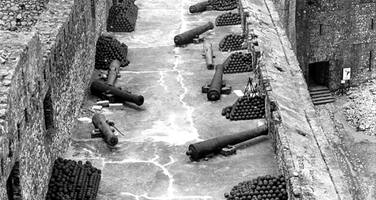
The recommendations resulting from the mission mainly emphasize the need to carry out interventions in the National Park to address urgent problems linked to: (i) structural stability; (ii) visitor security, and (iii) water damage, keeping in mind an individual approach and respecting the particularities of each of the components of the property. With regard to Sans-Souci, the mission recommended a two-level approach to ensure both the structural stability of the property and the establishment of a seismic study. The mission also identified important problems at the Citadel, mainly involving deterioration of the structure as well as security repercussions for visitors to the Queen Battery and the Coidavid Battery. In order to mitigate major infiltration problems affecting the Citadel structures, the mission recommended emergency measures be undertaken to seal the damaged walls, repair the ceilings and ensure the appropriate evacuation of rainwater and reservoir water. The mission also emphasized the need to install security railings for visitors. As concerns the Ramiers, the mission recommended to seal the walls to reduce the general deterioration, a halt to archaeological digs, and the cutting back of excessive vegetation throughout the area to enable the implementation of restoration work on the forts and ruins. The reports may be consulted at the following Internet link: https://whc.unesco.org/en/sessions/36COM.
Analysis and Conclusion by World Heritage Centre and the Advisory Bodies in 2012
The World Heritage Centre and the Advisory Bodies observe that although the State Party has begun, to the extent possible, to progressively implement the Committee decisions, it is a matter of urgency to carry out an intervention to ensure the stability of the structures that risk collapse. The conclusions of the studies conducted and the diagnostics of the components and structures have revealed the serious vulnerability of the property and clearly identified, in its recommendations, the urgent measures to be undertaken. The World Heritage Centre and the Advisory Bodies consider that if the proposed urgent safeguarding measures are not implemented between August and November 2012, the Committee should consider inscribing the property on the List of World Heritage in Danger, as the problems linked to its structural stability constitute a risk of collapse of the major components of the property which could, in time, endanger its Outstanding Universal Value.
Summary of the interventions
Decisions adopted by the Committee in 2012
36 COM 7B.99
National History Park – Citadel, Sans Souci, Ramiers (Haiti) (C 180)
The World Heritage Committee,
1. Having examined Document WHC-12/36.COM/7B.Add,
2. Recalling Decision 35 COM 7B.125 adopted at its 35th session (UNESCO, 2011),
3. Takes note of the information provided by the State Party concerning the steps taken to implement the World Heritage Committee Decisions, and recognizes the efforts deployed by the Institut de Sauvegarde du Patrimoine National (ISPAN )to ensure the safeguarding of the property;
4. Thanks the Government of Spain and the Spanish Agency for International Development Cooperation for the generous contribution that enabled the further implementation of the World Heritage Committee Decisions;
5. Takes note of the World Heritage Centre mission report (9-15 January 2012) and the multidisciplinary technical mission (6-22 March 2012), and endorses the recommendations developed to ensure the maintenance of the Outstanding Universal Value of the property, in particular the urgent interventions regarding (i) structural stability, (ii) visitor security, and (iii) the solution to the water infiltration problems, so that they will be integrated in the conservation plan without delay;
6. Reiterates its request to the State Party, in accordance with Paragraph 172 of the Operational Guidelines, to submit to the World Heritage Centre and the Advisory Bodies for examination prior to any intervention, the final project for the construction of the third section of the National Road RN003, as well as environmental, heritage and socio-economic impact assessment studies on the site;
7. Also reiterates its request to the State Party to submit the technical project for the improvement of the existing road within the Park boundaries, including the route, the engineering work for the canalization of the river, the type of asphalt to be used and the width of the route;
8. Requests the State Party to continue its efforts to complete the cadastral survey as well as the delineation of the Park boundaries and its buffer zone, and the legal framework for their protection, in the context of the retrospective inventory process undertaken in the Latin America and the Caribbean Region, and to await the results of the study before proceeding with the physical demarcation of the property, in order to facilitate the establishment of a participatory strategy for the conservation and management of the Park;
9. Also requests the State Party to await the completion of the conservation plan before pursuing tourism development projects, so that the conservation measures of the plan may be taken into account in the implementation of these projects and to actively involve the local communities in the conservation and management process;
10. Further takes note of the recent results obtained from the surveys concerning the structural stabilization of the Citadel, and urges the State Party to take all measures to start the emergency actions in collaboration with technical and financial institutions to ensure the integrity of the fortified structures;
11. Further requests the State Party to halt all touristic visits to the Citadel without delay until urgent security measures can be implemented to ensure secure conditions for visits;
12. Further requests the State Party to submit to the World Heritage Centre before 30 November 2012, a timetable of interventions, indicating the technical needs, as well as a detailed budget;
13. Calls upon the international community to ensure by every possible means, its support in the implementation of the recommendations to rapidly approve financial and human resources in order to assist the State Party to ensure the conservation of the entire property;
14. Requests the State Party to submit to the World Heritage Centre by 1 February 2013, an updated report on the state of conservation of the property and the implementation of the above, for examination by the World Heritage Committee at its 37th session in 2013.
Draft Decision: 36 COM 7B.99
The World Heritage Committee,
1. Having examined Document WHC-12/36.COM/7B.Add,
2. Recalling Decision 35 COM 7B.125 adopted at its 35th session (UNESCO, 2011),
3. Takes note of the information provided by the State Party concerning the steps taken to implement the World Heritage Committee decisions and recognizes the efforts deployed by the ISPAN to ensure the safeguarding of the property,
4. Thanks the Government of Spain and the Spanish Agency of International Development Cooperation for the generous contribution that enabled the further implementation of the World Heritage Committee decisions,
5. Takes note of the World Heritage Centre mission report (9-15 January 2012) and the multidisciplinary technical mission (6-22 March 2012) and endorses the recommendations developed to ensure the maintenance of the Outstanding Universal Value of the property, in particular the urgent interventions regarding (i) structural stability, (ii) visitor security, and (iii) the solution to the water infiltration problems, so they are integrated in the conservation plan without delay,
6. Reiterates its request to the State Party, in accordance with Paragraph 172 of the Operational Guidelines, to submit to the World Heritage Centre and the Advisory Bodies for examination prior to any intervention, the final project for the construction of the third section of the National Road RN003, as well as environmental, heritage and socio-economic impact assessment studies on the site;
7. Also reiterates its request to the State Party to submit the technical project for the improvement of the existing road within the Park boundaries, including the route, the engineering work for the canalization of the river, the type of asphalt and the width of the route;
8. Requests the State Party to continue its efforts to complete the cadastral survey as well as the delineation of the Park boundaries and its buffer zone, and the legal framework for their protection in the context of the retrospective inventory undertaken in the Latin America and the Caribbean Region and to await the results of the study before proceeding with the physical demarcation of the property, to facilitate the establishment of a participatory strategy for the conservation and management of the Park;
9. Also requests the State Party to await the completion of the conservation plan before pursuing tourism development projects so that the conservation measures of the plan may be taken into account in the implementation of these projects and to actively involve the local communities in the conservation and management process;
10. Further requests the State Party to submit to the World Heritage Centre before 30 November 2012, a timetable of interventions indicating the technical needs, as well as a detailed budget;
11. Calls upon the international community to ensure by every possible means, its support in the implementation of the recommendations to rapidly approve financial and human resources in order to assist the State Party to ensure the conservation of the entire property;
12. Finally requests the State Party to submit to the World Heritage Centre by 1 February 2013, an updated report on the state of conservation of the property and the implementation of the above, for examination by the World Heritage Committee at its 37th session in 2013.
 Haiti
Haiti
* :
The threats indicated are listed in alphabetical order; their order does not constitute a classification according to the importance of their impact on the property.
Furthermore, they are presented irrespective of the type of threat faced by the property, i.e. with specific and proven imminent danger (“ascertained danger”) or with threats which could have deleterious effects on the property’s Outstanding Universal Value (“potential danger”).
** : All mission reports are not always available electronically.