Complex of Hué Monuments
Factors affecting the property in 2004*
- Ground transport infrastructure
- Housing
- Management systems/ management plan
- Other Threats:
Need for restoration and enhancement of the monumental architecture of Hué
International Assistance: requests for the property until 2004
Total amount approved : 273,706 USD
| 2001 | Hue Heritage House (Approved) | 9,800 USD |
| 1999 | Emergency assistance for Hoi An and Hue following the ... (Approved) | 25,000 USD |
| 1999 | Assistance for technical cooperation to Hue and Hoi An (Approved) | 8,406 USD |
| 1998 | Promotion of the Convention at Complex of Hue Monuments (Approved) | 5,000 USD |
| 1998 | Historic monument of Queen Mother's Palace (Approved) | 50,000 USD |
| 1997 | Revision of urban planning regulations of the Complex ... (Approved) | 35,000 USD |
| 1997 | Establishment of Building Guidelines in Hue (Approved) | 12,500 USD |
| 1994 | New laboratory equipment and on-the-job training ... (Approved) | 108,000 USD |
| 1994 | Training Proqramme in the conservation of Architecture, ... (Not approved) | 0 USD |
| 1994 | Organization of a seminar in Hanoi on the protection of ... (Approved) | 20,000 USD |
Missions to the property until 2004**
Conservation issues presented to the World Heritage Committee in 2004
UNESCO fielded a monitoring mission to Hué in November 2003 to evaluate the state of conservation of the World Heritage property and advise the Vietnamese authorities on the steps to be taken to improve the conservation and protection of the heritage of Hué. This mission resulted in several observations.
The following operations, planned or already carried out, contribute to rendering the citadel of Hué its original urban and landscaping aspects:
a) Clearing the banks of the Perfume River at the level of the Kim Long Quarter;
b) Clearing the south-east ditches, with the creation of a road lined with trees along its outer side in the Phu Hoa Quarter;
c) The enhancement of the south-east ditch and glacis, opposite of the flag tower;
d) The planting and replanting of alignment trees;
e) Opening the Hau Door north-east of the citadel to public circulation;
f) The operational project for the restoration and enhancement of the Grand Canal;
g) The operational project for the enhancement of « garden houses » planned for the Kim Long Quarter.
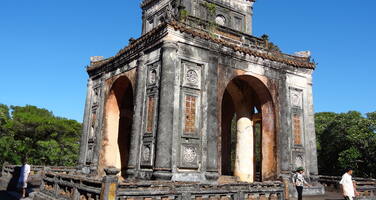
The ancient domestic and commercial architecture in the citadel and suburbs is under threat due to urban pressure that produces a general congestion. The monumental component of the property does not seem to be in danger, even if the restoration and the enhancement of the monumental architecture of Hué is a task of considerable magnitude.
Certain projects have already had, or may have, a negative impact on the heritage values of the site of Hué and its surroundings. These are especially:
a) the ominous development of road infrastructures within the inscribed property, making it vulnerable to urban sprawl of the geomantic environment by anarchic urbanisation and an increase of road traffic:
(i) by the creation of the south-west bypass of the national Route 1 crossing the inscribed
property, with the construction of a bridge across the Perfume River;
(ii) by the creation and widening of the roads, linked to the opening of the south-west bypass of Route 1;
(iii) by the widening of roads;
b) dangerous projects for developing the road infrastructures in the property inscribed linked to the danger of the urban infrastructure passing from level 2 to level 1, notably:
(i) the project for the creation of a south-west ring road with a bridge cutting off the perspective of the Perfume River;
(ii) the project to widen Nyuyen Chi Thanh street in the Phu Cat Quarter;
(iii) the project for widening the Tan Da street in the Huong So Quarter, which would result in widening the roads in the citadel and an increase in the circulation and parking of vehicles;
c) the worrisome construction of modern buildings that do not respect the regulations with regard to height and density;
d) the landfill of part of a pond to the north of the Tay Loc Quarter in the vicinity of the An Hoa Door and, generally, the increase in urban pressure on the hydrographic network structure and the agricultural land situated within the citadel.
ICOMOS stresses the urgent need for a Master Plan based on the recommendations of the mission report. This plan should not be conceived on the western model, but in such a way so as to take account of the local specificities and conditions. The table of contents in the Agreement for decentralized cooperation between the urban community of Lille (France) and the province of Thua Thien Hué is considered as an excellent working basis for such a plan. Additional regulations for the use of public space and sanitary conditions are necessary to strengthen the proposed Master Plan.
Summary of the interventions
Decisions adopted by the Committee in 2004
28 COM 15B.61
Complex of Hué Monuments
The World Heritage Committee,
- Recognizing the vulnerability of this World Heritage property in the context of the present economic and urban development in Vietnam,
- Congratulates the State Party and the local authorities for the excellent restoration work carried out on the monumental heritage of the citadel and along the Perfume River, and for its initiatives as concerns the enhancement of the landscaped heritage surrounding the citadel;
- Strongly urges the State Party to take immediately into account the recommendations of the UNESCO mission of November 2003;
- Encourages the State Party to proceed with the complete inventory of the traditional monumental and urban heritage, as well as the illegal constructions, or those having a negative impact on the property;
- Expresses its grave concern regarding the development of the road infrastructure and the modern constructions in and around the citadel, and notably with regard to the potential danger of the urban infrastructure of Hué and its surroundings passing from level 2 to level 1;
- Requests the State Party to urgently elaborate regulations for the management of the entire property, which, far from being simple rules for protection, should be the starting point of a project for long-term development and enhancement and should take into account all the components of the property at their different levels of understanding;
- Invites the State Party to consider an eventual re-nomination of the property to take into account the unique landscape value of the environment of Hué, and to ensure reinforced protection of the monuments associated with the citadel of Hué situated along the Perfume River;
- Further requests the State Party to submit to the World Heritage Centre, by 1 February 2005, a report on the progress made in the implementation of the recommendations of the UNESCO mission of November 2003, for examination by the Committee at its 29th session in 2005.
Draft Decision: 28 COM 15B.61
The World Heritage Committee,
1. Recognizing the vulnerability of this World Heritage property in the context of the present economic and urban development in Vietnam,
2. Congratulates the State Party and the local authorities for the excellent restoration work carried out on the monumental heritage of the citadel and along the Perfume River, and for its initiatives as concerns the enhancement of the landscaped heritage surrounding the citadel;
3. Strongly urges the State Party to take immediately into account the recommendations of the UNESCO mission of November 2003;
4. Encourages the State Party to proceed with the complete inventory of the traditional monumental and urban heritage, as well as the illegal constructions, or those having a negative impact on the property;
5. Expresses its grave concern regarding the development of the road infrastructure and the modern constructions in and around the citadel, and notably with regard to the potential danger of the urban infrastructure of Hué and its surroundings passing from level 2 to level 1;
6. Requests the State Party to urgently elaborate regulations for the management of the entire property, which, far from being simple rules for protection, should be the starting point of a project for long-term development and enhancement and should take into account all the components of the property at their different levels of understanding;
7. Invites the State Party to consider an eventual re-nomination of the property to take into account the unique landscape value of the environment of Hué, and to ensure reinforced protection of the monuments associated with the citadel of Hué situated along the Perfume River.
 Viet Nam
* :
The threats indicated are listed in alphabetical order; their order does not constitute a classification according to the importance of their impact on the property.
Furthermore, they are presented irrespective of the type of threat faced by the property, i.e. with specific and proven imminent danger (“ascertained danger”) or with threats which could have deleterious effects on the property’s Outstanding Universal Value (“potential danger”).
** : All mission reports are not always available electronically.