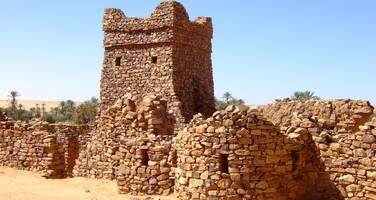
Ancient Ksour of Ouadane, Chinguetti, Tichitt and Oualata
Factors affecting the property in 2007*
- Changes in traditional ways of life and knowledge system
- Deliberate destruction of heritage
- Desertification
- Financial resources
- Housing
- Human resources
- Identity, social cohesion, changes in local population and community
- Impacts of tourism / visitor / recreation
- Management systems/ management plan
Factors* affecting the property identified in previous reports
a) Socio-economic and climatic changes;
b) Gradual abandonment of the towns;
c) Transformations made to houses affecting their authenticity;
d) Tourism pressure;
e) No technical conservation capacities;
f) No management mechanism (including legal);
g) Lack of human and financial resources;
h) Weak institutional coordination.
UNESCO Extra-Budgetary Funds until 2007
Total amount provided to the property: USD 44,166, 00 in the framework of the France-UNESCO Convention; USD 40,860 for the supervision of the World Bank-Mauritanian Government-UNESCO tripartite project (USD 1,245,000).
International Assistance: requests for the property until 2007
Total amount approved : 119,632 USD
| 2001 |
Realisation of preliminary Management plans for the ...
(Approved)
Reapproval: 29 Jun, 2002 (n°1501 - 20,000 USD)
|
20,000 USD |
| 2001 | Installation of Plaques and Publication of Leaflets to ... (Approved) | 5,000 USD |
| 2000 | Restoration of the site of Tichitt (Approved) | 6,000 USD |
| 2000 | Architectural models of the ancient cities in ... (Approved) | 5,000 USD |
| 1999 | Stabilitation of the sands surrounding the site of ... (Approved) | 20,000 USD |
| 1998 | Conservation of the Minaret of the Oasis of Ouadane (Approved) | 50,000 USD |
| 1995 | Preparation of tentative list and of the nomination ... (Approved) | 13,632 USD |
Missions to the property until 2007**
World Heritage Centre mission in April 2001; six World Heritage Centre missions between 2002 and 2004 in the framework of the World Bank project; France-UNESCO mission and joint ICOMOS-World Heritage Centre mission in December 2006.
Conservation issues presented to the World Heritage Committee in 2007
The State Party sent a report on 26 January 2007 on the state of conservation of the property. It mentioned that, in Tichitt, some electrical installations are anarchic and visible. The city of Tichitt, unlike the three other cities, did not know massive abandonment of its historic centre. It still remains densely inhabited. This Ksar preserves the majority of its heritage values.
In Ouadane, the national report indicates that the major issue is indeed the presence of the antenna of Mauritel on the outside limit of the inscribed perimeter. It constitutes an element which alters seriously the visual aspect of the site.
Besides, the report mentions the application of white painting on official buildings located within the buffer zone, creating a striking contrast that alters the cultural landscape. It also mentions the installation of a totally visible network of water conveyance.
Despite those remarks, the conclusions of the report are positive. It also states that, despite the lack of funding, the National Foundation for the Safeguarding of the Ancient Cities (FNSVA) created an institutional and legal mechanism in favour of the protection and restoration of the four sites through:
a) The modification of the decree of creation of the FNSVA to make it more operational;
b) the approval by the cabinet of town planning schemes and management plans of the old cities;
c) The elaboration of the documents of implementation of the Fund for the architectural and urban rehabilitation of the four cities.
At its 30th session, the Committee requested that a joint World Heritage Centre/ICOMOS mission should visit the property.
Therefore, the mission visited the property from 10-26 December 2006 to assess notably how the State Party had implemented the recommendations of the pilot project “Safeguarding and Development of Four World Heritage Cities in Mauritania” which were the following:
Promulgation by the Parliament of the Law for heritage protection;
Adoption of the urban development plans and safeguarding plans and the application of urban regulations;
Creation and financing of a Heritage Rehabilitation Fund;
Establishment of a management and technical assistance mechanism.
Legal Protection
No progress has been made on putting in place legal protection.
Master Plans and Management Plans
Urban development plans for all four towns were approved by the Council of Ministers on December 20, 2006. They were accompanied by minimal regulations relating to planning and construction. The creation of buffer zones was approved for each historical city. These plans integrate the inventories of the buildings with planning and protection measures, actions to be carried out as with regard to tourism, and institutional organization. More general management plans have not yet been addressed.
Resources
At the request of the State Party, a mission was organised under the France-UNESCO Convention in order to provide assistance to the FNSVA in setting up the appropriate mechanism for the establishment and functioning of the special Fund for the safeguarding, rehabilitation and promotion of the four cities inscribed on the World Heritage List.
The State Party is providing an annual funding of about USD 709,000 for the next five years. There three types of funding are foreseen:
· Operations initiated by the Municipalities on public buildings;
· Supporting the sale of local products and local arts and crafts;
· Support for private dwellings.
The complementary resources are not yet guaranteed and should come from a variety of sources including bilateral and/or multilateral donors; local communities; gifts and legacies, national or foreign; sponsorship; tourist tax and airport taxes; as well as other State grants.
The Fund will be managed by the FNSVA which will report to a Committee headed by the President and with members from Government departments.
Management capacities
There remains a need to delegate more responsibility to local players and to strengthen capacities both at administrative level and within the community in terms of traditional skills. A Management structure needs to be set up for each of the four cities with representatives of local communities. Currently the FNSVA is located far away from the cities: 1300 km from Oualata and more than 500 km from Tichitt, Chinguetti and Ouadane.
As well as addressing these issues, the mission report also re-confirmed the difficulties facing these four towns such as:
a) Progressive loss of traditional know-how by craftsmen such as stone masons;
b) Use of inappropriate new materials;
Un-regulated new building and demolition of houses, as well as re-use of materials;
Urban development which does not respect city limits;
Lack of information on the World Heritage status;
Depopulation and the abandonment of city centres and spread of ruined buildings;
Lack of water;
Sand encroachment;
Infrastructural developments.
Although some progress has been made in putting in place urban plans, and in agreeing to raise some of the needed funds for restoration and rehabilitation, a lot more needs to be done in terms of legal protection and management, in order to bring a halt to the progressive degradation of the cities and their abandon.
Summary of the interventions
Decisions adopted by the Committee in 2007
31 COM 7B.64
Ancient Ksour of Ouadane, Chinguetti, Tichitt and Oualata (Mauritania)
The World Heritage Committee,
1. Having examined Document WHC-07/31.COM/7B.Add,
2. Recalling Decision 30 COM 7B.54, adopted during its 30th session (Vilnius, 2006),
3. Notes with satisfaction that Master Plans have now be approved for all four cities and that the State Party is committed to raise an agreed amount of funds for the next five years to support rehabilitation and restoration works in the property;
4. Regrets that no progress has been made in putting in place legal protection;
5. Urges the State Party to establish appropriate local management mechanisms, with the adequate financial and human resources;
6. Encourages the State Party to submit an International assistance request for further capacity-building of the technical and managerial staff of the FNSVA;
7. Requests the State Party to submit, before 1 February 2009, a progress report on the implementation of the above recommendations for examination by the Committee at its 33rd session in 2009.
Draft Decision: 31 COM 7B.64
The World Heritage Committee,
1. Having examined Document WHC-07/31.COM/7B.Add,
2. Recalling Decision 30 COM 7B.54, adopted during its 30th session (Vilnius, 2006),
3. Notes with satisfaction that Master Plans have now be approved for all four cities and that the State Party is committed to raise an agreed amount of funds for the next five years to support rehabilitation and restoration works in the property;
4. Regrets that no progress has been made in putting in place legal protection;
5. Urges the State Party to establish appropriate local management mechanisms, with the adequate financial and human resources;
6. Encourages the State Party to submit an International assistance request for further capacity-building of the technical and managerial staff of the FNSVA;
7. Requests the State Party to submit, before 1 February 2009, a progress report on the implementation of the above recommendations for examination by the World Heritage Committee at its 33rd session in 2009.
 Mauritania
Exports
* :
The threats indicated are listed in alphabetical order; their order does not constitute a classification according to the importance of their impact on the property.
Furthermore, they are presented irrespective of the type of threat faced by the property, i.e. with specific and proven imminent danger (“ascertained danger”) or with threats which could have deleterious effects on the property’s Outstanding Universal Value (“potential danger”).
** : All mission reports are not always available electronically.