Cilento and Vallo di Diano National Park with the Archeological Sites of Paestum and Velia, and the Certosa di Padula
Cilento and Vallo di Diano National Park with the Archeological Sites of Paestum and Velia, and the Certosa di Padula
The Cilento is an outstanding cultural landscape. The dramatic groups of sanctuaries and settlements along its three east–west mountain ridges vividly portray the area's historical evolution: it was a major route not only for trade, but also for cultural and political interaction during the prehistoric and medieval periods. The Cilento was also the boundary between the Greek colonies of Magna Graecia and the indigenous Etruscan and Lucanian peoples. The remains of two major cities from classical times, Paestum and Velia, are found there.
Description is available under license CC-BY-SA IGO 3.0
Parc national du Cilento et du Vallo Diano, avec les sites archéologiques de Paestum et Velia et la Chartreuse de Padula
La zone du Cilento constitue un paysage culturel de qualité exceptionnelle. Ses ensembles impressionnants de sanctuaires et d'établissements éparpillés le long de trois chaînes de montagnes orientées est-ouest, reflètent de façon frappante l'évolution historique de la région en tant que voie majeure de commerce, mais aussi d'interface culturelle et politique durant la préhistoire et le Moyen Âge. C'était aussi la frontière entre les colonies grecques de la Magna Grecia et les peuples indigènes étrusques et lucaniens, et le site conserve les vestiges de deux importantes cités classiques, Paestum et Velia.
Description is available under license CC-BY-SA IGO 3.0
المنتزه الوطني في تشيلنتو وفالّو ديانو مع المواقع الأثرية في بايستوم وفيليا وكوخ بادولا
تشكل منطقة تشيلنتو منظرًا ثقافيًا بجودة مميزة. فمجمّعاتها المذهلة من المزارات والمنشآت المنتشرة على طول ثلاث سلاسل جبلية متوجهة من الشرق إلى الغرب، تعكس بطريقة باهرة التطور التاريخي للمنطقة كطريق أساسي للتجارة ولكن أيضًا كمنصة ثقافية وسياسية خلال عصور ما قبل التاريخ والقرون الوسطى. إنها أيضًا الحدود بين المستوطنات الإغريقية في الماغنا غريتشا والسكان الأصليين من الأتروريين واللوكانيين، ويحافظ الموقع على آثار المدينتين الكلاسيكيتين الأكثر أهمية بايستوم وفيليا.
source: UNESCO/CPE
Description is available under license CC-BY-SA IGO 3.0
奇伦托和迪亚诺河谷国家公园,帕埃斯图姆和韦利亚考古遗址
奇伦托地区是一处著名的文化名胜。在它三座东西向山脊上分布着引人注目的几组圣殿和村庄,生动地展现了这一地区的历史发展过程:在史前和中世纪期间,它不仅仅是当时主要的贸易通道,而且也是当时文化和政治交流的中心。奇伦托地区同时也是古希腊殖民地与本土的伊特拉斯坎人和卢卡尼亚人之间的边界。古希腊时期的两座主要城市帕埃斯图姆和韦利亚的遗迹也在这里被发现。
source: UNESCO/CPE
Description is available under license CC-BY-SA IGO 3.0
Культурный ландшафт района Чиленто, национальный парк Валло-ди-Диано, археологические памятники Пестума и Веллы, монастырь Чертоза-ди-Падула
Чиленто – это выдающийся культурный ландшафт. Выразительные группы святилищ и поселений, лежащие вдоль трех горных хребтов, наглядно иллюстрируют историческую эволюцию территории: это был путь, важный не только для развития торговли, но и для налаживания культурных и политических связей в доисторический период и в средневековье. Чиленто являлся также границей между греческими колониями Великой Греции и местными племенами этрусков и луканийцев. Здесь найдены руины двух крупных городов классического периода – Пестума и Веллы.
source: UNESCO/CPE
Description is available under license CC-BY-SA IGO 3.0
Parque Nacional del Cilento y Vallo di Diano, con los sitios arqueológicos de Paestum y Velia y la cartuja de Padula
La región del Cilento alberga un paisaje cultural de excepcional calidad, en el que se suceden –a lo largo de tres cadenas montañosas extendidas de este a oeste– conjuntos impresionantes de santuarios y asentamientos humanos, testimonios vívidos de la historia de esta región, que fue a la vez ruta comercial importante y punto de contactos políticos e intercambios comerciales, tanto en los tiempos prehistóricos como en la Edad Media. El sitio, que fue también frontera entre las colonias helénicas de la Magna Grecia y las poblaciones autóctonas de etruscos y lucanos, conserva los vestigios de Paestum y Velia dos ciudades importantes de la Antigüedad clásica.
source: UNESCO/CPE
Description is available under license CC-BY-SA IGO 3.0
パエストゥムとヴェリアの古代遺跡群を含むチレントとディアノ渓谷国立公園とパドゥーラのカルトゥジオ修道院
イタリア中南部のカンパニア州・チレント地方は、風光明媚な文化的景観を示している。東西に連なる三つの尾根に沿って連なる聖域や居住域は、先史時代と中世を通じて交易や文化的・政治的交流の主要なルートとしてのこの地域の歴史的変遷を物語っている。また、この地域はギリシャ人植民市の先住民であるエトルリア人などとの境界地域にあたるため、パエストゥムとヴェリアの二つの非常に重要な古代都市遺跡も保全されている。source: NFUAJ
Nationaal park Cilento e Vallo di Diano met archeologische opgravingen van Paestum, Velia en de Certosa di Padula
Het Nationaal park Cilento e Vallo di Diano bestaat uit een buitengewoon cultuurlandschap. De dramatische groepen heiligdommen en de nederzettingen langs de drie oost-west bergkammen, geven een levendig beeld van de historische evolutie in dit gebied. Het was niet alleen een belangrijke route voor de handel, maar ook voor culturele en politieke interactie tijdens de prehistorische en middeleeuwse periodes. De regio Cilento vormde de grens tussen de Griekse kolonies van Magna Graecia en de inheemse Etruskische en Lucanische volkeren. In het gebied zijn overblijfselen te vinden van twee grote steden uit de klassieke oudheid, Paestum en Velia.
Source: unesco.nl


Outstanding Universal Value
Brief synthesis
Cilento is a cultural landscape of outstanding value that has evidence of human occupation dating from 250,000 years ago. It has been successively occupied over time by farmers during the Neolithic period, by Bronze and Iron Age societies, Etruscans, Greek colonists, Lucanians, and was eventually incorporated into the Roman territory inthe 3rd century BC. Roman road networks replaced the earlier tracks, but after the collapse of the Western Roman Empire, these roads fell into disrepair and the ancient network was revived during the Middle Ages, as is evident in the feudal castles and religious establishments built along routes.
The site contains dramatic groups of sanctuaries and settlements extending across three different east-west mountain ridges in the province of Salerno, covering quite a vast area, 159,110ha, including part of the National Park Cilento e Vallo di Diano, the two archaeological sites of Paestum and Velia, and the monumental Certosa di Padula.
The National Park, essentially a mountainous region divided by several river valleys sloping down to the Tyrrhenian Sea, is defined by natural features: the Tyrrhenian Sea on the east, and the Sele and Tanagro rivers, with the broad sweep of the Vallo di Diano in its upper reaches.
Communication routes were established during pre-historic times along the crests of the mountain ranges, and while they fell into decline during the Roman era, they came back into use in the Middle Ages. Evidence of this use is visible in the many prehistoric and proto-historic sites discovered, and in the medieval towns and castles. The most noteworthy archaeological site is that of Paestum, the Greek city of Poseidonia, founded at the end of 7th century BC.
Another site of great importance is the archaeological area of Velia, which preserves the monumental remains of the colony of Elea, founded by the Phocaeans in the second half of the 6th century.
The Certosa di San Lorenzo at Padula in the Vallo di Diano is one of the most impressive monastic structures in the world. Its construction began in 1306, but its present Baroque form is the result of the transformations carried out in the 17th and 18th centuries. Today it is home to the Archaeological Museum of Lucanian Antiquities.
The Cilento presents an outstanding cultural landscape. The dramatic groups of sanctuaries and settlements along its three east–west mountain ridges vividly portray the area's historical evolution: it was a major route not only for trade, but also for cultural and political interaction during the prehistoric and medieval periods. The Cilento was also the boundary between the Greek colonies of Magna Graecia and the indigenous Etruscan and Lucanian peoples. The remains of two major cities from classical times, Paestum and Velia, can be found there.
Criterion (iii): During the prehistoric period, and again in the Middle Ages, the Cilento region served as a key route for cultural, political, and commercial communications in an exceptional manner, utilizing the crests of the mountain chains running east-west and thereby creating a cultural landscape of outstanding significance and quality.
Criterion (iv): In two key episodes in the development of human societies in the Mediterranean region, the Cilento area provided the only viable means of communication between the Adriatic and the Tyrrhenian seas in the central Mediterranean region, and this is vividly illustrated by the cultural landscape of today.
Integrity
The integrity of the property is intact. Within the National Park Cilento e Vallo di Diano one finds the two archaeological sites from the Greek cities of Paestum and Velia (called the Great Attractor); the monumental complex of the ancient monastery Certosa di Padula; and many sites of great archaeological and artistic relevance, such as the Lucanian settlements of Moio della Civitella, Roccagloriosa and Caselle in Pittari. The vast site also contains seaside landscapes (Punta Licosa, Palinuro, and Punta degli Infreschi) as well as inland landscapes, such as the Bulgheria mountains.
This ample stretch of land, located within a natural protected area of national importance, ensures the integrity of the site. In fact, despite the inevitable transformations in susch a vast territory, the property conserves its features as a cultural landscape, deriving from the age-old interaction between humans and nature.
Threats to the property are primarily related to natural disasters such as landslides and flooding. There is a possible threat to the integrity of the site due to illegally constructed buildings within the National Park.
Authenticity
The authenticity of the cultural elements within the park is high, providing an example of a cultural landscape of outstanding significance and quality on the Tyrrhenian Sea, with traces of human occupation dating back to pre-historic times. Vestiges of ancient mountain trail networks are still visible in the landscape, as are many of the religious sanctuaries. Villages and hamlets along the route have survived with little change impacting their authenticity.
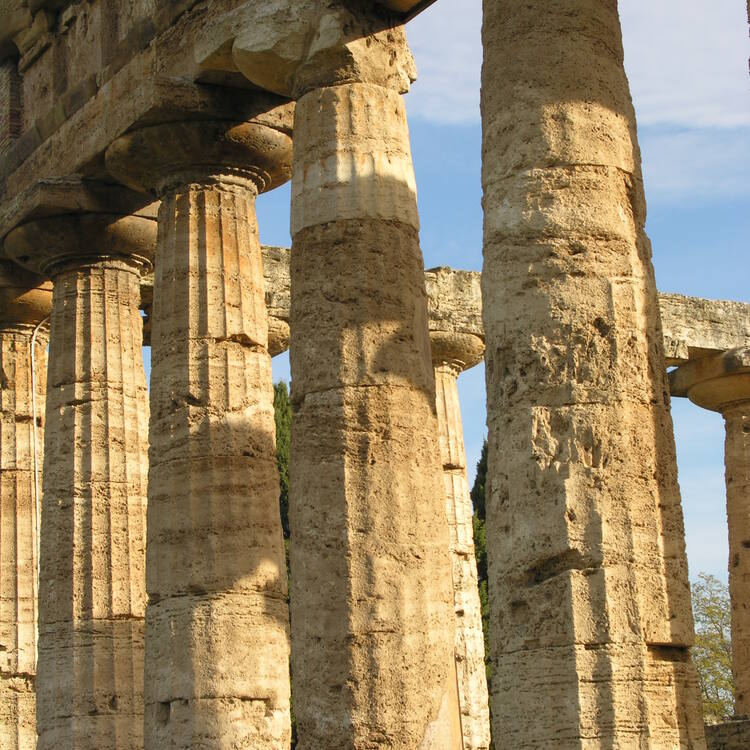
Much restoration work has been completed in the archaeological sites of Paestum and Velia and the Certosa di San Lorenzo. In Paestum, in addition to the restoration of the three Doric temples, the restoration of the house three blocks from the Roman and the eastern sector of the city walls has been completed. Furthermore, a new section dedicated to the Museum of Prehistory and Protohistory has been opened to the public. In Velia the Roman baths and the monumental Porta Rosa have been completely restored and conserved, together with the medieval tower on the acropolis. The Certosa di Padula has been superbly restored by the competent Soprintendenza.
Protection and management requirements
The property benefits from three different levels of protection: national, regional and local.
At the national level, the site is covered by Italian Legislative Decree no 42/2004 “Code for the Cultural Heritage and Landscape”, which offers protection for natural and panoramic beauty. As a result, all interventions require the approval of the relevant national heritage organizations (municipalities and Soprintendenza for Architectonic Heritage and Landscape, a peripheral office of the Ministry for Cultural Heritage and Activities). The archaeological sites and several individual buildings in the area are also covered by Decree 42/04 as cultural heritage. This is effectively a safeguarding measure, which ensures any activity on the site must be authorized by the relevant Soprintendenza.
The archaeological site of Paestum is also under the protection regime of L. 220/1957, which established a protected landscape area extending one kilometer outside the city walls.
Parco Nazionale del Cilento e Vallo di Diano is also protected by Italian Law no 394/1991, which covers the natural areas and enforces strict controls over designated areas. A Presidential Decree of June 1995 established the Park and guaranteed the protection of both the natural environment and the heritage buildings; it also encouraged the preservation of the cultural landscape within a programme of sustainable development. It is also worth noting that much of the park is a National Forest, which comes under the strict control of the Italian Forest Law. In June 2010, the programme of the Cilento and Vallo di Diano National Park took effect, classifying a good part of the areas included in the World Heritage property as zones of “integral reserve”, within which the natural environment is conserved and its integrity ensured. The authorization of the “Ente Parco” (Park Authority) is required for all activities within the park.
The Italian catalogue of Natura 2000 sites highlights the World Heritage property within the Park, as well as vast Sites of Community Importance (S.I.C.) and Zones of Special Protection (Z.P.S.), whose safeguarding is subject to a further procedure to assess its effects, ending with the issue of a Regional Authorization, after approval by the Ente Parco.
Ownership of properties within the property is both private and public. The overall supervision for the landscape and monumental buildings is the responsibility of the above-mentioned Soprintendenza and of the Italian government’s Ministero per i Beni e le Attività Culturali.
The archaeological sites of Paestum and Elea-Velia are managed by the Soprintendenza for the Archaeological Heritage of Salerno, Avellino, Benevento and Caserta, a peripheral office of the Ministry for Cultural Heritage and Activities. The Certosa di Padula is managed by the Soprintendenza for the Architectonic and Landscape Heritage of Salerno and Avellino, another peripheral office of the Ministry for Cultural Heritage and Activities.
For the preparation of the management system, the relevant authority appointed jointly with the peripheral offices of the Ministry for Cultural Heritage and Activities (Soprintendenze) is the Parco Nazionale del Cilento e Vallo di Diano.
The World Heritage property within the park is under the park’s direct administration (in accordance with the law), under the responsibility of the Parco Nazionale del Cilento e Vallo di Diano. This is a public body, with a full-time President, Director General and professional staff; the work is supervised by a governing council, with representatives of national, regional, and local institutions and authorities, as well as a management group consisting of senior staff, consultants, and other specialists. The park is under the authority of the Ministry of the Environment. It works closely and harmoniously with the authorities of those communes that are entirely or partially within the park, which are very supportive of its work, as is the Provincial Administration of Salerno.
Each of the three distinct areas of this property is surrounded by a defined buffer zone. The total area of the three buffer zones is 178,101 hectares.
 View photos from OUR PLACE the World Heritage collection


Protections
by other conservation instruments
2 protections / 2 elements
Biosphere Reserves (1 element)Geoparks (1 element)