Nemrut Dağ
Nemrut Dağ
The mausoleum of Antiochus I (69–34 B.C.), who reigned over Commagene, a kingdom founded north of Syria and the Euphrates after the breakup of Alexander's empire, is one of the most ambitious constructions of the Hellenistic period. The syncretism of its pantheon, and the lineage of its kings, which can be traced back through two sets of legends, Greek and Persian, is evidence of the dual origin of this kingdom's culture.
Description is available under license CC-BY-SA IGO 3.0
Nemrut Dağ
Le tombeau d'Antiochos Ier (69 à 34 av. J.-C.), qui régna sur le Commagène, royaume constitué au nord de la Syrie et de l'Euphrate après le démembrement de l'empire d'Alexandre, représente une des plus colossales entreprises de l'époque hellénistique. Le syncrétisme de son panthéon et la filiation légendaire grecque et perse de ses rois témoignent de la double origine de la culture et de l'esthétique de ce royaume.
Description is available under license CC-BY-SA IGO 3.0
نمرود داغ
يشكل قبر الملك انتوشوز الأول (69 - 34 قبل الميلاد) الذي تربع على عرش مملكة كوماجين الناشئة شمال سوريا والفرات عقب انهيار امبراطورية الاسكندر احدى الانجازات الأكثر ضخامة في العهد اليوناني. ويشهد كل من الطابع التوفيقي الذي يتسم به مدفن عظماء الأمة والبنوة الأسطورية اليونانية والفارسية لملوك كوماجين على الأصل المزدوج لثقافة هذه المملكة وجماليتها.
source: UNESCO/CPE
Description is available under license CC-BY-SA IGO 3.0
内姆鲁特达格
这里是安提俄克斯一世(公元前69-34年)的陵墓。他当时统治着科马哥纳──亚利山大王国解体后在叙利亚北部和幼发拉底河建立的王国,这是希腊时期最能体现勃勃雄心的建筑之一。这里的众神合一和王室血统可以溯源到希腊和波斯两个系列的传说中去,这一点反映了这一王国文化的双重起源。
source: UNESCO/CPE
Description is available under license CC-BY-SA IGO 3.0
Археологические находки на горе Немрут-Даг
Гробница Антиоха I (69-34 гг. до н.э.), который был правителем Коммагены (царства, основанного к северу от Сирии и реки Евфрат после распада империи Александра Македонского), это одно из наиболее амбициозных сооружений эллинистического периода. Эклектичность этого пантеона и различная последовательность смены царей в династии, что отражено в двух версиях легенды – древнегреческой и персидской, являются свидетельствами двойственного характера культуры этого царства.
source: UNESCO/CPE
Description is available under license CC-BY-SA IGO 3.0
Nemrut Dağ
El monte Nemrut alberga los vestigios de una de las más ambiciosas construcciones de la época helenística, el mausoleo del rey Antíoco I, que ocupó entre los años 69 y 34 a.C. el trono de Comagene, un reino creado al norte de Siria y el Éufrates tras el desmembramiento del imperio de Alejandro el Magno. El doble origen de la cultura y el arte de este reino lo corroboran tanto el sincretismo del panteón de sus dioses como el linaje grecopersa de sus soberanos.
source: UNESCO/CPE
Description is available under license CC-BY-SA IGO 3.0
ネムルット・ダー
北シリア一帯を支配していたコンマゲネ王国のアンティオコス1世(紀元前1世紀)が、アナトリア東部の高地に死後の自分のために建てた王墓。標高2150mのネムルット山の頂上にありますが、今では石を50mほど積み上げて作った墓や、周辺の巨大な10体の石像はすべて崩れている。壊れた彫像の頭部が荒涼たる虚空を見つめている。source: NFUAJ
Nemrut Dağ
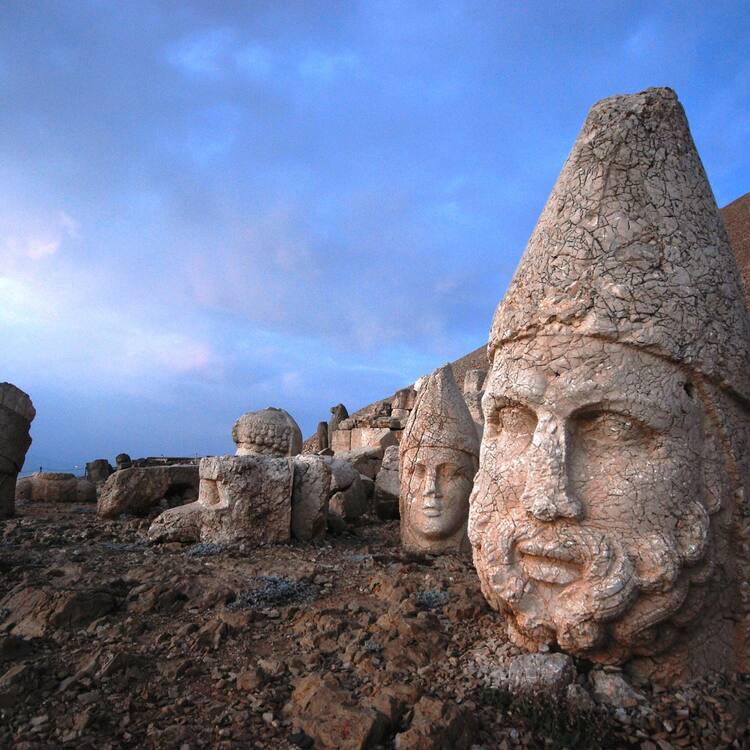
In Nemrut Dağ staat het mausoleum van Antiochus (69-34 voor Christus) die regeerde over Commagene, een koninkrijk ten noorden van Syrië en de Eufraat. De dubbele oorsprong van het Hellenistische koninkrijk blijkt uit het syncretisme van haar pantheon en de lijn van koningen, die herleid kan worden tot de legendarische Grieken en Perzen. Nemrut Dağ wordt onder andere gekenmerkt door kolossale stenen beelden waarvan de kop is afgebroken en naar een lager gedeelte is gerold. Een deel van de gebruikte stenen blokken wegen meer dan 9 ton. Hierdoor geldt de plek als een van de meest kolossale en ambitieuze ondernemingen van het Hellenistische tijdperk.
Source: unesco.nl


Outstanding Universal Value
Brief synthesis
Crowning one of the highest peaks of the Eastern Taurus mountain range in south-east Turkey, Nemrut Dağ is the Hierotheseion (temple-tomb and house of the gods) built by the late Hellenistic King Antiochos I of Commagene (69-34 B.C.) as a monument to himself.
With a diameter of 145 m, the 50 m high funerary mound of stone chips is surrounded on three sides by terraces to the east, west and north directions. Two separate antique processional routes radiate from the east and west terraces. Five giant seated limestone statues, identified by their inscriptions as deities, face outwards from the tumulus on the upper level of the east and west terraces. These are flanked by a pair of guardian animal statues – a lion and eagle – at each end. The heads of the statues have fallen off to the lower level, which accommodates two rows of sandstone stelae, mounted on pedestals with an altar in front of each stele. One row carries relief sculptures of Antiochos’ paternal Persian ancestors, the other of his maternal Macedonian ancestors. Inscriptions on the backs of the stelae record the genealogical links. A square altar platform is located at the east side of the east terrace. On the west terrace there is an additional row of stelae representing the particular significance of Nemrut, the handshake scenes (dexiosis) showing Antiochos shaking hands with a deity and the stele with a lion horoscope, believed to be indicating the construction date of the cult area. The north terrace is long, narrow and rectangular in shape, and hosts a series of sandstone pedestals. The stelae lying near the pedestals on the north terrace have no reliefs or inscriptions.
The Hierotheseion of Antiochos I is one of the most ambitious constructions of the Hellenistic period. Its complex design and colossal scale combined to create a project unequalled in the ancient world. A highly developed technology was used to build the colossal statues and orthostats (stelae), the equal of which has not been found anywhere else for this period. The syncretism of its pantheon and the lineage of its kings, which can be traced back through two sets of legends, Greek and Persian, is evidence of the dual origin of this kingdom's culture.
Criterion (i): The tomb of Antiochos I of Commagene is a unique artistic achievement. The landscaping of the natural site of Nemrut Dağ is one of the most colossal undertakings of the Hellenistic period (some of the stone blocks used weigh up to nine tons).
Criterion (iii): The tomb or the Hierotheseion of Nemrut Dağ bears unique testimony to the civilization of the kingdom of Commagene. Antiochos I is represented in this monument as a descendant of Darius by his father Mithridates, and a descendant of Alexander by his mother Laodice. This semi-legendary ancestry translates in genealogical terms the ambition of a dynasty that sought to remain independent of the powers of both the East and the West.
Criterion (iv): More so than the tombs at Karakus and Eski Kahta, the tumulus at Nemrut Dağ illustrates, through the liberal syncretism of a very original pantheon, a significant, historical period. The assimilation of Zeus with Oromasdes (the Iranian god Ahuramazda), and Heracles with Artagnes (the Iranian god Verathragna) finds its artistic equivalent in an intimate mixture of Greek, Persian and Anatolian aesthetics in the statuary and the bas-reliefs.
Integrity
Nemrut Dağ is largely intact and truthfully and credibly expresses it Outstanding Universal Value. The important cult areas of Commagene still exist, the structures are the original ones and their original interrelations can still be observed and perceived. Although the property boundary contains the tumulus and the east, west and north terraces, it does not include the full extent of the ceremonial routes. The greatest threat to the integrity of the property is the material damage caused by environmental conditions such as serious seasonal and daily temperature variations, freezing and thawing cycles, wind, snow accumulation, and sun exposure. The height of the tumulus is now reduced from its estimated original 60 m due to weathering, previous uncontrolled research investigations and climbing by visitors. Furthermore, the Nemrut property is located within a first degree earthquake zone and is very close to the East Anatolian Fault, which is seismically active. Therefore, the tumulus, statues and stelae are vulnerable to earthquakes.
Authenticity
Nemrut Dağ retains its authenticity in terms of form, materials and design as one of the unique artistic achievements of the Hellenistic period with its fascinating beauty of monumental sculptures in a spectacular setting. It has survived in a moderately well-preserved state. The original ceremonial routes to the Hierotheseion are known and still used for access today.
Protection and management requirements
Cultural components of the site are protected under the National Conservation Law No. 2863 and National Parks Law No. 2873. Mount Nemrut Tumulus was registered as a First Degree Archaeological Site under Act No. 2863 in 1986. After the preparation of current detailed maps, this site was revised and its surroundings were designated as an Interaction Transition Zone by Şanlıurfa Regional Council for Conservation of Cultural Property in 2008. Finally, the border of this zone, which acts as an unofficial Buffer Zone, was enlarged in 2011 by the same authority for the sake of the conservation of the cultural asset. Under the National Parks Law (No. 2873), an area that includes Nemrut Tumulus and other archaeological areas covering 13.850 ha were declared a Natural Park in 1988. With respect to this, the 1:25000 scaled “Long Term Development Plan of Mount Nemrut National Park” was approved in 2002 and reviewed in 2009 and 2011. Within the framework of the Commagene Nemrut Conservation Development Programme (CNCDP), launched in August 2006 with a protocol signed between the Ministry of Culture and Tourism and the Middle East Technical University (METU), geological studies, material research and structural analyses have been carried out to identify material properties of blocks, examine the deterioration mechanisms of the stones, investigate compatible mortars and determine appropriate structural interventions. The structure has been documented in detail and a reconstitution study, to be used to understand the original design considerations and all the previous interventions, has been completed.
Drawing upon data from the detailed research of the construction materials and the structural analyses made in the area, a restoration project has been prepared and includes the consolidation of the stones, the definition of structural interventions and preventive measures to control possible risks and limited aesthetic applications to the eroded blocks, which will permit a better perception of the original design considerations of the Hierotheseion. Measured drawings, restitution and restoration projects were approved by the Regional Council in 2011. The Commagene Nemrut Management Plan requires completion and implementation.
In 2009 projects were prepared for two visitor centres outside the property, one on the way to Adıyaman and the other on the way to Malatya.
 View photos from OUR PLACE the World Heritage collection
The Nomination files produced by the States Parties are published by the World Heritage Centre at its website and/or in working documents in order to ensure transparency, access to information and to facilitate the preparations of comparative analysis by other nominating States Parties.
The sole responsibility for the content of each Nomination file lies with the State Party concerned. The publication of the Nomination file, including the maps and names, does not imply the expression of any opinion whatsoever of the World Heritage Committee or of the Secretariat of UNESCO concerning the history or legal status of any country, territory, city or area or of its boundaries.