Matobo Hills
Matobo Hills
The area exhibits a profusion of distinctive rock landforms rising above the granite shield that covers much of Zimbabwe. The large boulders provide abundant natural shelters and have been associated with human occupation from the early Stone Age right through to early historical times, and intermittently since. They also feature an outstanding collection of rock paintings. The Matobo Hills continue to provide a strong focus for the local community, which still uses shrines and sacred places closely linked to traditional, social and economic activities.
Description is available under license CC-BY-SA IGO 3.0
Monts Matobo
Le site présente une profusion de formes rocheuses remarquables s’élevant au-dessus du bouclier de granit qui couvre la plus grande partie du Zimbabwe. Les grands blocs de roche offrent des abris naturels en abondance et sont associés à l’occupation humaine depuis le début de l’âge de pierre jusqu’au début des temps historiques, et de façon intermittente depuis lors. Ils abritent une collection de peintures rupestres exceptionnelles. Les monts Matobo demeurent un centre important pour la communauté locale qui utilise toujours les lieux sacrés et les sanctuaires en étroite liaison avec leurs activités traditionnelles, sociales et économiques.
Description is available under license CC-BY-SA IGO 3.0
تلال ماتوبو
يتتضمن هذا الموقع عدداً وافراً من الأشكال الصخرية الملفتة المرتفعة فوق أرض حاتة من الغرانيت تغطي الجزء الأكبر من زمبابوي. وتتضمن الكتل الصخرية الكبيرة ملاجئ طبيعية كثيرة وترتبط بالوجود البشري المستمر منذ بداية العصر الحجري حتى بداية العصور التاريخية والمتقطع مذاك الحين، كما تحتضن مجموعة من اللوحات الرائعة المحفورة في الصخور. وتبقى تلال ماتوبو مركزاً هاماً للمجتمع المحلي الذي لا يزال يؤم الأماكن المقدسة والأضرحة المرتبطة على نحو وثيق بنشاطاته التقليدية الاجتماعية والاقتصادية.
source: UNESCO/CPE
Description is available under license CC-BY-SA IGO 3.0
马托博山
津巴布韦大部分地区为花岗岩所覆盖,马托博地区具有最丰富的岩石地貌。这些巨石提供了大量的天然石洞,从石器时代早期直到较近的历史时期,断断续续一直与人类居所存在很大联系。这些巨石是岩画艺术的汇聚地。马托博山的神殿和宗教场所一直同当地的传统、社会活动和经济活动紧密相连,成为当地生活的焦点。
source: UNESCO/CPE
Description is available under license CC-BY-SA IGO 3.0
Холмы Матобо
Для этой местности характерны многочисленные скалистые холмы, возвышающиеся над гранитным щитом, покрывающим основную часть территории Зимбабве. Крупные скальные образования служили для древнего человека естественными укрытиями, с раннего каменного века и вплоть до начала нашей эры. Здесь также обнаружено великолепное собрание наскальной живописи. Холмы Матобо продолжают оставаться важным центром притяжения для местных сообществ, которые все еще используют святилища и священные места, тесно связанные с их традициями и социально-экономическим укладом, как места поклонения.
source: UNESCO/CPE
Description is available under license CC-BY-SA IGO 3.0
Montes Matobo
Este sitio se distingue por la profusión de formaciones rocosas muy características, que se elevan por encima de la masa granítica que cubre la mayor parte de Zimbabwe. Los grandes bloques de roca ofrecen abundantes refugios naturales que fueron ocupados sin interrupción por el ser humano desde la Edad de Piedra hasta los albores de los tiempos históricos, y luego de forma esporádica. Esos refugios albergan una serie excepcional de pinturas rupestres. Los Montes Matobo son todavía un centro de interés importante para la población local, cuya frecuentación de los lugares sagrados y santuarios existentes en ellos guarda una estrecha relación con sus actividades tradicionales, sociales y económicas.
source: UNESCO/CPE
Description is available under license CC-BY-SA IGO 3.0
マトボの丘群
ジンバブエ南西部、ブラワヨの南方約35㎞に位置する2050k㎡の遺産と、1050k㎡のバッファーゾーンから成る遺跡群。登録地域は、ジンバブエの大部分を占める花崗岩盾状地の上に隆起した独特の岩石地帯である。巨大な岩石は豊かなロック・シェルター(岩窟)の役割を果たしており、石器時代初期から有史初期までは継続的に、そして、それ以降は断続的に人類が居住したことを証している。また、岩肌には素晴しい壁画も残されている。source: NFUAJ
Matobo heuvels
Dit gebied laat een overvloed aan verschillende rotsvormen zien die uitsteken boven het granieten schild dat een groot deel van Zimbabwe bedekt. De grote keien zorgen voor veel natuurlijke schuilplaatsen en men gaat ervan uit dat ze zijn gebruikt als menselijk onderkomen vanaf de vroege Steentijd. De heuvels herbergen een van de hoogste concentraties rotskunst in zuidelijk Afrika. De tekeningen geven een volledig beeld van hoe naar voedsel zoekende samenlevingen plaats maakten voor agrarische samenlevingen. Tegenwoordig zijn de Matobo heuvels nog steeds belangrijk voor de lokale bevolking; ze gebruiken de heiligdommen en heilige plaatsen die nauw verbonden zijn met de traditionele, sociale en economische activiteiten van deze plek
Source: unesco.nl


Outstanding Universal Value
Brief synthesisThe Matobo Hills some 35 km south of Bulawayo are a profusion of distinctive granite landforms, densely packed into a comparatively tight area, that rise up to form a sea of hills. Their forms have resulted from the varied composition and alignment of the granite rocks, which responded differently to millions of years of weathering. These extraordinary granite rock formations have exerted a strong presence over the whole area – both in natural and cultural terms.
People have interacted with, and been inspired by, the dramatic natural rock formations of the Matobo Hills for over many millennia. This interaction has produced one of the most outstanding rock art collections in southern Africa; it has also fostered strong religious beliefs, which still play a major role in contemporary local society; and it demonstrates an almost uninterrupted association between man and his environment over the past 100,000 years.
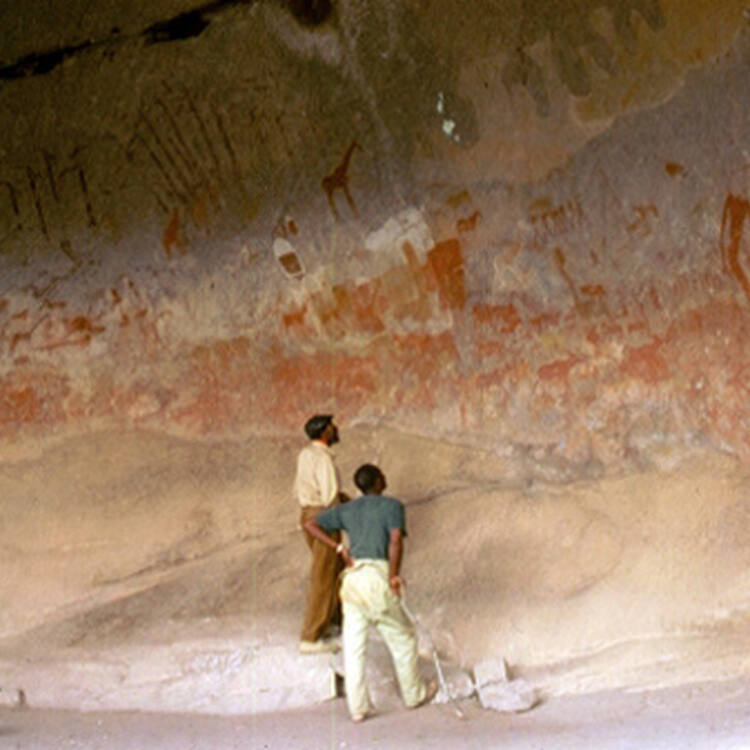
The Matobo Hills have one of the highest concentrations of rock art in Southern Africa dating back at least 13,000 years. The paintings illustrate evolving artistic styles and also socio-religious beliefs. The whole bears testimony to a rich cultural tradition that has now disappeared. The rich evidence from archaeology and from the rock paintings at Matobo provides evidence that the Matobo Hills have been occupied over a period of at least 500,000 years. Furthermore, this evidence provides a very full picture of the lives of foraging societies in the Stone Age and the way agricultural societies eventually came to displace them in the Iron Age.
The Mwari religion which is still practiced in the area, and which may date back to the Iron Age, is the most powerful oracular tradition in southern Africa. The Matobo rocks are seen as the seat of god and of ancestral spirits. Sacred shrines within the hills are places where contact can be made with the spiritual world. The living traditions associated with the shrines represent one of the most powerful intangible traditions in southern Africa and one that could be said to be of universal significance. This is a community response to a landscape rather than individual ones. The natural qualities of Matobo, in terms of the power of the rocks and of the produce from the surrounding natural environment, thus have strong cultural associations.
Criterion (iii): The Matobo Hills have one of the highest concentrations of rock art in southern Africa. The rich evidence from archaeology and from the rock paintings at Matobo provide a very full picture of the lives of foraging societies in the Stone Age and the way agricultural societies came to replace them.
Criterion (v): The interaction between communities and the landscape, manifested in the rock art and also in the long-standing religious traditions still associated with the rocks, are community responses to a landscape.
Criterion (vi): The Mwari religion, centred on Matobo, which may date back to the Iron Age, is the most powerful oracular tradition in southern Africa.
IntegrityIn order to reflect a coherent landscape, encompassing not only the rock paintings and rock batholiths but also the strong social interaction between local people and these tangible aspects, the boundary encompasses the Rhodes Matopos National Park and two Rural District Councils of Matobo and Umzingwane. The boundary thus encompasses all the attributes of Outstanding Universal Value.
Overall the rock paintings are in a fairly good state of preservation. Natural weathering is the main agent of change and although this has made some of the paintings difficult to decipher, the process is part of the relationship between the images and their setting. Further slight damage is being wrought by visitors. In only one cave are the paintings badly compromised: at Pomongwe Cave, experiments were carried out in the 1920s with linseed oil as a preservative and this has darkened the images. The archaeological evidence appears to be well protected – both within those caves, where large-scale excavations have taken place, and elsewhere in caves that could produce further evidence.
Through a system of taboos and cultural norms that prohibit desecration, the long-standing intangible heritage of indigenous traditional religious beliefs and practices are still instrumental in the preservation of the tangible heritage. Around the two shrines, there are no artificial buildings, structures, walls or other traces of human presence, apart from a wooden palisade that demarcates the area beyond which people may not proceed without permission from the ancestral spirits who are consulted by the custodian and the elders. There are development pressure from the demand for amenities and facilities by visitors. Increased population has had a negative impact on the natural environment.
The area is prone to droughts and floods and soil erosion is becoming a serious problem. There are also threats follows the introduction of exotic plants.
AuthenticityThe authenticity of the hunter-gatherer and a few agriculturist rock paintings in the Matobo Hills area has been widely confirmed. The rock paintings survive in situ and are still linked to a landscape that reflects elements of the pastoral and agricultural traditions reflected in painted images.
The living traditions and intangible heritage associated with the site and which bind the cultural and natural values together are still thriving. The annual pilgrimage in August attracts more than a thousand pilgrims who gather around the natural features of the rocks and the adjacent terraces, where participants dance, perform rituals, eat and sleep during the 3-week long ceremonies.
Protection and management requirementsThe Matobo Hills World Heritage Landscape comprises three types of land ownership, recognized by Zimbabwean laws namely, state protected areas (Matopo National Parks), communal lands and state land without individual tenure (Matobo and Umzingwane Districts), and privately owned land with individual tenure (commercial farms). Each land category is administered by the following Acts of Parliament: Rural District Council Act (29:13), Parks and Wildlife Act (20:14) and Natural Resources Board Act (20:13). The Department of National Parks and Wild Life Management takes care of the natural resources, and the management of cultural properties falls under the National Museums and Monuments of Zimbabwe Act (25:11) irrespective of the land tenure.
A Management Committee, consisting of key stakeholders has been established. The property was guided by a five year Management Plan for the period 2005-2009. For technical expertise the committee relies on technical staff drawn from the major stakeholders. Other organizations and agencies involved in management include the Natural Resources Board and the Forestry Commission.
The Management Plan needs revising so that it is a live and relevant document that addresses the opportunities provided by inscription. The Plan also needs to support integrated management to achieve sustainable development, which respects both cultural and natural parameters of the cultural landscape, and fosters the integration of intangible heritage issues into management and interpretation. It also needs to address threats, such as from uncontrolled visitor access, soil erosion and invasive plants. There is also a need for conservation plans for key aspects of the site.