Archaeological Sites of the Island of Meroe
Archaeological Sites of the Island of Meroe
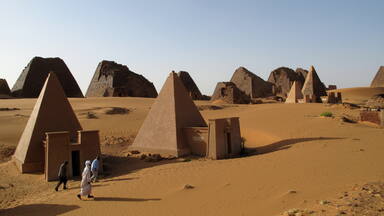
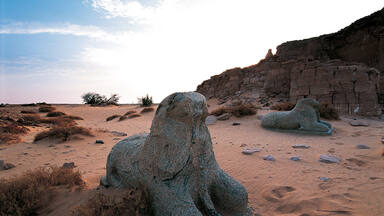
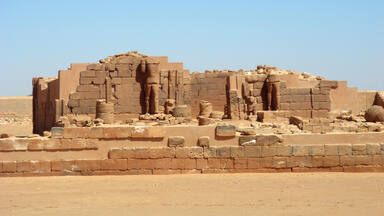
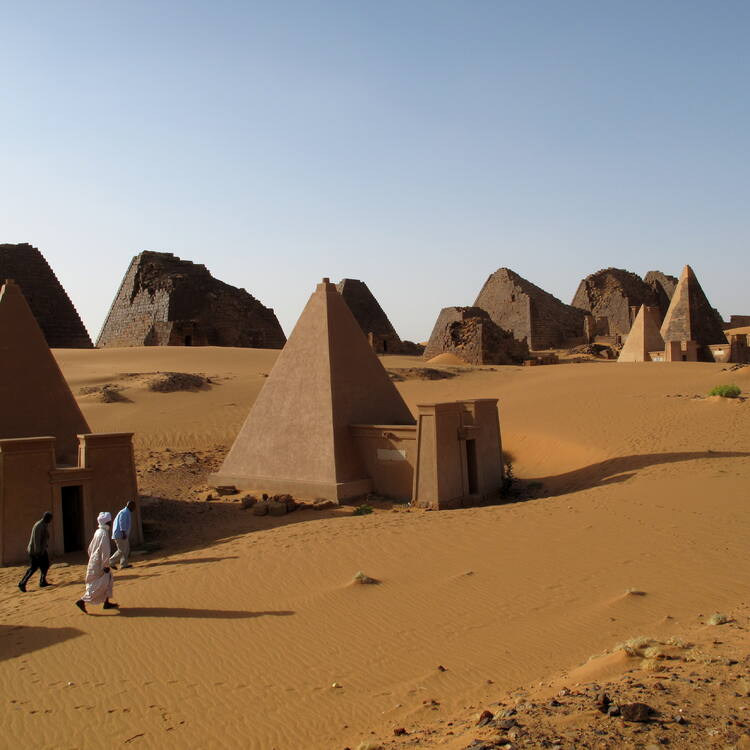
The Archaeological Sites of the Island of Meroe, a semi-desert landscape between the Nile and Atbara rivers, was the heartland of the Kingdom of Kush, a major power from the 8th century B.C. to the 4th century A.D. The property consists of the royal city of the Kushite kings at Meroe, near the River Nile, the nearby religious site of Naqa and Musawwarat es Sufra. It was the seat of the rulers who occupied Egypt for close to a century and features, among other vestiges, pyramids, temples and domestic buildings as well as major installations connected to water management. Their vast empire extended from the Mediterranean to the heart of Africa, and the property testifies to the exchange between the art, architectures, religions and languages of both regions.
Description is available under license CC-BY-SA IGO 3.0
Sites archéologiques de l’île de Méroé
Les sites archéologiques de l'île de Méroé, paysage semi-désertique entre le Nil et l'Atbara, était le cœur du royaume de Kouch, une puissance majeure du VIIIe siècle avant J.-C. au IVe siècle avant J.-C. Le site comprend un site urbain et funéraire, siège des souverains qui occupèrent l'Egypte pendant près d'un siècle. Le bien comprend la cité royale des rois kouchites à Méroé, au bord du Nil, et les sites religieux tout proches de Naqa et de Musawwarat es-Sufra. On y trouve, entre autres vestiges, des pyramides, des temples, et des bâtiments résidentiels ainsi que des installations majeures de gestion de l'eau. Leur vaste empire s'étendait de la Méditerranée au cœur de l'Afrique, et le bien témoigne des échanges dans les domaines de l'art, l'architecture, les religions et les langues entre les deux régions.
Description is available under license CC-BY-SA IGO 3.0
المواقع الأثرية في جزيرة مروي
هي عبارة عن مناطق شبه صحراوية بين نهر النيل ونهر عطبرة، معقل مملكة كوش، التي كانت قوة عظمى بين القرنين الثامن والرابع قبل الميلاد، وتتألف من الحاضرة الملكية للملوك الكوشيين في مروي، بالقرب من نهر النيل، وبالقرب من المواقع الدينية في نقاء والمصورات الصفراء. كانت مقرًّا للحكام الذين احتلوا مصر لما يقرب من قرن ونيف، من بين آثار أخرى، من مثل الأهرامات والمعابد ومنازل السكن وكذلك المنشآت الكبرى، وهي متصلة كلها بشبكة مياه. امتدت إمبراطورية الكوشيين الشاسعة من البحر الأبيض المتوسط إلى قلب أفريقيا، وتشهد هذه المساحة على تبادل للفنون والهندسة والأديان واللغات بين المنطقتين.
source: UNESCO/CPE
Description is available under license CC-BY-SA IGO 3.0
麦罗埃岛考古遗址
是一处位于尼罗河与阿特巴拉河之间的半荒漠景观,这里曾是公元前8世纪至公元4世纪间兴盛一时的库施(Kush)王国的中心地带。遗产由位于尼罗河边麦罗埃的库施王城、其附近的宗教遗址纳加神庙(Naqa)以及狮子神庙(Musawwarat es Sufra)所组成。这里曾是占领埃及近一世纪的统治者发号施令的地方,至今还拥有金字塔、神庙、民居建筑以及大型的用水设施等大量遗迹。庞大的库施帝国一度把疆土扩展到地中海以及非洲心脏地带,它所留下这一遗址也因此见证了上述两个地区在艺术、建筑、宗教与语言上的交流。
source: UNESCO/CPE
Description is available under license CC-BY-SA IGO 3.0
Археологические памятники острова Мероэ
полупустынный ландщафт в междуречье рек Нил и Атбара находился в самом сердце царства Куш, главной державы этого региона с 8-го века до н.э. по 4-й век н.э. Территория включает царскую столицу, которая располагалась в Мероэ вблизи Нила, на одноименном острове, по соседству с религиозным объектом Нака и Мусавварат-эс-Суфра. Это было местом властителей, которые правили Египтом почти в течение века. Оно хранит, среди прочего, развалины пирамид, храмов и жилых построек, а также важных сооружений, связанных с водообеспечением. Их огромная империя простиралась от Средиземного моря до самого сердца Африки, её территория является свидетелем культурных, архитектурных, религиозных и языковых обменов между регионами.
source: UNESCO/CPE
Description is available under license CC-BY-SA IGO 3.0
Los sitios arqueológicos de la isla de Meroe
Están situados en un paisaje semidesértico entre los ríos Nilo y Atbara, en lo que fue el centro del Reino de Kush, una gran potencia entre el siglo VIII a.C al siglo IV d.C. El sitio consiste en la ciudad real de los reyes kushitas en Meroe, cerca del río Nilo, y los sitios religiosos cercanos de Naqa y Musawwarat es Sufra. Fue sede del poder que ocupó Egipto durante casi un siglo y, entre otros vestigios, contiene pirámides templos y viviendas, así como instalaciones de gestión del agua. Este vasto imperio se extendió desde el Mediterráneo hasta el corazón de África, por lo que el lugar es testimonio del intercambio de artes, estilos arquitectónicos, religiones e idiomas entre ambas zonas.
source: UNESCO/CPE
Description is available under license CC-BY-SA IGO 3.0
メロイ島の古代遺跡群
この遺産は、ナイル川とアトバラ川に挟まれた荒野をのぞみ、紀元前8世紀から4世紀にかけて巨大な権力を持っていたクシュ王国の中心地であった。ナイル川近郊の宗教的な聖地ナガ及びサワラトスフラに隣接し、メロイのクシュ諸王の王都を含む。約1世紀にもわたって、エジプトを占領した支配者たちの居所であり、ピラミッドや寺院、住居、大きな水利施設も見られる。この巨大な帝国は、地中海からアフリカ大陸の中央部まで広がり、その遺跡は両方の地域の美術、建築、宗教、言語などの交流を示している。source: NFUAJ
Archeologische plaatsen van het eiland Meroë
De archeologische vindplaatsen op het eiland Meroë waren vroeger het gebied van het Kush koninkrijk, een belangrijke macht van de 8e eeuw voor tot de 4e eeuw na Christus. Het semiwoestijnlandschap tussen de Nijl en Arbara rivieren bevat de koninklijke stad van de Kushische koningen op Meroë, de religieuze plaats Naqa en Musawwarat es Sufra. Er zijn overblijfselen, piramides, tempels en woonhuizen te vinden en grote installaties gerelateerd aan waterbeheer. Het gebied van de Kushische vorsten strekte zich uit van de Middellandse Zee naar het hart van Afrika en getuigt van de uitwisseling tussen kunst, architectuur, religies en de talen van beide regio’s.
Source: unesco.nl


Outstanding Universal Value
Brief synthesis
The Island of Meroe is the heartland of the Kingdom of Kush, a major power in the ancient world from the 8th century BCE to the 4th century CE. Meroe became the principal residence of the rulers, and from the 3rd century BCE onwards it was the site of most royal burials.
The property consists of three separate site components, Meroe, the capital, which includes the town and cemetery site, and Musawwarat es-Sufra and Naqa, two associated settlements and religious centres. The Meroe cemetery, Musawwarat es-Sufra, and Naqa are located in a semi-desert, set against reddish-brown hills and contrasting with the green bushes that cover them, whilst the Meroe town site is part of a riverine landscape.
These three sites comprise the best preserved relics of the Kingdom of Kush, encompassing a wide range of architectural forms, including pyramids, temples, palaces, and industrial areas that shaped the political, religious, social, artistic and technological scene of the Middle and Northern Nile Valley for more than 1000 years (8th century BC-4th century AD). These architectural structures, the applied iconography and evidence of production and trade, including ceramics and iron-works, testify to the wealth and power of the Kushite State. The water reservoirs in addition contribute to the understanding of the palaeoclimate and hydrological regime in the area in the later centuries BCE and the first few centuries CE.
Criterion (ii): The Archaeological Sites of the Island of Meroe reflect the interchange of ideas and contact between Sub-Saharan Africa and the Mediterranean and Middle Eastern worlds, along a major trade corridor over a very long period of time. The interaction of local and foreign influences is demonstrated by the preserved architectural remains and their iconography.
Criterion (iii): The property with its wide range of monument types, well preserved buildings, and potential for future excavation and research, contributes an exceptional testimony to the wealth and power of the former Kushite state and its extensive contacts with African, Mediterranean and Middle Eastern societies. The Kushite civilization was largely expunged by the arrival of Christianity on the Middle Nile in the 6th century CE.
Criterion (iv):The pyramids at Meroe are outstanding examples of Kushite funerary monuments, which illustrate the association with the well preserved remains of the urban centre of the Kushite capital city, Meroe. The architectural remains at the three site components illustrate the juxtaposition of structural and decorative elements from Pharaonic Egypt, Greece, and Rome as well as from Kush itself, and through this represent a significant reference of early exchange and diffusion of styles and technologies.
Criterion (v): The major centres of human activity far from the Nile at Musawwarat and Naqa raise questions as to their viability in what is today an arid zone devoid of permanent human settlement. They offer the possibility, through a detailed study of the palaeoclimate, flora, and fauna, of understanding the interaction of the Kushites with their desert hinterland.
Integrity
The three site components selected represent the capital city of the Kushite kingdom, Meroe, with its associated extensive burial grounds of pyramid tombs, and the kingdom’s two largest hinterland centres, Musawwarat es-Sufra and Naqa. Together they provide evidence of the size, and influence of the Kushite civilization at the height of power.
Although many features of the site have deteriorated over the course of time, including the collapse of several pyramid tombs, inappropriate interventions which reduced the integrity of the site have not occurred since the treasure hunting of Ferlini in the 1830s, which was very deleterious to some of the pyramids in the Meroe cemeteries. The main north-south highway linking Khartoum and Port Sudan, which separated the two parts of the Meroe site has negative visual and auditory impact on the integrity of the property, as does the line of high voltage power transmission along its route.
Authenticity
Although at large the authenticity in terms of the attributes of material, design and substance is acceptable, conservation works at several temples and pyramids were based on large-scale reconstructions, including introduction of new materials, or anastylosis, which affected the authenticity of these features. However, considering the overall number of significant features on-site, the percentage of reconstructed or reassembled structures is comparatively small and does not impact on a general conception of authenticity.
At the site component of Meroe, archaeological research activities, primarily by foreign scholars since the late 19th century, have left large spoil heaps, which impact adversely on the authenticity of the setting.
Protection and management requirements
The property is protected under the provisions of article 13 (5) of the Interim Constitution of the Republic of Sudan of 2005, and under the Antiquities Protection Ordinance of 1905, amended in 1952 and most recently in 1999, which confers it the status of national monument. It is also protected by Presidential Decree (no. 162 of 2003) which established a natural reserve around the site and established the management committee. The reserve declared under this Decree encompasses the three site components and their complete buffer zones.
Although formally managed by a Committee involving a variety of stakeholders, the property is factually managed by the National Corporation of Antiquities and Museums (NCAM), which involves a field work section responsible for site supervision and coordination of the foreign archaeological missions. A technical office for supervision is located at Shendi, about 40km from Meroe and 60 km from Musawwarat es-Sufra and Naqa, where a resident site manager has been appointed. Security guards and police men supervise the property on a daily basis.
To ensure the requirement of a shared overarching management authority for serial properties, a management committee has been established and a chairperson appointed. Following the management plan drafted and approved in 2009, this management committee shall be supported by an executive World Heritage Site management team, which will oversee the implementation of the management plan strategies and actions. Financial provisions and staff are essential for the establishment of this team and the implementation of the management plan. As part of the future implementation of the management plan, it is necessary to develop conservation approaches based on best practice to avoid repeating some of the less fortunate techniques and methods used in the past.