Historic Centres of Stralsund and Wismar
Historic Centres of Stralsund and Wismar
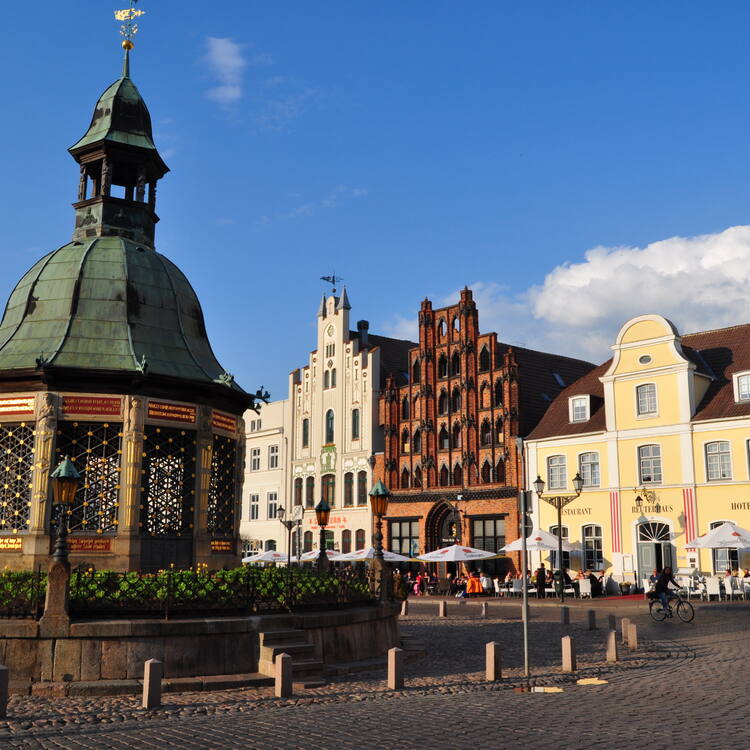
The medieval towns of Wismar and Stralsund, on the Baltic coast of northern Germany, were major trading centres of the Hanseatic League in the 14th and 15th centuries. In the 17th and 18th centuries they became Swedish administrative and defensive centres for the German territories. They contributed to the development of the characteristic building types and techniques of Brick Gothic in the Baltic region, as exemplified in several important brick cathedrals, the Town Hall of Stralsund, and the series of houses for residential, commercial and crafts use, representing its evolution over several centuries.
Description is available under license CC-BY-SA IGO 3.0
Centres historiques de Stralsund et Wismar
Les villes médiévales de Wismar et Stralsund, sur la côte de la Baltique de l'Allemagne du Nord, étaient d'importants centres commerciaux de la ligue hanséatique aux XIVe et XVe siècles. Passées sous l'autorité suédoise et devenues des postes de défense de la Suède sur les territoires allemands aux XVIIe et XVIIIe siècles, elles contribuèrent au développement des types de bâtiments caractéristiques et des techniques de construction du « Gothique brique » de la région de la Baltique. On en trouve des exemples dans plusieurs grandes cathédrales en brique, l'hôtel de ville de Stralsund et une série de bâtiments à usages résidentiel, commercial et artisanal, représentant son évolution sur plusieurs siècles.
Description is available under license CC-BY-SA IGO 3.0
سترالسوند وفيسمار التاريخيتان
كانت مدينتا فيسمار وسترالسوند اللتان تعودان إلى القرون الوسطى والواقعتان على ساحل بحر البلطيق في ألمانيا الشمالية مركزين تجاريين غاية في الأهمية أيام رابطة الهانزا في القرنين الرابع عشر والخامس عشر. وخضعتا للسلطة السويدية وأصبحتا مراكز دفاع للسويد على الأراضي الألمانية في القرنين السابع عشر والثامن عشر. وقد ساهمت هاتان المدينتان في تطوير أنواع عديدة من المباني المميزة وتقنيات البناء القرميدي القوطي الخاصة بمنطقة البلطيق. نجد أمثلة من هذا القبيل في عدد من الكاثدرائيات الكبيرة القرميدية وبلدية سترالسوند ومجموعة مباني سكنيّة أو تجاريّة أو حرفيّة تعكس عن تطوّرها عبر القرون.
source: UNESCO/CPE
Description is available under license CC-BY-SA IGO 3.0
施特拉尔松德与维斯马历史中心
维斯马和施特拉尔松德这两座中世纪的老城位于德国北部波罗的海沿岸,是公元14世纪至15世纪汉萨同盟(the Hanseatic League)的主要贸易中心。公元17世纪至18世纪,这里曾是日尔曼领土的瑞典管理和防御中心。这两座老城展示了波罗的海地区建筑的砖结构哥特式风格,这集中体现在当地数个主要的砖结构教堂、施特拉尔松德市政厅以及其他一系列居民住宅、商店和手工业作坊上,这些建筑向世人讲述着这两座老城数个世纪以来的变迁。
source: UNESCO/CPE
Description is available under license CC-BY-SA IGO 3.0
Исторические центры городов Штральзунд и Висмар
Средневековые города Висмар и Штральзунд, расположенные на Балтийском побережье в северной Германии, были важными торговыми центрами Ганзейского союза в XIV-XV вв. В XVII-XVIII вв. они стали административными и оборонительными форпостами Швеции на германских территориях. Эти города внесли вклад в развитие характерных типов зданий и строительной техники «кирпичной готики» Балтийского региона, что видно на примерах нескольких кафедральных соборов из кирпича, городской ратуши Штральзунда и целого ряда зданий жилого, торгового и производственного назначения, представляющих эволюцию местной архитектуры на протяжении нескольких столетий.
source: UNESCO/CPE
Description is available under license CC-BY-SA IGO 3.0
Centros históricos de Stralsund y Wismar
En los siglos XIV y XV, las ciudades medievales de Wismar y Stralsund, situadas en la costa báltica de la Alemania septentrional, fueron centros comerciales importantes de la Liga Hanseática. Durante los siglos XVII y XVIII, bajo la dominación de Suecia, se convirtieron en centros administrativos y militares de este país en territorio alemán. Ambas ciudades contribuyeron al auge de la construcción de edificios característicos del “gótico de ladrillo” de la región del Báltico y al desarrollo de las técnicas arquitectónicas. Varias catedrales, el ayuntamiento de Stralsund y una serie de edificios de uso residencial, comercial y artesanal son representativos de la evolución de ese estilo arquitectónico a lo largo de los siglos.
source: UNESCO/CPE
Description is available under license CC-BY-SA IGO 3.0
シュトラールズント及びヴィスマルの歴史地区
ドイツ北部,バルト海沿岸に位置するシュトラールズントとヴィスマルの中世の街は、14、15世紀にはハンザ同盟交易の中心地であった。ドイツが敗北した30年戦争後の17、18世紀にはスウェーデン領となった。これらの街は、バルト地方の特徴的な建築様式と建築技術であるゴシック様式のレンガ建築の発展に寄与している。いくつかの重要なレンガ造りの大聖堂、シュトラールズントの市庁舎、立ち並ぶ住居・商用建築・工房建築をみれば、何世紀にもまたがるこのゴシック式レンガ建築の発展の様子を知ることができる。source: NFUAJ
Historische centra van Stralsund en Wismar
De middeleeuwse steden Wismar en Stralsund liggen aan de Baltische kust van Noord-Duitsland. Het waren belangrijkste handelscentra van het Hanzeverbond in de 14e en 15e eeuw. In de 17e en 18e eeuw werden het Zweedse administratieve en defensieve centra voor de Duitse gebieden. De steden hebben bijgedragen aan de ontwikkeling van de karakteristieke bouwvormen en -technieken van de baksteengotiek in de Baltische regio. De historische centra tonen de ontwikkeling van deze gotiekstijl gedurende meerdere eeuwen. Dit is zichtbaar in een aantal belangrijke bakstenen kathedralen, het stadhuis van Stralsund en in de reeks huizen voor residentieel, commercieel en ambachtelijk gebruik.
Source: unesco.nl


Outstanding Universal Value
Brief synthesis
Founded in the 13th century, the medieval towns of Wismar and Stralsund, on the Baltic coast of northern Germany, represent different but complementary trading structures as leading centers of the Wendish section of the Hanseatic League from the 13th to the 15th centuries. In the 17th and the 18th centuries the towns became major administrative and defense centers within the Swedish kingdom, contributing to the development of military art and integrating another layer of cultural influences.
The towns contributed to the development of the characteristic building types and techniques of the Brick Gothic in the Baltic region, using fired brick. On the main elevations the bricks could be moulded in different decorative forms, thus permitting some very elaborate architecture. This is exemplified in several churches, the Town Hall of Stralsund, and in the series of houses for residential, commercial, and craft use, representing an evolution over several centuries. The typology of houses, such as the Dielenhaus and the Kemläden, were developed in the 14th century and became a characteristic feature of many Hanseatic towns.
Wismar has preserved its medieval harbour basin, whereas the island location of Stralsund has remained unchanged since the 13th century. To this day the unmistakable silhouette of Stralsund is characterized by the outstanding buildings of Brick Gothic architecture.
Criterion (ii): Wismar and Stralsund, leading centers of the Wendish section of the Hanseatic League from the 13th to 15th centuries and major administrative and defense centers in the Swedish kingdom in the 17th and 18th centuries, contributed to the development and diffusion of brick construction techniques and building types, characteristic features of Hanseatic towns in the Baltic region, as well as the development of defense systems in the Swedish period.
Criterion (iv): Stralsund and Wismar have crucial importance in the development of the building techniques and urban form that became typical of the Hanseatic trading towns, well documented in the major parish churches, the town hall of Stralsund, and the commercial building types, such as the Dielenhaus.
Integrity
Owing to the cities’ position, the important views of both towns have been well maintained and the boundary of the medieval town can still be traced well in both cases. Modern construction and industrial buildings have been located in the suburban areas, outside the historic towns. It is thus possible to appreciate the silhouette of the historic townscapes without major changes. The area is however susceptible to visual disruption by new development. The damage suffered in World War II was relatively minor, and a large amount of original architectural substance from the Middle Ages and subsequent periods has survived. All features and structures to convey the components’ significance as leading centres of the Hanseatic league are preserved.
Authenticity
The towns contain a large number of authentic historic structures representing the evolution from the Hanseatic period to the Swedish era. As centers, which were continuously inhabited and always the heart of urban life, whose harbour remained intact and of importance for the economy in all epochs, both cities have continuously preserved their use and can therefore be described as authentic with regard to their function. Today’s high standards with regard to the preservation of monuments have been applied, whereby highest priority is attributed to the preservation of the authentic material.
Protection and management requirements
The old towns are protected in their entirety as areas of historical value in the context of the laws on the protection of historical buildings and monuments of the federal Land of Mecklenburg-Vorpommern, which require that all building measures are subject to approval.
Additional protection is ensured by the respective regulations on areas of historical value and the preservation, design and redevelopment statutes adopted by both towns to secure integrity and authenticity. The components of the World Heritage property are surrounded by designated buffer zones.
Wismar as well as Stralsund have management plans, which are updated regularly. Both municipalities involve local and external experts who encourage consistency and appropriate solutions in building and town-planning practice (Architectural advisory board Stralsund, World Heritage council Stralsund, Architectural advisory board Wismar).
Both cities have established local coordinators for the site management.