Tsodilo
Tsodilo
With one of the highest concentrations of rock art in the world, Tsodilo has been called the ''Louvre of the Desert''. Over 4,500 paintings are preserved in an area of only 10 km2 of the Kalahari Desert. The archaeological record of the area gives a chronological account of human activities and environmental changes over at least 100,000 years. Local communities in this hostile environment respect Tsodilo as a place of worship frequented by ancestral spirits.
Description is available under license CC-BY-SA IGO 3.0
Tsodilo
Avec l’une des plus fortes concentrations d’art rupestre au monde, Tsodilo est parfois appelé le ''Louvre du désert''. Plus de 4 500 peintures sont conservées dans une zone de seulement 10km2 dans le désert du Kalahari. Le site renferme la mémoire de l’évolution humaine et environnementale sur une durée d’au moins 100 000 ans. Les communautés qui vivent encore dans cet environnement hostile respectent Tsodilo en tant que lieu de culte peuplé des esprits ancestraux.
Description is available under license CC-BY-SA IGO 3.0
تسوديلو
يحتوي موقع تسوديلو على أكبر مجموعة من الفن الصخري في العالم لدرجة أنّه يُطلق عليه أحياناً لقب "لوفر الصحراء". وهو يضم أكثر من 4500 رسمة في مساحة لا تزيد على 10 كم٢ فقط في صحراء كالاهاري. ويختصر هذا الموقع ذاكرة التطور البشري والبيئي على مرّ100000 سنة على الأقل. ولا تزال المجتمعات المحلية التي تقطن هذه البيئة المعادية تحترم تسوديلو كمكان عبادة تسكنه أرواح الأجداد والأسلاف.
source: UNESCO/CPE
Description is available under license CC-BY-SA IGO 3.0
措迪洛山
被誉为“沙漠卢浮宫”的措迪洛山是世界上岩石艺术最集中的地区之一。在卡拉哈里沙漠(Kalahari Desert)仅10平方公里的地方就保存了4500多幅绘画作品。这个地区的考古发现按年代顺序记载了至少10万年间的人类活动和环境变化。恶劣环境中生存的当地居民十分敬畏措迪洛山,将其作为对祖先神灵的膜拜之地。
source: UNESCO/CPE
Description is available under license CC-BY-SA IGO 3.0
Наскальная живопись в районе Цодило
Район Цодило, обладающий одним из самых значительных в мире собраний доисторического наскального искусства, называют «Лувром в пустыне». Свыше 4,5 тыс. изображений сохранилось на территории всего 10 кв. км в пустыне Калахари. Археологические находки этого района отражают хронологию деятельности человека и изменений природной среды на протяжении периода, по крайней мере, в 100 тыс. лет. Туземцы, проживающие в трудных условиях пустыни, считают Цодило священным местом и верят, что его посещают духи их предков.
source: UNESCO/CPE
Description is available under license CC-BY-SA IGO 3.0
Tsodilo
Llamado a veces el ”Louvre del desierto“, Tsodilo cuenta con una de las mayores concentraciones de arte rupestre del mundo. En una zona de unos 10 km² escasos del desierto de Kalahari se conservan mí¡s de 4.500 pinturas. Este sitio conserva la memoria de las actividades humanas y las mutaciones del medio ambiente de los últimos 100.000 años por lo menos. Las comunidades que viven hoy en día en este medio hostil veneran Tsodilo por considerarlo un lugar de culto habitado por espíritus ancestrales.
source: UNESCO/CPE
Description is available under license CC-BY-SA IGO 3.0
ツォディロ
アフリカ大陸南端、ボツワナ西北端に位置し「砂漠のルーブル」といわれている。世界で最も石の芸術が集積している場所の一つで、4500以上の絵がカラハリ砂漠のわずか10k㎡の地域に点在する。少なくとも10万年以上にわたる人類の歴史や環境の変化が、これらの絵画を通して読み取れる。ジンバブエ共和国のマトボ・ヒル壁画群とナミビア壁画群とのほぼ中間に位置し、サン人の美術全体の伝播に大きな役割を果たした。source: NFUAJ
Tsodilo
Met een van de hoogste concentraties van rotskunst in de wereld is Tsodilo ook wel het ‘Louvre van de woestijn’. Meer dan 4.500 schilderijen zijn bewaard gebleven in een gebied van slechts tien vierkante kilometer van de Kalahari woestijn. De heuvels van Tsodilo liggen in het noordwesten van Botswana in de buurt van de grens met Namibië en boden mensen meer dan 100.000 jaar onderdak en andere middelen. De archeologische vondsten van het gebied geven een chronologisch verslag van de menselijke activiteiten en milieuveranderingen gedurende deze lange periode. De lokale gemeenschappen in deze vijandige omgeving beschouwen Tsodilo als een plaats van voorouderverering.
Source: unesco.nl


Outstanding Universal Value
Brief synthesis
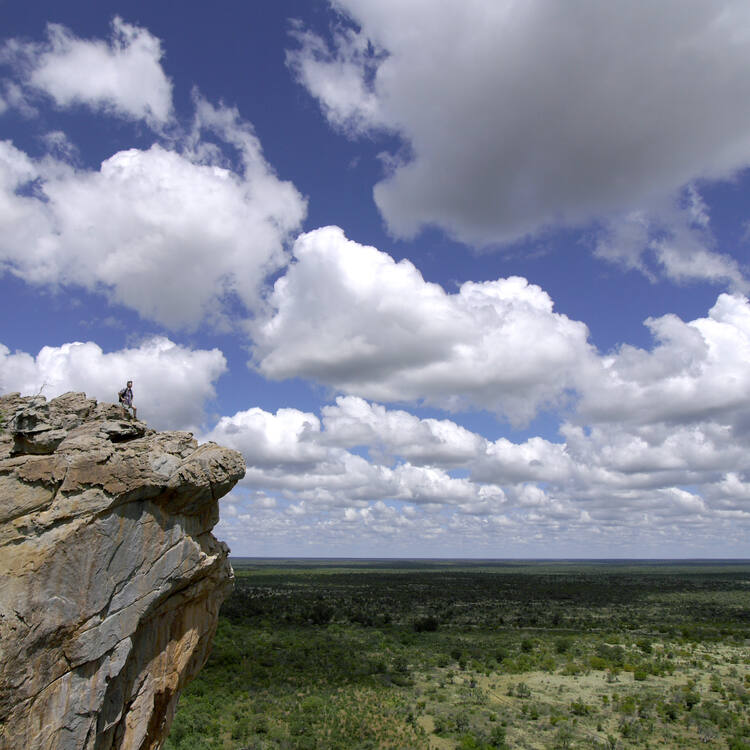
Located in north-west Botswana near the Namibian Border in Okavango Sub-District, the Tsodilo Hills are a small area of massive quartzite rock formations that rise from ancient sand dunes to the east and a dry fossil lake bed to the west in the Kalahari Desert. The Hills have provided shelter and other resources to people for over 100,000 years. It now retains a remarkable record, in its archaeology, its rock art, and its continuing traditions, not only of this use but also of the development of human culture and of a symbiotic nature/human relationship over many thousands of years.
The archaeological record of the site gives a chronological account of human activities and environmental changes over at least 100,000 years, although not continuously.
Often large and imposing rock paintings exist in the shelters and caves, and although not accurately dated appear to span from the Stone Age right through to the 19th century. In addition, within the site sediments, there is considerable information pertaining to the paleo-environment. This combination provides an insight into early ways of human life, and how people interacted with their environment both through time and space.
The local communities revere Tsodilo as a place of worship and as a home for ancestral spirits. Its water holes and hills are revered as a sacred cultural landscape, by the Hambukushu and San communities.
Criterion (i): For many thousands of years the rocky outcrops of Tsodilo in the harsh landscape of the Kalahari Desert have been visited and settled by humans, who have left rich traces of their presence in the form of outstanding rock art.
Criterion (iii):Tsodilo is a site that has witnessed visits and settlement by successive human communities for many millennia.
Criterion (vi): The Tsodilo outcrops have immense symbolic and religious significance for the human communities who continue to survive in this hostile environment.
Integrity
The boundaries contain all the main sites. Three basic long-term facts have contributed to Tsodilo’s outstanding state of preservation: its remoteness, its low population density, and the high degree of resistance to erosion of its quartzitic rock. The considerable archaeological evidence is generally well preserved. All excavations are controlled in accordance with the national legislation. Previous excavations have been properly backfilled and, in most instances, leaving intact deposits and strata as a resource for future research.
The property attracts increasing visitor numbers, resulting in the need to manage the threat of increased litter. Despite these increased visits, there have been limited reports of vandalism and graffiti due to the compulsive guided tour regulations put in place.
Authenticity
The authenticity of the rock art in terms of materials, techniques, setting and workmanship is impeccable and, other than some impact caused by natural deterioration and visitors, it remains as original as the time of its creation. Conservation work has been limited to preventive strategies without altering the art and its substrate.
The intangible values of the site continue to be practiced thereby authenticating them as sacred and relevant to local communities. This approach ensures their continued evolvement in line with traditional protection systems.
Protection and management requirements
The site owned by the Government is currently protected in terms of the Monuments & Relics Act 2001, and by conditions of the Anthropological Research Act 1967, National Parks Act 1967, and Tribal Act 1968.
Declared a National Monument in 1927, the responsibility for looking after Tsodilo Hills rests with the Department of National Museum and Monuments in collaboration with the Tsodilo Management Authority, an independent advisory group comprising the Tsodilo Community Trust, community based organizations, NGOs and selected critical government based Departments.
To ensure the conservation of all the site attributes, in 1997, a revised Integrated Management Plan was developed and approved by stakeholders. An Integrated management Plan detailing community initiatives was developed in 2007 and currently being implemented in the buffer area of the site. With the assistance of the African World Heritage Fund, a Core Area Management Plan was developed for the site in 2009.
The main objective of the previous and the current management plans is to ensure the conservation of the values of the site. In addition to the existing site office, and the Tsodilo Management Authority Trust, the Government has opened a regional Monument office to directly oversee the implementation of the management plan for the site.
 View photos from OUR PLACE the World Heritage collection