Archaeological Areas of Pompei, Herculaneum and Torre Annunziata
Archaeological Areas of Pompei, Herculaneum and Torre Annunziata
When Vesuvius erupted on 24 August AD 79, it engulfed the two flourishing Roman towns of Pompei and Herculaneum, as well as the many wealthy villas in the area. These have been progressively excavated and made accessible to the public since the mid-18th century. The vast expanse of the commercial town of Pompei contrasts with the smaller but better-preserved remains of the holiday resort of Herculaneum, while the superb wall paintings of the Villa Oplontis at Torre Annunziata give a vivid impression of the opulent lifestyle enjoyed by the wealthier citizens of the Early Roman Empire.
Description is available under license CC-BY-SA IGO 3.0
Zones archéologiques de Pompéi, Herculanum et Torre Annunziata
L’éruption du Vésuve, le 24 août de l’an 79, a enseveli les deux villes romaines florissantes de Pompéi et d’Herculanum ainsi que nombre de riches maisons de la région. Depuis le milieu du XVIIIe siècle, elles sont progressivement mises au jour et rendues accessibles au public. La vaste étendue de la ville commerciale de Pompéi contraste avec les vestiges plus restreints mais mieux préservés de la cité résidentielle de détente d’Herculanum, tandis que les superbes peintures murales de la villa Oplontis de Torre Annunziata donnent un témoignage très vivant du mode de vie opulent des citoyens les plus riches des débuts de l’Empire romain.
Description is available under license CC-BY-SA IGO 3.0
المناطق الأثرية في بومبي، هركولانيوم وتورّي أنّونزياتا
أدّى انفجار بركان فيزوفو في 24 آب/أغسطس من العام 79 إلى طمر مدينتي بومبي وهركولانيوم الرومانيتين المزدهرتين وكذلك عدد من المنازل الغنية في المنطقة. ومنذ منتصف القرن الثامن عشر، كُشفت تلك الآثار تدريجًا وأصبح الوصول إليها ممكنًا. كما أن المساحة الواسعة من مدينة بومبي التجارية تشكل تناقضًا مع الآثار الأقل عددًا ولكن المحفوظة أكثر للمدينة السكنية هركولانيوم، بينما تعطي الرسوم الجدارية الرائعة لفِلاّ أُبلونتيس في تورّي أنّونزياتا شهادة حيّة جدًا على نمط الحياة المترف للمواطنين الأكثر غنى في بدايات الامبراطورية الرومانية.
source: UNESCO/CPE
Description is available under license CC-BY-SA IGO 3.0
庞培、赫库兰尼姆和托雷安农齐亚塔考古区
公元79年8月24日维苏威火山的爆发,吞没了两个繁盛的罗马城市:庞培和赫库兰尼姆以及那个地区的许多富家别墅。从18世纪中叶始,被掩埋的一切都逐渐挖掘出来并向公众公开开放。庞培商业城的广阔,与规模不大却保存完好的赫库兰尼姆假日胜地相得益彰,而托雷安农齐亚塔的奥普隆蒂斯别墅的壮丽壁画,呈现给我们一幅早期罗马帝国富裕的市民生活方式的生动画面。
source: UNESCO/CPE
Description is available under license CC-BY-SA IGO 3.0
Археологические зоны - Помпеи, Геркуланум и Торре-Аннунциата
После извержения Везувия 24 августа 79 г. два процветающих древнеримских города Помпеи и Геркуланум, вместе со многими богатыми виллами в окрестностях, были погребены под пеплом. Они были постепенно раскопаны и стали доступны для обозрения с середины XVIII в. Большие размеры торгового города Помпеи контрастируют с меньшими, но лучше сохранившимися руинами курорта Геркуланум, в то время как превосходные настенные росписи виллы Оплонтис в Торре-Аннунциата дают яркое представление о богатом образе жизни, которым наслаждались состоятельные граждане ранней Римской империи.
source: UNESCO/CPE
Description is available under license CC-BY-SA IGO 3.0
Zonas arqueológicas de Pompeya, Herculano y la Torre Annunziate
La erupción del Vesubio ocurrida el 24 de agosto del año 79 sepultó las dos florecientes ciudades romanas de Pompeya y Herculano, así como numerosas mansiones de las comarcas circundantes. Desde mediados del siglo XVIII se empezaron a desenterrar sus ruinas paulatinamente y se hicieron accesibles al público. La vasta extensión ocupada por los restos de ciudad mercantil de Pompeya contrasta con el espacio más reducido de los vestigios, mejor conservados, de la ciudad residencial de Herculano. Las soberbias pinturas murales de la Villa Oplontis, situada en Torre Annunziata, son un vívido testimonio de la vida opulenta de los ciudadanos romanos más pudientes en los primeros años de la Roma imperial.
source: UNESCO/CPE
Description is available under license CC-BY-SA IGO 3.0
ポンペイ、エルコラーノ及びトッレ・アヌンツィアータの遺跡地域
紀元79年8月24日のヴェスヴィオ山噴火によって、繁栄していたポンペイやヘルクラーヌム(現エルコラーノ)、周辺の多くの豊かな都市が廃虚と化した。18世紀中頃以来発掘が進み、残るは現在約2割程度。トッレ・アヌンツィアータのヴィラ・オプロンティスの華麗な壁画は、初期ローマ帝国市民の富欲な生活様式を鮮明に伝えている。source: NFUAJ
Archeologische gebieden van Pompeii, Herculaneum en Torre Annunziata
Toen de vulkaan Vesuvius uitbarstte op 24 augustus in het jaar 79, overspoelde het de twee bloeiende Romeinse steden Pompeii en Herculaneum met lava, evenals de vele rijke villa's in het gebied. De laatste zijn geleidelijk opgegraven en toegankelijk gemaakt voor het publiek vanaf het midden van de 18e eeuw. De enorme uitgestrektheid van de commerciële stad Pompeii staat in schril contrast met de kleinere maar beter bewaard gebleven resten van het vakantieoord Herculaneum. De prachtige muurschilderingen van Villa Oplontis in Torre Annunziata geven een levendige indruk van de overvloedige levensstijl van de rijkere burgers van het vroege Romeinse Rijk.
Source: unesco.nl


Outstanding Universal Value
Brief synthesis
The World Heritage property includes three different archaeological areas: the ancient towns of Pompeii and Herculaneum together with the Villa of the Mysteries (to the west of Pompeii) and the Villa of the Papyri (to the west of Herculaneum), and the Villa A (Villa of Poppaea) and Villa B (Villa of Lucius Crassius Tertius) in Torre Annunziata. The vast expanse of the commercial town of Pompeii contrasts with the smaller but better-preserved remains of the smaller Herculaneum, while Villa A in Torre Annunziata gives a vivid impression of the opulent lifestyle enjoyed by the wealthier citizens of the early Roman Empire.
When Vesuvius erupted in 79 AD, it engulfed the two flourishing Roman towns of Pompeii and Herculaneum, as well as the many wealthy countryside villas in the area. Pompeii was buried largely by a thick layer of volcanic ash and lapilli and Herculaneum disappeared under pyroclastic surges and flows. These sites have been progressively excavated and made accessible to the public since the mid-18th century. However, in the case of Herculaneum large areas of the ancient town still lie under the modern town and have only been explored and surveyed by the network of 18th-century tunnels that drew the attention of Grand Tour visitors, the basis still today for visiting the Herculaneum's underground ancient theatre. These areas are mostly not currently included in the World Heritage property.
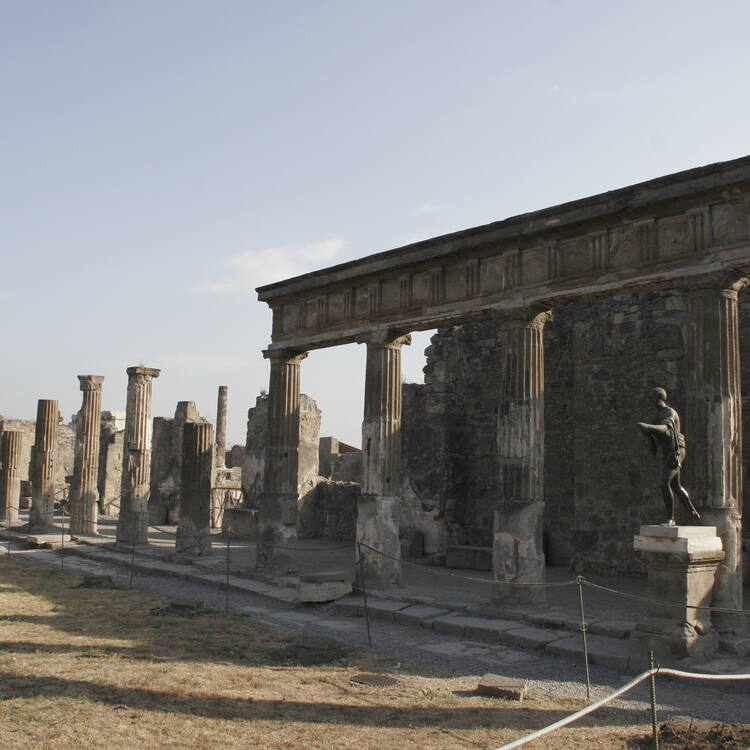
Pompeii, with its well-preserved buildings in an excavated area of 44 ha, is the only archaeological site in the world that provides a complete picture of an ancient Roman city. The main forum is flanked by a number of imposing public buildings, such as the Capitolium, the Basilica and temples and within the city there are also many public bath complexes, two theatres and an amphitheatre.
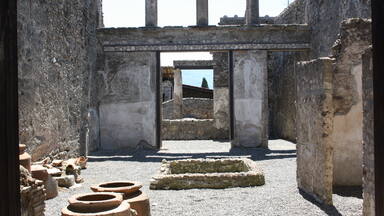
In Herculaneum several impressive public buildings are well preserved, including a spacious palaestra accessed through a monumental gateway, two sets of public baths, one of which (Central Thermae) is monumental and vividly decorated, the College of the Priests of Augustus, and a theatre of standard form. The Villa of the Papyri, outside the city walls, is an opulent establishment. The town is also noteworthy for the completeness of its shops, still containing equipment such as enormous wine jars.
Herculaneum’s urban districts and seafront display a higher level of preservation with noteworthy conservation of upper floors thanks to the pyroclastic material that buried the town. Organic matter was often carbonized by the high temperatures and exceptionally preserved finds include everyday objects such as foodstuffs, architectural elements and wooden furniture.
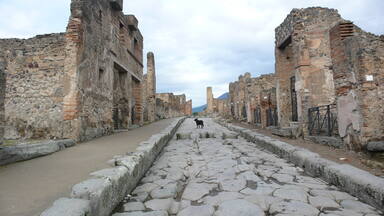
Both Pompeii and Herculaneum are renowned for their remarkable series of residential and commercial buildings, built along well-paved streets. The earliest is the atrium house, entirely inward-looking with a courtyard at its centre: the House of the Surgeon at Pompeii is a good example. Under Hellenistic influences, this type of house was enlarged and decorated with columns and arcades and equipped with large representative rooms. In its highest form, this type of Roman house, known from towns all over the Empire, developed into a veritable mansion, richly decorated and with many rooms, of which the House of the Faun and the House of the Chaste Lovers are outstanding examples.
The suburban villas across the Vesuvian area are perhaps even more exceptional in terms of the scale of their buildings and grounds, as well as their lavish decorations. The Villa of the Mysteries is an enormous residence just outside Pompeii’s city walls, developed from a modest house built in the 3rd century BC, named from the remarkable wall paintings in the triclinium, which depict the initiation rites ('mysteries') of the cult of Dionysus.
The two villas in Torre Annunziata are both extraordinary examples of suburban buildings in the countryside of Pompeii. The villa A, so-called “of Poppaea”, is a huge maritime residence built in the middle of the 1st century BCE, enlarged during the Imperial period and under restoration at the moment of the eruption. It is especially well known for its magnificent and well-preserved wall paintings, one of the most important examples of Roman painting with their superb illusionistic frescos of doors, colonnades and garden views. On the other hand, villa B is an excellent example of villa rustica provided with rooms and spaces designated for market activities such as storage of amphoras and trading of locally produced foodstuffs, especially wine.
There were many changes to these buildings over time in response to changing circumstances of the owners; these include repairs and adjustments that were a response to the seismic events that led up to the AD 79 eruption and reflect a community living with changing environmental and economic conditions.
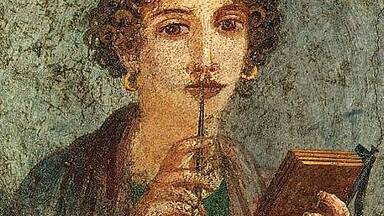
A special feature of Pompeii is the wealth of graffiti on its walls. An election was imminent at the time of the eruption, and there are many political slogans scrawled on walls, as well as others of a more personal nature, often defamatory. At Herculaneum, the volcanic deposits preserved hundreds of wax tablets, some of which conserve legal documents, and more than 1,800 papyri scrolls containing Greek philosophical texts were found at the Villa of the Papyri.
The diverse range of literary sources available in Pompeii and Herculaneum provides a picture of the final decades of these ancient cities and the image of socially complex and dynamic communities, representing exceptional evidence of typical ways of life in Roman society in the first century AD and the importance of texts in political and private life.
Other important sources of archaeological evidence are the human remains of those who died in the eruption. Pompeii witnessed an early archaeological experiment when plaster was poured into voids found in the volcanic material and which allowed casts to be made of the forms of the human and animal victims and other organic material. At Herculaneum, on the other hand, about 300 skeletons were discovered along the ancient shoreline. The study of these significant samples of victims from the towns provides insight into their health, lifestyles and death and a chance to compare the two data sets. The casts themselves are important resources as they contain both skeletal remains and evidence of 19th- and 20th-century archaeological practice.
Another important legacy of the twentieth century was the presentation of Herculaneum to the public as an ‘open-air museum’, perhaps Europe’s first, with buildings reconstructed based on archaeological evidence and displays of original objects within the archaeological site. This concept of ‘open-air museum’ had already been adopted in some buildings in Pompeii, as a medium to communicate the meaning of ancient spaces, at the end of the 19th century.
The impressive remains of the towns of Pompeii and Herculaneum and their associated villas, destroyed and yet preserved by Mount Vesuvius, provide a complete and vivid picture of society and daily life at a specific moment in the past that is unparalleled elsewhere. The rediscovery and history of these places as archaeological sites has captured the collective imagination century after century, shaping archaeological, art historical, conservation and interpretation practices in Europe and beyond.
Criterion (iii): Pompeii and Herculaneum are the only Roman cities ruins preserved in such an exceptional way and have no parallels in integrity and extent in the world. The villas in Torre Annunziata have the best preserved wall paintings of the Roman period.
Criterion (iv): The sites of Pompeii, Herculaneum and Torre Annunziata provide a full picture of Roman life from the 1st century BC to the 1st century AD through the urban, architectural, decorative and daily life aspects that have been preserved. The villa A in Torre Annunziata is the most significant example of suburban villa of the Roman period.
Criterion (v): The sites of Pompeii, Herculaneum and Torre Annunziata are outstanding examples of urban and suburban Roman settlements. They also provide a vivid and comprehensive picture of Roman life at one precise moment: the eruption of Vesuvius in 79 AD.
Integrity
The inscribed property has an area of 98 ha, with a buffer zone of 1,726 ha. Owing to the eruptions, the archaeological remains are unparalleled anywhere in the world for their completeness and extent. The three parts of the property are of adequate size to contain the attributes to express its Outstanding Universal Value, except at Herculaneum where integrity would be improved by inclusion within the property, via a minor boundary modification, of the theatre and the largest part of the ancient town with its most significant public monuments still lying beneath the modern Ercolano, and known only through 18th century tunnels.
The individual components and ancient urban fabric are in overall good condition and the town plan, structures and setting with regard to the Vesuvius are still sufficiently intact. Some structures continue to be at risk of collapse or loss of decorative detail given the scale of active decay in archaeological sites of this size and nature where original urban infrastructure (drainage, roofing etc.) can only be partially reinstated. A property with such extensive ruins exposed will always require continuous and continuing maintenance.
Authenticity
Since the first discoveries, excavation, conservation, consolidation, restoration and maintenance works have been implemented on the remarkable remains of these sites with varying intensity. The sites show the evolution of archaeological practices, conservation techniques and approaches to presentation over the past two centuries. The level of reconstruction and the use of materials, such as concrete and steel utilized in restorations before the 1980s, would be approached differently today. More enduring techniques and materials have been progressively introduced. It may be argued that these early restorations have, in some cases, a historical significance of their own which should be safeguarded when they contribute to the overall coherence at an urban scale, as in the case of Amedeo Maiuri’s open-air museum at Herculaneum at its peak in the 1950s.
A general shift in conservation approaches in the 21st century is favouring authenticity; instead of concentrating on single buildings, conservation campaigns are focusing on entire districts of the ancient towns, consisting of one or more insulae, and so achieving a more coordinated and homogenous result.
Despite the nature and quality of earlier restoration and reconstruction works, the authenticity of the individual components and the ancient urban and suburban fabric as a whole is very high.
Protection and management requirements
The property was protected by the provisions of past Law No 1089/1939 and since 2004 is under the Legislative Decree No 42/2004 (“Cultural Heritage and Landscape Code”). The perimeter of the Pompeii site is protected by the Decree of June 10th 1929. Environmental legislation in the form of the Legislative Decree No 42/2004 extended this protection to a wider area. All buildings and excavation works within the modern towns around the sites must be approved by the relevant heritage authorities.
At Herculaneum, where most of the ancient city lies under the modern town, additional protection is offered by development restrictions of the high-risk zone of Mount Vesuvius and wider Regional territorial plans.
The Vesuvius National Park also provides additional layers of protection of the broader setting while the MAB Biosphere designation provides a framework to promote further coordination.
The 3 component parts are owned by the State and, together with the immediate surrounding areas, are managed by the Archaeological Park of Pompeii (also overseeing the villas in Torre Annunziata) and the Archaeological Park of Herculaneum, two autonomous institutions established recently as part of a broader ministerial reform which attempts to bring decision making closer to the sites themselves.
These local heritage authorities include technical/scientific (archaeologists, architects, restorers), security and reception staff. Annual visitor numbers at the sites exceeds two and a half million (half of these are estimated to be foreign visitors).
A major public-private partnership, the Herculaneum Conservation Project, has shaped conservation and site management and enhancement at Herculaneum since 2001. The ‘Grande Progetto Pompei’, approximately a 5-year project begun in 2012 with the European Union has, among other things, stabilized and conserved buildings in the areas of highest risk at Pompeii.
A new management plan was presented to the World Heritage Centre for review in 2014. The development of this management plan has already proved an important tool to identify and implement provisions to regulate and control development in the setting of the property components in addition to existing measures. Increasing emphasis on a management planning approach, also at Herculaneum, will help integrate management, conservation and maintenance programmes in all three components of the property. This is central to reducing causes of decay, managing public enjoyment and use, guaranteeing risk management and securing these sites a constructive role in the sustainable development of the broader Vesuvian area.Links
-
Pompeii Official website
-
Pompeii Facebook page (in Italian only)
-
Pompeii Instagram account (in Italian only)
-
Pompeii Sites Twitter (X) account (in Italian only)
-
Pompeii YouTube Channel (in Italian only)
-
Parco Archeologico di Ercolano - Official website (in Italian only)
-
Ercolano - Parco Archeologico Instagram account (in Italian only)
-
Parco Archeologico di Ercolano YouTube Channel (in Italian only)
-
Ercolano - Parco Archeologico Facebook page (in Italian only)



The Nomination files produced by the States Parties are published by the World Heritage Centre at its website and/or in working documents in order to ensure transparency, access to information and to facilitate the preparations of comparative analysis by other nominating States Parties.
The sole responsibility for the content of each Nomination file lies with the State Party concerned. The publication of the Nomination file, including the maps and names, does not imply the expression of any opinion whatsoever of the World Heritage Committee or of the Secretariat of UNESCO concerning the history or legal status of any country, territory, city or area or of its boundaries.