Archaeological Site of Panamá Viejo and Historic District of Panamá
Archaeological Site of Panamá Viejo and Historic District of Panamá
Founded in 1519 by the conquistador Pedrarías Dávila, Panamá Viejo is the oldest European settlement on the Pacific coast of the Americas. It was laid out on a rectilinear grid and marks the transference from Europe of the idea of a planned town. Abandoned in the mid-17th century, it was replaced by a ‘new town’ (the ‘Historic District’), which has also preserved its original street plan, its architecture and an unusual mixture of Spanish, French and early American styles. The Salón Bolívar was the venue for the unsuccessful attempt made by El Libertador in 1826 to establish a multinational continental congress.
Description is available under license CC-BY-SA IGO 3.0
Site archéologique de Panamá Viejo et district historique de Panamá
Fondé en 1519 par le conquistador Pedrarias Dávila, Panamá Viejo fut le premier établissement européen sur la côte pacifique des Amériques. Son plan en damier témoigne de la conception européenne de ville planifiée. Abandonnée au milieu du XVIIe siècle, elle fut remplacée par une ville nouvelle, le « District historique », qui a conservé intact le tracé de ses rues ; l’architecture est un mélange insolite de styles espagnol, français et américain ancien. Le Salón Bolivar a été le théâtre de la tentative infructueuse du Libertador qui voulait créer en 1826 un congrès continental multinational.
Description is available under license CC-BY-SA IGO 3.0
موقع باناما فياجو الاثري ومقاطعة باناما التاريخية
كانت باناما فياجو التي أسّسها المغامر الاسباني بيدرارياس دافيلا في العام 1519، أول منشأة أوروبية على ساحل المحيط الهادئ في اميركا. ويشهد تخطيطها المؤلف من المربعات المنسقة، على المفهوم الاوروبي للمدينة المخططة. وتم استبدالها في منتصف القرن السابع عشر بمدينة جديدة "المقاطعة التاريخية" التي حافظت على تخطيط شوارعها. وكانت الهندسة عبارة عن مزيج غريب من الاساليب الاسبانية والفرنسية والاميركية القديمة. وكان صالون بوليفار مسرح المحاولة غير المثمرة لليبرتادور الذي اراد انشاء مجلس قاريّ متعدد الجنسيات في العام 1826.
source: UNESCO/CPE
Description is available under license CC-BY-SA IGO 3.0
巴拿马城考古遗址及巴拿马历史名区
西班牙征服者帕卓若斯·戴勒于1519年建立了最初的巴拿马城,这是欧洲殖民者在美洲太平洋地区最早的定居地。该城以直线网状布局,表现出欧洲城镇规划的概念。在17世纪中叶被遗弃之后,它被新城(历史区)所取代,新城保留了原来的街道和建筑式样以及由西班牙、法国、早期美国所混杂成的建筑风格。1826年,艾利博多曾进行一次尝试,试图把撒乐波利瓦尔建成一座多国国会集中地,但是这个尝试最终失败了。
source: UNESCO/CPE
Description is available under license CC-BY-SA IGO 3.0
Археологические памятники Панамы-Вьехо (Старой Панамы) и историческая часть города Панама
Панама-Вьехо – это старейшее европейское поселение на тихоокеанском побережье Америки, основанное в 1519 г. конкистадором Педрариасом Давила. Город имел планировку в виде прямоугольной сетки, что отразило произошедший в Европе переход к идее планируемого города. Оставленный в середине XVII в., он был заменен «Новым городом» (историческим районом), который также сохранил первоначальный план улиц, архитектуру и необычную смесь разных стилей – испанского, французского и нарождающегося американского. Салон Боливара – место, где в 1826 г. этот освободитель бывших испанских колоний (El Libertador) предпринял безуспешную попытку созвать объединяющий их континентальный конгресс.
source: UNESCO/CPE
Description is available under license CC-BY-SA IGO 3.0
Sitio arqueológico de Panamá Viejo y distrito histórico de Panamá
Fundada en 1519 por el conquistador Pedrarias Dávila, la ciudad de Panamá Viejo fue el primer asentamiento europeo en la costa americana del Pacífico. Su trazado en damero es un excelente ejemplo de la concepción europea de la planificación urbana. Abandonada a mediados del siglo XVII, esta ciudad fue reemplazada por otra nueva –el actual distrito histórico– que también ha conservado el trazado inicial de sus calles, así como la arquitectura de sus edificios, en la que el estilo español se mezcla de forma insólita con el francés y el americano primigenio. En el distrito histórico se halla el Salón Bolívar, donde el Libertador trató infructuosamente de establecer un congreso continental multinacional en 1826.
source: UNESCO/CPE
Description is available under license CC-BY-SA IGO 3.0
パナマ・ビエホ古代遺跡とパナマの歴史地区
パナマは1519年スペインの征服者が建設した、太平洋岸におけるヨーロッパ初の植民地。1671年以後発展した歴史地区は、道路設計に初期の様式を残し、建造物はスペイン・フランス・アメリカ原住民の諸様式の混合である。シモン・ボリヴァールのサロンは、1826年開催の不成功に終わったラテンアメリカ諸国の連帯を目指すパナマ会議の会場。source: NFUAJ
Archeologisch gebied Panamá Viejo en historisch district Panamá
Panamá Viejo – in 1519 gesticht door de conquistador Pedrarias Dávila – is de oudste Europese nederzetting van Zuid-Amerika aan de kust van de Stille Oceaan. Het werd gebouwd volgens een rechthoekig patroon en markeert de overname van de Europese manier van stadsplanning. Halverwege de 17e eeuw werd de stad verlaten en vervangen door een ‘nieuwe stad’ (het ‘historisch district’). Hiervan zijn het oorspronkelijke stratenplan, de architectuur en ongewone mix van Spaanse, Franse en vroege Amerikaanse stijlen intact gebleven. In het district bevindt zich de Salón Bolívar; de plek waar visionair Simón Bolivar in 1826 een niet-succesvolle poging deed een Pan-Amerikaans congres op te richten.
Source: unesco.nl


Outstanding Universal Value
Brief synthesis
Panama City, the oldest continuously occupied European settlement in the Pacific coast of the Americas, was founded in 1519, as a consequence of the discovery by the Spanish of the South Sea in 1513. The archaeological remains of the original settlement (known today as the Archaeological Site of Panamá Viejo) include the Pre-Columbian vestiges of the Cuevan aboriginal occupation of the same name, and currently encompass a protected heritage site covering 32 ha. The settlement was a first rank colonial outpost and seat of a Royal Court of Justice during the 16th and 17th centuries when Panama consolidated its position as an intercontinental hub. Its growth in importance, as it profited from the imperial bullion lifeline, is reflected by the imposing stone architecture of its public and religious buildings.
During its 152 years of existence, the town was affected by slave rebellion, fire and an earthquake, but was destroyed in the wake of a devastating pirate attack in 1671. Since it was relocated and never rebuilt, Panamá Viejo preserves its original layout, a slightly irregular, somewhat rudimentary grid with blocks of various sizes. There is archaeological evidence of the original street pattern and the location of domestic, religious and civic structures. The site is an exceptional testimony of colonial town planning; the ruins of its cathedral, convents and public buildings showcase unique technological and stylistic characteristics of its temporal and cultural context. It also offers invaluable information on a variety of aspects of social life, economy, communications and the vulnerability of a strategic site within the geopolitical dynamics at the height of Spanish imperial power.
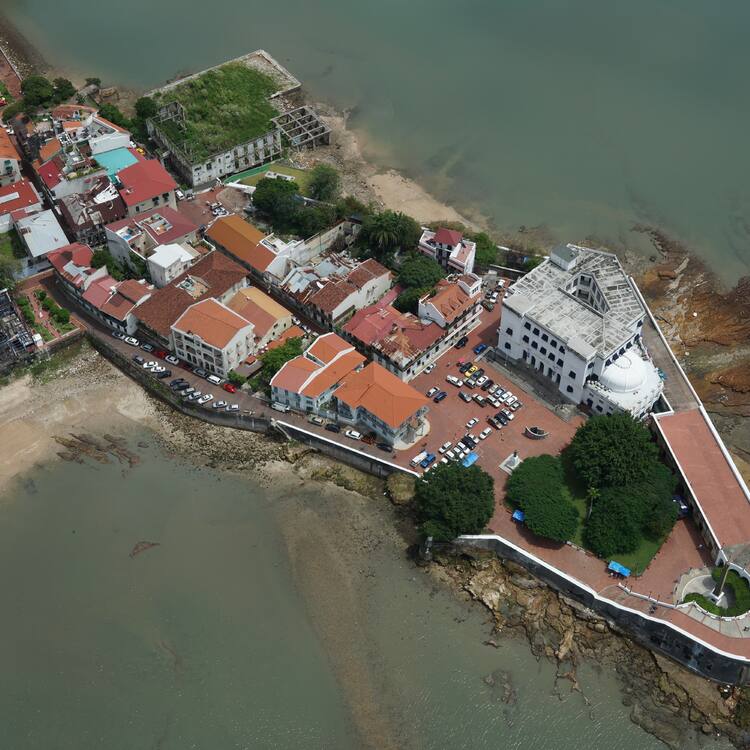
In 1673 the city was moved some 7.5 km southeast, to a small peninsula at the foot of Ancón hill, closer to the islands that were used as the port and near the mouth of a river that eventually became the entrance of the Panama Canal. The relocated town, known today as Casco Antiguo or the Historic District of Panama, not only had better access to fresh water but could be fortified. The military engineers, moreover, took advantage of the morphological conditions that complemented the wall surrounding the peninsula, all of which prevented direct naval approaches by an enemy. The area within the walls had an orthogonal layout, with a central plaza and streets of different widths; outside the walls the suburb of Santa Ana had an irregular layout. There is a centrally-located main plaza (which was enlarged in the 19th century) and several smaller post-colonial plazas on the fringes. Most of the seaward walls of the colonial fortifications and parts of the landward bastions and moat survive. Several buildings within the District are identified as important for the country’s 17th-20th century heritage. Most outstanding are the churches, above all the cathedral with its five aisles and timber roof; San Felipe Neri, San José, San Francisco and especially La Merced with its well-preserved colonial timber roof. The Presidential Palace originally built in the late 17th century and partially reconstructed in the 18th, 19th and early 20th centuries, is a revealing example of the transformations that characterize the Historic District as a whole. The House of the Municipality, the Canal Museum building (originally the Grand Hotel), the National Theatre, the Ministry of Government and Justice and the Municipal Palace are outstanding buildings of a more recent period. There are several exceptional examples of domestic architecture from the colonial period, above all the mid-18th century Casa Góngora, and also several hundred houses from the mid-19th to the early 20th centuries that illustrate the transformation of living concepts from the colonial period to modern times. These include not only upper-class houses from the entire period, but also 2- to 5-floor apartment houses and wooden tenement buildings from the early 20th century erected to satisfy the requirements of a more stratified urban society
Particularly relevant is the Salón Bolivar, originally the Chapter Hall of the convent of San Francisco, which is the only surviving part of the 17th-18th century complex. The Salón Bolívar has special historical importance as the site of the visionary, but abortive attempt by Simon Bolivar in 1826 to establish what would have been the world’s first multinational and continental congress.
The present-day appearance of the Historic District is marked by a unique blend of 19th- and early 20th century architecture inspired in late colonial, Caribbean, Gulf Coast, French and eclectic (mostly Neo-Renaissance) styles. In the 19th and early 20th centuries, building styles evolved significantly, but spatial principles were fundamentally preserved. The Historic District’s layout, a complex grid with streets and blocks of different widths and sizes and fortifications inspired in late Renaissance treaties, is an exceptional and probably unique example of 17th-century colonial town planning in the Americas. These special qualities, which differentiate the Property from other colonial cities in Latin America and the Caribbean, resulted from the construction, first of a railroad (1850-55) and then a canal (1880-1914) that linked the Atlantic and Pacific Oceans. The construction of the canal, a landmark in the history the Americas and the world, had a tangible effect on the development of the Historic District and its surrounding area.
Criterion (ii): Panamá Viejo is an exceptional testimony of town planning of its period and culture. It exhibits an important interchange of human values since it bore great influence on subsequent developments in colonial Spanish town planning, even in areas vastly different in climate and setting. The Historic District’s layout reflects the persistence and interchange of human values, which have been oriented towards interoceanic and intercontinental communications for several centuries at this strategic site on the Central American Isthmus.
Criterion (iv): In both Panamá Viejo and the Historic District, house and church types from the 16th to the 18th centuries represent a significant stage in the development of Spanish colonial society as a whole. Panamá Viejo is an exceptional example of the period’s building technology and architecture. In the Historic District, surviving multiple-family houses from the 19th and early 20th centuries are original examples of how society reacted to new requirements, technological developments and influences brought about by post-colonial society and the building of the Panama Canal.
Criterion (vi): The ruins of Panamá Viejo are closely linked to the European discovery of the Pacific Ocean, the history of Spanish expansion in the Isthmus of Central America and in Andean South America, the African diaspora, the history of piracy and proxy war, the bullion lifeline to Europe, the spread of European culture in the region and the commerce network between the Americas and Europe. The Salón Bolívar is associated with Simón Bolívar´s visionary attempt in 1826 to establish a multinational congress in the Americas, preceding the Organization of American States and the United Nations.
Authenticity
The conditions of authenticity of both components of the Property —the Archaeological Site of Panamá Viejo and the Historic District of Panamá— have been maintained. Upon abandonment, the core area of Panamá Viejo was never rebuilt and retained its original street layout. No reconstructions of archaeological remains have been carried out and all conservation and intervention work amongst the ruins has been done in accordance with international standards. Within the boundaries of the protected heritage area there are a few modern structures, but these are clearly identified and differentiated from the archaeological remains.
The urban layout of the Historic District of Panama City may be considered to be entirely authentic, preserving its original form largely unchanged. The organically developed stock of buildings from the 18th to the 20th centuries has changed little over time. Most of the fabric of the buildings and fortifications, as well as the public spaces, is original. There is evidence that dressed stone and other building materials from the ruins of the Archaeological Site of Panamá Viejo were quarried and recycled to help rebuild the relocated settlement and for the construction of buildings and fortifications of the Historic District, thus providing a measure of material continuity between the two components of the Property. In some well documented cases, such as La Merced, entire church facades were reconstructed on the new site.
The property has maintained the street layout, structural volumetry and the urban scale. Many streets retain the brick paving characteristic of the early years of the 20th century. Although a certain level of gentrification has taken place, the traditional use has been largely preserved, with a mixture of residential, commercial, institutional and religious activities coexisting with non-traditional touristic and entertainment uses. Since the modern habilitation of interior spaces in the buildings can potentially compromise the essence of the site by replacing traditional structural systems with modern structural materials, clear guidelines need to be enforced in the implementation of restoration and rehabilitation projects for historic buildings.
Integrity
Both components of the Property meet the conditions of integrity. As a Pre-Columbian and Historic Archaeological Site with both historic ruins and stratified contexts, Panamá Viejo includes all the elements necessary to convey the Outstanding Universal Value for which this component was included as an extension of the Historic District and Salón Bolívar’s original inscription. The size of the protected area is consistent with the distribution of the relevant physical attributes, constituting a coherent and clearly defined whole. In 2012, the Via Cincuentenario was relocated from the core area of the site, generating a new border that will contain growth from the neighbouring communities. With the implementation of zoning regulations (Ministry of Housing Zoning regulation 2006) and a National Law (2007), a land and marine buffer zone that regulates the development of the neighbouring communities and the waterfront has been established to control the erosion of its borders.
The Historic District maintains, within its boundaries and those of the locally-protected adjacent area, a sufficient representation of all the attributes that convey Outstanding Universal Value, particularly the urban layout, the dimension and distribution of ground plots, the remaining colonial fortifications and non-residential buildings of monumental value. A great variety of residential building typologies is also present. In almost all cases, the volumetry, rhythm of facade openings and long, open balconies have withstood the substantial number of architectural interventions that have taken place since the 1997 inscription, most of which have adapted the inner distributions of houses and open places within the plots to current requisites of privacy and safety.
Development and significant conservation challenges are the most critical aspect threatening the integrity of the Historic District. To address threats, the legislative and regulatory framework needs to be enforced and comprehensive interventions implemented to reverse lack of maintenance of historic buildings.
Protection and management requirements
The Property enjoys diverse legislative and regulatory measures to ensure its protection and conservation. The original delimitation and conservation regulations for the areas of heritage protection date back to 1976 (Law 91/1976). This law recognizes and legally defines national culture and heritage. It was complemented by the National Heritage Law of 1982 (Law 14/1982), which created the National Heritage Directorate as part of the National Institute of Culture and became the State entity responsible for the protection and management of Panamá Viejo and the Historic District. An Advisory Commission was also created by this law. The heritage law provides for administrative sanctions for destroying heritage assets; fines were increased five-fold by a 2003 law (Law 58/2003). Moreover, the Penal Code was modified in 2007 to include jail sanctions for the criminal destruction of heritage assets (Law 14/2007).
Each component of the property has been provided with a management framework responding to its particularities within Panama City’s urban dynamics and the administrative realities of a centralized State. Whereas Panamá Viejo is an uninhabited public land archaeological park surrounded by unregulated working class settlements, the Historic District is a living city centre with a mixture of residential and institutional functions presenting social and conservation challenges associated to processes of re-occupation and use of private and public property.
The management role of the National Institute of Culture over protected historic sites has been complemented and reinforced by private-sector philanthropy and the technical and administrative resources of other State institutions. In the case of Panamá Viejo, the Patronato Panamá Viejo, a mixed private-public non-profit organization with a legal mandate to administer central government subsidies and raise its own funds, supports site maintenance, architectural conservation and research projects.
In the case of the Historic District of Panamá, a 1997 law (Decree-Law 9/1997) established specific guidelines for architectural interventions and expanded protection to an adjacent area. It also provided for a series of fiscal incentives for restoration projects and reinforced the role of the Advisory Commission to make the process of heritage project approvals more efficient and transparent. More detailed regulations were passed (Executive Decree 51/2004), with guidelines incorporating zoning and infrastructural aspects as well as providing a conservation handbook with specific recommendations for architectural interventions and new construction. The protection and management roles of the National Institute of Culture were complemented by the creation of a new inter-institutional public organization: the Oficina del Casco Antiguo (OCA), which produced a Master Plan and assumed the role of inter-institutional coordination. A buffer zone was established around the peninsula where the Historic District stands. Construction and occupation permits and the corresponding taxes remain the responsibility of elected municipal authorities, yet the approval of architectural plans and documents for projects located within the Historic District remains the exclusive responsibility of the National Heritage Directorate. The formulation, implementation and periodic review of a comprehensive Heritage Management Plan will be required to ensure that conservation and management of both component parts occurs within a coordinated scheme.
 View photos from OUR PLACE the World Heritage collection


The Nomination files produced by the States Parties are published by the World Heritage Centre at its website and/or in working documents in order to ensure transparency, access to information and to facilitate the preparations of comparative analysis by other nominating States Parties.
The sole responsibility for the content of each Nomination file lies with the State Party concerned. The publication of the Nomination file, including the maps and names, does not imply the expression of any opinion whatsoever of the World Heritage Committee or of the Secretariat of UNESCO concerning the history or legal status of any country, territory, city or area or of its boundaries.