18th-Century Royal Palace at Caserta with the Park, the Aqueduct of Vanvitelli, and the San Leucio Complex
18th-Century Royal Palace at Caserta with the Park, the Aqueduct of Vanvitelli, and the San Leucio Complex
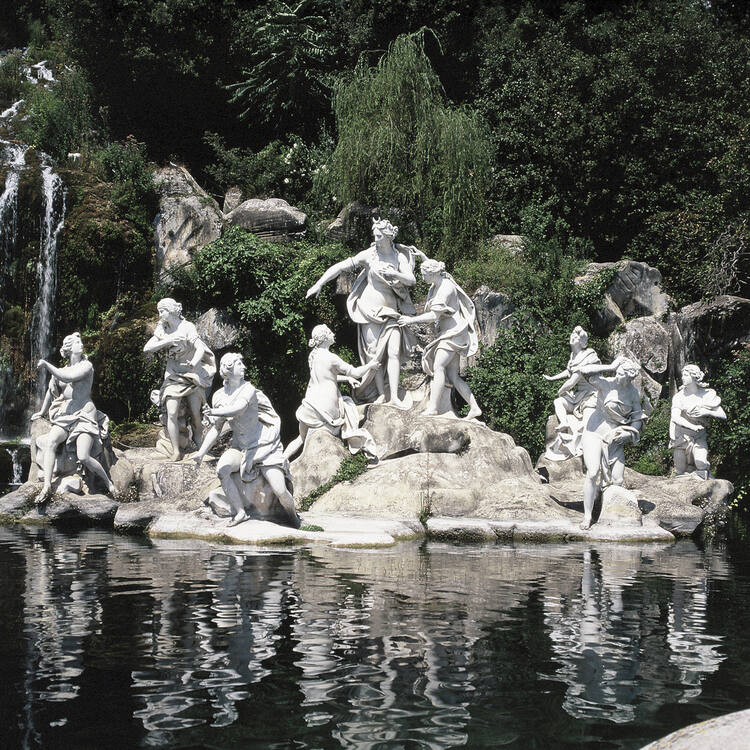
The monumental complex at Caserta, created by the Bourbon king Charles III in the mid-18th century to rival Versailles and the Royal Palace in Madrid, is exceptional for the way in which it brings together a magnificent palace with its park and gardens, as well as natural woodland, hunting lodges and a silk factory. It is an eloquent expression of the Enlightenment in material form, integrated into, rather than imposed on, its natural setting.
Description is available under license CC-BY-SA IGO 3.0
Palais royal du XVIIIe siècle de Caserte avec le parc, l’aqueduc de Vanvitelli et l’ensemble de San Leucio
L'ensemble monumental de Caserte, créé par Charles III (Carlo Borbone) au milieu du XVIIIe siècle pour rivaliser avec Versailles et le palais royal de Madrid, est exceptionnel dans la manière dont il réunit un somptueux palais avec son parc et ses jardins mais aussi une partie naturelle boisée, des pavillons de chasse et un complexe industriel pour la production de la soie. C'est une évocation éloquente et concrète de la période des Lumières, intégrée plutôt qu'imposée à son paysage naturel.
Description is available under license CC-BY-SA IGO 3.0
القصر الملكي للقرن الثامن عشر في كازيرتا مع الحديقة وقناة فانفيتيلّي ومجموعة سان لوتشيو
إنها مجموعة نصب كازيرتا أنشأها شارل الثالث (كارلو بروبوني) في منتصف القرن الثامن عشر لتنافس فرساي والقصر الملكي في مدريد، وهي مجموعة استثنائية بطريقة جمعها بين قصر فخم وحدائقه وأيضًا جزء طبيعي مشجَّر، ومساحات للصيد ومجمَّع صناعي لإنتاج الحرير. إنها لتعبير بليغ وملموس عن حقبة الأنوار مندمجة بمحيطها الطبيعي ليست مفروضة عليه.
source: UNESCO/CPE
Description is available under license CC-BY-SA IGO 3.0
卡塞塔的18世纪花园皇宫、凡韦特里水渠和圣莱乌西建筑群
卡塞塔地区的综合名胜群是波旁王朝国王查理斯三世为了与凡尔赛宫和马德里皇宫争奇斗美而在18世纪中叶修建的。这一建筑群别出心裁地把豪华的宫殿及其园林和花园、天然林地、打猎用的山林小屋和生产丝绸的工业设施完美地结合在一起。名胜群充分体现了启蒙运动在建筑领域的影响:以物质形式融入自然景观,实现两者完美的结合,而不是将启蒙思想强加于自然景观。
source: UNESCO/CPE
Description is available under license CC-BY-SA IGO 3.0
Королевский дворец XVIII в. с парком в Казерте, акведук Ванвителли и фабричный поселок Сан-Леучо
Монументальный комплекс в Казерте, созданный королем Карлом III Бурбоном в середине ХVIII в. в попытке соперничать с Версалем и Королевским дворцом в Мадриде, является исключительным примером сочетания великолепного дворца с окружающими его парками и садами, а также с природным лесным ландшафтом, охотничьими домиками и шелковой фабрикой. Это яркое выражение эпохи Просвещения в материальной форме, интегрированной в природное окружение.
source: UNESCO/CPE
Description is available under license CC-BY-SA IGO 3.0
Palacio Real del siglo XVIII de Caserta con el parque, el acueducto de Vanvitelli y el conjunto de San Leucio
Construido a mediados del siglo XVIII por Carlos III de Borbón para rivalizar con Versalles y palacio real de Madrid, el conjunto monumental de Caserta es excepcional por la forma en que conjunta un suntuoso palacio con sus parques y jardines, un bosque natural, una serie de pabellones de caza y una manufactura de seda. Elocuente materialización de las ideas del Siglo de las Luces, Caserta no se impone al paisaje natural circundante, sino que se integra perfectamente en él.
source: UNESCO/CPE
Description is available under license CC-BY-SA IGO 3.0
カゼルタの18世紀の王宮と公園、ヴァンヴィテッリの水道橋とサン・レウチョ邸宅群
ナポリ王国のヴェルサイユと称されるガゼルタ。ヴェルサイユとマドリードの王宮に対抗して、1752年ブルボン王家のカルロ3世の命により、建築家ヴァンヴィテルリがイタリアで最も華麗なこの王宮と庭園、水道橋、絹工場などを森林地帯のなかに造った。啓蒙主義の精神を雄弁に物語る造形とされる。source: NFUAJ
18e-eeuws Koninklijk paleis in Caserta met park, het aquaduct van Vanvitelli en het San Leucio complex
In 1734 werd Karel III (Carlo Borbone) koning van Napels, een autonoom koninkrijk dat niet langer deel uitmaakte van het Spaanse Rijk. Hij besloot in 1750 om een nieuw koninklijk paleis te bouwen om het paleis van Versailles en het koninklijk paleis te Madrid te overtreffen als symbool van het nieuwe koninkrijk. Het monumentale complex is bijzonder vanwege de manier waarop het een prachtig paleis samenbrengt met haar park en tuinen, alsmede de omliggende natuurlijke bossen, de jachthuizen en een zijdefabriek. Het paleis is een uitgesproken weerspiegeling van de Verlichting in materiële vorm, meer geïntegreerd in dan opgelegd aan de natuurlijke omgeving.
Source: unesco.nl


Outstanding Universal Value
Brief synthesisThe extraordinary monumental complex of Caserta, in the north of Naples, was planned in the second half of the 18th century by the architect Luigi Vanvitelli, according to the wishes of Charles of Bourbon to rival Versailles and Madrid. It includes a sumptuous palace with a park, gardens and wooded area, as well as the Aqueduct Carolino and the industrial complex of San Leucio, built for the production of silk.
The Royal Palace is the centrepiece of the whole architectural composition and is located on a central axis which connects and unifies the entire complex. The portico and the stream of the fountains in the park which lead to the scenic backdrop of the waterfall, formed by the Aqueduct Carolino, are also situated along this axis.
With its four courtyards and three atriums, the Royal Palace is a great example of monumental structure built to be a magnificent palace for the royal family and its court and, at the same time, an administrative centre inspired by the model of Escorial in Spain.
The park is the latest of the great European gardens inspired by the creations of Versailles and the 16th century models of villas in Rome and Tuscany. The English Garden is one of the greatest, oldest and most important picturesque gardens created in Europe.
The main part of the San Leucio estate is the ancient hunting Lodge of the Belvedere, converted by King Ferdinando IV of Bourbon into a silk mill to create an idealistic community of workers, who were guaranteed homes, schools, medical care and all services. The huge building complex, set around the inner courtyards, became the symbol of a model society based on the value of work and equality.
The Aqueduct Carolino, with its imposing viaduct “Ponti della Valle” is a stunning work of engineering and provides an extraordinary infrastructure not only serving the palace, the gardens and the future capital of the kingdom, but also the mills, the ironworks and the manufacturing industries located along its path.
Criterion (i): The 18th century estate of Caserta is a unique creation of the spirit of the Enlightenment which was able to build buildings of great architectural value, well set in a natural landscape, according to a broad scale development plan.
Criterion (ii): The 18th century Royal Palace of Caserta with the park, the Aqueduct Carolino, and the complex of San Leucio are all important evidence of the interchange of human values, thanks to the broad scale of its original project for an ambitious new town, consisting of imposing buildings, gardens, streets and surrounding natural landscape according to an innovative concept of planning. This new configuration of the landscape has been realized through engineering works of exceptional historical interest, like the Aqueduct Carolino, which was created to connect and unify the entire complex.
Criterion (iii): The monumental complex of Caserta is an outstanding example of urban planning implemented by the Bourbon dynasty, according to Vitruvian principles of solidity, functionality and beauty in line with the neoclassical culture in vogue at the time.
Criterion (iv): The outstanding value of the industrial complex of Belvedere, planned to produce silk, derives from the idealistic principles underlying its original conception and management.
Integrity
The site has good conditions of social-functional integrity because the Royal Palace and the Belvedere complex are recognized by the local community as a symbol of a historic period of development of the region; the Aqueduct Carolino retains its original utility serving not only royal properties but also surrounding areas.
The buildings have material-structural integrity because the later adjustments to interior spaces did not change the features of their architecture. The buildings and the gardens have been subject to scientific restoration and the surrounding area retains the principal features of the original landscape design.
The risks to the Royal Palace and park are the pressure of urban development in the surrounding landscape and the wear caused by the flow of visitors.
The risks to the San Leucio complex are urban development pressure in the surrounding landscape and the shortage of funds for maintenance, due to the lack of new uses for most of the building.
The risks to the Aqueduct Carolino are the transformation of the surrounding landscape due to urbanization and the shortage of funds for maintenance.
Authenticity
Even though the entire property has undergone conservation, the level of authenticity of the buildings and open spaces remains high. The original appearance is still well preserved and the inappropriate intrusions are limited to an acceptable minimum.
The restoration and the maintenance of the buildings and the gardens respect the original projects by Luigi Vanvitelli, his son Carlo, and Francesco Collecini, and retain the original material and structural consistency.
Local people keep alive the tradition of regularly visiting the palace and the park and encourage the continuation of craft production of silk in San Leucio
Protection and management requirements
In particular, the Royal Palace and the park, the English Garden, the Bosco di San Silvestro and the Belvedere buildings are protected as monuments.
The former Royal Estate of San Leucio, the surrounding Tifatini Hills and the medieval town of Casertavecchia are protected as landscape by the same Decree n.42/04. The surroundings of the Royal Palace, the wide elliptic square in the front of the southern facade and the huge street directed to Naples (Carlo III avenue) are also protected as landscape.
Any kind of intervention in this buffer zone needs the authorization by the competent authority (the Municipality and the Ministry of Cultural Heritage and Activities and Tourism through the local office, the Soprintendenza relevant for “Belle Arti e Paesaggio” in the provinces of Caserta and Benevento).
A plan for the protection of the landscape (Landscape Plan) for the surroundings of the Royal Palace and the estate of San Leucio was approved by the Ministry of Culture in October 2000. The protection of the surroundings of the Aqueduct Carolino is entrusted to the landscape protection plan for the Monte Taburno, approved by the Ministry in 1996.
Responsibility for the management of state-owned assets has recently been transferred to the Museum of the Royal Palace of Caserta, an agency of the Ministry of Cultural Heritage and Activities and Tourism created in December 2014, to guarantee the conservation and enhancement of the property.
Parts of the Royal Palace complex are currently used by the school of Military Air Force but in December 2014 the Ministries of Culture and Defence have approved a program to move the school away by December 2020 and to reserve the entire Royal Palace for cultural and educational functions.
The Bosco di San Silvestro is run by volunteers of the World Wildlife Fund for Nature (WWF), who are preserving and keeping it open to the public as an "oasis" of flora and fauna.
The Municipality of Caserta manages the Belvedere buildings, where there is a museum of the royal rooms and of silk production.


The Nomination files produced by the States Parties are published by the World Heritage Centre at its website and/or in working documents in order to ensure transparency, access to information and to facilitate the preparations of comparative analysis by other nominating States Parties.
The sole responsibility for the content of each Nomination file lies with the State Party concerned. The publication of the Nomination file, including the maps and names, does not imply the expression of any opinion whatsoever of the World Heritage Committee or of the Secretariat of UNESCO concerning the history or legal status of any country, territory, city or area or of its boundaries.