Samarra Archaeological City
Factors affecting the property in 2008*
- War
Factors* affecting the property identified in previous reports
State of war in the country that does not allow the responsible authorities to assure the protection and management of the property.
Threats for which the property was inscribed on the List of World Heritage in Danger
State of war in the country that does not allow the responsible authorities to assure the protection and management of the property.
Desired state of conservation for the removal of the property from the List of World Heritage in Danger
This will be defined as soon as the situation allows it.
Corrective Measures for the property
a) Establishment of a local management coordination unit on the site;
b) Preparation and implementation of a conservation and management plan;
c) Maintenance and emergency conservation activities.
Timeframe for the implementation of the corrective measures
UNESCO Extra-Budgetary Funds until 2008
Total amount provided to the property: USD 100,000 from the Nordic World Heritage Fund for training and documentation aiming at the preparation of the Nomination File.
International Assistance: requests for the property until 2008
Total amount approved : 0 USD
Missions to the property until 2008**
Conservation issues presented to the World Heritage Committee in 2008
On 12 February 2008, the World Heritage Centre received a report from the State Party. The Archaeological City of Samarra remains an insecure military area and, therefore, the archaeological and administrative staff is not able to carry out its work.
The camp built between the House of Ornaments (north) and the Caliph Palace (south) and the sand mound built by the military forces still exist (the mound starts from the entrance of the modern city, passes close to Caliph Al Mu’atasim Palace, turns to Abbasid Horse Race Tracks, and finally goes down until Al Qadisiyah residential area), having a serious impact upon the important remains of the ancient city. There is also deep concern regarding the movements and presence of military vehicles over the clay-made antiquities in the City of Samarra.
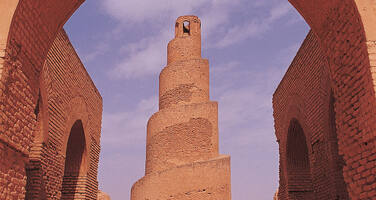
Moreover, owing to the above issues and the lack of periodic maintenance, some of the archaeological buildings of the property are in great need of protection. These buildings include the House of Ornaments, the Caliph Palace, Al-Mashuq Palace, the spiral minaret, and the Abu Dulaf Mosque.
The World Heritage Centre and the Advisory Bodies remain deeply concerned by the continued movements of military vehicles over archaeological remains and other military activities that could affect the outstanding universal value of the property.
Summary of the interventions
Decisions adopted by the Committee in 2008
32 COM 7A.17
Samarra Archaeological City (Iraq) (C 276 rev)
The World Heritage Committee,
1. Having examined Document WHC-08/32.COM/7A,
2. Recalling Decision 31 COM 8B.23 adopted at its 31st session (Christchurch, 2007),
3. Notes with great concern the continuing difficult situation in Iraq and deplores the loss of human lives;
4. Also notes with concern the continued destruction of the archaeological remains, e.g. through vehicular movements and calls upon the State Party to ensure that this is addressed;
5. Encourages the State Party, should the situation allow it, to implement the corrective measures identified:
a) establishment of a local management coordination unit on the site;
b) preparation and implementation of a conservation and management plan;
c) maintenance and emergency conservation activities;
6. Reiterates its request to the State Party to develop, in consultation with the World Heritage Centre and the Advisory Bodies, a proposal for the Desired state of conservation for the removal of the property from the List of World Heritage in Danger, for examination by the World Heritage Committee at its 33rd session in 2009;
7. Calls upon the international community to assist, in every way possible, the State Party in the protection of this property, with the advice of ICOMOS;
8. Requests the State Party, should the situation allow, to invite a joint World Heritage Centre/ICOMOS Reactive Monitoring mission to Samarra;
9. Also requests the State Party to submit to the World Heritage Centre, by 1 February 2009, a report for examination by the World Heritage Committee at its 33rd session in 2009;
10. Decides to retain Samarra Archaeological City (Iraq) on the List of World Heritage in Danger.
Draft Decision: 32 COM 7A.17
The World Heritage Committee,
1. Having examined Document WHC-08/32.COM/7A,
2. Recalling Decision 31 COM 8B.23 adopted at its 31st session (Christchurch, 2007),
3. Notes with great concern the continuing difficult situation in Iraq and deplores the loss of human lives;
4. Requests the State Party, should the situation allow it, to establish a site management unit and to initiate the preparation of a conservation and management plan for the property;
5. Reiterates its request to the State Party to develop, in consultation with the World Heritage Centre and the Advisory Bodies, a proposal for the Desired state of conservationfor the removal of the property from the List of World Heritage in Danger,for examination by the World Heritage Committee at its 33rd session in 2009;
6. Calls upon the international community to assist the State Party in the protection of this property;
7. Also requests the State Party to submit to the World Heritage Centre, by 1 February 2009, a report for examination by the World Heritage Committee at its 33rd session in 2009;
8. Decides to retain Samarra Archaeological City (Iraq) on the List of World Heritage in Danger.
 Iraq
Iraq
Exports
* :
The threats indicated are listed in alphabetical order; their order does not constitute a classification according to the importance of their impact on the property.
Furthermore, they are presented irrespective of the type of threat faced by the property, i.e. with specific and proven imminent danger (“ascertained danger”) or with threats which could have deleterious effects on the property’s Outstanding Universal Value (“potential danger”).
** : All mission reports are not always available electronically.