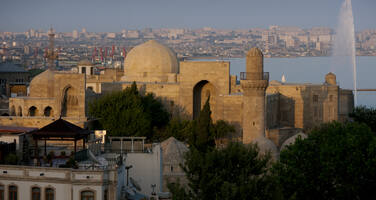
Walled City of Baku with the Shirvanshah's Palace and Maiden Tower
Factors affecting the property in 2009*
- Deliberate destruction of heritage
- Housing
- Management systems/ management plan
Factors* affecting the property identified in previous reports
a) Changing urban fabric due to the demolition of buildings and uncontrolled construction within the Walled City;
b) Overall lack of any management system and in particular insufficient coordination between the national and municipal authorities;
c) Absence of a comprehensive management plan that addresses conservation problems, urban development control and tourism activities.
Threats for which the property was inscribed on the List of World Heritage in Danger
- Changing urban fabric due to the illegal demolition of historic buildings and uncontrolled construction and reconstruction within the Walled City;
- Lack of any management system and insufficient coordination between the national and municipal authorities;
- Absence of a comprehensive management plan that addresses conservation problems, urban development control and tourism activities.
Desired state of conservation for the removal of the property from the List of World Heritage in Danger
a) Operational institutional framework for the conservation and management of the World Heritage property and its buffer zone;
b) Clearly defined and approved framework for the active involvement of all stakeholders;
c) “Integrated Area Management Action Plan” implemented.
Corrective Measures for the property
a) Administrative structure and related programmes within the Cabinet of Ministers defined and supported with adequate resources and fully operational;
b) Completion of an inventory of all monuments, buildings and their infrastructures indicating their physical condition as well as expected rehabilitation methodologies;
c) Completion and implementation of the “Integrated Area Management Action Plan” to address conservation issues, urban development control and tourism management with the active involvement of all stakeholders.
Timeframe for the implementation of the corrective measures
UNESCO Extra-Budgetary Funds until 2009
Total amount provided to the property: USD 30,000 (American Funds Special Account 2005/06); USD 22,000 (Netherlands Funds-in-Trust, 2005/06)
International Assistance: requests for the property until 2009
Total amount approved : 15,000 USD
| 1998 | Preparation of nomination file for the Walled City of ... (Approved) | 15,000 USD |
Missions to the property until 2009**
February 2002: UNESCO mission; October 2002: UNESCO/ICOMOS mission; January 2003 and April 2003: UNESCO missions; November 2003: ICCROM mission; October 2004: UNESCO mission to participate in the Round Table; September 2005: UNESCO mission (with the University of Minnesota, USA); March 2007 and January 2009: joint World Heritage Centre/ICOMOS missions.
Conservation issues presented to the World Heritage Committee in 2009
During its 32nd session (Quebec City, 2008), the World Heritage Committee reiterated its request to the State Party to adopt the completed “Integrated Area Management Action Plan” (including integration of the recently initiated conservation master plan for “Icherisheher”) and to integrate the Management Action Plan into the urban planning system of the City of Baku. The World Heritage Committee also reiteratedits request to the State Party to develop, in consultation with the World Heritage Centre and the Advisory Bodies, a draft Statement of outstanding universal value including the conditions of integrity and authenticity, for examination by the World Heritage Committee at its 33rd session in 2009. The World Heritage Committee urged the State Party to prepare guidelines for the rehabilitation and restoration of historic buildings, and the design of new constructions and street furniture, and to clearly define and approve an institutional coordination framework for the active involvement of stakeholders.
The State Party submitted the report requested by the World Heritage Committee on 29 January 2009.
This report notes that a legal basis for the activities of the new management entity created to protect the World Heritage property (the State Department of the Historical-Architectural Reserve “Icherisheher” - SDHARIS) was approved by the Presidential decree 574 dated 16 May 2007.This entity which replaced co-management by the Ministry of Culture and the City of Baku was designed to strengthen co-ordination of decision-making in favour of World heritage values and reports directly to the Cabinet of Ministers. The report also notes later decrees and regulations which define its powers to act on different types of property. It provides information on the main orientations of the SDHARIS (study, planning, policy formulation, protection of monuments, project review, approval and monitoring, strategy development for socio-economic development), its internal structure (housing communal service, scientific production restoration workshop, Museum of Icherisheher, scientific cultural centre) and the principal activities undertaken to date, including setting up of Advisory councils: a Scientific Council, and a Council of Elders within the community. The report stresses that all illegal demolitions have been stopped, and project review provisions much strengthened.
The State Party report also describes progress made in launching the Conservation Master Plan, including the signing of a contract for the work in December 2008.
The State Party reports on numerous projects undertaken to support the three main thrusts of the Integrated Area Management Action Plan (stopping all illegal constructions in the area of Icherisheher; restoration of the historical view of Icherisheher, and turning Icherisheher into an international tourism center which meets the modern requirements of the industry). These projects include regular mechanical cleaning of streets and public spaces, improvement of street lighting, limiting and remote monitoring of car entry to the historic core, and many restoration/ repair projects particularly adjacent the fortification wall. In the period 2007-2008, hundreds of projects have been undertaken on public and private structures, re-surfacing of public streets, removal of overhead wires in many areas, refurbishment of existing public gardens, and creation of gardens in small open spaces, repair and revealing works on the city walls, identification and promotion of tourist itineraries, improvement of civic infrastructure and development of numerous exhibits, events and media promotion programs showcasing Icherisheher.
The State Party report notes in particular initiatives taken in relation to removing Baku from the List of World Heritage in Danger:
a) Initiation of the Icherisheher Conservation Master Plan;
b) Implementation of the “Urgent Actions Plan” of the “Integrated Area Management Action Plan”;
c) Inviolability of all monuments and historical buildings provided through placing all the buildings and monuments in the control of the Reserve, by Presidential decree;
d) Stopping all illegal constructions in the area and creating new provisions for review of all projects relative to stringent criteria for protecting the values of the property;
e) The management structure, staffing, subordinated bodies and consultation councils of the Department of the State Historical-Architectural Reserve “Icherisheher now in place, activated, and fulfilling their support functions;
f) Updated inventory of all historical-architectural monuments and buildings carried out (current condition, photos and other useful information stored in electronic database);
g) Many projects for the restoration of historical buildings, monuments, residential buildings undertaken by the Department, to appropriate defined standards, in accordance with provisions of the “Integrated Area Management Action Plan”;
h) Archeological works carried out within the territory which push back the history of the property by several thousand years.
A joint UNESCO World heritage Centre / ICOMOS mission to the World Heritage property took place from 25 – 30 January 2009.
The conclusions of the mission report indicated that the State Party has put in place all of the corrective measures specified by the World Heritage Committee at the time of the inscription of Baku on the List of World Heritage in Danger:
a) The administrative structure and related programmes of the management agency are fully functional and have been provided with an annually approved budget;
b) An inventory of all monuments, buildings and their infrastructure indicating their physical condition as well as expected rehabilitation methodologies has been completed;
c) The Integrated Urban Area Management Action Plan has been completed and is being implemented.
The mission further noted that since operationalization of the SDHARIS, the many targeted and energetic actions of this body have had a profound positive impact on Icherisheher. Not only have these actions resulted in numerous important upgrades to buildings, streets and public spaces, but the cumulative impact of these efforts and the rapidity with which they have been undertaken has resulted in a change of attitude about the future of Icherisheher. Its historic buildings are no longer seen as degraded obstacles to development, but as important opportunities for investment and for renewal of civic pride in the Icherisheher area.
These efforts have been supported by the IAMAP (Integrated Area Management Action Plan) completed in April 2007, and the development process of the CMP (Conservation Master Plan) for Icherisheher.
The mission also noted however that while excellent progress has been made by the State Party in responding to the issues raised by the World Heritage Committee during the 32nd session, not all targets had been fully met at the time of the mission:
a) A draft Statement of outstanding universal value has not yet been submitted by the State Party in collaboration with the World Heritage Centre and the Advisory Bodies. Accordingly neither the Integrated Area Management Action Plan nor the Conservation Master Plan acknowledge or reference the property’s outstanding universal value as the basis for protection of the World Heritage property;
b) The CMP was presented to the State Party for the first time during the January 2009 mission. While containing very valuable detailed analysis and prescriptive projections concerning all structures, spaces and features of Icherisheher, this document has not yet been discussed extensively within SDHARIS, or with stakeholders who would be impacted by its many proposals, and at present lacks an overall “introduction” which can provide a full context for its application and use. This document has to date been prepared in English and Italian but is not yet available in Azeri;
c) At this time, with the CMP essentially a provisional document, awaiting detailed review, the IAMAP and CMP cannot yet be fully integrated, as requested by the World Heritage Committee;
d) A set of guidelines for architectural change as called for by the World Heritage Committee has been provided in Volume IV of the IAMAP. It would be useful to extend these essentially generic principles for internal use within SDHARIS and for owners or their designers;
e) The institutional co-ordination framework requested by the World Heritage Committee has not been explicitly addressed at present. This remains important particularly to improve collaboration with the Executive Power of the Municipality of Baku. In spite of the extensive mandate given SDHARIS by Presidential Decree, many goals described within the IAMAP and the CMP (concerned for example with improvements to services, infrastructure, and traffic) require close co-operation with the City of Baku. The statutes of SDHARIS provide the necessary consultative mechanisms to strengthen collaboration with the Executive Power of the Municipality of Baku, and these should be developed and made operational.
The World Heritage Centre and the Advisory Bodies recognize the progress made to date in the implementation of the corrective measures but note that some steps still need to be taken to reach the Desired state of conservation for the removal of the property from the List of World Heritage in Danger. It is noted that the State Party is making efforts to achieve the Desired state of conservation by 1 February 2010. Therefore, the World Heritage Centre and the Advisory Bodies recommend that a mission take place soon after that date in order to ascertain whether the property can be removed from the List of World Heritage in Danger.
Summary of the interventions
Decisions adopted by the Committee in 2009
33 COM 7A.25
Walled City of Baku with the Shirvanshah's Palace and Maiden Tower (Azerbaijan) (C 958)
The World Heritage Committee,
1. Having examined Document WHC-09/33.COM/7A,
2. Recalling Decision 32 COM 7A.25, adopted at its 32nd session (Quebec City, 2008),
3. Warmly welcomes the State Party's efforts to improve the state of conservation of the property and the significant progress made in the implementation of the corrective measures for the removal of the property from the List of World Heritage in Danger;
4. Notes that the State Party developed a draft Statement of Outstanding Universal Value, for examination by the World Heritage Committee at its 34th session in 2010;
5. Also notes that the State Party informed the World Heritage Centre on 15 June 2009 that it has improved the conservation and management of the property and its buffer zone by carrying out the following:
a) Preparation of the draft Conservation Master Plan,
b) Ensuring that the State Department of the Historical-Architectural Reserve "Icherisheher" (SDAHRIS) now works in close contact and coordination with the Executive Power of City of Baku as well as other stakeholders,
c) Setting up protection for the buffer zone;
6. Requests the State Party, concerning development of its several management instruments:
a) To formally approve the draft Conservation Master Plan (CMP), to submit it to the World Heritage Centre, and integrate it within the Integrated Area Management Action Plan (IAMAP),
b) To extend and develop the design guidelines for the rehabilitation and restoration of historic buildings, and the design of new constructions and street furniture, already included in the IAMAP, for efficient use by the State Department of the Historical-Architectural Reserve "Icherisheher" (SDHARIS) and Icherisheher owners,
c) To ensure that the integrated CMP and IAMAP acknowledge and reference the Statement of Outstanding Universal Value to be approved by the World Heritage Committee,
d) To formally adopt the revised IAMAP in the urban planning system of the City of Baku;
7. Also requests the State Party to submit to the World Heritage Centre, by 1 February 2010, an updated report on the state of conservation of the property and progress made in the implementation of the paragraph 6 above, for examination by the World Heritage Committee at its 34th session in 2010;
8. Decides to remove the walled city of Baku with the Shirvanshah's Palace and Maiden Tower (Azerbaijan) from the List of World Heritage in Danger.
33 COM 8C.3
Update of the List of World Heritage in Danger
The World Heritage Committee,
1. Following the examination of the state of conservation reports of properties inscribed on the List of World Heritage in Danger (WHC-09/33.COM/7A, WHC-09/33.COM/7A.Add and WHC-09/33.COM/7A.Add.2, WHC-09/33.COM/7A.Corr),
2. Decides to remove the following properties from the List of World Heritage in Danger:
- Azerbaijan, Walled City of Baku with the Shirvanshah's Palace and Maiden Tower (Decision 33 COM 7A.25
- Germany, Dresden Elbe Valley (Decision 33 COM 7A.26)
Draft Decision: 33 COM 7A.25
The World Heritage Committee,
1. Having examined Document WHC-09/33.COM/7A,
2. Recalling Decision 32 COM 7A.25, adopted at its 32nd session (Quebec City, 2008),
3. Notes the State Party’s efforts to improve the state of conservation of the property and_the significant progress made in the implementation of the corrective measures for the removal of the property from the List of World Heritage in Danger;
4. Reiterates its requests to the State Party to develop, in consultation with the World Heritage Centre and the Advisory Bodies, a draft Statement of outstanding universal value including the conditions of integrity and authenticity, for examination by the World Heritage Committee at its 34th session in 2010;
5. Requests the State Party, concerning development of its several management instruments:
a) To review and complete the draft Conservation Master Plan (CMP),
b) To integrate it within the “Integrated Area Management Action Plan” (IAMAP),
c) To extend and develop the design guidelines for the rehabilitation and restoration of historic buildings, and the design of new constructions and street furniture, already included in the IAMAP, for efficient use by SDHARIS and Icherisheher owners,
d) To ensure that both the CMP and the IAMAP acknowledge and reference the Statement of outstanding universal value to be approved by the World Heritage Committee,
e) To formally adopt the revised IAMAP in the urban planning system of the City of Baku;
6. Reiterates its encouragement of the State Party to clearly define and approve an institutional coordination framework for the active involvement of stakeholders;
7. Also requests the State Party to submit to the World Heritage Centre, by1 February 2010, an updated report on the state of conservation of the property, and progress made in the implementation of the Paragraphs 5 and 6 above, for examination by the World Heritage Committee at its 34th session in 2010;
8. Further requests the State Party to invite a joint World Heritage Centre / ICOMOS reactive monitoring mission, after 1 February 2010, in order to review the implementation of its requests;
9. Decides to retain the Walled City of Baku with the Shirvanshah’s Palace and Maiden Tower (Azerbaijan) on the List of World Heritage in Danger.
 Azerbaijan
Exports
* :
The threats indicated are listed in alphabetical order; their order does not constitute a classification according to the importance of their impact on the property.
Furthermore, they are presented irrespective of the type of threat faced by the property, i.e. with specific and proven imminent danger (“ascertained danger”) or with threats which could have deleterious effects on the property’s Outstanding Universal Value (“potential danger”).
** : All mission reports are not always available electronically.