Island of Gorée
Factors affecting the property in 2004*
- Erosion and siltation/ deposition
- Management systems/ management plan
- Other Threats:
a) Important historic buildings in a state of serious dilapidation; b) Replica of the Gorée-Almadies Memorial
Factors* affecting the property identified in previous reports
Urban Pressure; Lack of management mechanism (including legislation).
International Assistance: requests for the property until 2004
Total amount approved : 73,700 USD
| 1981 | Technical assistance for the renovation of the Island ... (Approved) | 40,700 USD |
| 1981 | Equipment and financial assistance for the Island of ... (Approved) | 33,000 USD |
Missions to the property until 2004**
Conservation issues presented to the World Heritage Committee in 2004
During its 27th session, the World Heritage Committee requested ICOMOS and the World Heritage Centre to organize a joint evaluation mission to the Island of Gorée, in consultation with the national authorities. The mission was organized from 29 March to 3 April 2004. The objectives of this mission were to evaluate the state of conservation of the property, and to advise the Committee on whether or not to inscribe it on the List of World Heritage in Danger.
The mission reached the following conclusions on the state of conservation of the Island of Gorée:
a) Architectural heritage
Although there are important historic buildings in a state of serious dilapidation, efforts to improve the general state of conservation of the architectural heritage have been made since 2002 by the Senegalese authorities. It was noted that, to date, many buildings have been rehabilitated, several restoration activities, financed by Senegal and destined for socio-cultural activities, are ongoing, and that urban development activities have been carried out with the aim of facilitating visitor flow throughout the Island. Furthermore, a report on the updating of the safeguard plan was prepared in 2003.
However, it is important to recall the serious threats of collapse that exist with regard to the buildings in the northern part of the Island (William Ponty School, Sisters' School, Sisters' Pavillon and annexes, Military Hospital, Guards' camp building), as well as the urgent need to resolve the matter of the eviction of squatters and the commencement of the restoration/stabilisation work of these buildings before they collapse. It is also necessary to verify the architectural interventions or improvements to ensure that the restoration/reconstruction work is being carried out according to strict rules that respect the spirit and history of the materials that had always been used on the Island.
It is therefore indispensable to reflect upon the revitalisation of traditional conservation techniques in Gorée, and establish technical documents to ensure the very best interventions, both in the buildings and the development of public areas.
b) Replica of the Gorée-Almadies Memorial project erected on the Castel site
Following a fervent wish expressed by the black intellectuals, writers and artists from various continents, a construction project for a Memorial for Africa and its Diaspora was initiated by the Senegalese Government. It was planned to build this vast complex on the Almadie site, as the statute of the Island of Gorée did not permit the erection of a monument of that size. Nevertheless, the Senegalese Government foresaw the construction on the Island of a reduced replica so as to ensure "the symbolic link" between the Memorial and the Island. The orientations, structures and strategies that Senegal had elaborated for the execution of this project were approved by UNESCO during the 136th session of the Executive Board in 1991.
This replica of the Gorée-Almadies Memorial, in reinforced concrete, was constructed in 1999 on the site of the Castel, in the southern part of the Island. Since its inauguration in 1999 by H.E. President Abdou Diouf, a vast controversy has ensued with a view to its demolition. Despite this controversy, five years later the replica has not yet been demolished by the Senegalese authorities. During a meeting organized by the special team for activities related to the study of the slave trade and its implications, on 5 December 2003, the Director-General of UNESCO commented on the disputed presence of the replica and recommended that all questions linked to the integrity of the site be referred to the World Heritage Centre. Recalling the provisions contained in the World Heritage Convention, notably those concerning the preservation of the global character of the inscribed property, the World Heritage Centre wrote on 10 December 2003, to a letter the Senegalese authorities requesting them to undertake, as soon as possible, the necessary steps to demolish this monument which greatly affects the authenticity and the interpretation of the property, both by its material and its monumental size. From a technical point of view, the experts recommended insisting that the Senegalese authorities proceed with the demolition. But taking into account the time lapsed and the political sensitivities and affective links with the Gorée-Almadies Memorial project, the experts wished to have the advice of the Committee on this question.
c) State of conservation of the coastal zone
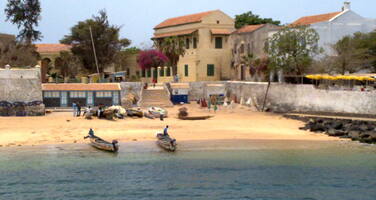
Important degradation of the coastal zone has been observed. The rocks surrounding the entire property have been considerably worn down due to sea erosion. The destruction of the West Battery, the degradation of the foundations of the buildings annexed to the Relais de l'Espadon in the north of the Island, the destruction of the enclosure of the Ecole Mariama Ba in the south of the Island, are just some of the visible examples that illustrate the urgent need to undertake actions to halt this erosion as soon as possible. On 3 February 2004, the Government of Senegal transmitted to the Director-General of UNESCO the copy of a project for the protection of the coast of the Island of Gorée, submitted for funding to the State of Qatar. It is important that Senegal informs UNESCO of the outcome of this dossier.
d) Inscription of the Island on the List of World Heritage in Danger
In accordance with the Operational Guidelines for the implementation of the World Heritage Convention, (paragraphs 80 to 82), the situation of Gorée does not at present indicate a need for its inscription on the List of World Heritage in Danger. Furthermore, Senegal has undertaken since 2003, a series of activities to improve the state of conservation of the Island.
Summary of the interventions
Decisions adopted by the Committee in 2004
28 COM 15B.42
Island of Gorée (Senegal)
The World Heritage Committee,
1. Taking note of the results of the evaluation mission carried out at the property, the actions undertaken by the World Heritage Centre concerning the demolition of the replica of the Gorée-Almadies Memorial, and the efforts undertaken by the Senegalese authorities to improve the state of conservation of the Island of Gorée,
2. Considering that the erection of the replica of the Gorée-Almadies Memorial refers to information communicated by the State Party during the 136th session of the Executive Board of UNESCO in 1991,
3. Expresses its concern in view of the information regarding the erection of the replica of the Gorée-Almadies Memorial on the property and its negative impact on the integrity of the property;
4. Invites the State Party to respond to the World Heritage Centre's letter of the 10 December 2003 concerning the erection of the replica of the Gorée- Almadies Memorial, requesting it to undertake corrective measures;
5. Emphasizes the need to undertake urgent measures to improve the overall management of the property, especially the elaboration of administrative provisions for the nomination of a manager for the property who will be responsible for the elaboration of a management plan;
6. Invites the international community to support the funding of the project for the protection of the coastal zone of the Island of Gorée;
7. Requests the State Party to submit, by 1 February 2005, a report on the strategies which will be put in place with a view to taking corrective measures to address the negative impact of the replica on the property, for examination by the Committee during its 29th session in 2005.
Draft Decision: 28 COM 15B.42
The World Heritage Committee,
1. Taking note of the results of the evaluation mission carried out at the property, the actions undertaken by the World Heritage Centre concerning the demolition of the replica of the Gorée-Almadies Memorial, and the efforts undertaken by the Senegalese authorities to improve the state of conservation of the Island of Gorée,
2. Considering that the erection of the replica of the Gorée-Almadies Memorial refers to information communicated by the State Party during the 136th session of the Executive Board of UNESCO in 1991,
3. Recognizing the negative impact on the authenticity and interpretation of the property, as well as the political sensitivities and affective links to the Gorée-Almadies Memorial project,
4. Invites the State Party to respond to the World Heritage Centre's letter concerning the erection of the replica of the Gorée-Almadies Memorial, requesting it to undertake corrective measures;
5. Emphasizes the need to undertake urgent measures to improve the overall management of the property, especially the elaboration of administrative provisions for the nomination of a manager for the property who will be responsible for the elaboration of a management plan;
6. Invites the international community to support the funding of the project for the protection of the coastal zone of the Island of Gorée;
7. Requests the State Party to submit, before 1 February 2005, a report on the state of conservation of the property for examination by the Committee during its 29th session in 2005.
 Senegal
* :
The threats indicated are listed in alphabetical order; their order does not constitute a classification according to the importance of their impact on the property.
Furthermore, they are presented irrespective of the type of threat faced by the property, i.e. with specific and proven imminent danger (“ascertained danger”) or with threats which could have deleterious effects on the property’s Outstanding Universal Value (“potential danger”).
** : All mission reports are not always available electronically.