Hospicio Cabañas, Guadalajara
Hospicio Cabañas, Guadalajara
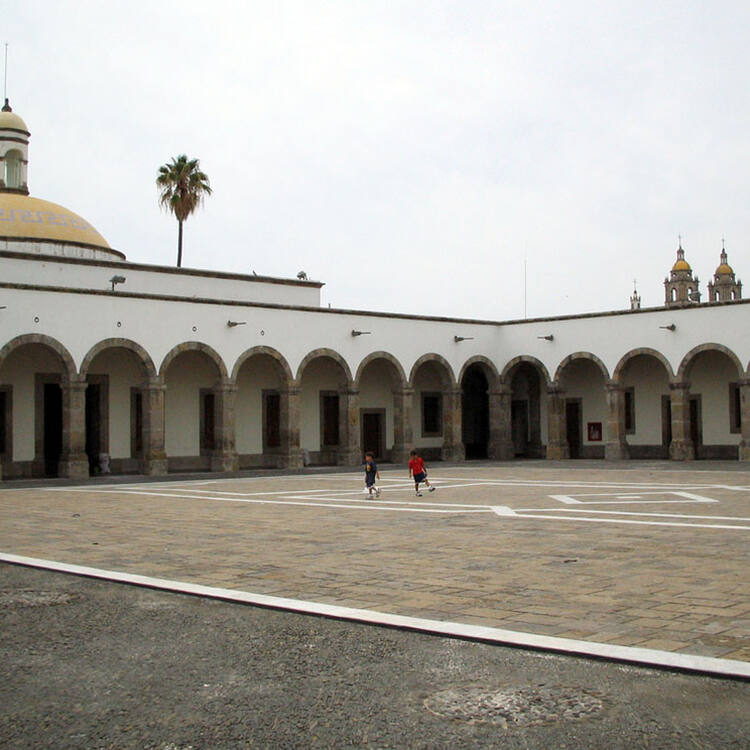
The Hospicio Cabañas was built at the beginning of the 19th century to provide care and shelter for the disadvantaged – orphans, old people, the handicapped and chronic invalids. This remarkable complex, which incorporates several unusual features designed specifically to meet the needs of its occupants, was unique for its time. It is also notable for the harmonious relationship between the open and built spaces, the simplicity of its design, and its size. In the early 20th century, the chapel was decorated with a superb series of murals, now considered some of the masterpieces of Mexican art. They are the work of José Clemente Orozco, one of the greatest Mexican muralists of the period.
Description is available under license CC-BY-SA IGO 3.0
Hospice Cabañas, Guadalajara
Conçu comme institution de bienfaisance, l'Hospice Cabañas fut construit au début du XlXe siècle, pour aider les plus démunis : orphelins, vieillards, handicapés et invalides chroniques. Cet ensemble remarquable présente plusieurs caractéristiques originales, liées à ses fonctions d'œuvre charitable. Son dessin s'écarte des modèles suivis par les hôpitaux et les hospices de l'époque, ce qui le rend unique. L'harmonie atteinte entre les espaces ouverts et les espaces construits, la simplicité de son dessin ainsi que ses dimensions font de lui un ensemble exceptionnel. Au début du XXe siècle, sa chapelle a été décorée d'un ensemble de superbes peintures, considérées comme l'un des chefs-d'œuvre de la peinture murale mexicaine, faites par José Clemente Orozco, l'un des grands muralistes mexicains de cette période.
Description is available under license CC-BY-SA IGO 3.0
مأوى كابانياس في غوادالاخارا
اعتُبر مأوى كابانياس مؤسسة إحسان بعد ان تمّ انشاؤه في بداية القرن التاسع عشر لمساعدة الاكثر عوزًا: الايتام والعجزة والمعوّقين والعاجزين بشكلٍ دائم. وتقدّم هذه المجموعة الفريدة مميزاتٍ عديدةً ترتبط بوظائف عمل الاحسان الذي تقوم به. فمخطّطها يبتعد عن النماذج المتّبعة في مستشفيات ذلك العصر ومآويه، ممّا يجعلها فريدة. فالتناغم المحقَّق بين المساحات المفتوحة والمساحات التي بُني عليها، وبساطة مخطّطها بالاضافة الى أحجامها جعلت منها مجموعةً استثنائيّةً. وفي بداية القرن العشرين، زيّنت كنيستها برسوماتٍ رائعةٍ تُعتبر من منحوتات الرسم الجدراني المكسيكي التي قام بها خوسيه كليمنتي اوروزكو وهو من أهمّ رسامي الجدران المكسيكيين في تلك الفترة.
source: UNESCO/CPE
Description is available under license CC-BY-SA IGO 3.0
瓜达拉哈拉的卡瓦尼亚斯救济所
19世纪初期,在瓜达拉哈拉修建起了卡瓦尼亚斯救济所,用来照顾和庇护那些生活有困难的人们,如孤儿、老人、残疾人以及慢性病患者。这个救济所在当时是绝无仅有的一个,它的设计包含了许多特殊的考虑,以满足那些生活困难人群的特殊要求。这个救济所还因为室内外空间的和谐、简约的设计和它的规模而举世闻名。在20世纪初期,这里的小教堂内装饰有许多精美的壁画,很多现在被认为是墨西哥艺术中的杰作,它们出自当时最著名的墨西哥壁画画家何塞·克莱门蒂·奥罗斯科之手。
source: UNESCO/CPE
Description is available under license CC-BY-SA IGO 3.0
Госпиталь Кабаньяс в городе Гвадалахара
Госпиталь «Осписио-Кабаньяс» был построен в начале XIX в. для предоставления ухода и крова обездоленным людям – сиротам, старикам, инвалидовам и хронически больным. Этот замечательный комплекс, который имеет несколько характерных особенностей, был спроектирован с учетом потребностей его обитателей и являлся уникальным для своего времени. Он также примечателен гармоничным сочетанием открытых и застроенных пространств, простотой дизайна, а также своими размерами. В начале XX в. местная часовня была украшена великолепным циклом стенных росписей, которые ныне расцениваются как шедевры мексиканского искусства. Это работы Хосе Клементе Ороско, одного из крупнейших мексиканских художников-монументалистов того времени.
source: UNESCO/CPE
Description is available under license CC-BY-SA IGO 3.0
Hospicio Cabañas de Guadalajara
Este hospicio se creó a principios del siglo XIX para dispensar cuidados y ofrecer asilo a toda suerte de desamparados, ya fuesen huérfanos, ancianos, discapacitados o inválidos. El conjunto arquitectónico es único en su género porque, a diferencia de los centros análogos de su época, presenta una serie de elementos absolutamente originales, especialmente concebidos para satisfacer las necesidades de los asilados. Son especialmente notables la sencillez de su trazado y sus dimensiones, así como la armonía lograda entre los edificios y los espacios al aire libre. A comienzos del siglo XX, la capilla fue ornamentada con un conjunto de frescos soberbios debidos al pincel de José Clemente Orozco, uno de los grandes muralistas mexicanos de la época. Estas pinturas se consideran hoy en día una gran obra maestra del arte mejicano.
source: UNESCO/CPE
Description is available under license CC-BY-SA IGO 3.0
グアダラハラのオスピシオ・カバーニャス
19世紀初期のグアダラハラに、孤児・老人・障害者などの恵まれない人々のための病院が建設された。入院者の生活を快適なものにするさまざまな特色を備えたこの注目すべき建築群は、この時代の基準からすれば抜きんでた水準を誇った。20世紀初頭には、その教会堂はメキシコの壁画運動の推進者ホセー・クレメンテ・オロスコの作品で飾られた。source: NFUAJ
Hospicio Cabañas, Guadalajara
Het Hospicio Cabañas werd aan het begin van de 19e eeuw gebouwd om zorg en onderdak te bieden aan de minder bedeelden; wezen, ouderen, gehandicapten en chronisch zieken. Dit opmerkelijke complex was uniek voor zijn tijd omdat het een aantal ongewone kenmerken heeft die speciaal ontworpen zijn om aan de behoeften van de bewoners te voldoen. Het gebouw is ook bijzonder vanwege de harmonieuze relatie tussen de open en gebouwde ruimtes, de eenvoud van het ontwerp en z'n omvang. Begin 20e eeuw werd de kapel versierd met prachtige muurschilderingen, die nu beschouwd worden als meesterwerken van Mexicaanse kunst.
Source: unesco.nl


Outstanding Universal Value
Brief Synthesis
Located in Guadalajara in the central region of western Mexico, Hospicio Cabañas was founded at the beginning of the 19th century to provide care and shelter to the needy including orphans, elderly, handicapped and chronic invalids. Architect Manuel Tolsá, designed a predominantly Neoclassical complex on a monumental scale, covering 2.34 hectares. Despite its size, the hospice’s uniqueness relates primarily to the simplicity of its design, specifically its dimensions and the harmony achieved between the buildings and the outdoor spaces. The overall composition is formed by a rectangular plan measuring 164 metres by 145 metres and contains a complex of single-story buildings laid out around a series of twenty-three courtyards varying in size and characteristics.
The hospice’s founder, Bishop Cabañas commissioned a design that responded to its social and economic requirements through an outstanding solution of great subtlety and humanity. The single-storey scale, covered passageways between buildings, and arcades traversing most courtyards focused on the comfort of its residents allowing them to move freely. The light and air provided by the open spaces were intended to promote healing. In addition, it was one of Bishop Cabañas’ objectives to educate residents through the learning of a trade. For example, the hospice’s corridors provided space for one of Guadalajara’s first printing press workshops and throughout the 19th century innumerable texts were published from this location.
The exception to the complex’s uniform height of 7.5 metres is found in along its central axis with the chapel and kitchen. The kitchen is topped by a saucer dome and small lantern. It is the chapel, however, that is the visually dominant feature of the hospice with its imposing dome rising 32.5 metres.
In the late 1930s, the chapel was ornamented with fifty-seven superb frescoes painted by José Clemente Orozco, one of the greatest Mexican muralists of the time. These works are considered a great masterpiece of Mexican art and illustrate both Spanish culture as well as Mexico’s indigenous culture with gods, sacrifices and temples. The focus of the murals is found in the chapel’s dome with the work El Hombre de Fuego (The Man of Fire) which represents the submission of humans to machines.
Currently, the hospice is the home of the Cabañas Cultural Institute and the Cultural Heritage of Humanity. A buffer zone of 18 urban blocks measuring 37.26 hectares surrounds the complex bounded by Federacion Street in the north, Javier Mina in the south, Mariano Jiménez in the east and on the west Calzada Independencia.
Criterion (i):The Hospicio Cabañas is a unique architectural complex designed to respond to social and economic requirements for housing the sick, the aged, orphans, and the needy with an outstanding solution of great subtlety and humanity. The murals painted in the chapel by José Clemente Orozco are considered great masterpieces of Mexican art.
Criterion (ii): The group of paintings in the chapel of the Hospicio, in particular the allegory El Hombre de Fuego (The Man of Fire) is considered to be one of the masterpieces of 20th century mural painting and had profound cultural influence beyond the American continent.
Criterion (iii): This is a unique building dedicated to public welfare assistance and speaks of the exceptional humanitarian spirit of its promoter and producer Bishop Juan Ruiz de Cabañas.
Criterion (iv): The Hospicio Cabañas is an outstanding work of renowned architect Manuel Tolsá, built predominantly in the Neoclassical style, that provided a completely different architectural solution to the conventional design of its time. The restriction of one level to facilitate movement of patients, large open spaces with natural lighting and ventilation to promote healing, and covered walkways between the different modules of the building, whose scale, covering 2.34 hectares, was at that time and still is today considered monumental.
Integrity
The original plan of architect Manuel Tolsá remains intact as the property includes the entire 2.34 hectare complex of buildings designed to house the Hospicio Cabañas. With the exception of the kitchen garden, which was divided into forty plots and bisected by two roads in the 1850s, there has been almost no later addition. At the time of inscription, a management plan was being prepared that included a buffer zone of 37.26 hectares surrounding the complex.
The property is in an earthquake prone area and as a result, seismic reinforcing has been undertaken to protect the buildings, particularly in the columns and artwork in the chapel.
Authenticity
The authenticity of the complex of the Hospicio Cabañas is high. Although no longer a hospice, its current use as the home of the Cabañas Cultural Institute and the Cultural Heritage of Humanity has required minimal change to the design. Modifications included the removal of walls to create a large conference room or theatre to house 199 people. Since 1996, work has been done to reverse changes to the kitchen wing dating from the early 20th century.
Some recent interventions that involved modern techniques and materials necessary for the preservation of the ensemble were carried out after thorough studies. An example of this work is the reinforcing of the roof construction with the replacement of original wooden beams by metal frameworks. Moreover, the columns supporting the chapel’s dome were also reinforced in recognition of the region’s seismic risks. Stabilisation of the murals was required in response to evidence of the plaster parting from the supporting walls.
Protection and management requirements
The property is currently owned by the State of Jalisco and managed by the Cabañas Cultural Institute. It is protected as an immoveable historic monument under the 1972 Federal Law on Archaeological, Artistic and Historical Monuments and Zones which imposes strict controls on interventions. Technical responsibility for its conservation and restoration is under the Ministry of Culture, Government of Jalisco with technical support from the National Institute of Anthropology and History (INAH) and the National Institute of Fine Arts (INBA), both part of the National Council for Culture and the Arts (CNCA) of the Ministry of Education.
The complex presently houses the Cabañas Cultural Institute, and the Cultural Heritage of Humanity. The current operation of the building requires a management plan methodology, in order to strengthen, support and consolidate the organization’s roles and responsibilities. The Cabañas Cultural Institute ’s role as contemporary museum, with both temporary and permanent exhibitions, as well as the show rooms for the works of Maestro. José Clemente Orozco. Both the murals and the building itself need to maintain the conditions of the museum space, in accordance with technical safety requirements and the conservation of collections, without affecting their heritage status.
An urban development plan (1997-98) provides protection for the inscribed property from the surrounding area. This document defines the buffer zone which includes 18 blocks and part of the Plaza Tapatia covering an area of 37.26 hectares.


The Nomination files produced by the States Parties are published by the World Heritage Centre at its website and/or in working documents in order to ensure transparency, access to information and to facilitate the preparations of comparative analysis by other nominating States Parties.
The sole responsibility for the content of each Nomination file lies with the State Party concerned. The publication of the Nomination file, including the maps and names, does not imply the expression of any opinion whatsoever of the World Heritage Committee or of the Secretariat of UNESCO concerning the history or legal status of any country, territory, city or area or of its boundaries.