Mount Wutai
Mount Wutai
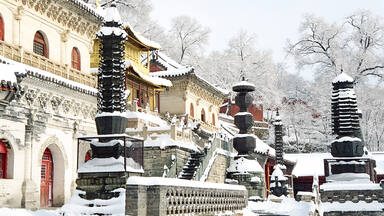
With its five flat peaks, Mount Wutai is a sacred Buddhist mountain. The cultural landscape is home to forty-one monasteries and includes the East Main Hall of Foguang Temple, the highest surviving timber building of the Tang dynasty, with life-size clay sculptures. It also features the Ming dynasty Shuxiang Temple with a huge complex of 500 statues representing Buddhist stories woven into three-dimensional pictures of mountains and water. Overall, the buildings on the site catalogue the way in which Buddhist architecture developed and influenced palace building in China for over a millennium. Mount Wutai, literally, 'the five terrace mountain', is the highest in Northern China and is remarkable for its morphology of precipitous slopes with five open treeless peaks. Temples have been built on this site from the 1st century AD to the early 20th century.
Description is available under license CC-BY-SA IGO 3.0
Mont Wutai
Avec ses cinq plateaux, le Mont Wutai est une montagne sacrée bouddhiste. Ce paysage culturel compte 41 monastères, dont la grande salle orientale du temple de Foguang, l’un des derniers édifices en bois de la dynastie Tang existant, orné de sculptures d’argile grandeur nature. Il abrite également le temple Shuxiang de la dynastie Ming, vaste ensemble de 500 statues représentant les légendes bouddhistes tissées dans des décors de montagnes et d’eau en trois dimensions. Globalement, les bâtiments de ce site illustrent la façon dont l’architecture bouddhiste a contribué au développement et influencé la construction de palaces en Chine pendant plus d’un millénaire. Le Mont Wutai, littéralement « la montagne aux cinq terrasses », est le plus haut du nord de la Chine. Il est particulièrement remarquable de par sa typologie, faite de pentes vertigineuses et de cinq sommets dénudés. Les temples ont été construits sur ce site à partir du 1er siècle ap. J.C. et ce jusqu’au début du 20è siècle.
Description is available under license CC-BY-SA IGO 3.0
جبل ووتاي
يُعتبر جبل ووتاي، بالقمم المسطحة الخمس التي يتميز بها، جبلاً بوذياً مقدساً. ويشمل هذا المنظر الثقافي 41 ديراً، فضلاً عن الحائط الرئيسي الشرقي لمعبد فوغوانغ الذي يمثل أعلى مبنى من الخشب بقي منذ أسرة تانغ، ويحوي تماثيل طينية بالحجم الطبيعي. ويضم هذا الجبل أيضاً معبد شوكسيانغ الخاص بأسرة ميتغ، مع ما يحتويه من مُجمع ضخم يوجد فيه 500 تمثال تمثل قصصاً بوذية منسوجة في صور ثلاثية الأبعاد للجبال والماء. وعموماً، فإن الأبنية في هذا الموقع تمثل كتالوجاً يخص الأسلوب التي تطور بمقتضاه الفن المعماري البوذي وتأثيره في مجال بناء القصور خلال ما يزيد عن ألف سنة. وعلى وجه التحديد، فإن جبل ووتاي، الذي يمثل مرتفعاً ذا خمس مصاطب، يُعتبر أعلى جبل في شمال الصين، كما أنه يتميز بجوانبه الشديدة الانحدار ذات قمم خمس مكشوفة وخالية من الأشجار. وقد بنيت معابد في هذا الموقع منذ القرن الأول بعد الميلاد وحتى القرن العشرين.
source: UNESCO/CPE
Description is available under license CC-BY-SA IGO 3.0
五台山
source: UNESCO/CPE
Description is available under license CC-BY-SA IGO 3.0
Monte Wutai
El Monte Wutai es una cumbre sagrada del budismo con cinco mesetas planas. El paisaje cultural inscrito en la Lista comprende 41 monasterios, así como la gran sala del Templo de Foguang orientada al este, que es el edificio de madera más importante de los subsistentes de la época la dinastía de los Tang. Este edificio posee esculturas de arcilla de tamaño natural. El paisaje cultural abarca también el templo de Shuxiang que data de la dinastía de los Ming y cuenta con un gran conjunto de 500 figuras escultóricas “suspendidas” que representan escenas budistas tejidas en imágenes tridimensionales de montañas y agua. En su conjunto, los edificios de este sitio constituyen un verdadero catálogo del desarrollo de la arquitectura budista y de su influencia en la construcción de edificios palaciegos en China a lo largo de más de un milenio. El Monte Wutai, que en chino significa literalmente “la montaña de las cinco terrazas”, es la cima más alta del norte de China. Su morfología es notable y se caracteriza por sus laderas cortadas a pico y sus cinco cimas de forma redondeada y sin árboles. La construcción de templos en este sitio se extendió desde el siglo I hasta principios del siglo XX.
source: UNESCO/CPE
Description is available under license CC-BY-SA IGO 3.0
五台山
五台山は5つの平坦な頂をもった仏教聖地で、佛光寺を含む41の僧院が文化的景観をつくりだしている。なかでも等身大の塑像を収めた佛光寺の東大殿は、残存する4棟の唐時代の木造建築のなかで最も高くそびえる。また、明時代の殊像寺の巨大な壁画は、仏教説話を表す五百羅漢像を配し、山河が三次元で描かれている。この地域の建造物からは、千年以上にわたり中国で仏教建築が発達し、宮殿建築に影響を与えた過程を見てとることができる。五台山は中国北部で最も高い山だが、樹木のない切り立った頂は、地形学的にも際立っている。この地域に寺院が建てられたのは、1世紀から20世紀初頭にかけてのことである。source: NFUAJ
Berg Wutai
Wutai is een heilige boeddhistische berg, met 41 kloosters. Wutaishan – letterlijk ‘vijf terrassenberg’ – is de hoogste berg in Noord-China en opvallend vanwege de vijf platte, boomloze open bergtoppen. Vanaf de 1e eeuw voor Christus tot de vroege 20e eeuw zijn hier tempels gebouwd. De Foguang tempel uit de Tang dynastie is de hoogste houten tempel – met levensgrote kleisculpturen – die bewaard is gebleven. De Shuxiang tempel uit de Ming dynastie is een enorm complex met 500 standbeelden die boeddhistische verhalen illustreren. De gebouwen tonen de ontwikkeling van de boeddhistische architectuur en haar invloed op de bouw van paleizen in China gedurende duizend jaar.
Source: unesco.nl


Outstanding Universal Value
Brief synthesis
Mount Wutai with its five flat peaks is one of the four sacred Buddhist mountains in China. It is seen as the global centre for Buddhist Manjusri worship. Its fifty-three monasteries, include the East Main Hall of Foguang Temple, with life size clay sculptures, the highest ranking timber building to survive from the Tang Dynasty, and the Ming Dynasty Shuxiang Temple with a huge complex of 500 ‘suspension’ statues, representing Buddhist stories woven into three dimensional pictures of mountains and water. The temples are inseparable from their mountain landscape. With its high peaks, snow covered for much of the year, thick forests of vertical pines, firs, poplar and willow trees and lush grassland, the beauty of the landscape has been celebrated by artists since at least the Tang Dynasty – including in the Dunhuang caves. Two millennia of temple building have delivered an assembly of temples that present a catalogue of the way Buddhist architecture developed and influenced palace building over a wide part of China and part of Asia. For a thousand years from the Northern Wei period (471-499) nine Emperors made 18 pilgrimages to pay tribute to the bodhisattvas, commemorated in stele and inscriptions. Started by the Emperors, the tradition of pilgrimage to the five peaks is still very much alive. With the extensive library of books collected by Emperors and scholars, the monasteries of Mount Wutai remain an important repository of Buddhist culture, and attract pilgrims from across a wide part of Asia.
Criterion (ii): The overall religious temple landscape of Mount Wutai, with its Buddhist architecture, statues and pagodas reflects a profound interchange of ideas, in terms of the way the mountain became a sacred Buddhist place, endowed with temples that reflected ideas from Nepal and Mongolia and which then influenced Buddhist temples across China.
Criterion (iii): Mount Wutai is an exceptional testimony to the cultural tradition of religious mountains that are developed with monasteries. It became the focus of pilgrimages from across a wide area of Asia, a cultural tradition that is still living.
Criterion (iv): The landscape and building ensemble of Mount Wutai as a whole illustrates the exceptional effect of imperial patronage over a 1,000 years in the way the mountain landscape was adorned with buildings, statuary, paintings and steles to celebrate its sanctity for Buddhists.
Criterion (vi): Mount Wutai reflects perfectly the fusion between the natural landscape and Buddhist culture, religious belief in the natural landscape and Chinese philosophical thinking on the harmony between man and nature. The mountain has had far-reaching influence: mountains similar to Wutai were named after it in Korea and Japan, and also in other parts of China such as Gansu, Shanxi, Hebei and Guandong provinces.
Integrity and authenticity
All the temples and landscape associated with the sacred Buddhist mountain are included in the nominated area. The integrity of some of the temple ensembles was threatened by uncontrolled development but this has been either reversed or is being controlled. For the landscape, the visual integrity relies on sustaining the beauty of the mountain and its forests so that the inseparability of the temples and the mountain can be appreciated together with their religious associations. The temples demonstrate a long history of construction and reconstruction. The exception is Foguang East Hall which with its statues has remained largely unreconstructed since the Tang Dynasty. The attributes such as the assembly of temples, the specific buildings that reflect the interchange of cultures, the relationship of buildings to the mountain landscape, the beauty of the forested landscape to the northwest, the pilgrim routes and the masterpieces within the temples, could be said to clearly reflect the outstanding universal value of the property.
Protection and management requirements
The following plans guide the management of the property: Conservation and Management Plan for the nominated World Heritage site (2005-2025) and the Master Plan of the Mount Wutai National Park (1987 and amended in 2005). Both plans are implemented by the National Park. A World Heritage Protection Division, part of the Wutai local administration, and provided with professional staff, will be responsible for the implementation of the Conservation and Management Plan.