Humberstone and Santa Laura Saltpeter Works
Humberstone and Santa Laura Saltpeter Works
Humberstone and Santa Laura works contain over 200 former saltpeter works where workers from Chile, Peru and Bolivia lived in company towns and forged a distinctive communal pampinos culture. That culture is manifest in their rich language, creativity, and solidarity, and, above all, in their pioneering struggle for social justice, which had a profound impact on social history. Situated in the remote Pampas, one of the driest deserts on Earth, thousands of pampinos lived and worked in this hostile environment for over 60 years, from 1880, to process the largest deposit of saltpeter in the world, producing the fertilizer sodium nitrate that was to transform agricultural lands in North and South America, and in Europe, and produce great wealth for Chile. Because of the vulnerability of the structures and the impact of a recent earthquake, the site was also placed on the List of World Heritage in Danger to help mobilize resources for its conservation.
Description is available under license CC-BY-SA IGO 3.0
Usines de salpêtre de Humberstone et de Santa Laura
Les usines de Humberstone et de Santa Laura représentent plus de 200 anciens sites d’extraction du salpêtre, où des ouvriers, venus du Chili, du Pérou et de Bolivie, vécurent dans des cités minières et forgèrent une culture pampina commune. Cette culture se manifeste dans la richesse de la langue, la créativité et les liens de solidarité, et surtout dans les luttes pionnières menées par les pampinos pour la justice sociale, luttes dont l’impact fut profond sur l’histoire sociale. Installés dans la Pampa désertique et reculée, l’un des déserts les plus arides du globe, des milliers de pampinos ont vécu et travaillé, à partir de 1880 et pendant plus de soixante ans, dans un environnement hostile pour exploiter le plus grand gisement de salpêtre du monde et produire le nitrate de soude, un engrais qui allait transformer le paysage agricole de l’Amérique du Nord et du Sud, ainsi que celui de l’Europe, tout en procurant de grandes richesses au Chili.
Description is available under license CC-BY-SA IGO 3.0
مصانع نترات الصوديوم في همبرستون وسانتا لاورا
تمثل مصانع همبرستون وسانتا لاورا أكثر من200 موقع قديم لاستخراج نترات الصوديوم، حيث كان يعيش العمال القادمون من شيلي والبيرو وبوليفيا في مدن منجمية. وقد استحدثوا ثقافة مشتركة تبرز من خلال ثراء اللغة والإبداع وعلاقات التضامن، وبالأخص عبر أولى حركات النضال التي قادها هؤلاء في سبيل العدالة الاجتماعية والتي كان أثرها عميقاً على التاريخ الاجتماعي. استقر العمال في سهول البامبا الشاسعة والنائية، في إحدى الصحارى القاحلة، حيث عاش آلاف العمال وعملوا، بدءاً من العام 1880 وطوال أكثر من 60 عاماً، في بيئة معادية، من أجل استغلال أكبر منجم لإنتاج نترات الصوديوم في العالم، ذاك السماد الذي أحدث تغييراً جذرياً في المنظر الزراعي في أميركا الشمالية والجنوبية وفي أوروبا، وعاد بثروات كبرى على شيلي.
source: UNESCO/CPE
Description is available under license CC-BY-SA IGO 3.0
亨伯斯通和圣劳拉硝石采石场
亨伯斯通和圣劳拉硝石采石场遗址由200多个以前的采矿点组成,来自智利、秘鲁和玻利维亚的工人就居住在企业生活区中,形成了独特的社区文化。这种文化体现于丰富的语言、创造力和团结力上,尤其是争取社会公正的先锋精神,这对社会历史有着深远的影响。此处遗址位于地球上最干燥的沙漠之一,偏远的潘帕沙漠地区(desert Pampa)。从1880年开始,成千上万名来自智利、秘鲁和玻利维亚的矿工就在这样恶劣的环境下生活和工作了60多年,开采世界上最大的硝石矿,生产化肥硝酸钠,用于改造北美洲和南美洲以及欧洲的农田,并为智利创造了巨大财富。由于这里的建筑物容易遭到破坏,最近又受到地震影响,这里已列入了《濒危世界遗产名录》,以便募集资源,对其实施保护。
source: UNESCO/CPE
Description is available under license CC-BY-SA IGO 3.0
Производства селитры Хамберстон и Санта-Лаура
Предприятия Хамберстон и Санта-Лаура включают свыше 200 бывших разработок селитры, где в городках добывающей компании жили рабочие из Чили, Перу и Боливии, формируя характерную культуру проживания «пампинос». Эта культура отличалась богатым языком, духом творчества и солидарности, а более всего – своей борьбой за социальную справедливость, которая оказала глубокое воздействие на дальнейший ход исторических событий в этом регионе. Находясь в отдаленной «пампе» – одной из самых безводных пустынь на земле, тысячи «пампинос» жили и работали в неблагоприятных природных условиях более 60 лет, начиная с 1880 г., чтобы освоить крупнейшее в мире месторождение селитры. Произведенное на этой основе удобрение, которое преобразило сельскохозяйственные земли в Северной и Южной Америке и в Европе, принесло Чили огромное богатство.
source: UNESCO/CPE
Description is available under license CC-BY-SA IGO 3.0
Oficinas salitreras de Humberstone y Santa Laura
Las oficinas de Humberstone y Santa Laura cuentan con un total de 200 lugares de extracción del salitre, donde trabajadores llegados de Chile, Perú y Bolivia vivieron agrupados en campamentos de las compañías mineras. Aquí forjaron la cultura comunitaria específica de los pampinos, caracterizada por su creatividad, la riqueza de su expresión lingüística, los vínculos solidarios entre sus miembros y su lucha precursora por la justicia social, que dejaría una honda huella en la historia de los movimientos sociales. A estas y otras oficinas salitreras instaladas en el desierto de la Pampa –una de las zonas mí¡s í¡ridas del planeta y mí¡s hostiles al ser humano– acudieron miles de pampinos desde 1880 para vivir y trabajar en ellas por espacio de sesenta años, a fin de extraer del yacimiento de salitre mí¡s grande del mundo el nitrato de sodio, fertilizante que transformó la agricultura en las dos Américas y en Europa, proporcionando a Chile una riqueza considerable.
source: UNESCO/CPE
Description is available under license CC-BY-SA IGO 3.0
ハンバーストーンとサンタ・ラウラ硝石工場群
source: NFUAJ
Salpeterfabrieken van Humberstone en Santa Laura
Source: unesco.nl


Outstanding Universal Value
Brief Synthesis
In the remote desert Pampa, one of the driest deserts on earth, thousands of people lived and worked from the first half of the 19th century to process the largest deposit of saltpeter in the world, producing the fertiliser sodium nitrate that was to transform agricultural land in North and South America, and Europe, and produce great wealth for Chile.
Humberstone and Santa Laura works are the best preserved and most representative remains of a series of over 200 saltpeter works that once existed, all of which were interconnected by a specially built modern railway system, and constitute an exceptional testimony to technological progress and global exchanges which were the cornerstone of the industrial era. In this area, workers, drawn from Chile, Peru and Bolivia, to this hostile environment, lived in company towns and forged a distinctive communal Pampinos culture, manifest in their own rich language, creativity, and solidarity, and above all in pioneering struggles for social justice, that had a profound impact generally on social history.
The industrial heritage site was developed from 1872 and until mid 20th century; it is located 45 km. from the port of Iquique in the midst of a desert landscape. The property covers a surface area of 573.48 hectares, with a buffer zone of 1,826.39 hectares that encompasses the two main sites which stand at a distance of approximately 1 km from each other. These complement each other, because the industrial area of Santa Laura is better conserved, while Humberstone has better preserved residential and service areas.
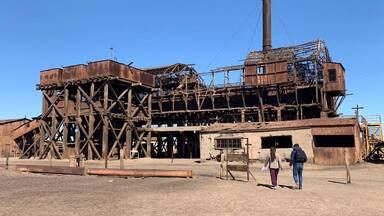
The site of Santa Laura conserves the remains of the industrial installations that were used for saltpeter processing such as industrial installations and equipment, including the only leaching shed and a saltpeter grinder that remain intact today, installations for manufacturing iodine, for energy production and buildings such as the administration house and the main square. The Humberstone site contains the attributes that express the quality of urban settlements, such as the living quarters, public spaces and the regular grid pattern of the Camp, with a main square around which communal buildings are clustered. Other relevant attributes are the remains of the railway line that linked Santa Laura and Humberstone, the gravel heaps, the construction techniques, architectural styles and materials, in particular the costrón and the Pampa concrete, distinctive construction materials together with the calamine and timber that were brought from other latitudes.
The remains of saltpeter works are also present in the buffer zone which is also significant for the conservation of the characteristics of the natural setting of the Pampa which illustrate the relationship between the built environment and the adaptation to the natural setting.
The two saltpeter works are the most representative remaining vestiges of an industry that transformed the lives of a large proportion of the population of Chile, brought great wealth to the country. The output of the industry, nitrate fertilisers, had indirectly a transforming influence on existing agricultural lands in Europe, and on newly cultivated land in other latitudes and indirectly supported the agricultural revolution of the late 19th century in many parts of the world. The remaining buildings are testimony to the social order and technical processes that drove the industry.
The pioneering social agenda of the saltpeter workers’ unions had far-reaching effects on labour laws throughout Chile and further afield. The distinctive culture of the Pampinos that evolved in association with the industry, which expresses the language, the memory of the saltpeter culture and its influence on social process, has resonance amongst the local population today and is another important attribute of the property. The place still has a strong symbolic and evocative association for the people from the Pampa, former workers and their families, who use the place for meetings and commemorations such as Saltpeter Week.
Criterion (ii): The development of the saltpeter industry reflects the combined knowledge, skills, technology, and financial investment of a diverse community of people who were brought together from around South America, and from Europe. The saltpeter industry became a huge cultural exchange complex where ideas were quickly absorbed and exploited. The two works represent this process.
Criterion (iii): The saltpeter mines and their associated company towns developed into an extensive and very distinct urban community with its own language, organisation, customs, and creative expressions, as well as displaying technical entrepreneurship. The two nominated works represent this distinctive culture.
Criterion (iv): The saltpeter mines in the north of Chile together became the largest producers of natural saltpeter in the world, transforming the Pampa and indirectly the agricultural lands that benefited from the fertilisers the works produced. The two works represent this transformation process.
Integrity
The attributes at the nucleus of the complex of the two saltpeter works still reflect the key manufacturing processes and social structures and ways of life of these company towns. As opposed to what occurred in many other saltpeter works, Santa Laura and Humberstone were not fully dismantled when they were no longer functional. However, looting, demolition and lack of conservation and maintenance that occurred until the declaration of the site as a National Monument in 1970 compromised the overall integrity of the two works.
Efforts have been made by the State Party to reverse the conditions that threaten the integrity of the property. Notwithstanding these works, interventions are still needed to ensure that no further erosion of integrity occurs, particularly by addressing the considerable damage that exists at some of the industrial structures in Santa Laura which are still at risk.
The State Party is stressing the multidisciplinary analysis of vulnerability of the materials and the instability of the structures, the assessment of the composition of the materials and their pathologies, the effect of environmental conditions on them, the soil and mechanical actions on structures, so as to identify the best methods of conserving and maintaining them and the use and historic functioning of machinery and buildings.
The buffer zone is an attempt to protect the desert landscape and its relationship with the built environment, as well as the remains from still older saltpeter works and mining camps, including railway lines and roads as well as pedestrian footpaths which give a certain sense to the historic reality of the saltpeter canton (complex of several interrelated saltpeter works). However, no formal buffer zone has been established to control and regulate activities that occur in the surroundings to mitigate the visual impacts on the setting derived from contemporary industrial buildings.
Authenticity
The two saltpeter works have remained better conserved that any other saltpeter works in the Pampa of northern Chile and what remains at the site is authentic and original. The relatively few interventions, the lack of additions of architectural elements or constructive materials from outside or which are different from those used originally have helped in maintaining the authenticity of the property.
The authenticity of the site is heightened as a result of its characteristics and its relationship to the landscape which illustrates the occupation of the territory in the saltpeter era and powerfully evokes how the desert was conquered.
The conservation of manifestations of intangible attributes of the saltpeter era also contributes toward the authenticity of the site. Humberstone houses the most important gathering of a commemoration of the industry as a whole: the Saltpeter Week which annually gathers together people from all over the Pampa; i.e. former saltpeter workers and their descendants.
However, there are significant challenges for the conservation of the conditions of authenticity, in light of the nature and vulnerability of the materials in the specific environmental conditions, and the identification of interventions which do not compromise these characteristics.
Protection and management requirements
The property is a National Monument in the category of Historic Monument – the maximum level of protection of heritage in this country -. It is administered by a private entity, the Saltpeter Museum Corporation, under the supervision of the National Monuments Council, a state institution responsible for the protection of Chile’s cultural heritage. A 2004-2009 Management Plan was produced and now needs to be updated. In addition, the human and financial resources for its sustained implementation will need to be secured and provided to the Corporation.
The formal definition of a buffer zone and the establishment and enforcement of regulatory measures is also an action that needs to be implemented as a crucial measure to protect the desert landscape both geographically as well as in relation to the remains of mining exploration and the transport of the saltpeter in general.
To ensure the conservation of Outstanding Universal Value, authenticity and integrity of the property, the Priority Interventions Plan needs to be implemented, including the structural consolidation and the recovery of buildings at risk. Physical conservation must be addressed bearing in mind the effects of the camanchaca - dense and frequent mist generated by the Pacific Ocean - and its high saltiness, capable of seriously damaging metals, timbers and even stone materials. It is necessary to conceptually reflect on authenticity which opens up a space coherently with replacing those pieces and sections that have irredeemably deteriorated, defining a criteria for change associated with that degradation, in order to maintain them for all time. This must be done in addition to the protection of materials with anti-corrosion treatments.
An essential imperative for the protection, conservation and management of the site is an in-depth knowledge of the techniques, construction systems, and ways of life, exploration systems and the economic conditions at the time. The importance of the technology itself of this exploitation is of great singularity and the complexities of life associated with saltpeter impose a considerable challenge on how it is all interpreted. Also essential is protecting, conserving and managing those artistic elements that are a part of the history of the site whilst it was functioning and being abandoned, such as the “graphic designs” on the walls, and the movable assets.
 View photos from OUR PLACE the World Heritage collection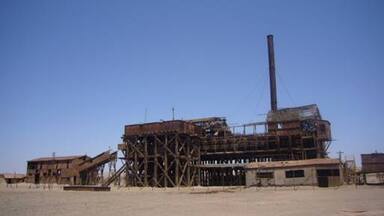




List of World Heritage in Danger
Inscription Year on the List of World Heritage in Danger
2005 -2019The Nomination files produced by the States Parties are published by the World Heritage Centre at its website and/or in working documents in order to ensure transparency, access to information and to facilitate the preparations of comparative analysis by other nominating States Parties.
The sole responsibility for the content of each Nomination file lies with the State Party concerned. The publication of the Nomination file, including the maps and names, does not imply the expression of any opinion whatsoever of the World Heritage Committee or of the Secretariat of UNESCO concerning the history or legal status of any country, territory, city or area or of its boundaries.