Centennial Hall in Wrocław
Centennial Hall in Wrocław
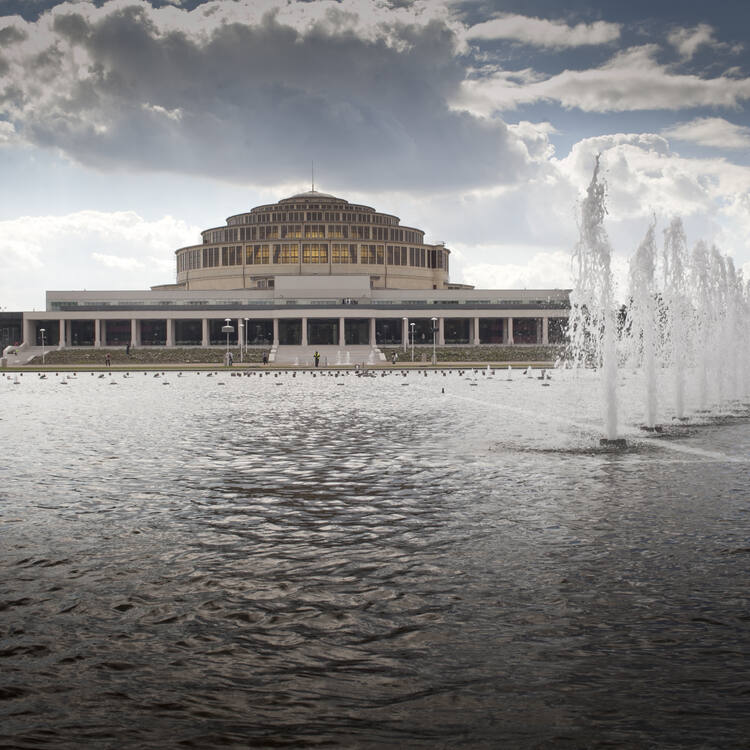
The Centennial Hall, a landmark in the history of reinforced concrete architecture, was erected in 1911-1913 by the architect Max Berg as a multi-purpose recreational building, situated in the Exhibition Grounds. In form it is a symmetrical quatrefoil with a vast circular central space that can seat some 6,000 persons. The 23m-high dome is topped with a lantern in steel and glass. The Centennial Hall is a pioneering work of modern engineering and architecture, which exhibits an important interchange of influences in the early 20th century, becoming a key reference in the later development of reinforced concrete structures.
Description is available under license CC-BY-SA IGO 3.0
Halle du Centenaire de Wroclaw
La Halle du centenaire, un jalon de l’histoire de l’architecture en béton armé, a été construite entre 1911 et 1913 par l’architecte Max Berg. C’est un bâtiment à plan central au cœur du Parc des Expositions servant de salle d’exposition polyvalente. La Halle du centenaire forme un quadrilobe symétrique, avec un vaste espace circulaire au centre qui peut accueillir 6 000 sièges. Le dôme nervuré de 23 m est coiffé d’une lanterne d’acier et de verre. La Halle du centenaire est un exemple précurseur du début de l’architecture et de l’ingénierie moderne ; elle illustre un important échange d’influences au début du XXe siècle et elle est devenue une référence majeur dans l’évolution postérieure des structures en béton armé.
Description is available under license CC-BY-SA IGO 3.0
قاعة المئة عام في روكلاو
تعتبر قاعة المئة عام أساسيةً في تاريخ العمارة بالإسمنت المسلّح. وقد بناها ماكي برغ المهندس بين 1911 و1913. قاعة المئة عام صالة لعرض المعارض المختلفة وهي بناء بمخطط أساسي في قلب مدينة المعارض. وتتكوَّن من أربعة أجزاء متناظرة، مع مساحة دائرية واسعة في المركز وتسمح باستقبال 6000 مقعد. ويغطي أعلى القبة المضلّع 32م، مصباح من المعدن والزجاج. كما تُعتبَر قاعة المئة عام نموذجًا يُبشِّر ببداية الهندسة المعمارية الحديثة، ويدل على تبادل التأثرات في بداية القرن العشرين، وقد أصبحت مرجعًا أساسيًا في التطوّر الذي حصل بعد ذلك في بُنى الباطون المسلّح.
source: UNESCO/CPE
Description is available under license CC-BY-SA IGO 3.0
弗罗茨瓦夫百年厅
弗罗茨瓦夫的百年纪念会堂。百年纪念会堂(德语是Jahrhunderthalle,波兰语是Hala Ludowa)是钢筋混凝土建筑史上的一个里程碑。该会堂由建筑师Max Berg于1911-1913年设计建造,是当时弗罗茨瓦夫的市政厅。那个时候,弗罗茨瓦夫叫Breslau,是德国的一部分。百年纪念会堂是一个多功能娱乐场所,位于展览中心,其结构为中心对称式。它呈现出对称的四叶片形状,中心是开阔的圆形空间(直径65米,高42米),可容纳6000多人。会堂上方是23米高,由钢和玻璃构成的灯笼式穹顶。窗户由进口硬木制成,墙壁上覆盖了一层由水泥和一般木材或软木混合而成的绝缘层以改善音响效果。墙上没有装饰和点缀,只是外露的水泥部分留有木质模板的印子。百年纪念会堂的西边是一个模仿古代公共集会场地而建的巨大广场。北边是1912年建筑师Hans Poelzig设计的有4个穹顶的历史展览馆。展览中心北侧有一个人造池塘,Poelzig设计了一个环池水泥走廊。入口附近是展览中心管理公司的办公楼(Breslauer 展览股份有限公司),建于1937年,由Richard Konwiarz设计。一条伸向广场的宽阔柱廊是Max Berg 于1924年设计的,柱子由钢筋混凝土浇筑而成。百年纪念会堂是现代工程建筑的先驱之作,展现了20世纪初期各种影响力的交汇,对后来钢筋混凝土建筑的发展具有重要的参考价值。
source: UNESCO/CPE
Description is available under license CC-BY-SA IGO 3.0
«Зал Столетия» во Вроцлаве
«Зал Столетия» («Ярхундертхалле» - по-немецки, поляки называют его «Хала Людова» - «Народный Дом»), достопримечательность в истории развития архитектуры из железобетона, был возведен в 1911-1913 гг. Максом Бергом, бывшим в то время городским архитектором Бреслау, как назывался польский город Вроцлав, когда он входил в состав Германии. «Зал Столетия» - многоцелевое зрелищное здание находящееся в центре выставочного городка. По своей структуре «Зал Столетия» - это симметричный четырехугольник с обширным круглым центральным пространством (диаметром 65 м и высотой 42 м), где могут разместиться около 6000 человек. Купол высотой 23 м увенчан фонарем из стали и стекла. Оконные рамы выполнены из твердой древесины ценных пород. С целью улучшить акустику стены покрыты изолирующим слоем бетона, смешанного с древесиной или пробковой корой. Фасады лишены украшений или орнамента, но показывают текстуру бетона со следами деревянной опалубки. С западной стороны «Зала Столетия» устроена монументальная площадь, оформленная в виде древнего форума. На север от него находится павильон с четырьмя куполами, спроектированный в 1912 г. архитектором Хансом Пельцигом для размещения исторической выставки. В северной части выставочного городка Пельциг запроектировал бетонную перголу, окруженную искусственным водоемом. Рядом с входом находится служебное здание компании, управлявшей выставочным городком (Бреслауэр Мессе А.Г.), построенное в 1937 г. по проекту Рихарда Конвиарца. Монументальные ворота ведут на форум, образованный колоннадой из железобетона, спроектированной Максом Бергом в 1924 г. «Зал Столетия» - это пионерная работа в области современных конструкций и архитектуры, которая демонстрирует тесное взаимодействие различных течений в начале ХХ в., что стало важным импульсом дальнейшего развития железобетонных конструкций.
source: UNESCO/CPE
Description is available under license CC-BY-SA IGO 3.0
Centro del Centenario de Wroclaw
El Centro del Centenario, que marcó un hito en la historia de la construcción con hormigón armado, fue construido entre 1911 y 1913 por el arquitecto Max Berg. Situado en la Feria de Exposiciones y dotado de una estructura planeada en torno a un eje central, el Centro es un edificio destinado a múltiples usos de índole recreativa. Su planta, en forma de trébol de cuatro hojas simétricas, está dotada de un vasto espacio circular central en el que pueden tomar asiento unas 6.000 personas. Su cúpula nervada tiene 23 metros de altura y está rematada por una linterna de acero y cristal. Obra precursora de la ingeniería y arquitectura modernas con una considerable mezcla de tendencias estilísticas de los inicios del siglo XX, el Centro del Centenario se convirtió en un elemento de referencia clave para el desarrollo ulterior de las estructuras arquitectónicas en hormigón armado.
source: UNESCO/CPE
Description is available under license CC-BY-SA IGO 3.0
ヴロツワフの百周年記念ホール
source: NFUAJ
Hala Stulecia in Wrocław
Source: unesco.nl


Outstanding Universal Value
Brief synthesis
The Centennial Hall in Wrocław, a milestone in the history of reinforced concrete architecture, was designed by the architect Max Berg and built in 1911-1913. The hall has a symmetrical quatrefoil ground plan with a huge circular central space covered by a ribbed dome topped with a lantern. It can accommodate up to 10,000 people.
The Centennial Hall is an outstanding example of early Modernism and the innovative use of reinforced concrete structures in the building industry. At the time of its construction, it was the largest ever reinforced concrete dome in the world. It played a significant role in the creation of a new technological solution of high aesthetic value, which became an important point of reference in the design of public spaces and in the further evolution of this technology. Drawing on historical forms, the building was a pioneering design responding to emerging social needs, including an assembly hall, an auditorium for theatre performances, an exhibition space and a sports venue. The building is a significant watershed in the history of Modern architecture.
The Exhibition Grounds, whose main feature the Centennial Hall, stands at the intersection of its principal axes, constitutes an integral spatial whole. They were designed jointly by Max Berg and Hans Poelzig. On the west side of the Centennial Hall there is a monumental square modelled on the ancient forum, which is preceded by the colonnade (built in 1925) of the main entrance. To the north of the square stands the Pavilion of the Historical and Artistic Exhibition, now known as the Four Domes Pavilion, which was built in 1912-1913 according to a design by Hans Poelzig. In the northern part of the Exhibition Grounds stands a concrete pergola enclosing a pond. It is separated from the Centennial Hall by a building housing a restaurant with an open terrace.
The design of the Exhibition Grounds combined new elements with the southern part of the 19th-century Szczytnicki Park, which was used as the setting for thematic garden exhibitions, such as the Japanese Garden, as well as for the temporary Exhibition of Cemetery Art, an extant reminder of which is an 18th-century wooden church relocated from Upper Silesia in 1912.
Criterion (i): The Centennial Hall in Wrocław is a creative and innovative example in the development of construction technology in large reinforced concrete structures. The Centennial Hall occupies a key position in the evolution of methods of reinforcement used in architecture, and represents one of the climactic points in the history of the use of metal in structural consolidation.
Criterion (ii): The Centennial Hall is a pioneering work of Modern engineering and architecture, which exhibits an important interchange of influences in the early 20th century, becoming a key reference in the later development of reinforced concrete structures.
Criterion (iv): As part of the Exhibition Grounds of Wrocław, the Centennial Hall is an outstanding example of Modern recreational architecture that served a variety of purposes, ranging from hosting conferences and exhibitions to concerts, theatre and opera.
Integrity
The Exhibition Grounds, together with the Centennial Hall, have retained their compositional integrity within the boundary of the property. As a whole, they have retained their structural integrity and views on the property. Also, the use of the grounds is compatible with the originally intended functions.
Since the time of its construction, the Hall has remained a fully complete and unique facility in terms of structure and materials used. The building has undergone a series of renovations in order to maintain its structural condition and to replace installations in accordance with obligatory safety standards for public use buildings.
The property’s boundaries include the entire extant central part of the Exhibition Grounds. After the end of the Centennial Exhibition in 1913, temporary architectural features and seasonal garden plantings were removed. Some permanent structures, such as the roof of the colonnade of the main entrance and the restaurant building with its open terrace, were destroyed during the Second World War.
Despite some losses, the most important features situated on the two main axes of the Exhibition Grounds survive to this day: the Centennial Hall, the Four Dome Pavilion, the colonnade of the main entrance and the pergola with its pond. The Japanese Garden and the wooden Baroque church are also extant.
In 1948, the composition of the Exhibition Grounds was supplemented with a steel spire designed by Stanisław Hempel, which was placed in the middle of the ‘forum’.
All investment plans in the property and its buffer zone need to be assessed carefully to avoid adverse impacts on its Outstanding Universal Value.
Authenticity
The Centennial Hall and Exhibition Grounds within the boundaries of the inscription have retained their unique cohesive spatial layout and permanent compositional features. The Centennial Hall is a fully authentic building in terms of architectural form, specific construction technology and materials. The building is in good condition following the completion of renovation work addressing its conservation as well as functional and technical modernisation.
The structural condition of other features within the exhibition complex is varied, as is the state of preservation of their historic fabric. The property is used in accordance with its original intended functions.
Protection and management requirements
The entire property (36.69 ha) is legally protected under regulations governing the protection of monuments, which are implemented by national and local conservation services.
The system of legal protection pertaining to the property has been supplemented by the perennial efforts of the local self-government, which have led to the entire area within the buffer zone (189,68 ha) being covered by local spatial development plans protecting the property at the level of by-laws in accordance with the provisions of the spatial planning and development act.
All conservation and investment works are preceded by pertinent historical studies and research as well as environmental analyses, taking into consideration the spatial context. Each operation requires that the proposed work be approved and relevant permission be obtained from conservation services.
Responsibility for the property is shared by several legal entities with various profiles of activity, hence individual buildings and spaces are used for different functions. The main part of the Centennial Hall complex serves as an exhibition and conference centre and as a widely accessible recreational area, in keeping with its original intended purpose.
G All investment plans in the property and its buffer zone must be subordinate to the protection of the Outstanding Universal Value, and the preservation of its character and historical spatial context.
Fulfilment of this objective will be through the implementation of a Management Plan for the area inscribed on the World Heritage List. The aim of this document is to coordinate activities related to the management and monitoring of the Centennial Hall complex and its buffer zone. The plan will ensure the sustainable use and functioning of the entire complex, taking into account social, environmental and economic issues, as well as the full use of its tourism potential and the landscape values of the property and its surroundings.
Links
-
Centennial Hall (Hala Stulecia) Restaurant
-
Centennial Hall in Wrocław LinkedIn account (in Polish only)
-
Centennial Hall in Wrocław Twitter (X) page (in Polish only)
-
Centennial Hall in Wrocław TikTok account (in Polish only)
-
Centennial Hall in Wrocław YouTube account (in Polish only)
-
Centennial Hall in Wrocław Instagram page (in Polish only)
-
Centennial Hall in Wrocław Facebook page (in Polish only)
-
Centennial Hall in Wrocław Official Website


The Nomination files produced by the States Parties are published by the World Heritage Centre at its website and/or in working documents in order to ensure transparency, access to information and to facilitate the preparations of comparative analysis by other nominating States Parties.
The sole responsibility for the content of each Nomination file lies with the State Party concerned. The publication of the Nomination file, including the maps and names, does not imply the expression of any opinion whatsoever of the World Heritage Committee or of the Secretariat of UNESCO concerning the history or legal status of any country, territory, city or area or of its boundaries.