Gebel Barkal and the Sites of the Napatan Region
Gebel Barkal and the Sites of the Napatan Region
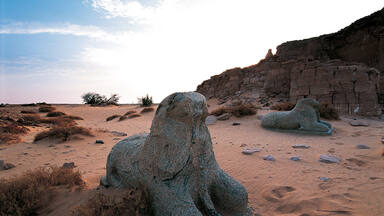
These five archaeological sites, stretching over more than 60 km in the Nile valley, are testimony to the Napatan (900 to 270 BC) and Meroitic (270 BC to 350 AD) cultures, of the second kingdom of Kush. Tombs, with and without pyramids, temples, living complexes and palaces, are to be found on the site. Since Antiquity, the hill of Gebel Barkal has been strongly associated with religious traditions and folklore. The largest temples are still considered by the local people as sacred places.
Description is available under license CC-BY-SA IGO 3.0
Gebel Barkal et les sites de la région napatéenne
Ces cinq sites archéologiques couvrent une région de plus de 60 kilomètres de long dans la vallée du Nil. Tous les sites sont de culture napatéenne (de 900 à 270 avant J.-C.) et méroïtique (de 270 avant J.-C. à 350 après J.-C.), de l’époque du second royaume de Kush. Les sites comprennent des tombeaux avec et sans pyramide, des temples, des bâtiments d’habitation et des palais. Depuis l’Antiquité, la colline de Gebel Barkal est demeurée intimement liée aux traditions religieuses et au folklore. Les temples majeurs y sont toujours considérés comme des lieux sacrés.
Description is available under license CC-BY-SA IGO 3.0
جبل البركل ومواقع المنطقة النوبية
تشغل هذه المواقع الأثرية الخمسة مساحة يفوق طولها 60 كيلومتراً في وادي النيل. وتحمل هذه المواقع كلها آثار الثقافة النوبية (900 - 270 قبل الميلاد) والمروية (270 قبل الميلاد – 350 ميلادية) السائدتين في ظل دولة كوش الثانية. وتتضمن هذه المواقع قبوراً مزوّدة بأهرام أو مجرّدة منها، بالإضافة الى معابد وأبنية سكنية وقصور. ومنذ عصور ما قبل التاريخ، ارتبط جبل البركل ارتباطاً وثيقاً بالتقاليد الدينية والفولكلور، اما المعابد الأساسية فلا يزال ينظر إليها كأماكن ذات طابع ميتولوجي.
source: UNESCO/CPE
Description is available under license CC-BY-SA IGO 3.0
博尔戈尔山和纳巴塔地区
博尔戈尔山和纳巴塔地区的5个考古遗址,分布在尼罗河河谷方圆60多公里的区域内,是库施第二王国纳巴塔文化(公元前900年到公元前270年)和麦罗埃文化(公元前270年到公元350年)的历史见证。在这5个遗址中,考古学家还发现了大量带有或不带有金字塔的陵墓、庙宇、居住区和宫殿等建筑物。博尔戈尔山自古就与宗教传统和当地民俗紧密相连。在当地人看来,博尔戈尔山最大的庙宇群至今仍然是极为神圣的地方。
source: UNESCO/CPE
Description is available under license CC-BY-SA IGO 3.0
Священная скала Гебель-Баркал и археологические памятники в области Напатан
Пять археологических зон, растянувшихся более чем на 60 км по долине Нила, являются свидетельствами культур Напатан (900-270 гг. до н.э.) и Мероэ (270 г. до н.э. - 350 г. н.э.) второго царства Куш. Здесь можно увидеть гробницы, с пирамидами или без пирамид, храмы, жилые комплексы и дворцы. С античных времен холм Гебель-Баркал тесно связан с религиозными традициями и мифологией. Крупнейшие храмы все еще считаются местными жителями священными.
source: UNESCO/CPE
Description is available under license CC-BY-SA IGO 3.0
Gebel Barkal y sitios de la región napatea
Este sitio comprende cinco áreas arqueológicas que se extienden por el valle del Nilo, a lo largo de una zona de 60 km de longitud. Todas ellas datan de la época del segundo reino de Kush y son exponentes de las culturas napatea (900–270 a. C.) y meroítica (270 a. C.–350 d. C.). Los vestigios arqueológicos comprenden tumbas, con pirámides o sin ellas, templos, viviendas y palacios. El monte Barkal ha estado estrechamente vinculado a las tradiciones religiosas y el folclore de la población desde la Antigüedad. Hoy en día, los templos más importantes se siguen considerando lugares sagrados.
source: UNESCO/CPE
Description is available under license CC-BY-SA IGO 3.0
ゲベル・バルカルとナパタ地域の遺跡群
ゲベル・バルカはスーダン北部、ナイル川第4急流の下流右岸、カレイマ近郊にそびえる山。ナパタ地方の聖地であり、約100mもの切り立った崖下に、長さ約60㎞にわたり多くの遺跡が残る。これらはヌビア遺跡の一部を構成するとも考えられ、ナパタ文化(紀元前900~同270年)とメロエ文化(紀元前270~紀元後350年)のもので、第2クシュ王国時代に遡る。山の西側にはクシュ王国メロエ時代のピラミッド群がある。遺跡には寺、宮殿、住宅街までが含まれる。source: NFUAJ
Gebel Barkal en de gebieden van de Napata regio
De Gebel Barkal en Napata regio bestaan uit vijf archeologische vindplaatsen, die zich uitstrekken over meer dan 60 kilometer in de Nijl vallei. Ze getuigen van de Napata (900 tot 270 voor Christus) en Meroïtische cultuur (270 voor tot 350 na Christus), in de tijd van het tweede Koninkrijk van Kush. In het gebied zijn graven – met en zonder piramides, tempels, wooncomplexen en paleizen te vinden. De heuvel van Gebel Barkal wordt sinds de oudheid geassocieerd met religieuze tradities en folklore. De grootste tempels worden nog steeds beschouwd als heilige plaatsen door de lokale bevolking.
Source: unesco.nl


Outstanding Universal Value
Brief synthesis
Gebel Barkal and the Sites of the Napatan Region comprise five archaeological sites on both sides of the Nile in an arid area considered part of Nubia. Together they cover an area more than 60 km long. The sites (Gebel Barkal, Kurru, Nuri, Sanam and Zuma) represent the Napatan (900 - 270 BC) and Meroitic (270 BC - 350 AD) cultures of the second kingdom of Kush. They include tombs, with and without pyramids, temples, burial mounds and chambers, living complexes and palaces. They exhibit an architectural tradition that shaped the political, religious, social and artistic scene of the Middle and Northern Nile Valley for more than 2000 years (1500 BC- 6th Century AD).
The pyramids, tombs, temples, palaces, burial mounds and funerary chambers set in the desert border landscape on the banks of the Nile, are unique in their typology and technique. The remains, with their art and inscriptions, are testimony to a great ancient culture that existed and flourished only in this region.
Gebel Barkal has been a sacred mountain since New Kingdom times (ca. 1500 BC). The Egyptians believed that their State God Amon resided in this "Holy Mountain". Today, the mountain is locally named (Gebel Wad el-Karsani) after a Muslim sheikh (saint) buried near the 100m high, flat-topped sandstone rock. The mountain is closely associated with religious traditions, since the tomb of this sheikh is still being visited by the local people for blessings.
Criterion (i): The pyramids, palaces, temples, burial chambers and funerary chapels of Gebel Barkal and the Sites of the Napatan Region and their related relief, writings and painted scenes on walls represent a masterpiece of creative genius demonstrating the artistic, social, political and religious values of a human group for more than 2000 years.
The corbel vaults of the tombs of Kurru constitute a new building technique which influenced Mediterranean architecture from the 7th Century BC onwards.
Criterion (ii): In terms of their architecture the sites of the Napatan Region testify to the revival of a once almost universal religion and related language: the Egyptian old script and the worship of the State God Amon.
Criterion (iii): Gebel Barkal and the other sites of the property bear an exceptional witness of the Napato-Meroitic (Kushite) civilization that prevailed in the Nile Valley from the 9th Century BC to the Christianization of the country in the 6th Century. This civilization had strong links to the northern Pharaonic and other African cultures.
Criterion (iv): The typology of the buildings, their details and the layout of the ensemble of the pyramids of Gebel Barkal, Nuri and Kurru with their steep angles and decorated sides, together with the painted rock-cut burial chambers, represent an outstanding example of funerary architecture and distinctive art that prevailed over a long period of time (9th Century BC- 4th Century AD). The mounds of Zuma represent a continuation of some aspects of this burial tradition up to the 6th Century AD.
Criterion (vi): Since antiquity the hill of Gebel Barkal has been strongly associated with religious traditions and local folklore. For this reason, the largest temples (Amon Temple for example) were built at the foot of the hill and are still considered by the local people as sacred places.
Integrity (2009)
The building materials and shapes of the pyramids, palaces, temples, burial chambers and funerary chapels have not been altered or modified. The relief, writings and painted scenes have equally preserved their original design, texture and color.
The high degree of intactness of the attributes expressing Outstanding Universal Value gives the serial site's great integrity. The archaeological buildings are only very slightly affected by modern urban extensions. However, careful monitoring of the developments around the property needs to be carried out, especially urban extension on the Desert side.
Authenticity (2009)
The five sites are located in an exceptional river and semi-desert landscape almost untouched by modern development.
Most of the pyramids of Gebel Barkal are still preserved in their original shape and height. The relief and paintings on the walls of temples and burial chambers are equally well preserved. Even the monuments affected by the action of nature and man still demonstrate the original pattern of human occupation of the territory.
The limited inadequate restoration interventions of the last century are easy to remove and replace by others according to modern scientific standards.
The material remains, such as the inscriptions (Mut Temple) and the paintings (Kurru), express the revival of a once almost universal religion and related language: the Egyptian old script and the worship of the State God Amon.
The scene preserved inside the rock-cut temple dedicated to the Goddess Mut and representing King Taharqa worshiping God Amon seated inside the flat topped mountain testifies to the sacred nature of this mountain.
The site is connected with the greatest Kings of the Middle Nile Region, whose political power extended up to the Egyptian Delta and Palestine. One of their famous rulers, Taharqa, is the only Sudanese sovereign mentioned by name in the Old Testament.
All these attributes in terms of design, materials, art, inscriptions, location and setting express the Outstanding Universal Value of the property.
Protection and management requirements (2009)
The property is protected by the Antiquities Protection Ordinance of 1905, amended in 1952 and recently in 1999. A Management Council has been established and a resident site manager has been appointed. He is assisted by a group of technicians.
A management plan was prepared in 2007 and approved in 2009. This plan still needs to be fully implemented.
The sites are guarded by a military force from the Police of Tourism and Antiquities. Detailed topographic maps have been prepared showing clearly the boundaries of the property. A buffer zone which would provide a better protection to the property is still to be established on the five components of the property. This buffer zone is only partially established. A consultant company is preparing the design and cost for the fencing and basic infrastructure on the sites. A museum for the history of the region has been established within the compound of a tourist village at Sanam in cooperation with a local investor.
The Management Council will attract foreign partners to contribute to the ongoing efforts for the preservation of the archaeological heritage of the sites. There is still a considerable potential for research on the five components of the property.
 4
4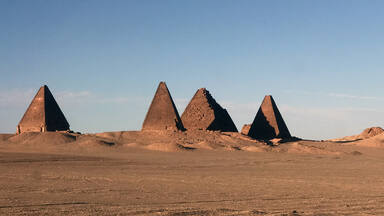



The Nomination files produced by the States Parties are published by the World Heritage Centre at its website and/or in working documents in order to ensure transparency, access to information and to facilitate the preparations of comparative analysis by other nominating States Parties.
The sole responsibility for the content of each Nomination file lies with the State Party concerned. The publication of the Nomination file does not imply the expression of any opinion whatsoever of the World Heritage Committee or of the Secretariat of UNESCO concerning the history or legal status of any country, territory, city or area or of its boundaries.