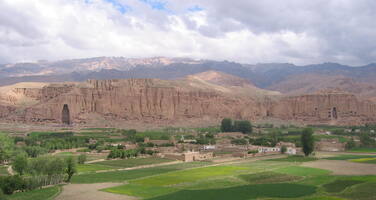
Cultural Landscape and Archaeological Remains of the Bamiyan Valley
Factors affecting the property in 2005*
- Management systems/ management plan
- Other Threats:
a) Consolidation of the cliffs and nichesb) Lack of a long-term on-site monitoring systemc) Demining
Factors* affecting the property identified in previous reports
Consolidation of the cliffs and niches; absence of a site management plan; lack of a long-term on-site monitoring system; demining.
International Assistance: requests for the property until 2005
Total amount approved : 30,000 USD
| 2002 | Training for national and local authorities in the ... (Approved) | 30,000 USD |
Missions to the property until 2005**
Regular UNESCO missions are sent in the framework of a large extra-budgetary project.
Conservation issues presented to the World Heritage Committee in 2005
The World Heritage Centre received a progress report from the State Party on 5 March 2005.
In line with the recommendations of the Second UNESCO/ICOMOS Expert Working Group on the Preservation of Bamiyan held in Munich in December 2003, major extra-budgetary activities have been implemented by UNESCO in cooperation with the donors for the conservation of this World Heritage property.
A bilateral financial contribution of approximately one million euros was granted from 2002 to 2004 by the Government of Germany, through ICOMOS Germany for the safeguarding of Afghanistan’s cultural heritage, notably for the preservation of the fragments of the statues of the Buddha in Bamiyan and of traditional buildings in the Bamiyan Valley. The conservation of the fragments of the Great Bhuddas has been initiated, and ICOMOS wishes to complete the work during 2005.
The amount of US$ 1,815,967 was granted in 2002 by the Government of Japan for the safeguarding of the property. Thanks to this contribution, the first phase of the emergency consolidation of the cliffs and niches has been finalized and the preservation of mural paintings has started. A Third Expert Working Group Meeting for Bamiyan, organized by UNESCO and the National Research Institute for Cultural Properties (NRICP) of Japan took place in Tokyo in December 2004. For the first time, experts were able to use Carbon14 dating technology to ascertain the age of the two Buddha statues, as well as of the mural paintings: the Small Buddha was shown to date from 507 AD, the Great Buddha dates from 551 AD and the mural paintings were dated between the late 5th and early 9th century AD. The experts agreed on the need to pursue the activities undertaken during the first phase of the project, which focused on emergency measures, and emphasized that longer-term measures are urgently required for the second phase to ensure the continued preservation of the property.
A Preliminary Master Plan for the property, which identifies cultural zones and buffer zones upon archaeological investigations, has been submitted by NRICP of Japan to the State Party and to UNESCO in July 2004. This Preliminary Master Plan, with its proposed guidelines, would become the basis for the site-management planning of the property.
A project for the construction of a Cultural Heritage Training Centre, initiated by the National Federation of UNESCO Associations in Japan, through its grant of US$ 446,381 in 2003 and a complementary contribution of US$ 90,000 through three years’ earmarked funds to the World Heritage Fund, is being implemented with UNESCO’s support foreseeing its inauguration in June 2005. This Training Centre foresees to employ the local population and to bring in expertise for heritage conservation and to organize capacity-building activities for the national and regional experts.
The State Party, moreover, has purchased land and started the construction of the surrounding walls of a museum of Bamiyan, which would eventually cover an area of 11,000 square metres. In the meantime, archaeological investigations have also been carried out by the University of Strasbourg, in cooperation with the French Archaeological Mission in Afghanistan (DAFA).
Summary of the interventions
Decisions adopted by the Committee in 2005
29 COM 7A.21
Cultural Landscape and Archaeological Remains of the Bamiyan Valley (Afghanistan)
The World Heritage Committee,
1. Having examined Document WHC-05/29.COM/7A,
2. Recalling its Decision 28 COM 15A.22, adopted at its 28th session (Suzhou, 2004),
3. Commends the State Party of Afghanistan for its dedication towards the safeguarding of the property;
4. Requests the World Heritage Centre and the Advisory Bodies to review the preliminary comprehensive management plan prepared by the National Research Institute for Cultural Properties (NRICP) of Japan and to assist the State Party in finalizing this comprehensive management plan based on the Statement of outstanding universal value of the property and in line with the principles set out in the Operational Guidelines (2005);
5. Invites the international community to support the State Party in its efforts towards removing the property from the List of World Heritage in Danger;
6. Invites the State Party to provide the World Heritage Centre with detailed technical information on the large-scale local museum under construction within the property and clarify its relation to the Cultural Heritage Training Centre in Bamiyan;
7. Requests the State Party to submit to the World Heritage Centre, by 1 February 2006, a progress report on the state of conservation of this property, for examination by the Committee at its 30th session (Vilnius, 2006);
8. Decides to retain the Cultural Landscape and Archaeological Remains of the Bamiyan Valley (Afghanistan) on the List of World Heritage in Danger.
29 COM 8C.2
New World Heritage List in Danger
The World Heritage Committee,
1. Having examined the of state of conservation reports of properties on the List of World Heritage in Danger (WHC-05/29.COM/7A and WHC-05/29.COM/7A.Add),
2. Decides to maintain the following properties on the List of World Heritage in Danger:
- Minaret and Archaeological Remains of Jam (Afghanistan)(Decision 29 COM 7A.20)
- Cultural Landscape and Archaeological Remains of the Bamiyan Valley (Afghanistan)(Decision 29 COM 7A.21)
- Tipasa (Algeria) (Decision 29 COM 7A.16)
- Walled City of Baku with the Shirvanshah's Palace and Maiden Tower (Azerbaijan) (Decision 29 COM 7A.28)
- Royal Palaces of Abomey (Benin) (Decision 29 COM 7A.13)
- Manovo-Gounda St Floris National Park (Central African Republic)(Decision 29 COM 7A.1)
- Comoé National Park (Côte d'Ivoire) (Decision 29 COM 7A.2)
- Mount Nimba Strict Nature Reserve (Côte d'Ivoire/Guinea) (Decision 29 COM 7A.3)
- Okapi Wildlife Reserve (Democratic Rep. of the Congo) (Decision 29 COM 7A.5)
- Kahuzi-Biega National Park (Democratic Rep. of the Congo) (Decision 29 COM 7A.5)
- Virunga National Park (Democratic Rep. of the Congo) (Decision 29 COM 7A.5)
- Garamba National Park (Democratic Rep. of the Congo) (Decision 29 COM 7A.5)
- Salonga National Park (Democratic Rep. of the Congo) (Decision 29 COM 7A.5)
- Abu Mena (Egypt) (Decision 29 COM 7A.17)
- Simien National Park (Ethiopia) (Decision 29 COM 7A.4)
- Cologne Cathedral (Germany) (Decision 28 COM 7A.29)
- Río Plátano Biosphere Reserve (Honduras) (Decision 29 COM 7A.12)
- Group of Monuments at Hampi (India) (Decision 29 COM 7A.22)
- Manas Wildlife Sanctuary (India) (Decision 29 COM 7A.9)
- Bam and its Cultural Landscape (Islamic Republic of Iran) (Decision 29 COM 7A.23)
- Ashur (Qal'at Sherqat) (Iraq) (Decision 29 COM 7A.18)
- Old City of Jerusalem and its Walls (Jerusalem) (Decision 29 COM 7A.31)
- Kathmandu Valley (Nepal ) (Decision 29 COM 7A.24)
- Air and Ténéré Natural Reserves (Niger) (Decision 29 COM 7A.6)
- Fort and Shalamar Gardens in Lahore (Pakistan) (Decision 29 COM 7A.25)
- Chan Chan Archaeological Zone (Peru) (Decision 29 COM 7A.30)
- Rice Terraces of the Philippine Cordilleras (Philippines) (Decision 29 COM 7A.26)
- Djoudj National Bird Sanctuary (Senegal) (Decision 29 COM 7A.7)
- Ichkeul National Park (Tunisia) (Decision 29 COM 7A.8)
- Ruins of Kilwa Kisiwani and Ruins of Songo Mnara (United Republic of Tanzania) (Decision 28 COM 7A.15)
- Everglades National Park (United States of America) (Decision 29 COM 7A.10)
- Historic Town of Zabid (Yemen) (Decision 29 COM 7A.19)
Draft Decision: 29 COM 7A.21
The World Heritage Committee,
1. Having examined Document WHC-05/29.COM/7A,
2. Recallingits Decision28 COM 15A.22, adopted at its 28th session (Suzhou, 2004),
3. Commends the State Party for its dedication for the safeguarding of the property;
4. Requeststhe World Heritage Centre and the Advisory Bodies to review the Preliminary Master Plan prepared by the National Research Institute for Cultural Properties (NRICP) of Japan and to assist the State Party in developing a comprehensive Management Plan based on the Statement of Outstanding Universal Value of the property and in line with the principles set out in the Operational Guidelines (2005);
5. Invites the State Party to provide the World Heritage Centre with detailed technical information on the large-scale local museum under construction within the property and clarify its relation to the Cultural Heritage Training Centre in Bamiyan;
6. Requests the State Party to submit to the World Heritage Centre, by 1 February 2006, a progress report on the state of conservation of this property, for examination by the Committee at its 30th session in 2006;
7. Decides to retain the property on the List of World Heritage in Danger.
 Afghanistan
Exports
* :
The threats indicated are listed in alphabetical order; their order does not constitute a classification according to the importance of their impact on the property.
Furthermore, they are presented irrespective of the type of threat faced by the property, i.e. with specific and proven imminent danger (“ascertained danger”) or with threats which could have deleterious effects on the property’s Outstanding Universal Value (“potential danger”).
** : All mission reports are not always available electronically.