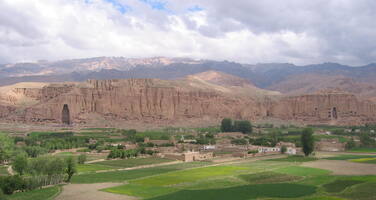
Cultural Landscape and Archaeological Remains of the Bamiyan Valley
Factors affecting the property in 2006*
- Civil unrest
- Other Threats:
a) Fragile state of the cliffs and nichesb) Presence of anti-personnel mines in the are
Factors* affecting the property identified in previous reports
a) Fragile state of the cliffs and niches;
b) Absence of a site management plan and monitoring system;
c) Presence of anti-personnel mines in the area.
Threats for which the property was inscribed on the List of World Heritage in Danger
The property was inscribed as an Emergency nomination on the World Heritage List and simultaneously on the List of World Heritage in Danger in view of the post-conflict situation.
UNESCO Extra-Budgetary Funds until 2006
Total amount provided to the property: USD 3,124,027 (2003-2007) by the UNESCO Japanese Funds-in-Trust Project “Safeguarding of the Bamiyan site”, Phases I and II.
International Assistance: requests for the property until 2006
Total amount approved : 30,000 USD
| 2002 | Training for national and local authorities in the ... (Approved) | 30,000 USD |
Missions to the property until 2006**
Conservation issues presented to the World Heritage Committee in 2006
The State Party submitted a progress report on the state of conservation of the property to the World Heritage Centre on 31 March 2006, which makes brief references to excavations, surveying, conservation projects and the security arrangements made to prevent illegal excavation and looting in the Bamiyan Valley.
The State Party also reported that a decision had been taken to locate all new government buildings in the Eesa Khan Champaign as foreseen within the Bamiyan City Master Plan, which also includes the foreseen local museum. The original plan for the museum in the northern bazaar of Bamiyan, previously reported to the Committee at its 29th session, has therefore been abandoned.
Through the implementation of the UNESCO Japan-Funds-in-Trust project the following information has been provided:
The preliminary draft site management plan prepared by the Tokyo National Research Institute of Cultural Properties (NRICP) in 2004 is currently under revision, and its completion is foreseen for November 2006 after consultation with the State Party. While the Site Management Plan is established as an overall policy document to ensure an adequate framework for the safeguarding of the outstanding universal valueof the property, the State Party expressed a strong need for a regulated zoning system, to be adopted for the control of land-use and building in and around the Bamiyan site. In order to ensure the protection of cultural heritage resources while infrastructure development is rapidly increasing to accommodate the tourism potential and housing needs of the local population, UNESCO has entrusted Aachen Technical University to provide technical assistance to the State Party for the development of a master plan.The finalised zoning proposal was presented in December 2005 to the State Party, and was officially approved in March 2006 by the Ministry of Urban Development and Housing. The approval of the master plan will enable the completion of the above-mentioned comprehensive site management plan, defining the roles of the relevant authorities for the management and monitoring of the property.
An on-site workshop is planned in June 2006 to provide a wide awareness-raising opportunity to the local people, as well as other concerned bilateral/multilateral development agencies, donors and NGOs, to ensure appropriate coordination for the long-term implementation of the master plan.
Archaeological missions from France and Japan have carried out on-site excavations, to determine the extension of the areas of archaeological remains, especially within the current buffer zones of the World Heritage site, and this will continue from June 2006 onwards. A training workshop for archaeological professionals in Afghanistan will be held by Japanese experts on the conservation techniques of archaeological objects.
Experts of NRICP have collected fragments of the mural paintings in the Buddhist caves. These have been securely packed and temporarily stored in the Bamiyan Training Centre for Cultural Heritage Conservation. This Centre opened in 2005 with funding from the National Federation of UNESCO Associations of Japan. Presently the pigments of the mural paintings are being analysed in order to identify the most appropriate cleaning and consolidation methods for the mural paintings. 3D measurements in 50 caves have also been carried out which will be used to monitor topographic distribution of the decay with respect to both the paintings and the caves.
The ICOMOS Germany expert team, led by the President of ICOMOS, has continued work on the collection and conservation of the remaining fragments of the two Giant Buddha statues, which were destroyed in March 2001. With significant financial support from the Government of Germany (143,000 Euros), nearly two-thirds of the fragments of the Western Giant Buddha were salvaged (100 sculptured fragments), and considerable progress was made with regard to the Eastern Giant Buddha (160 fragments) in 2005. Fragments weighing up to 35 tons, along with a countless number of small fragments, were removed from the niches with the help of a crane, then were sorted, documented and deposited in the shelters close to the niches constructed in 2004. The fragments are presently being analysed by experts in Germany. The organic material contained in the fragments enables dating by the Carbon-14 method as well as the identification of the original colouring and different treatment of the surfaces of the exploded Buddha statues. Eventually, geological methods may further allow precise definition of the original position of all the fragments for future consideration of a possible anastylosis.
The conservation of all fragments in both niches is foreseen to be completed by October 2006. As soon as the fragments are identified, documented and stored, the State Party, assisted by the International Coordination Committee for the Safeguarding of Afghanistan’s Cultural Heritage, will make appropriate decisions concerning the long-term conservation plan.
Capacity building for local experts and workers are an essential part of all activities. The Fourth Expert Working Group on the Preservation of the Bamiyan Site,held in Kabul from 7 to 10 December 2005, reviewed all operations which took place in 2005, and determined priorities for further activities to be implemented in 2006.
Under the UNESCO Japanese Funds-in-Trust project, the finalisation of the emergency consolidation works for the niches of the Giant Buddha statues will be carried out from late August 2006 by a specialised Italian engineering company, TREVI, which also worked on the site in 2004.
The presence of antipersonnel mines is a major problem, and UNESCO has established an agreement with the United Nations Mine Action Center in Afghanistan (UNMACA), to initiate a major de-mining operation in and around the Bamiyan site, beginning in mid-April.
While large-scale operational activities are still underway for the safeguarding of the property, no benchmarks have yet been identified. In view of the successful operational activities that have been carried out for the consolidation and conservation of the site, it will be appropriate to define clear benchmarks and a reasonable timeframe for the possible removal of the property from the List of World Heritage in Danger.
Summary of the interventions
Decisions adopted by the Committee in 2006
30 COM 7A.23
Cultural Landscape and Archaeological Remains of Bamiyan Valley (Afghanistan) (C 208rev)
The World Heritage Committee,
1. Having examined Document WHC-06/30.COM/7A,
2. Recalling Decision 29 COM 7A.21, adopted at its 29th session (Durban, 2005),
3. Highly commends the State Party and the international community for their efforts and commitment to the safeguarding of this property;
4. Urges the State Party to enhance the awareness level of Outstanding Universal Value among stakeholders, along with capacity building;
5. Requests the World Heritage Centre to assist in the finalisation of the comprehensive site management plan by the State Party based on the Outstanding Universal Value of the property and in line with the principles set out in the Operational Guidelines;
6. Also requests the State Party to invite a joint World Heritage Centre/ICOMOS reactive monitoring mission to assess the state of conservation of the property and to define, in close collaboration with the State Party, benchmarks for corrective measures and related timeframe for the possible removal of the property from the List of World Heritage in Danger, for examination by the Committee at its 31st session in 2007;
7. Further requests the State Party to submit to the World Heritage Centre by 1 February 2007, a comprehensive site management plan and a progress report on the implementation of the master plan and on the state of conservation of the property, for examination by the Committee at its 31st session in 2007; and
8. Decides to retain the Cultural Landscape and Archaeological Remains of the Bamiyan Valley (Afghanistan) on the List of World Heritage in Danger.
30 COM 8C.2
Update of the World Heritage List in Danger (Retained Properties)
The World Heritage Committee,
1. Having examined the state of conservation reports of properties inscribed on the List of World Heritage in Danger (WHC-06/30.COM/7A and WHC-06/30.COM/7A.Add.Rev),
2. Maintains the following properties on the List of World Heritage in Danger:
• Afghanistan, Minaret and Archaeological Remains of Jam (Decision 30 COM 7A.22)
• Afghanistan, Cultural Landscape and Archaeological Remains of the Bamiyan Valley, (Decision 30 COM 7A.23)
• Azerbaijan, Walled City of Baku with the Shirvanshah's Palace and Maiden Tower (Decision 30 COM 7A.29)
• Benin, Royal Palaces of Abomey (Decision 30 COM 7A.16)
• Central African Republic, Manovo-Gounda St Floris National Park (Decision 30 COM 7A.1)
• Chile, Humberstone and Santa Laura Saltpeter Works (Decision 30 COM 7A.31)
• Côte d'Ivoire, Comoé National Park (Decision 30 COM 7A.2)
• Côte d'Ivoire / Guinea, Mount Nimba Strict Nature Reserve (Decision 30 COM 7A.3)
• Democratic Rep. of the Congo, Okapi Wildlife Reserve (Decision 30 COM 7A.8)
• Democratic Rep. of the Congo Kahuzi-Biega National Park (Decision 30 COM 7A.6)
• Democratic Rep. of the Congo Virunga National Park (Decision 30 COM 7A.7)
• Democratic Rep. of the Congo Garamba National Park (Decision 30 COM 7A.4)
• Democratic Rep. of the Congo Salonga National Park (Decision 30 COM 7A.5)
• Egypt, Abu Mena (Decision 30 COM 7A.19)
• Ethiopia, Simien National Park (Decision 30 COM 7A.9)
• Honduras, Río Plátano Biosphere Reserve (Decision 30 COM 7A.15)
• India, Manas Wildlife Sanctuary (Decision 30 COM 7A.13)
• Islamic Republic of Iran, Bam and its Cultural Landscape (Decision 30 COM 7A.25)
• Iraq, Ashur (Qal'at Sherqat) (Decision 30 COM 7A.20)
• Jerusalem, Old City of Jerusalem and its Walls (Decision 30 COM 7A.34)
• Nepal, Kathmandu Valley (Decision 30 COM 7A.26)
• Niger, Air and Ténéré Natural Reserves (Decision 30 COM 7A.10)
• Pakistan, Fort and Shalamar Gardens in Lahore (Decision 30 COM 7A.27)
• Peru, Chan Chan Archaelogical Zone (Decision 30 COM 7A.32)
• Philippines, Rice Terraces of the Philippine Cordilleras (Decision 30 COM 7A.28)
• United Republic of Tanzania, Ruins of Kilwa Kisiwani and Ruins of Songo Mnara (Decision 28 COM 7A.17)
• United States of America, Everglades National Park (Decision 30 COM 7A.14)
• Venezuela, Coro and its Port (Decision 30 COM 7A.33)
• Yemen, Historic Town of Zabid (Decision 30 COM 7A.21)
Draft Decision: 30 COM 7A.23
The World Heritage Committee,
1. Having examined Document WHC-06/30.COM/7A,
2. Recalling Decision 29 COM 7A.21, adopted at its 29thsession (Durban, 2005),
3. Highly commends the State Party and the international community for their efforts and commitment to the safeguarding of this property;
4. Requests the World Heritage Centre to assist in the finalisation of the comprehensive site management plan by the State Party based on the outstanding universal value of the property and in line with the principles set out in the Operational Guidelines;
5. Also requests the State Party to invite a joint World Heritage Centre / ICOMOS reactive monitoring mission to assess the state of conservation of the property and to define, in close collaboration with the State Party, benchmarks for corrective measures and related timeframe for the possible removal of the property from the List of World Heritage in Danger, for examination by the Committee at its 31st session in 2007;
6. Further requests the State Party to submit to the World Heritage Centre by 1 February 2007, a comprehensive site management plan and a progress reporton the implementation of the master plan and on the state of conservation of the property, for examination by the Committee at its 31st session in 2007; and
7. Decides to retain the Cultural Landscape and Archaeological Remains of the Bamiyan Valley (Afghanistan) on the List of World Heritage in Danger.
 Afghanistan
Exports
* :
The threats indicated are listed in alphabetical order; their order does not constitute a classification according to the importance of their impact on the property.
Furthermore, they are presented irrespective of the type of threat faced by the property, i.e. with specific and proven imminent danger (“ascertained danger”) or with threats which could have deleterious effects on the property’s Outstanding Universal Value (“potential danger”).
** : All mission reports are not always available electronically.