New Lanark
New Lanark
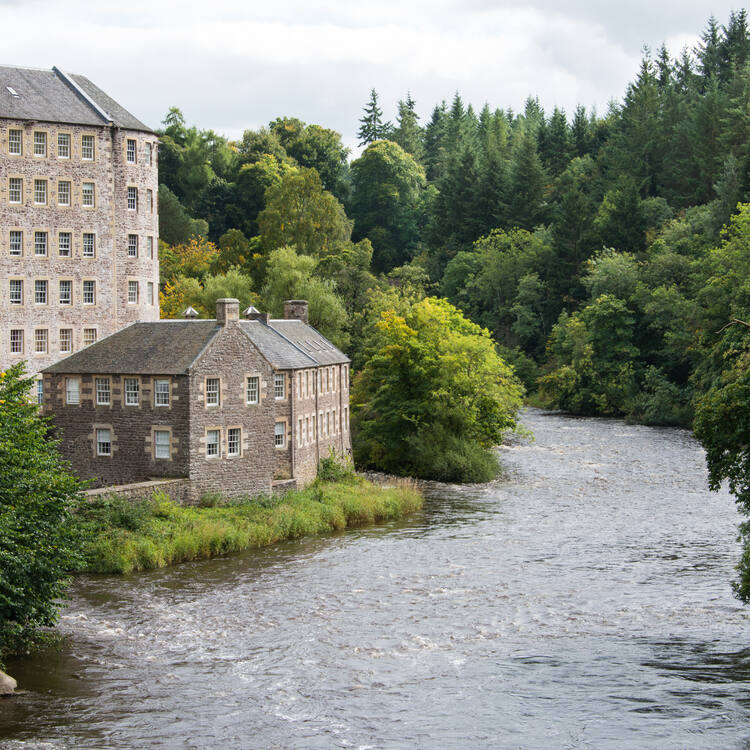
New Lanark is a small 18th- century village set in a sublime Scottish landscape where the philanthropist and Utopian idealist Robert Owen moulded a model industrial community in the early 19th century. The imposing cotton mill buildings, the spacious and well-designed workers' housing, and the dignified educational institute and school still testify to Owen's humanism.
Description is available under license CC-BY-SA IGO 3.0
New Lanark
Le petit village de New Lanark est situé dans un magnifique paysage écossais où le philanthrope et utopiste Robert Owen établit une société industrielle modèle au début du XIXe siècle. Les imposantes manufactures, les logements ouvriers spacieux et bien conçus, le digne institut d'éducation et l'école attestent encore aujourd'hui de l'humanisme d'Owen.
Description is available under license CC-BY-SA IGO 3.0
لانارك الجديدة
تقع قرية نيو لانارك الصغيرة في مكان رائع في اسكتلندا أسس فيه العالم الانساني والحالم روبرت أوين مجتمعاً صناعياً نموذجياً في بداية القرن التاسع عشر، ولا تزال المعامل الكبيرة ومساكن العمال الفسيحة والمصممة بصورة جيدة ومعهد التربية الرفيع المستوى والمدرسة تشهد حتى اليوم على انسانية أوين.
source: UNESCO/CPE
Description is available under license CC-BY-SA IGO 3.0
新拉纳克
新拉纳克是18世纪坐落在苏格兰风景最优美的地方的一个小村庄。19世纪早期,慈善家、乌托邦理想主义者罗伯特·欧文在此创建了现代工业化社区的模型。令人难忘的棉磨坊、宽敞且装备齐全的工人社区、严谨的教育机构和良好的学校教育,时至今日仍是欧文人文主义的明证。
source: UNESCO/CPE
Description is available under license CC-BY-SA IGO 3.0
Фабричный поселок Нью-Ланарк
Нью-Ланарк – это небольшая деревня XVIII в., расположенная в живописной местности в Шотландии. Здесь филантроп и утопический идеалист Роберт Оуэн создал в начале XIX в. образцовую индустриальную общину. Внушительные здания текстильных фабрик, просторное и удобное жилье рабочих, прекрасные здания института и школы служат памятником гуманизма этого человека.
source: UNESCO/CPE
Description is available under license CC-BY-SA IGO 3.0
New Lanark
Situada en un magnífico paraje de Escocia, la pequeña aldea de New Lanark fue el lugar donde el filántropo utopista Robert Owen estableció una comunidad industrial modelo a principios del siglo XIX. Las imponentes construcciones de las manufacturas textiles, las espaciosas y bien diseñadas viviendas los trabajadores, el digno edificio del instituto de educación y la escuela son todavía testigos del ideal humanista que inspiró la acción de Owen.
source: UNESCO/CPE
Description is available under license CC-BY-SA IGO 3.0
ニュー・ラナーク
スコットランド様式の建造物が今なお景観として残る小都市。19世紀初頭、イギリスの社会主義者ロバート・オーエンは産業革命後の悲惨な労働環境を批判。ニュー・ラナーク紡績工場を買収して、人道主義的な工場経営という年来の理想を実施して大成功を収めた。ニュー・ラナークは一時、“革命主義のメッカ”と称されていた。今なお工場群や労働者住宅、教育施設がそのままの姿をとどめており、オーエンのヒューマニズムが息づいている。source: NFUAJ
New Lanark
New Lanark is een klein 18e-eeuws dorp in een subliem Schots landschap waar de filantroop en utopische idealist Robert Owen begin 19e eeuw een model-industriële gemeenschap vormde . Het was de bedoeling dat het model zich zou verspreiden over de hele wereld in de 19e en 20e eeuw. Owen zorgde daarom voor imposante katoenspinnerijgebouwen, ruime en goed ontworpen arbeiderswoningen en een waardige onderwijsinstelling en school. Hierdoor kon volgens hem zowel de geestelijke als de lichamelijke toestand van mensen verbeterd worden. Om deze reden staat New Lanark synoniem voor Owen's sociale filosofie van progressief onderwijs, fabriekshervorming, humane werkmethoden, internationale samenwerking en tuinsteden.
Source: unesco.nl


Outstanding Universal Value
Brief synthesis
New Lanark is an exceptional example of a purpose-built 18th century mill village, set in a picturesque Scottish landscape near the Falls of Clyde, where in the early years of the 19th century, the Utopian idealist Robert Owen (1771-1858) inspired a model industrial community based on textile production. It was there that Owen first applied his form of benevolent paternalism in industry, building on the altruistic actions of his father-in-law, David Dale. It was there, too, that he formulated his Utopian vision of a society without crime, poverty, and misery. New Lanark prospered under his enlightened management.
The village was founded in 1785, and the cotton mills, powered by water-wheels, were operational from 1786 to 1968. At the turn of the 19th century the mill buildings formed one of the largest industrial groups in the world.
The creation of the model industrial settlement at New Lanark, in which planning and architecture were integrated with a humane concern on the part of the employers for the well-being of the workers, is a milestone in social and industrial history. The moral, social and environmental values which underpinned Robert Owen's work at New Lanark provided the basis for seminal material and intangible developments that have had lasting influences on society over the past two hundred years.
New Lanark is a unique reminder that the creation of wealth does not automatically imply the degradation of its producers. The village offered a cultural response to the challenges presented by industrial society and was the test-bed for ideas that sought to improve the human condition around the world. The nature and layout of New Lanark inspired other benevolent industrialists to follow his example, and this movement laid the foundations for the work of Ebenezer Howard (1850-1928) in creating the concept of the Garden City. The social and economic systems that Owen developed were considered radical in his own time but are now widely accepted in modern society.
The imposing mill buildings, the spacious and well designed workers' housing, and the dignified educational institute and school still survive to testify to Owen's humanism.
Criterion (ii): When Richard Arkwright’s new factory system for textile production was brought to New Lanark the need to provide housing and other facilities for the workers and managers was recognised. It was there that David Dale and Robert Owen created a model for industrial communities that was to spread across the world in the 19th and 20th centuries.
Criterion (iv): New Lanark saw the construction not only of well designed and equipped workers’ housing but also public buildings designed to improve their spiritual as well as their physical needs.
Criterion (vi): The name of New Lanark is synonymous with that of Robert Owen and his social philosophy in matters such as progressive education, factory reform, humane working practices, international cooperation, and garden cities, which was to have a profound influence on social developments throughout the 19th century and beyond.
Integrity
The property encompasses all of the elements necessary to clearly express its Outstanding Universal Value and ensure complete representation of the property’s significance. The appearance of the buildings of the village is now close to that of the early nineteenth century, during Owen’s management, based on the physical evidence, archaeology, graphic and written archive material available. In restoring the village to its historic state, some later 20th century structures have been removed to focus on those elements that contributed to the property’s Outstanding Universal Value.
Authenticity
The level of authenticity at New Lanark is high. The process of conservation and rehabilitation has now been in progress for almost half a century, and major projects continue to the present day. The village has seen little change from its heyday of cotton production in the early nineteenth century. Where elements are missing or have been replaced, the property is clearly interpreted to reflect this. Where rebuilding or reconstruction have been necessary, this has been carried out to the best conservation standards, based on full historic records. Repair and restoration has been undertaken using appropriate traditional materials and workmanship, following original designs wherever possible, and always respecting existing historic fabric. The original weir, lade and waterways which provided water-power to the mills from the 1780s are still in use today.
Protection and management requirements
World Heritage properties in Scotland are protected through the following legislation. The Town and Country Planning (Scotland) Act 1997 and The Planning etc. (Scotland) Act 2006 provide a framework for local and regional planning policy and act as the principal primary legislation guiding planning and development in Scotland. Additionally, individual buildings, monuments and areas of special archaeological or historic interest are designated and protected under The Planning (Listed Building and Conservation Areas) (Scotland) Act 1997 and the 1979 Ancient Monuments and Archaeological Areas Act.
The Scottish Historic Environment Policy (SHEP) is the primary policy guidance on the protection and management of the historic environment in Scotland. Scottish Planning Policy (SPP) sits alongside the SHEP and is the Government’s national planning policy on the historic environment. It provides for the protection of World Heritage properties by considering the impact of development on the Outstanding Universal Value, authenticity and integrity.
The management of the World Heritage property New Lanark is the responsibility of its three main partners: South Lanarkshire Council, Historic Scotland and the New Lanark Trust. The New Lanark Management Plan is endorsed and strategically overseen by the management partners, who also assume responsibility for its implementation.
The sustainable management of tourism at New Lanark is addressed in the Management Plan. The Partnership Group, through the implementation of the Management Plan, ensures that present and future tourism within the property is developed in an environmentally and economically sustainable way for the benefit of the local community.


The Nomination files produced by the States Parties are published by the World Heritage Centre at its website and/or in working documents in order to ensure transparency, access to information and to facilitate the preparations of comparative analysis by other nominating States Parties.
The sole responsibility for the content of each Nomination file lies with the State Party concerned. The publication of the Nomination file, including the maps and names, does not imply the expression of any opinion whatsoever of the World Heritage Committee or of the Secretariat of UNESCO concerning the history or legal status of any country, territory, city or area or of its boundaries.